
How to Create an Electrical Safety Program for Your Australian Workplace
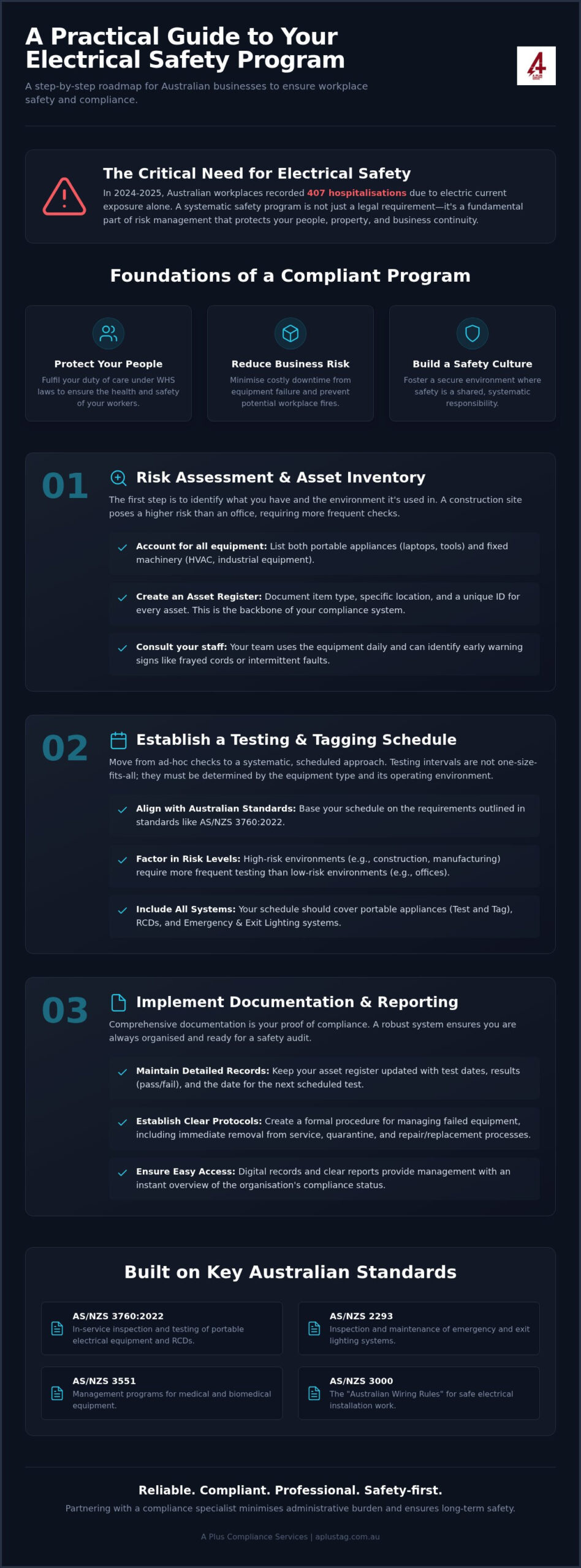
In the 2024–2025 period, there were 652 hospitalisations in Australia from electricity and air pressure-related injuries, with 407 of these specifically caused by exposure to an electric current. For facility managers and business owners, these figures highlight the serious responsibility of maintaining a safe workplace. Understanding how to create an electrical safety program that actually works is often the biggest hurdle. Between varying testing intervals and the pressure of upcoming safety audits, it’s easy to feel uncertain about whether your organisation is truly protected.
You likely already know that compliance isn’t just about ticking a box; it’s about building a systematic approach to risk management. This guide provides a practical, step-by-step roadmap to establishing a robust electrical safety program that meets current Australian Standards, including the updated AS/NZS 3760:2022. We’ll explore how to organise your asset registers, manage multiple sites with ease, and move from a reactive mindset to a state of organised control. By following this structured process, you can reduce workplace risks and ensure your documentation is always audit-ready.
Key Takeaways
- Understand the core components of a systematic safety framework by learning how to create an electrical safety program that aligns with Australian Standards.
- Conduct a comprehensive asset inventory to ensure every piece of electrical equipment is accounted for and correctly categorised for testing.
- Determine precise testing intervals for Test and Tag and RCD requirements based on your specific site risk profile and operational environment.
- Implement a robust documentation system that includes detailed asset registers and clear protocols for managing equipment that fails inspection.
- Explore the benefits of a long-term compliance partnership to maintain safety standards while minimising the administrative burden on your organisation.
The Foundation of an Australian Electrical Safety Program
An electrical safety program is a structured framework designed to identify, assess, and control electrical risks in a systematic way. It isn’t just a manual on a shelf; it’s an active process that ensures every piece of equipment, from office printers to heavy industrial machinery, remains safe for use. For a Person Conducting a Business or Undertaking (PCBU), establishing this program is a core legal obligation. Under Australian WHS laws, you have a duty of care to ensure the health and safety of workers so far as is reasonably practicable.
When you look at how to create an electrical safety program, the first step is recognising that safety and business efficiency are linked. A well-designed program prevents accidents and safeguards your most valuable assets: your people and your property. By moving away from ad-hoc checks toward a professional schedule, you create a predictable environment where compliance becomes a seamless part of daily operations.
Why Compliance is More Than a Legal Requirement
While meeting regulatory standards is essential, the benefits of a robust safety program extend much further. Faulty electrical equipment is a primary contributor to workplace fires and unexpected power failures. A structured approach significantly reduces these risks, protecting your business from the costly downtime associated with equipment failure. It also fosters a culture of safety where employees feel secure and valued. Professional testing, such as those found in our comprehensive compliance services, identifies hidden faults like internal wire degradation or earthing issues before they escalate into dangerous incidents.
Key Australian Standards to Reference
Your program must be built upon established benchmarks to be effective. The foundational document for electrical installations is AS/NZS 3000, commonly known as the Australian wiring rules. This standard sets the technical requirements for safe electrical work across the country. For the ongoing management of equipment, several other standards dictate the rigor and frequency of your testing:
- AS/NZS 3760:2022: This is the primary standard for the in-service safety inspection and testing of portable electrical equipment and RCDs.
- AS/NZS 2293: This governs the routine inspection and maintenance of emergency and exit lighting systems.
- AS/NZS 3551: A specialised standard for the management programs of medical and biomedical equipment in healthcare settings.
These standards provide the “state of knowledge” required to manage electrical hazards effectively. They ensure that your testing intervals and methodologies are based on proven safety protocols rather than guesswork. Using these standards as your guide helps you build a program that is both legally defensible and practically effective.
Step 1: Conduct a Comprehensive Risk Assessment and Asset Inventory
Identifying every electrical asset is the logical starting point for anyone learning how to create an electrical safety program. You need to account for both portable appliances, like laptops and kettles, and fixed equipment, such as manufacturing machinery or HVAC systems. According to Safe Work Australia, the environment in which equipment is used significantly dictates the level of risk. A high-risk construction site with moisture and dust exposure requires a much more frequent inspection cycle than a climate-controlled office.
Categorise your assets based on their usage frequency and exposure to potential damage. Equipment that is moved often or used in harsh conditions is more likely to develop faults. It’s also vital to consult with your staff. They are the ones using the equipment daily and can often pinpoint flickering lights, loose power points, or frayed cords before they appear on an official register. This collaborative approach ensures your inventory is accurate and grounded in real-world usage.
Building Your First Asset Register
An asset register serves as the backbone of your compliance journey. It’s a living document that tracks every item requiring testing, ensuring nothing is overlooked during a safety audit. For a register to be effective, it must include essential data points: the item type, its specific location, and a unique identification number. Managing this manually can be difficult across multiple sites. A professional compliance partner can help automate this process, creating a digital register that provides clear visibility over your entire asset pool. If you aren’t sure where to start, you can request a site assessment to begin building your inventory.
Identifying High-Risk Areas and Equipment
Certain zones within your workplace naturally present higher hazards. Focus your attention on wet areas, workshops, and high-traffic communal spaces like staff kitchens. Extension leads and power boards are common points of failure, often suffering from mechanical damage or overloading. While visual inspections catch external issues, some hazards are invisible. For instance, thermal imaging testing is a highly effective way to identify hot spots and hidden faults within switchboards before they lead to fire or equipment failure. This proactive approach ensures your program addresses risks at every level of your electrical infrastructure.
Step 2: Establish a Routine Testing and Tagging Schedule
Once you’ve identified your assets, the next phase in how to create an electrical safety program is building a sustainable testing calendar. This isn’t a one-off event but a recurring cycle that ensures your workplace remains compliant over time. The frequency of these tests is primarily dictated by AS/NZS 3760, which classifies environments based on their potential to damage equipment. By establishing a clear schedule, you remove the guesswork and ensure that safety checks occur before hazards develop.
Determining the Right Intervals for Your Site
The contrast between different work environments is stark. Equipment on a construction or demolition site, for example, requires testing every 3 months due to the harsh conditions. In a standard office environment, the interval for most portable appliances extends to 12 months, or even up to 5 years for equipment not subject to regular movement. It’s vital to remember that these intervals are minimum requirements. If your risk assessment identifies specific hazards, you should adjust your schedule to be more frequent. A professional site assessment determines the optimal schedule by weighing these regulatory minimums against your actual operational risks.
Integrating Specialised Safety Inspections
A comprehensive program goes beyond just portable appliances. You must also account for fixed safety systems. Incorporating RCD testing into your routine ensures that these life-saving switches will trip in the event of a fault. Similarly, maintaining emergency lighting standards requires 6-monthly discharge tests to ensure your team can evacuate safely during a power failure.
For healthcare and aged care facilities, your schedule must also include the specialised requirements for biomedical devices under AS/NZS 3551. Beyond these core electrical tasks, consider the broader safety net. Microwave radiation testing in staff kitchens and the regular maintenance of fire extinguishers and blankets should be part of the same management cycle. For multi-site organisations, coordinating these various schedules into a single service window minimises disruption and ensures that no location falls behind on its obligations. This systematic approach transforms compliance from a source of stress into a predictable, well-managed part of your business operations.
Step 3: Implement Documentation and Reporting Systems
The final pillar in how to create an electrical safety program is establishing a rigorous documentation system. While the physical testing is vital, your compliance status is only as strong as your records. In the event of a safety audit or an incident, your documentation serves as the primary evidence that you’ve met your duty of care. A methodical reporting system ensures that every test result is captured, every failure is addressed, and no upcoming deadlines are overlooked through human error.
Transitioning to a digital reporting format is the most effective way to maintain order. Paper records are easily lost or damaged; digital files are accessible, searchable, and secure. Utilising automated reminders within your system ensures that you’re never caught off guard by an expiring tag. This proactive management allows site managers to focus on daily operations while maintaining total visibility over their compliance obligations across multiple locations.
The Essentials of a Compliance Report
A high-quality compliance report provides much more than a simple list of passes. To be truly useful, it should include the specific date of the test, the name of the qualified technician, and the detailed results for each asset. When an item fails, a detailed failure report is essential. This data allows you to identify patterns, such as specific equipment types or locations that frequently malfunction, helping you plan for future repairs or capital replacements. Implementing professional compliance monitoring simplifies this process, ensuring your business is always audit-ready with organised, transparent data.
Managing Failed Items and Repairs
Identifying a fault is only half the battle; the safety of your team depends on what happens next. You must implement a strict “Tag, Record, Remove” process. Any item that fails inspection should be immediately fitted with a “Danger: Do Not Use” tag and physically removed from the work area. This prevents accidental use by staff who may not be aware of the fault.
It’s critical that failed items are not returned to service until they’ve been professionally repaired and re-tested. Simply taping a cord or ignoring a minor fault is not enough to satisfy safety requirements. By documenting the entire lifecycle of a failed asset, from the initial fault to its eventual repair or disposal, you provide clear proof that you’ve taken all reasonable steps to minimise risk. This level of thoroughness is what defines a professional safety program and protects your organisation from liability.
Partnering for Long-Term Electrical Compliance
While the previous steps provide the blueprint for how to create an electrical safety program, the true test of any safety framework is its long-term sustainability. For many facility and operations managers, the challenge isn’t the initial setup; it’s the ongoing management of recurring testing cycles across multiple assets and sites. Partnering with a dedicated compliance specialist like A Plus Compliance Services transforms this complex requirement into a streamlined, hands-off process that prioritises safety without sacrificing efficiency.
Our approach focus on your business continuity. We understand that a workplace doesn’t stop just because safety checks are due. By employing a punctual, safety-first methodology, we ensure that testing is conducted with minimal disruption to your daily operations. Clear communication is at the heart of this partnership. You’ll always know when we’re arriving, what’s being tested, and exactly which items require attention. This level of professional transparency reduces the administrative burden on your team, allowing you to focus on core business activities with the confidence that your compliance is in expert hands.
Why Professional Testing Beats the DIY Approach
Accurate electrical testing requires more than just a basic understanding of equipment; it requires specialised, calibrated instruments and industry-literate training. While it might be tempting to manage minor checks internally, a professional service provides a level of precision that DIY methods cannot match. A third-party verification of your safety systems offers significant peace of mind, providing an unbiased audit trail that holds up under scrutiny. Beyond the testing itself, expert technicians deliver high-quality asset registers through our comprehensive services that are organised, accurate, and ready for immediate review during a safety audit.
Setting Up a Recurring Compliance Schedule
The most significant advantage of a long-term partnership is the transition from reactive fixes to proactive management. Our system includes automated due-date reminders, ensuring that no testing window is ever missed. This is particularly valuable for multi-site organisations that require a consistent standard of safety across various locations. Instead of managing dozens of different schedules, you have a single point of contact and a unified reporting structure that keeps your entire organisation protected.
Building a safer workplace starts with a clear understanding of your current standing. We invite you to contact our team to discuss a tailored compliance schedule or to arrange a professional assessment of your workplace. By formalising your approach today, you ensure a more organised, compliant, and secure environment for your entire team.
Securing Your Workplace with a Systematic Approach
Establishing a robust safety framework is about moving from a state of uncertainty toward organised control. By conducting a thorough risk assessment and building a detailed asset register, you ensure that every electrical hazard is identified and managed. This systematic approach allows you to satisfy your legal obligations while protecting your team from the physical and operational risks of equipment failure.
Learning how to create an electrical safety program is the first step toward building long-term resilience. As specialists in AS/NZS 3760 and AS/NZS 3551, we focus on providing the detailed reporting and scheduled maintenance needed to keep your business moving. A professional partnership ensures that your safety systems are verified by experts, reducing your administrative burden and keeping your documentation audit-ready at all times.
Taking a proactive stance on electrical safety is the most effective way to ensure a secure environment for everyone. We’re here to act as your dependable compliance partner, helping you organise your requirements into a simple, recurring cycle that works for your organisation.
Frequently Asked Questions
What is an electrical safety program?
An electrical safety program is a systematic framework designed to identify, assess, and control electrical risks within a workplace. It involves a combination of routine physical inspections, such as Test and Tag, alongside rigorous documentation like asset registers. By implementing this structured approach, organisations can ensure they meet their duty of care under Australian WHS laws while protecting employees from electrical hazards and maintaining operational continuity throughout their facilities.
How often does equipment need to be tested and tagged in Australia?
Testing intervals are not universal; they depend on the specific work environment and the type of equipment in use. For instance, high-risk environments like construction sites require three-monthly testing, while equipment in a standard office might only need testing every twelve months or longer. If you are researching how to create an electrical safety program, it’s essential to consult the AS/NZS 3760 standard and obtain professional guidance to establish a schedule tailored to your site’s unique risk profile.
Who is considered a competent person for electrical testing?
Under AS/NZS 3760:2022, a competent person is someone who has acquired through training, qualifications, or experience the knowledge and skills required to test electrical equipment safely. This person must understand the relevant Australian Standards and be able to use the necessary testing instruments correctly. While some staff can undergo specific training, many organisations choose to use specialised compliance technicians to ensure that all testing and reporting meet the highest professional standards and legal requirements.
What happens if an electrical item fails a safety test?
If an item fails a safety test, it must be clearly identified with a danger tag and immediately removed from service to prevent accidental use. The failure is recorded in your compliance report and asset register, providing a clear audit trail for safety audits. You must then decide whether to have the item professionally repaired or replaced. It is critical that faulty equipment is not returned to the workplace until it has been verified as safe by a qualified technician.
Is an asset register a legal requirement for my business?
While specific legislation varies between states, Australian WHS laws generally require a Person Conducting a Business or Undertaking (PCBU) to keep records of all electrical testing and maintenance. An asset register is the most effective way to meet this obligation. It provides a comprehensive log of every electrical item, its location, and its test history. This documentation is vital during safety audits and serves as evidence that you have taken reasonably practicable steps to ensure workplace safety.
Can electrical testing be completed outside of normal business hours?
Yes, electrical testing can be arranged outside of normal operating hours to minimise disruption to your daily business activities. This is particularly beneficial for high-traffic environments like hospitality venues, schools, or medical clinics where access to equipment during the day is difficult. Professional compliance partners often offer flexible scheduling to work around your site access requirements, ensuring that your safety program is maintained without compromising your team’s productivity or the comfort of your clients.
How do I know which Australian Standards apply to my workplace?
The standards applicable to your workplace depend on your industry and the specific assets you manage. Most commercial sites must follow AS/NZS 3760 for portable appliances and RCDs. If you operate a healthcare facility, AS/NZS 3551 for biomedical equipment is essential. Meanwhile, AS/NZS 2293 governs emergency and exit lighting for all public buildings. A professional site assessment is the most reliable way to identify which standards apply to your specific operations and infrastructure.
What are the benefits of outsourcing my electrical safety program?
Outsourcing your electrical safety program provides access to specialised technical expertise and calibrated testing equipment that most businesses don’t maintain internally. A professional partner provides detailed asset registers and automated due-date reminders, significantly reducing the administrative burden on facility managers. This partnership ensures that your compliance is managed by specialists who stay up to date with changing Australian Standards, providing a higher level of risk reduction and peace of mind for your entire organisation.
