
Compliance Monitoring: Australian Workplace Safety 2026
If a WorkSafe inspector walked through your doors today, could you produce an accurate, up-to-date asset register for every piece of electrical and medical equipment on-site within minutes? For many facility managers, the complexity of managing disparate Australian Standards like AS/NZS 3760:2022 and AS/NZS 2293 often leads to a reliance on manual, error-prone systems. We understand that the fear of missing a testing deadline or facing liability isn’t just about the potential for significant fines; it’s about the safety of your people and the continuity of your operations. Establishing a systematic approach to compliance monitoring is the solution that transforms safety from a reactive chore into a streamlined, professional routine.
You’ll learn how to establish a robust framework that protects your staff, ensures regulatory adherence, and simplifies your workplace safety obligations. We’ll clarify the essential differences between monitoring and auditing, explain how to manage equipment testing schedules with ease, and show you how to maintain documentation that’s always ready for scrutiny. This guide provides a clear path toward becoming a more organised and safety-first organisation, supported by methodical processes that provide long-term peace of mind for Victorian business owners and managers.
Key Takeaways
- Understand how proactive compliance monitoring differs from a standard audit by focusing on continuous assessment and recurring safety cycles.
- Learn how to maintain critical safety standards, including electrical Test and Tag (AS/NZS 3760) and emergency lighting discharge tests (AS/NZS 2293).
- Discover how professional reporting and automated asset registers can significantly reduce the administrative burden on facility and operations managers.
- Gain a clear, step-by-step approach to conducting site assessments and determining the correct testing intervals for your specific equipment and environment.
- Recognise the strategic value of a long-term compliance partnership in ensuring your organisation remains audit-ready and safety-focused.
Understanding Compliance Monitoring in the Modern Australian Workplace
Effective workplace safety isn’t a destination reached once a year; it’s a continuous state of readiness. In the context of Australian business operations, compliance monitoring refers to the proactive and ongoing assessment of safety protocols and equipment. This process ensures that your organisation remains aligned with Regulatory compliance requirements, protecting both your staff and your reputation. By moving beyond reactive fixes, facility managers can establish a methodical system that identifies potential hazards before they result in equipment failure or workplace injury.
Every business owner in Victoria holds a fundamental “Duty of Care” to provide a safe working environment. Meeting this obligation requires more than just good intentions; it demands a structured approach to risk management that accounts for every piece of equipment on the floor. Relying on a “set and forget” mentality creates significant regulatory risk, as safety status can degrade rapidly due to wear and tear or environmental factors. A consistent monitoring programme ensures that your safety measures remain functional and effective throughout the entire year, not just on the day of an inspection, helping you avoid the pitfalls of a purely reactive maintenance schedule.
To better understand how this framework functions within a professional setting, watch this helpful video:
The Difference Between Monitoring and Auditing
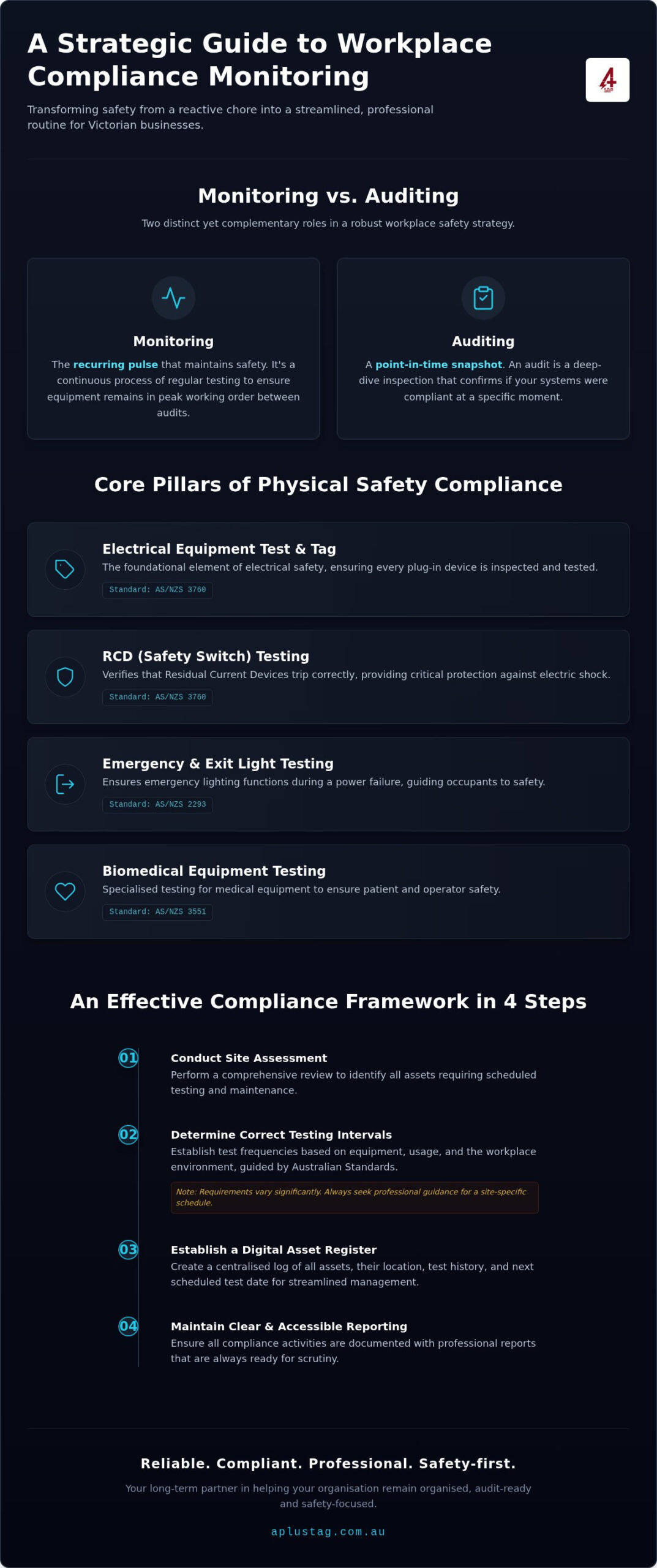
While the terms are often used interchangeably, they serve distinct roles in a safety strategy. An audit acts as a point-in-time snapshot, providing a deep dive that confirms whether your systems were compliant at the specific moment of inspection. In contrast, compliance monitoring is the recurring pulse that maintains safety in the weeks and months between those audits. Monitoring involves the regular testing of assets, such as RCDs and emergency lights, to ensure they remain in peak working order. By integrating both functions, you create a robust safety culture where documentation is always current and equipment is consistently verified.
Why National Standards Drive the Monitoring Process
The intervals for your safety checks aren’t arbitrary; they’re dictated by specific Australian Standards. For instance, AS/NZS 3760:2022 outlines the requirements for electrical safety testing, while AS/NZS 2293 governs the maintenance of emergency lighting systems. Compliance monitoring is a continuous cycle of verification. These standards ensure your safety services are performed at the correct frequency based on your specific environment, ensuring you meet both internal policies and state-based legislative demands. Adhering to these national benchmarks provides a clear, defensible record of your commitment to workplace safety, which is essential if your organisation is ever subject to a formal investigation.
The Core Pillars of Physical Safety Compliance Monitoring
Physical safety monitoring represents the practical application of your WHS management system. While policies provide the necessary framework, the physical testing of equipment ensures that these standards are actually met on the floor. Compliance monitoring in this context involves a rigorous schedule of inspections, ranging from the power tools in a workshop to the life-saving equipment in a hospital ward. It transforms abstract safety goals into a series of verifiable, documented actions that protect your workforce.
Electrical Equipment and AS/NZS 3760
Portable appliance testing, commonly known as Test and Tag, is the foundational element of any electrical safety programme. Adhering to the current AS/NZS 3760:2022 standard ensures that every plug-in device is electrically safe for use. This recurring cycle creates a visible compliance trail, giving staff confidence that their equipment has been professionally verified. For a detailed breakdown of how often your specific equipment needs testing, see our Professional Test and Tag Services guide. Regular tagging prevents the use of damaged cords or faulty machinery, which are primary causes of electrical fires and shocks.
Emergency Systems and AS/NZS 2293
Emergency and exit lighting must function perfectly during a power failure or evacuation. Under AS/NZS 2293, businesses must conduct 6-monthly discharge tests and annual inspections to verify battery performance and luminaire functionality. Maintaining an accurate logbook is a legal requirement; it provides the documentation needed during a safety audit. You can find more details on these requirements in our Emergency Lighting Standards Australia resource. Consistent monitoring ensures these lights remain bright when they are needed most.
Biomedical and Patient Area Monitoring
Healthcare environments require a significantly higher level of rigour due to the critical nature of patient care. Monitoring for biomedical equipment follows AS/NZS 3551, which involves safety and performance testing for clinical devices. Additionally, patient areas must comply with AS/NZS 3003 to prevent electrical hazards in sensitive treatment zones. These specialised environments often require more frequent monitoring intervals to manage the high-risk nature of the equipment. Our Biomedical Devices Safety Guide offers deeper insights into these clinical requirements, and for a comprehensive overview of the biomedical equipment testing requirements Australia mandates across AS/NZS 3551, AS/NZS 3760, and AS/NZS 3003, our complete compliance guide provides the detailed roadmap healthcare facilities need.
Residual Current Device (RCD) testing, or safety switch testing, is another critical pillar of compliance monitoring. These switches are designed to disconnect power instantly if a fault is detected, preventing fatal electric shocks. Regular push-button and trip-time testing ensures these devices remain responsive and effective. If you need help determining the right testing frequency for your site, you can discuss a compliance schedule with our experienced team to ensure no deadline is missed.
The Strategic Value of Professional Compliance Monitoring
Professional compliance monitoring offers more than just a safety net; it provides a strategic advantage by removing the guesswork from facility management. By outsourcing these technical tasks to a dependable partner, operations managers can refocus their energy on core business activities. This shift reduces the administrative burden while ensuring that safety documentation remains precise and audit-ready. Instead of reacting to equipment failures, you move into a state of organised control where safety is managed through routine and precision.
Third-party objectivity is a critical component of a robust safety culture. Internal staff may occasionally overlook minor equipment wear due to site familiarity, but a specialised technician provides an unbiased assessment. This level of transparency is consistent with the expectations set out in the National Compliance and Enforcement Policy, which prioritises verifiable adherence to safety standards. Proactive identification of faults, such as frayed leads or failing RCDs, prevents minor issues from escalating into equipment failure or workplace fires.
Moving Beyond Manual Spreadsheets
Relying on manual spreadsheets for asset management is a high-risk strategy. Human error, such as accidental deletions or missed entries, can lead to gaps in your safety record and expired testing dates. Digital reporting solves this by providing instant access to your status via a structured asset register. These systems offer automated due-date reminders, ensuring that recurring maintenance happens on schedule without the need for constant manual oversight. This digital approach creates a long-term record of compliance monitoring, which is invaluable when negotiating insurance renewals or demonstrating a history of safety to stakeholders.
Minimising Operational Disruption
A professional monitoring service understands that your business can’t stop for safety checks. Methodical scheduling allows technicians to work around your peak operational times, providing “quiet” compliance that maintains safety without causing bottlenecks. Punctuality and responsiveness are essential traits of a reliable partner; arriving on time and working efficiently ensures minimal impact on your daily workflow. By integrating these checks into a broader suite of safety services, you can consolidate your requirements into a single, predictable visit, further streamlining your site management.
Implementing an Effective Compliance Monitoring Framework
Establishing a structured framework for compliance monitoring ensures that no safety asset is overlooked. This systematic approach moves your business from a state of potential uncertainty to one of organised control. By following a logical sequence of stages, you can build a safety programme that is both transparent and defensible. The goal is to create a repeatable cycle that integrates seamlessly with your daily operations while meeting all specialised safety requirements.
- Step 1: Conduct a site assessment. Walk the entire facility to identify every electrical appliance, RCD, and emergency light that requires professional testing.
- Step 2: Determine testing intervals. Testing frequencies vary based on the workplace and equipment type; for example, a workshop environment requires more frequent checks than a standard office. Always obtain site-specific professional guidance to ensure you meet the correct standards. Victorian businesses can refer to our detailed guide on test and tag frequency Victoria to accurately categorise equipment and assign the correct maintenance cycles.
- Step 3: Establish an asset register. Centralise all identified assets into a single, accessible register for transparent record-keeping.
- Step 4: Execute the schedule. Perform the physical inspections and tests according to the determined intervals to maintain continuity.
- Step 5: Review and address failures. Examine your compliance reports immediately and resolve any failed items to ensure site safety remains uncompromised.
Developing a Robust Asset Register
A professional asset register acts as the backbone of your safety documentation. It should capture essential data for every asset, including a unique identifier, the item’s location, the test date, and the specific result. Digital registers significantly simplify the auditing process, allowing you to provide regulators with instant, clear evidence of your safety history. Unique tags on every piece of equipment provide a physical link to this digital record, making it easy for staff to verify the status of a tool or device before use.
Managing Failed Items and Remediation
Identifying a fault is only the first part of the process; the remediation phase is what actually prevents workplace incidents. When an item fails a test, it must be immediately tagged with a “Danger – Do Not Operate” tag and removed from service to prevent accidental use. Recording the subsequent repair or replacement is vital for maintaining a complete compliance history. Failure management is as important as the testing process itself. Addressing these vulnerabilities promptly ensures that your compliance monitoring cycle remains unbroken and your workplace remains secure.
Partnering for Long-Term Safety and Audit Readiness
Choosing a long-term partner over a one-off contractor is a strategic decision that shifts the responsibility of schedule management from the facility manager to a specialised expert. A Plus Compliance Services acts as a dependable ally, ensuring that recurring compliance monitoring cycles are never missed. This proactive approach eliminates the stress of the last-minute rush before a site inspection or insurance renewal. By maintaining a continuous history of safety, your organisation remains perpetually audit-ready, with all documentation and asset registers kept in a structured, professional state.
Clear and professional reporting is the cornerstone of this partnership. When safety data is presented in a logical, easy-to-read format, business owners can make informed decisions without wading through technical jargon. This transparency builds trust and provides a clear narrative of your commitment to workplace safety. Instead of managing a disparate collection of testing tags and paper logbooks, you gain a centralised system that provides a bird’s-eye view of your entire compliance status.
Tailored Monitoring for Diverse Industries
Different environments demand different levels of rigour. For example, high-risk construction sites require more frequent testing than a quiet office, while healthcare facilities must adhere to the strict requirements of AS/NZS 3551 for biomedical equipment. Multi-site organisations benefit significantly from centralising their data, allowing head office to view the safety status of every location through a single, transparent reporting system. You can explore our full range of specialised capabilities via the A Plus Compliance Services Offerings page, which details how we adapt our services to meet specific industry standards and operational needs.
The A Plus Approach to Reliable Compliance
Our approach is built on the pillars of being reliable, compliant, and professional. We prioritise clear communication and safety-first service delivery, ensuring that our technicians arrive on time and work with minimal disruption to your daily operations. Methodical scheduled maintenance is the core of what we do; we provide automated due-date reminders so you don’t have to track them yourself. This partnership model focuses on building long-term relationships through consistent performance and high-quality reporting. If you are looking to simplify your safety obligations, we invite you to request a quote for a tailored compliance monitoring programme designed for your specific site requirements.
Securing Long-Term Safety and Operational Order
Transitioning from reactive safety fixes to a state of organised, professional control requires more than occasional checks. Establishing a robust compliance monitoring framework ensures that every electrical appliance and emergency system is verified according to the specific demands of your environment. By integrating recurring testing cycles, you remain aligned with critical standards like AS/NZS 3760 and AS/NZS 2293 without the administrative burden of manual tracking. This methodical approach builds a defensible history of safety through professional asset registers and structured reporting; these are essential for audit readiness and insurance renewals.
Relying on a dependable partner allows you to focus on your core operations while we’ll manage the complexities of scheduled maintenance and due-date reminders. Our expertise provides the objectivity needed to identify faults before they lead to failure, ensuring a stress-free experience for site managers and business owners across Victoria. We focus on providing a safety-first service that prioritises reliability and punctuality in every inspection.
We’re here to help you simplify your safety obligations and maintain a secure, organised, and safety-first working environment for years to come.
Frequently Asked Questions
What is the primary goal of compliance monitoring?
The primary goal of compliance monitoring is to ensure a continuous state of workplace safety by identifying and resolving hazards before they lead to incidents. Unlike reactive maintenance, this proactive approach focuses on the recurring verification of safety assets like RCDs and emergency lighting. It helps business owners fulfill their legal duty of care by providing a transparent record of safety adherence, ultimately protecting staff and minimising operational risks.
How often should compliance monitoring occur in an Australian workplace?
Testing frequencies are not uniform; they are determined by the specific environment and the type of equipment in use. For instance, a construction site requires more frequent compliance monitoring than a low-risk office space. Standards such as AS/NZS 3760:2022 and AS/NZS 2293 provide the necessary benchmarks for these intervals. We always recommend obtaining site-specific professional guidance to ensure your schedule remains fully compliant with current Australian Standards.
Is compliance monitoring a legal requirement for small businesses?
Yes, every Australian business has a legal obligation under Work Health and Safety (WHS) laws to provide a safe working environment. Size does not exempt an organisation from its duty of care. Small businesses must ensure that their electrical and safety equipment is regularly tested and maintained. Implementing a methodical monitoring programme is the most reliable way for smaller entities to demonstrate they are taking reasonably practicable steps to manage workplace risks.
What is the difference between a compliance audit and compliance monitoring?
A compliance audit is a point-in-time snapshot that evaluates whether your safety systems meet requirements at a specific moment. In contrast, monitoring is the recurring pulse that maintains those standards between audits. While an audit might happen annually, monitoring involves the scheduled testing and inspection of assets throughout the year. Together, they create a robust safety culture that ensures your documentation and equipment are always current and ready for inspection.
What happens if an item fails during a compliance monitoring check?
If a piece of equipment fails a safety check, it must be immediately fitted with a “Danger – Do Not Operate” tag and removed from service. This prevents accidental use while a repair or replacement is arranged. The failure must be recorded in your asset register to maintain a complete history of the item’s lifecycle. Proper remediation is a critical step in the monitoring cycle, ensuring that identified hazards are effectively neutralised.
Can compliance monitoring be managed across multiple business locations?
Managing safety across multiple sites is highly effective when using a centralised digital asset register. This system allows head office to monitor the compliance status of every location through a single interface. It simplifies the oversight of recurring testing schedules and ensures that documentation is consistent across the entire organisation. This approach is particularly valuable for multi-site Victorian businesses looking to maintain high standards of safety and accountability.
Does compliance monitoring help with insurance premiums?
While we cannot guarantee a reduction in costs, maintaining a detailed history of safety checks often simplifies the insurance renewal process. Insurers view a robust monitoring programme as evidence of effective risk management and a commitment to workplace safety. Providing a professional asset register and clear compliance reports demonstrates that your organisation is proactive. This transparency can make your business a more attractive prospect for underwriters during their assessment.
What documentation is required to prove compliance monitoring has occurred?
Proving your adherence to safety standards requires several key pieces of documentation. You should maintain a comprehensive asset register that includes unique identifiers for every item, test dates, and specific results. Additionally, you’ll need detailed compliance reports and, where applicable, logbooks for emergency lighting systems. Physical tags on equipment also serve as a visible indicator of compliance for staff and regulators, linking the physical asset to your digital records.
