
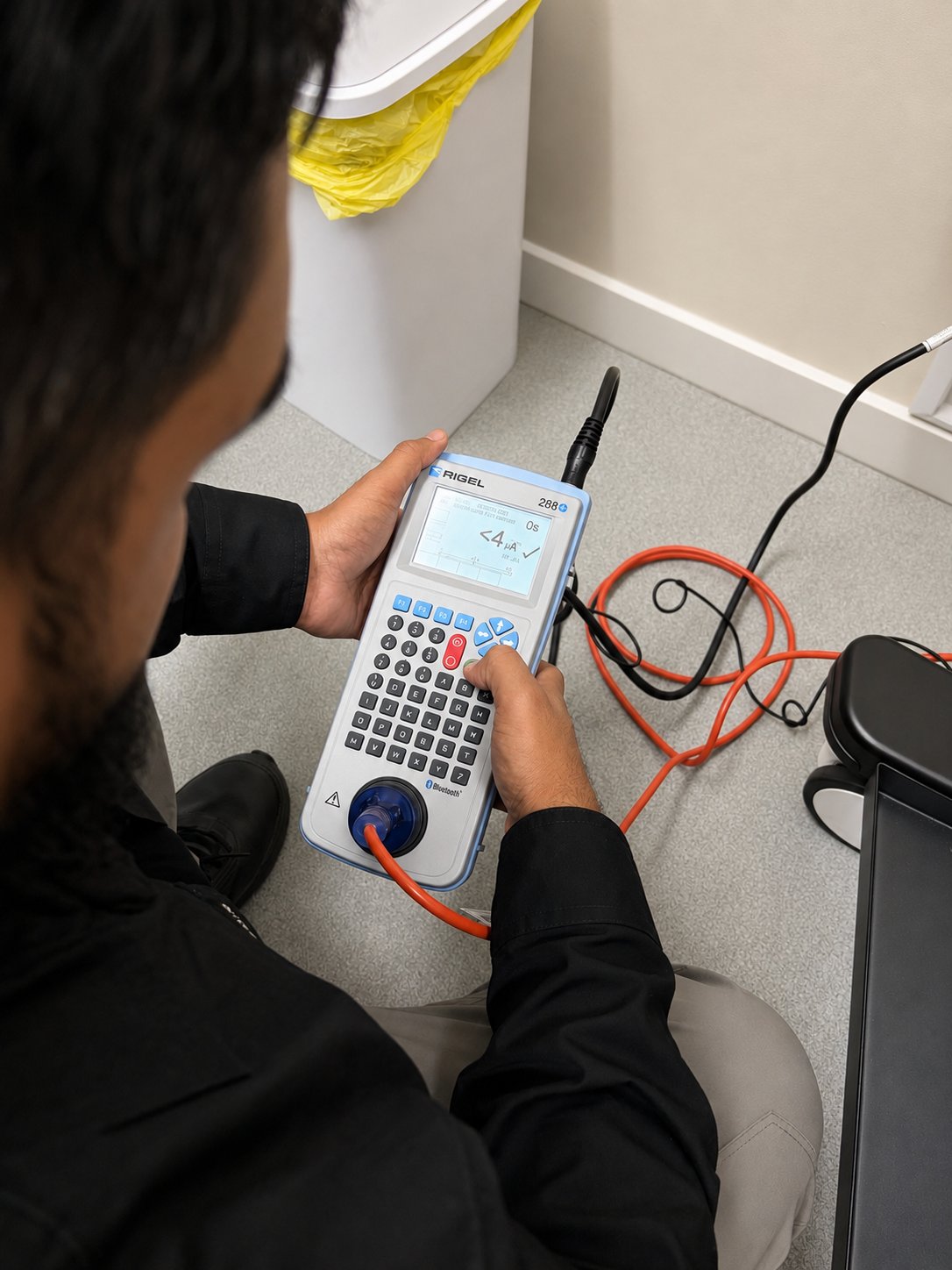
Body protected electrical area
The classification of a treatment space determines the electrical protections required. A body-protected electrical area is a patient area where medical equipment may connect electrically to a patient’s body, but not directly to the heart. In Australia, AS/NZS 3003 sets additional electrical safety requirements for patient areas alongside the general installation rules in AS/NZS 3000.
It’s understandable to focus on the medical equipment, but the safety of the room’s electrical installation and RCD protection also matters. The area’s classification helps determine how the installation should be arranged, tested and maintained.
This article explains the difference between body-protected and cardiac-protected areas, how patient areas are classified, and what to consider about outlets, RCDs and routine testing. It also explains how patient-area electrical safety relates to medical equipment testing, helping you plan compliance and maintain clear facility records.
Key Takeaways
- Understand how body-protected and cardiac-protected areas differ, including the significance of a possible direct electrical connection to the heart.
- Learn why patient-area classification informs the electrical installation requirements under AS/NZS 3003.
- See how outlet identification and signage help make a room’s electrical arrangements clearer for staff.
- Review the role of RCD protection in patient-area electrical safety, including the 10 mA requirement stated by NSW Health for hospital and healthcare facility patient areas.
- Find out how electrical safety testing, RCD testing and biomedical equipment testing can support organised compliance management.
What’s the difference between body-protected and cardiac-protected areas?
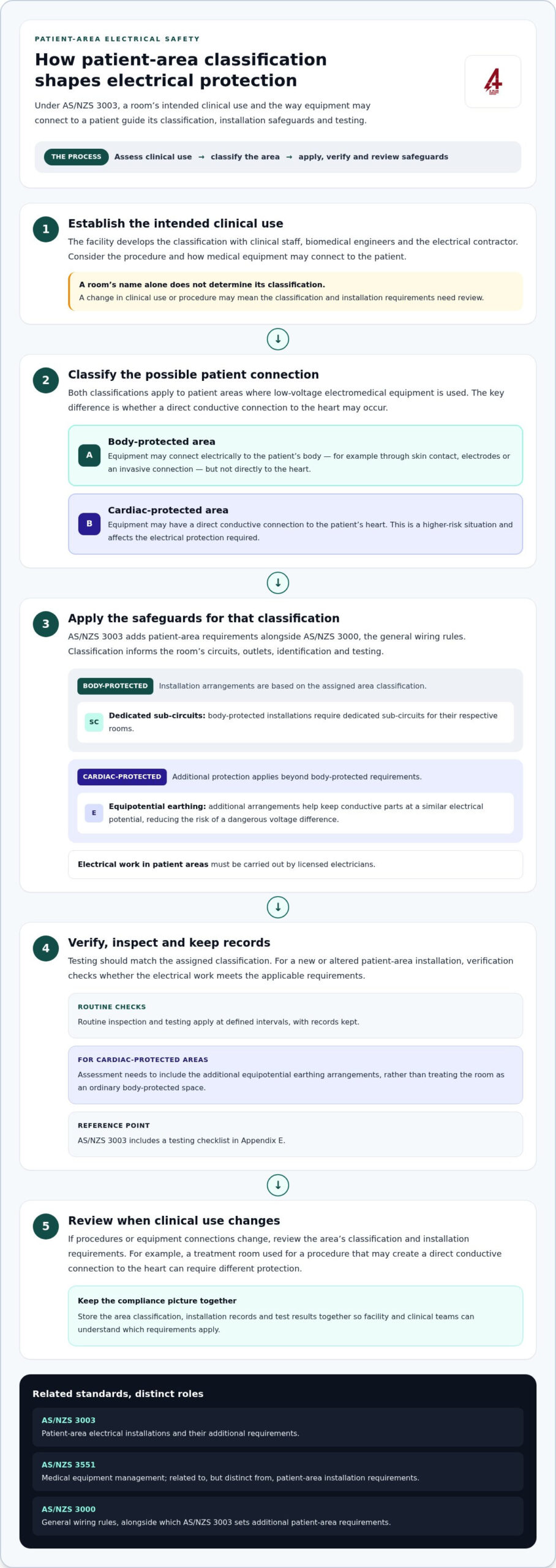
Under AS/NZS 3003:2018, patient areas are classified according to how electrical medical equipment may connect to a patient. A body-protected area allows connections to the patient’s body, such as through skin contact, electrodes or invasive connections that don’t reach the heart. A cardiac-protected area presents a higher-risk situation: equipment may have a direct conductive connection to the patient’s heart. That difference affects the electrical protection required in the room.
Both classifications apply to patient areas where low-voltage electromedical equipment is used. The intended clinical activity is central. For example, a treatment room using equipment connected to a patient’s skin may be body-protected, while a procedure that could create a direct conductive connection to the heart may require cardiac protection. A room’s name alone does not determine its classification. Facility representatives assess the intended use with clinical staff, biomedical engineers and the electrical contractor.
Electrical protection also differs. AS/NZS 3003 requires additional equipotential earthing arrangements in cardiac-protected areas beyond those required in body-protected areas. Equipotential earthing connects conductive parts so they remain at a similar electrical potential, reducing the risk of a dangerous voltage difference. The standard identifies nominated areas for classification in clauses 2.2.3 and 2.2.4. Correct classification therefore informs the design and verification of the patient-area installation.
Testing should correspond to the assigned classification. For a new or altered patient-area installation, verification checks whether the electrical work meets the applicable requirements. Routine inspection and testing also apply at defined intervals, with records kept. In a cardiac-protected area, assessment needs to include the additional equipotential earthing arrangements, rather than treating the room as an ordinary body-protected space. AS/NZS 3003 includes a testing checklist in Appendix E.
Classification also guides later changes. If clinical use changes, equipment connections or procedures may alter the electrical risk, so the area’s classification and installation requirements need review. For example, converting a general treatment room to support a procedure with a direct conductive connection to the heart can affect the required protection. Keep the area’s classification, installation records and test results together, so facilities and clinical teams can understand which requirements apply. AS/NZS 3551 addresses medical equipment management, while AS/NZS 3003 concerns patient-area electrical installations; these serve related but distinct purposes.
What is a body-protected electrical area?
In Australia, AS/NZS 3003 sets patient-area electrical requirements alongside AS/NZS 3000, the general wiring rules. Classification determines the installation safeguards, circuit arrangements, signage and testing needed for the room.
Defining body-protected patient areas
A body-protected patient area is a space where medical equipment can connect electrically to a patient’s body, but not directly to the heart. AS/NZS 2500:2004 guides the safe use of electricity in patient care and states that patient areas should be wired at least to body-protected requirements under AS/NZS 3003. This classification matters in healthcare settings, including medical and dental practices.
Patient-area classification considers the room’s intended clinical use and equipment. The facility makes that assessment with clinical staff, biomedical engineers and the electrical contractor. A dental treatment room using electromedical equipment on a patient is a common example. AS/NZS 3003 also identifies nominated areas for classification in clauses 2.2.3 and 2.2.4.
Permitted equipment and devices
Medical and general electrical appliances may be used in a body-protected area when appropriate to the clinical task and supported by the room’s compliant installation. AS/NZS 3551 covers medical equipment management, while AS/NZS 3003 addresses the patient-area installation. Matching equipment, circuits and intended use helps facilities maintain a clear safety record.
There isn’t a universal device list that makes every appliance suitable for every procedure. The clinical use, how equipment connects to the patient and the area’s classification all matter. AS/NZS 3551 provides the relevant framework for managing medical equipment; device testing and records should align with the equipment and its use.
What electrical safety requirements apply in Australia? AS/NZS 3003 adds patient-area requirements to AS/NZS 3000, including safeguards for circuits, outlets, identification and testing. Body-protected installations also require dedicated sub-circuits for their respective rooms.
What does body protection mean under AS/NZS 3003? It describes the protection level for patient areas where equipment may connect to the patient’s body without a direct conductive connection to the heart. The classification guides the installation requirements.
What are the requirements for equipotential bonding? AS/NZS 3003 requires additional equipotential earthing arrangements in cardiac-protected areas beyond those required in body-protected areas. Equipotential earthing helps limit voltage differences between conductive parts.
Who can design and install the area? Licensed electricians must carry out electrical work in patient areas. The facility develops the classification with clinical staff, biomedical engineers and the electrical contractor.
What does installation or upgrade cost? The scope depends on the existing installation, room layout, circuit changes and required safeguards. As these factors determine the work involved, there is no single cost that applies to every facility.
How are areas inspected, tested and certified? New patient treatment areas must be tested and certified before use. AS/NZS 3003 also requires routine inspection and testing at defined intervals, with records kept; completed patient-area work is tested at intervals not exceeding 12 months by a qualified assessor.
Socket outlets, markings and signage
In Australian patient areas, outlet placement and identification help staff distinguish supplies and use equipment correctly. AS/NZS 3003 sets specific arrangements for body-protected installations, including separate cleaner circuits and classification signage. These details matter in treatment rooms where clinical equipment, cleaning appliances and different electrical supplies may be used in the same space.
Outlet colours identify the type of supply. In a body-protected installation, normal-supply socket outlets are white, essential-supply outlets are red, and UPS-supply outlets are dark blue. UPS means uninterruptible power supply. Clear identification helps staff recognise the supply serving an outlet, particularly when choosing where to connect equipment during clinical work.
Placement also has defined requirements. Socket outlets in these areas are located within 2 metres of the area entrance and are individually switched. A cleaner socket-outlet must be located within 15 m of the relevant area. These provisions support practical access, while helping distinguish ordinary clinical outlets from those intended for cleaning equipment.
The cleaner circuit has a separate role in the installation. Under clause 2.4.1.1, a cleaner sub-circuit must be separate from other sub-circuits; clause 2.4.1.3 states it must supply cleaner socket-outlets only. This separation helps avoid confusion between outlets for cleaning equipment and outlets serving clinical or general appliances. Facilities can use outlet labels and circuit records to make the arrangement easier to identify during maintenance.
For some Australian installations, IEC industrial-type socket-outlets are described as having 3 to 5 round pins and a rating of 10 to 100 A. The outlet type and circuit arrangement need to suit the installation design and intended use. Don’t assume that an outlet’s appearance alone establishes its supply or permitted use; markings and circuit documentation provide important context.
Classification signage is another part of the installation. AS/NZS 3003 requires patient areas to display signage showing their classification. Staff can then see whether a room is designated body-protected or cardiac-protected, rather than relying on a room name such as “procedure room”. In practice, facilities should keep signage legible and consistent with the area’s documented classification.
These arrangements support compliance and help reduce electric-shock risks by making outlets and supplies easier to identify. During an installation review, compare room signage, outlet colours, switching, the cleaner circuit and circuit records. If treatment rooms have been altered, check that the installation documentation and identification reflect the changes.
Electric shock risk reduction
Electrical installations in patient areas are designed to reduce electric-shock risk where patients may be connected to medical equipment. Body protection is one part of the overall arrangement. The room’s classification, wiring and equipment use all matter. For example, a dental treatment room needs an installation suited to its patient-care activities, rather than simply the general wiring approach used elsewhere in the building.
For healthcare facilities, a practical starting point is to align the intended clinical use with the area’s identified classification. If procedures or equipment change, reassess whether the existing installation remains suitable. A change from general consultation to treatment involving electrical equipment connected to a patient may affect the safeguards and checks that apply. Keep the classification and installation records accessible to those responsible for the room.
Older tenancies need particular care before electrical changes. Before carrying out new electrical work in an older tenancy, assess whether the existing installation is suitable for the patient-area use. Adding a new power point is one example of new work. The proposed change therefore needs to be considered in the context of the existing patient-area installation. Establish the room’s condition and classification before planning additions.
Inspection and testing help identify defects or corrective actions in the installation. AS/NZS 3003 requires verification when a patient-area installation is new or altered, as well as routine inspection and testing at defined intervals, with records kept. New patient treatment areas must be tested and certified before use. Requirements vary according to the workplace, equipment, risk assessment and applicable standards, so site-specific professional guidance helps set an appropriate testing schedule.
What are the risks and consequences of non-compliant body-protected areas? An installation that does not meet the requirements for its classification may expose patients to avoidable electric-shock risks. Inspection and testing can identify non-compliant conditions and the corrective actions needed to address them.
For facility managers, a structured review can clarify the next steps. Consider these practical actions:
- Confirm the room’s documented patient-area classification and intended clinical use.
- Record changes to treatment activities, equipment or electrical installations.
- Arrange inspection and testing after new work or alterations, and retain the results.
- Ensure corrective actions are recorded and followed through before the affected area is used.
AS/NZS 3003 also includes a detailed testing checklist in Appendix E. Keeping inspection results, classification details and alteration records together gives healthcare teams a practical reference when reviewing a room or planning future work.
Electrical safety and RCD protection
Residual current devices (RCDs), often called safety switches, help reduce electric shock risk by interrupting power when they detect an electrical fault. NSW Health states that all patient areas in hospitals and healthcare facilities must be wired at least as body-protected electrical areas and protected with a 10 mA RCD. This protection needs to suit the room’s classification and intended clinical use.
RCDs in body-protected patient areas must be double pole, including cleaners’ RCDs. They must be readily accessible below 2 m and visible. AS/NZS 3003 sets their locations by Table 2.1, and RCDs must be at least 500 mm from a light switch. These requirements make correct positioning and identification part of maintaining the installation, not just the initial design.
The device itself must meet the applicable product standard. Australian RCDs for these installations must comply with AS/NZS 3190, AS/NZS 61008.1 or AS/NZS 61009.1, as applicable. Line-side cabling to patient RCDs also requires mechanical protection under AS/NZS 3000 clause 2.4.2. These provisions address different parts of the arrangement: device suitability, accessibility and protection of conductors.
RCD protection works alongside other installation requirements. Body-protected electrical areas must comply with Sections 2 and 3 of AS/NZS 3003. The standard also specifies additional rules for socket-outlet locations, including circumstances where RCD protection is not required based on the 2 m rule. That specific location rule should not be read as a general exemption for every outlet in a treatment area.
Alterations need the same careful attention. Section 6 of AS/NZS 3003 applies to alterations and additions in Australian body-protected installations. For example, adding a circuit or changing a treatment room may affect the existing protection and its documentation. Electrical work in patient areas must be carried out by licensed electricians, and new or altered installations require verification against applicable requirements.
Routine inspection and testing help confirm that patient-area installations remain suitable. Completed patient-area electrical work must be tested at intervals not exceeding 12 months by a qualified assessor. Testing frequency can also depend on the workplace, equipment, risk assessment and applicable standards, so obtain site-specific professional guidance. Keep records of results, defects and corrective actions alongside the area’s classification.
- Confirm each RCD’s location, visibility and accessibility.
- Record test results and corrective actions for the relevant treatment area.
- Review protection and documentation after electrical alterations or changes in clinical use.
A Plus Compliance Services: Test & Tag (Electrical Safety Testing)
A Plus Compliance Services supports workplaces across Melbourne and Victoria with Test & Tag (Electrical Safety Testing), RCD Testing and Biomedical Equipment Safety Testing. These services help organisations plan equipment checks and keep testing records organised.
For healthcare facilities, ongoing support can help keep testing schedules and records aligned as equipment and site needs change. A Plus Compliance Services also provides Emergency & Exit Light Testing as part of broader workplace compliance planning.
To discuss ongoing electrical safety testing support for your workplace, contact A Plus Compliance Services or visit aplustag.com.au.
Make ongoing compliance easier to manage
Turn the room’s classification and electrical records into a practical maintenance plan. Assign responsibility for keeping documents current, recording changes to clinical use and ensuring relevant records are accessible to those who manage each treatment area. This gives your facility a clearer basis for planning work and tracking follow-up.
For a body-protected electrical area, connect the room’s documented status with the equipment and maintenance records your team uses. When a room changes function, review the information supporting its ongoing management. A consistent process helps prevent important updates from being missed during staff handovers or operational changes.
A Plus Compliance Services can discuss how its electrical safety services fit your organisation’s compliance needs. Get in touch to talk through a practical next step for your site.
With clear ownership and organised records, your team can manage ongoing safety responsibilities with greater confidence.
Frequently Asked Questions
What rooms have to comply?
Rooms intended for patient care using low-voltage electromedical equipment need assessment against AS/NZS 3003. The relevant unit is the patient-use space, not necessarily the whole building or clinic. A facility can map rooms by their actual function, such as treatment, diagnostics or consultation, then record which spaces fall within the standard’s scope. This room-by-room approach helps keep site records useful when services or layouts change.
Who decides how a patient area is classified?
The facility determines the classification with input from clinical staff, biomedical engineers and the electrical contractor. A practical record should note who contributed, the room’s intended clinical activities and the basis for its classification. Keep this information with room plans and electrical records. If procedures or equipment change, update the documentation so staff and contractors can use current site information.
What is a body protected electrical area in Australia?
It is a patient area intended for low-voltage medical equipment operating at 50-1000 V, where equipment may connect electrically to the patient’s body without reaching the heart. The classification describes the electrical installation requirements for that use. For facilities, recording which rooms have this designation helps distinguish patient-care spaces from other areas when managing room schedules, electrical records and changes to clinical use.
Which locations in Australian healthcare facilities require body-protected electrical areas?
Assess patient-use rooms in hospitals, day-procedure centres, general practices, dental surgeries, specialist rooms, physiotherapy and allied-health clinics, and aged-care treatment areas where low-voltage electromedical equipment is used. The assessment applies to spaces used for patient treatment, not automatically to every room in the facility. A room-use register can help identify spaces for assessment at healthcare sites with both clinical and administrative functions.
How do body-protected electrical areas differ from cardiac-protected electrical areas?
The distinction depends on whether a procedure could create a direct conductive connection between equipment and the patient’s heart. That clinical possibility calls for cardiac-protected classification and additional electrical arrangements. For operational planning, ensure room-use information reflects the procedures actually performed there. This gives facilities a clear basis for identifying spaces that may need a classification review as services change.
Which Australian standards and state or territory rules govern body-protected electrical areas?
AS/NZS 3003 addresses electrical installations in patient areas, while AS/NZS 3000 covers general electrical installations. AS/NZS 2500 is a guide to safe electricity use in patient care, and AS/NZS 3551 concerns medical equipment management. State and territory electrical safety requirements also apply. For a site record, note the standards relevant to the work and the jurisdiction where the facility operates, rather than relying on an old project reference.
What are the requirements for equipotential bonding in a body-protected electrical area?
