Facility Manager’s Guide to Electrical Safety: Australian Compliance 2026
Effective electrical safety isn’t a checklist you complete once a year; it’s a continuous management system that protects both your people and your operational continuity. For those responsible for complex sites, maintaining a facility manager’s guide to electrical safety is the first step toward transforming a fragmented set of tasks into a reliable safety culture. You likely understand the pressure of managing multiple expiry dates across various equipment types while ensuring that mandatory testing doesn’t bring your operations to a sudden standstill.
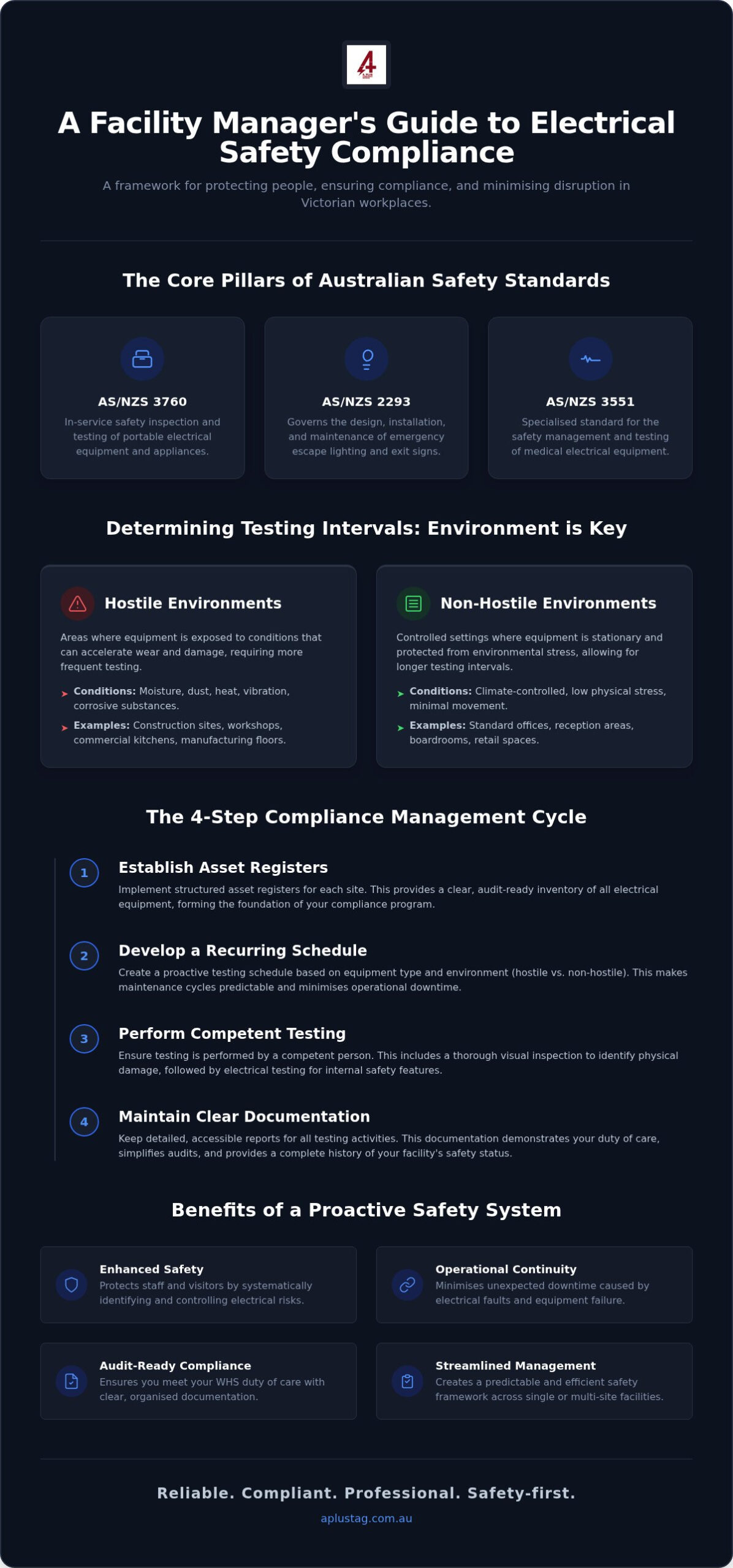
It’s common to feel the weight of administrative tasks when tracking compliance across multi-site locations. This article provides a comprehensive framework to help you master your workplace safety obligations with confidence and clarity. You’ll learn how to establish a streamlined compliance schedule that aligns with current Australian Standards, such as AS/NZS 3760 for equipment and AS/NZS 2293 for emergency lighting. We will also outline how to develop audit-ready documentation and asset registers that reduce the risk of electrical failure, ensuring your Victorian business remains secure, organised, and fully compliant throughout 2026.
Key Takeaways
- Understand the core requirements of AS/NZS 3760 and AS/NZS 2293 to ensure your facility meets its mandatory duty of care under Australian WHS laws.
- Learn how to distinguish between hostile and non-hostile environments to accurately determine the required testing intervals for different equipment types.
- Use this facility manager’s guide to electrical safety to implement structured asset registers that provide clear, audit-ready documentation for every site.
- Discover strategies for developing recurring compliance schedules that help minimise operational downtime and keep your maintenance cycles predictable.
- Streamline your site management by integrating emergency lighting and fire equipment testing into a unified, professional safety framework.
Understanding Your Regulatory Obligations and Australian Standards
Under Australian Work Health and Safety (WHS) legislation, facility managers hold a significant duty of care. This responsibility requires you to provide a safe working environment by identifying, assessing, and controlling electrical risks. It’s not merely about avoiding fines; it’s about protecting every individual who enters your site. The primary objective of electrical safety testing is risk mitigation through systematic verification. This process forms the foundation of any comprehensive facility manager’s guide to electrical safety.
Compliance is a continuous cycle rather than a one-time event. Equipment degrades, environments change, and safety standards evolve. To maintain a secure facility, you must move beyond reactive repairs toward a proactive, scheduled management framework. The two core pillars of this framework are AS/NZS 3760, which covers portable appliances, and AS/NZS 2293, which governs emergency and exit lighting systems.
The Role of AS/NZS 3760 in Workplace Safety
AS/NZS 3760 is the primary standard for the safety inspection and testing of electrical equipment. It applies to most portable appliances found in offices, workshops, and commercial kitchens. A critical aspect of this standard is the definition of a “competent person.” This individual doesn’t necessarily need to be a licensed electrician for all tasks, but they must possess the specific knowledge, training, and experience to perform testing accurately.
Effective testing involves more than just plugging a device into a machine. A thorough visual inspection is the first line of defence. In fact, many electrical faults are identified through careful observation of damaged cords, cracked plugs, or signs of overheating. Once the visual integrity is confirmed, electrical testing verifies internal safety features like earth continuity and insulation resistance that are invisible to the naked eye.
Specialised Standards for Healthcare and Construction
While AS/NZS 3760 is the baseline, certain facilities require more rigorous protocols. For those managing healthcare or aged care environments, AS/NZS 3551 is essential. This standard specifically addresses the safety and performance of medical electrical equipment. It ensures that devices directly involved in patient care operate within strict safety parameters to prevent harm.
Construction sites and high-risk industrial areas also face stricter requirements due to their “hostile” nature. These environments involve dust, moisture, and physical vibration, which accelerate equipment wear. Identifying which standards apply to your facility depends on the specific activities performed on-site. By adhering to these standards, you create a robust facility manager’s guide to electrical safety that protects your staff and your business assets while ensuring your compliance services are tailored to the actual risks present in your workplace.
Mandatory Testing Intervals and Workplace Environments
Determining how often equipment requires inspection depends entirely on its operating environment. A toaster in a staff kitchen faces different wear than a computer in a climate-controlled office. This distinction is central to any facility manager’s guide to electrical safety. In Australian standards, we categorise these as either hostile or non-hostile environments. Hostile environments involve factors like moisture, heat, dust, or physical vibration that can damage equipment or its power supply.
Residual Current Devices (RCDs) play a vital role in these settings by cutting power instantly when a fault is detected. Regular testing ensures these life-saving switches function correctly when needed. For a deeper look at these requirements, you can refer to our complete guide to RCD testing. Establishing a schedule based on actual risk helps you maintain a safe site without over-servicing low-risk areas.
Classifying Your Facility Environment
High-risk areas like commercial kitchens, workshops, and production floors are classic examples of hostile environments. Here, equipment is frequently moved, subjected to temperature fluctuations, or exposed to corrosive substances. Conversely, standard office environments are usually non-hostile, where equipment remains stationary and protected from environmental stress. Shared spaces, such as breakrooms or common corridors, require a specialised approach. These areas often see high traffic and varied equipment use, making them prone to unexpected wear. Correctly identifying these zones ensures your testing resources are allocated where they’re needed most.
Determining Correct Testing Frequencies
Testing intervals aren’t arbitrary; they’re designed to catch faults before they cause incidents. While requirements vary based on the workplace and equipment type, common cycles include:
- 3-month intervals: Typically required for equipment on construction sites or in extremely high-wear environments.
- 6-month intervals: Common for production equipment or tools used in workshops and commercial kitchens.
- 12-month intervals: The standard for most portable equipment in lower-risk, non-hostile office settings.
Managing items that move between different environments is a common challenge for facility professionals. If a piece of equipment is regularly taken from a safe office to a high-risk workshop, it must be tested according to the more frequent schedule. Obtaining site-specific professional guidance is the most reliable way to ensure your schedule remains compliant and efficient while you follow this facility manager’s guide to electrical safety.
Integrating Emergency Lighting and Fire Equipment Maintenance
A building’s safety infrastructure relies on more than just the equipment plugged into the walls. Maintaining a comprehensive facility manager’s guide to electrical safety requires looking beyond the power point to the systems that activate when the grid fails. Emergency and exit lighting systems, governed by AS/NZS 2293, are essential for guiding occupants to safety during a power outage or fire. These systems are often neglected until an emergency occurs, which makes regular, documented verification a critical management priority.
Managing these requirements alongside your portable appliance testing creates a more efficient safety ecosystem. By aligning your electrical safety cycles with fire protection maintenance, you reduce the administrative burden of tracking separate contractors and expiry dates. This integrated approach ensures that every safety component, from the RCD in the switchboard to the extinguisher on the wall, is ready for an audit at any moment. For a detailed breakdown of these requirements, see our emergency lighting standards guide.
The 6-Month and Annual Discharge Tests
Australian standards require emergency lighting to undergo a discharge test every six months. During this procedure, a technician simulates a total power failure to ensure every unit remains illuminated for at least 90 minutes using its internal battery. If a light fails to stay lit for the full duration, it must be repaired or replaced immediately to maintain compliance. Common failure points often include depleted batteries or faulty lamps, which are easily identified during these routine checks.
Regular verification ensures that evacuation routes remain visible during a crisis. A systematic testing cycle allows you to identify aging components before they fail, preventing the risk of a dark stairwell during an emergency. These tests provide the data needed for your asset register, proving that your facility meets its mandatory safety obligations under AS/NZS 2293.
Fire Protection and Portable Suppression
Fire extinguishers and fire blankets are the first line of defence against small workplace fires. In commercial settings, these items require regular inspection to confirm they’re in the correct location, fully charged, and free from physical damage. Coordinating these fire safety checks with your electrical compliance services simplifies the logistics of site management. It allows for a single, comprehensive site visit that addresses multiple safety pillars simultaneously.
Maintaining accurate compliance records for fire safety audits is just as vital as the physical testing itself. Every extinguisher and blanket must be tagged with its test date and result, and these details should be mirrored in your digital asset register. This level of organisation demonstrates a proactive approach to safety, showing that you’ve taken all reasonable steps to protect your facility and its occupants from fire-related risks.
Best Practices for Asset Registers and Compliance Reporting
A digital asset register serves as the backbone of modern facility management. It moves beyond the limitations of traditional paper logbooks, offering a dynamic, real-time view of your entire safety landscape. This level of oversight is a core component of a facility manager’s guide to electrical safety. It provides the transparency needed to manage risk effectively across large or complex sites. Without a centralised register, tracking hundreds or thousands of individual items becomes an administrative burden that’s prone to human error. A professional register ensures that no piece of equipment is overlooked during a testing cycle.
The Components of a Professional Asset Register
Every piece of equipment must have a unique identifier, usually a durable barcode or a dedicated ID number. This allows for precise tracking and history logging over several years. Your register should record the specific test result, the date of inspection, and exactly when the next test is due. If an item fails, it’s not enough to simply remove it from service; the register must document the specific remedial action taken. This level of detail is vital for long-term maintenance budgeting and strategic planning. By reviewing your asset data, you can identify equipment types that fail frequently. This allows you to make informed procurement decisions and potentially switch to more reliable brands or models.
Streamlining Audit Readiness
Professional reporting makes the audit process remarkably straightforward. When a safety inspector or WHS representative visits your site, you can present a structured digital report immediately. This demonstrates that your facility is well-regulated. It shows you’re proactive about safety rather than reactive. Automated due-date reminders are also essential for staying organised. This is particularly true when managing multi-site operations where manual tracking is impossible. For more detailed information on tracking these cycles and maintaining high standards, read our pillar on compliance monitoring. Consistent data integrity ensures that every location follows the same rigorous protocols, regardless of its size or function. It creates a single source of truth that protects your business from liability. It also ensures you’re adhering to the principles outlined in this facility manager’s guide to electrical safety.
Developing a Recurring Compliance Schedule for Your Facility
Establishing a successful safety programme requires more than technical knowledge; it requires a strategic approach to timing. This final phase of our facility manager’s guide to electrical safety focuses on the practical execution of your testing cycles. A well-designed schedule ensures that safety never comes at the cost of productivity. By planning your requirements in advance, you transform compliance from a disruptive hurdle into a seamless part of your facility’s operational rhythm.
A proactive schedule allows you to group different testing requirements together, such as combining RCD testing with your annual fire extinguisher inspections. This level of coordination is what separates a well-managed site from one that is constantly reacting to overdue notices. When you view compliance as a recurring cycle, you can better manage your resources and ensure that every safety pillar is addressed without the stress of last-minute bookings.
Minimising Site Disruption
Professional testing shouldn’t bring your workplace to a standstill. The most effective way to manage this is by coordinating testing with low-traffic periods or staggered intervals. For example, scheduling RCD testing or emergency light discharge tests during scheduled shutdowns or after-hours ensures that essential power isn’t interrupted when staff are at their most active. Clear communication is the key to success here. Providing tenants or department heads with advance notice allows them to prepare for brief power interruptions, maintaining a stress-free environment for everyone involved.
A Plus Compliance Services operates with a “minimal disruption” philosophy. This means our technicians work around your specific site needs rather than imposing a rigid, inconvenient schedule. Whether it’s a healthcare facility that needs quiet zones respected or a hospitality venue that requires morning-only service, we adapt our workflow to suit yours. This approach ensures your safety obligations are met while your core business activities continue uninterrupted.
The Value of Long-Term Compliance Partnerships
Relying on a series of one-off contractors often leads to fragmented records and inconsistent testing standards. In contrast, selecting a long-term compliance partner ensures a deep understanding of your facility’s unique electrical layout and equipment history. This consistency is invaluable when it comes to identifying recurring faults or managing complex multi-site requirements. It also significantly reduces the administrative burden on the facility manager. Instead of chasing different vendors for reports, you have a single, dependable partner who proactively manages your recurring cycles.
Positioning your business as a well-regulated entity requires a partner who is as invested in your safety as you are. A Plus Compliance Services specialises in developing these tailored, recurring schedules for Victorian businesses. We don’t just perform a test; we manage your entire compliance timeline, providing automated reminders and structured reporting that keeps you ahead of your obligations. Requesting a tailored site assessment is the first step toward a more organised and secure facility. By integrating all your compliance services into one master schedule, you ensure that your workplace remains safe, compliant, and fully operational throughout 2026 and beyond.
Securing Your Facility’s Future with Proactive Compliance
Managing a complex site requires a shift from reactive repairs to a structured, systematic approach. This facility manager’s guide to electrical safety has outlined how integrating Australian Standards like AS/NZS 3760 and AS/NZS 2293 into a single, recurring schedule simplifies your safety obligations. By adopting a digital asset register, you ensure that every piece of equipment is tracked with precision, providing the transparency needed for audit readiness and long-term maintenance budgeting.
A Plus Compliance Services acts as a dependable partner to help you maintain this order. We provide accurate asset registers with every service and use automated due-date reminders so you don’t miss a critical deadline. Our technicians prioritise professional, punctual service designed for minimal site disruption, allowing your operations to continue smoothly while we secure your environment.
Taking these proactive steps today protects your people and your business for years to come.
Frequently Asked Questions
What is electrical test and tag in an Australian facility context?
Test and tag is a systematic process of visually inspecting and electrically testing portable appliances to ensure they remain safe for use. In a facility context, this involves checking items like computers, kitchen appliances, and power tools according to the AS/NZS 3760 standard. This practice is a fundamental part of a facility manager’s guide to electrical safety, as it helps identify hidden faults like insulation breakdown or earth continuity issues before they cause accidents.
How often does equipment need to be tested in a commercial office?
Testing frequencies in a commercial office generally follow a 12-month or 5-year cycle, depending on the environment and equipment type. For example, equipment that is frequently moved or used in common areas often requires annual testing. Conversely, stationary equipment in a non-hostile office environment may only need testing every five years. It’s essential to obtain site-specific professional guidance to determine the exact intervals that apply to your specific workplace and equipment.
Can electrical testing be completed outside normal operating hours?
Yes, electrical testing can be scheduled after-hours or during weekends to minimise disruption to your daily operations. Professional compliance partners often offer flexible scheduling to ensure that essential power-down procedures, such as RCD or emergency light testing, don’t interfere with staff productivity. This approach allows for a thorough inspection of all equipment while the facility is at low capacity, ensuring a stress-free experience for tenants and employees alike.
What happens when a piece of equipment fails a safety test?
When an item fails a safety test, it must be immediately withdrawn from service and clearly labelled with a “Danger” or “Out of Service” tag. The technician will record the failure in the asset register and notify the facility manager of the specific fault. The item should then be repaired by a qualified professional or disposed of permanently. Recording these failures is a critical step in maintaining accurate compliance documentation and preventing accidental use of faulty equipment.
How do I manage electrical compliance across multiple facility locations?
Managing multi-site compliance is best achieved through a centralised digital asset register and automated due-date reminders. By partnering with a single service provider, you can ensure consistent testing standards and reporting formats across all locations. This unified approach allows you to view the compliance status of every site through a single dashboard, making it much easier to prepare for audits and manage maintenance budgets across your entire property portfolio.
What are the mandatory requirements for emergency light testing?
Emergency and exit lights must undergo a discharge test every six months in accordance with AS/NZS 2293. This procedure involves simulating a power failure to ensure the internal batteries can keep the lights illuminated for at least 90 minutes. Additionally, a visual inspection is required to check for physical damage or burnt-out lamps. Documenting these results in a dedicated register is mandatory to prove your facility meets its safety obligations during an official audit.
Do I need a separate asset register for fire equipment and electrical items?
While you can maintain separate logs, integrating both fire and electrical equipment into one comprehensive asset register is highly recommended. A unified register allows you to track test results, locations, and next due dates for extinguishers, RCDs, and portable appliances in one place. This consolidated view simplifies site management and provides a more holistic perspective on your facility’s safety status, which is a key recommendation in any facility manager’s guide to electrical safety.
Is thermal imaging necessary for facility switchboards?
Thermal imaging is a highly effective preventative maintenance tool that identifies “hot spots” in switchboards before they lead to electrical fires or equipment failure. While not always mandatory for every site, it’s often recommended for commercial and industrial facilities to detect loose connections or overloaded circuits that are invisible to the naked eye. Regular thermal scans can significantly reduce the risk of unexpected downtime and are often required by insurance providers as part of a risk management strategy.
