Emergency Lighting Standards Australia: The 2026 Compliance Guide
A single failed battery during a fire audit can transform a routine safety check into a significant legal and financial liability for your organisation. It’s common to feel frustrated by the complex technicalities of the National Construction Code and how they intersect with the current emergency lighting standards. You want to ensure your building remains safe, but managing recurring testing schedules while avoiding workplace disruption is a constant balancing act for any diligent facility manager.
This guide provides a professional, step-by-step path toward total safety confidence and audit readiness. We’ll outline the essential AS/NZS 2293 requirements, provide a structured approach to your mandatory 6-monthly maintenance schedule, and explain how a precise asset register serves as your best defence during a safety audit. By the end of this article, you’ll have a predictable framework to manage your safety obligations with ease, transparency, and complete peace of mind.
Key Takeaways
- Learn how AS/NZS 2293 and the National Construction Code work together to define your legal safety obligations.
- Understand the critical importance of the 90-minute discharge test and why six-monthly inspections are mandatory for emergency lighting standards compliance.
- Identify common points of failure, such as degraded batteries or obscured exit signs, to prevent costly audit non-conformance.
- Discover how a detailed asset register simplifies insurance requirements and ensures you’re always audit-ready.
- Explore the benefits of a streamlined safety strategy by integrating lighting inspections with Test & Tag and RCD testing.
What is AS/NZS 2293? Understanding the Australian Standard
AS/NZS 2293 serves as the definitive framework for emergency lighting standards across Australia. It isn’t merely a technical manual for electricians; it’s a critical safety protocol designed to protect occupants during power outages or fire emergencies. Compliance isn’t a one-time event completed at the point of construction. Instead, it’s a continuous obligation that ensures every exit sign and emergency light functions perfectly when visibility is compromised. This standard provides a structured approach to keep your workplace safe and audit-ready at all times.
Relying on a “set and forget” mentality is a common mistake that leads to failed audits. Safety systems inevitably degrade over time. Batteries lose capacity, and electronic components can fail without warning. By treating these emergency lighting standards as a recurring cycle of professional care, you transform a complex regulatory burden into a manageable, predictable safety asset. This proactive stance is what separates compliant, well-regulated businesses from those at risk of significant liability.
The Role of the National Construction Code (NCC)
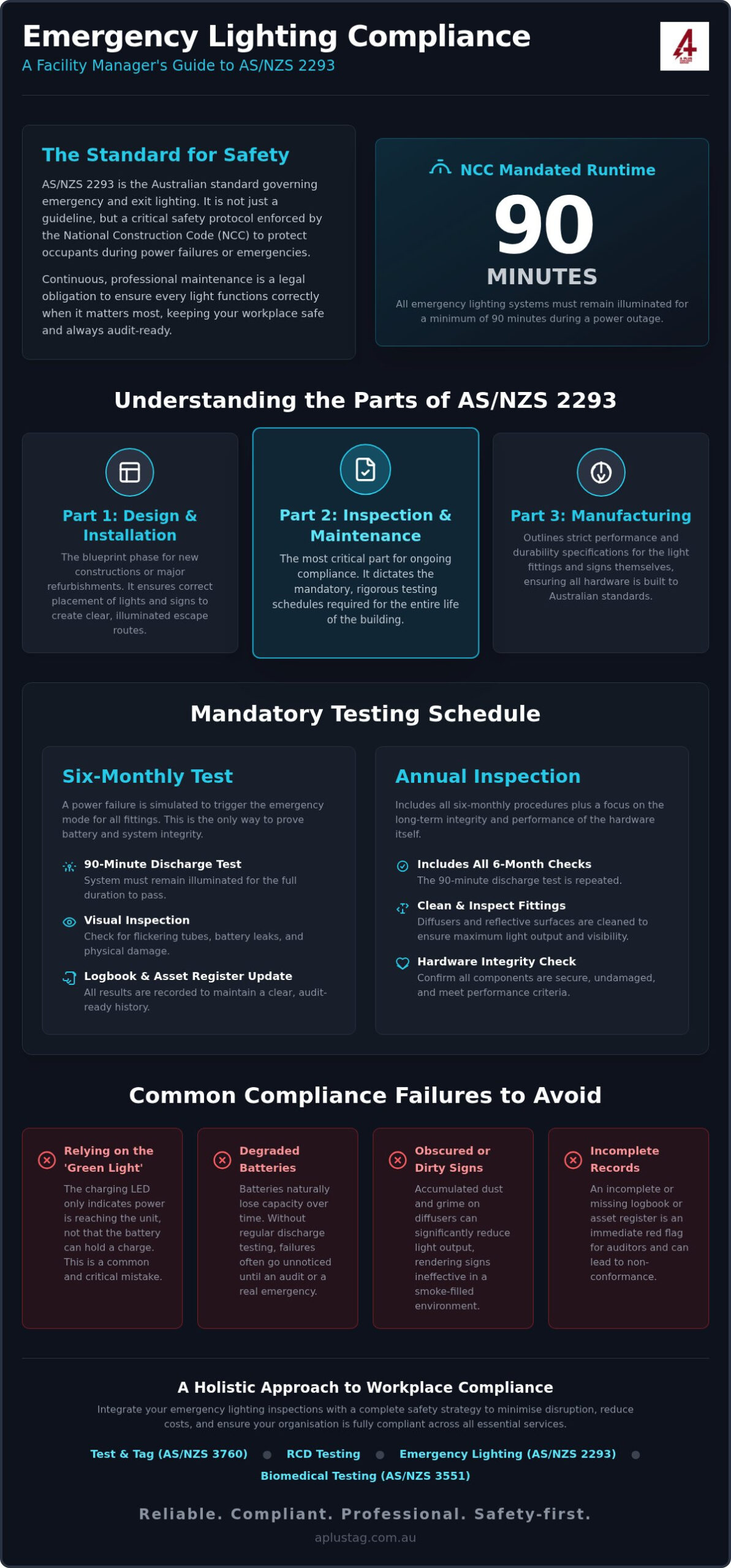
The NCC provides the legal weight behind these standards by mandating specific safety requirements for different building types. It specifies that buildings ranging from Class 2 (multi-unit residential) to Class 9 (public buildings like hospitals or schools) must have adequate emergency lighting installed. A central requirement is the ability for these systems to provide at least 90 minutes of illumination during a total power failure. Failing to meet these requirements exposes building owners and employers to severe legal penalties, potential insurance voids, and, most importantly, unacceptable risks to occupant safety. Professional testing ensures your equipment meets these precise NCC benchmarks during every inspection.
Key Differences Between AS/NZS 2293 Parts 1, 2, and 3
To maintain a compliant site, it helps to understand how the standard is organised into three distinct sections. Each part plays a specific role in the lifecycle of your safety system:
- Part 1: Focuses on system design and installation. This is the blueprint phase for new builds or major refurbishments, ensuring lights are placed in the correct locations to guide people to safety.
- Part 2: This is the most relevant section for existing businesses. It dictates the rigorous inspection and maintenance routines required to keep a building compliant over its entire lifespan.
- Part 3: Outlines manufacturing specifications. This ensures that the actual light fittings and exit signs you purchase meet strict Australian durability and performance criteria before they are even installed.
By following this three-part structure, the standard ensures that safety is built-in from the design phase and maintained through professional, methodical testing cycles.
Mandatory Testing Schedules: 6-Month vs Annual Requirements
Adhering to emergency lighting standards requires a disciplined approach to maintenance. Australian law doesn’t leave safety to chance; it mandates a specific, two-tiered testing cycle to ensure every component remains operational. Every six months, a functional discharge test must occur, followed by a more comprehensive inspection every twelve months. This structured rhythm ensures that when a real emergency strikes, the path to safety is illuminated without fail, protecting both your staff and your legal standing.
The 90-minute discharge test is the “gold standard” of compliance for a simple reason: it’s the only definitive way to prove a battery can sustain light for the duration required by the NCC. A visual check of the green “charging” LED is insufficient for true safety. That light only confirms power is reaching the unit. It doesn’t guarantee the battery will hold that charge when mains power cuts out. Only a timed discharge provides the certainty required for a safety audit.
The 6-Month Discharge Test Procedure
During this semi-annual service, a technician simulates a total power failure at the switchboard to trigger the emergency mode for every fitting on the circuit. The system must remain illuminated for a full 90 minutes to pass. While the test runs, we conduct thorough visual inspections. This involves checking for flickering tubes, signs of battery leakage, and the general clarity of the exit sign faces. We then record every result in your on-site logbook or digital asset register to maintain a transparent, audit-ready history of your compliance.
The Annual Inspection: Going Beyond the Battery
The annual inspection builds upon the six-monthly test by focusing on the long-term integrity of the hardware. Over a year, dust and grime accumulate on diffusers, which can significantly reduce light output. We clean the fittings to maintain optimal lumen levels and ensure maximum visibility. Additionally, we check for any new physical obstructions or changes to the building layout that might block a clear view of an exit path. This is also the time to verify the internal charging systems and electronic components to ensure they haven’t degraded. Coordinating these cycles as part of your emergency and exit light testing ensures your workplace stays safe without the stress of managing multiple vendors.
While modern monitored systems provide real-time alerts for component failures, they don’t replace the need for physical inspections. A computer cannot see if a new shelving unit is blocking an exit sign or if a diffuser has been cracked by a passing trolley. A methodical, hands-on approach remains the most reliable way to ensure your building meets the highest emergency lighting standards while providing a safe environment for everyone on-site.
Types of Emergency and Exit Lighting Systems
Selecting the correct hardware is a vital step in meeting Australian emergency lighting standards. While the testing schedule ensures reliability, the physical fittings must be appropriate for your specific building environment. Modern safety systems are generally categorised into two functional types: maintained and non-maintained. Maintained fittings, such as exit signs, stay illuminated at all times to provide constant guidance. In contrast, non-maintained lights, like recessed “spitfire” units, only activate when the primary power supply fails. Both play a distinct role in a comprehensive safety plan.
The industry has seen a significant shift toward LED technology. This transition isn’t just about energy efficiency; it’s about reliability. LED fittings generate less heat and have a much longer lifespan than traditional fluorescent tubes. This reduced heat output prevents the premature degradation of internal batteries, which is the leading cause of system failure. For specialised environments like basement car parks or industrial sites, we also install weatherproof or vandal-resistant fittings to ensure the system remains robust despite harsh conditions or high traffic.
Exit Signage: Visibility and Colour Standards
Australian safety regulations require a standardised green and white colour palette for all exit signage. This specific colour combination is chosen for its high visibility in smoke-filled or dark environments. You’ll notice that modern signs have transitioned from the word “EXIT” to the “Running Man” pictogram. This shift aligns Australian buildings with international safety symbols, ensuring the message is clear regardless of language. Proper placement is equally critical. Signs must be positioned above every exit door, at every change of direction in a corridor, and along any egress path where the exit isn’t immediately obvious.
Central Battery vs Single Point Systems
When designing or maintaining a system, you’ll likely encounter either single point or central battery configurations. Single point systems are the most common choice for small to medium-sized Australian businesses. In this setup, every light fitting contains its own dedicated battery and charging circuit. This decentralised approach is easier to install and ensures that a single battery failure won’t compromise the entire building’s safety.
Central battery systems are typically reserved for very large complexes or high-rise towers. These involve a large, centralised bank of batteries that powers every emergency light in the building through a dedicated circuit. While the initial installation is more complex, maintenance is often more efficient because all batteries are located in one central room. However, this system requires a high level of professional oversight to ensure the central bank remains fully operational at all times.
Common Compliance Failures and How to Avoid Them
Maintaining a safe workplace requires more than just installing the right hardware. Many businesses fall short of emergency lighting standards because of preventable maintenance oversights. The most frequent point of failure is a degraded battery. While a unit might appear functional under normal power, it often fails to sustain the required 90 minutes of illumination during a discharge test. Batteries naturally lose their chemical capacity over time, making regular professional exit light testing the only way to ensure they’ll perform during a genuine power outage.
Physical obstructions represent another common compliance gap. It’s easy for a new pallet rack, a hanging promotional banner, or a modified office partition to block the line of sight to an exit sign. If your floor plan changes, your lighting layout must be reassessed to ensure egress paths remain clear and visible from every corner of the room. We also frequently encounter failures in older units where incorrect globes have been fitted or internal ballasts have reached the end of their service life, causing flickering or total failure when the system switches to battery power.
The Importance of the Compliance Logbook
A missing or incomplete logbook is a major red flag for any safety auditor. Under Australian regulations, you’re required to maintain a detailed record of all testing and repairs for at least seven years. This documentation serves as your primary evidence of due diligence in the event of an incident or insurance claim. While traditional paper logbooks were once the norm, they’re easily lost or damaged. Modern digital asset registers have become the preferred choice for organised businesses. A professional register should clearly list the date of each test, the specific result for every fitting, the name of the technician, and a record of any corrective repairs made to the system.
Preparing for a Fire Safety Audit
Success in a fire safety audit is built on consistent preparation rather than last-minute fixes. We recommend conducting a regular walk-through of all exit paths to ensure signs are clean, visible, and undamaged. It’s also highly effective to coordinate your lighting inspections with other mandatory checks. Ensuring your fire extinguishers, blankets, and RCDs are serviced at the same time creates a comprehensive safety shield for your organisation. Victorian businesses in particular should be aware that understanding the fire extinguisher testing requirements Victoria mandates is equally critical to maintaining a complete and audit-ready fire safety program. It’s a sobering reality that a single failed emergency light can be enough to invalidate a whole building’s fire safety certificate, leading to potential fines or the suspension of your occupancy permit. Utilising our detailed compliance reporting and asset registers provides the structured evidence you need to pass any audit with complete confidence.
A Holistic Approach to Workplace Compliance
Managing workplace safety shouldn’t feel like a series of disconnected chores. When you treat emergency lighting standards as one part of a larger electrical safety ecosystem, you gain significant operational efficiencies. Bundling lighting inspections with other essential services like Test & Tag or RCD testing reduces the administrative burden on your team. It also ensures that every potential electrical hazard is addressed in a single, methodical sweep rather than through sporadic visits from multiple contractors. This integrated strategy is the most reliable way to maintain a safe, audit-ready environment.
Proactive safety also involves identifying hidden risks before they manifest as emergencies. We use thermal imaging testing to detect hot spots in switchboards and electrical components that could lead to a fire. This technology allows us to see what the naked eye cannot, providing an extra layer of protection for your premises. By integrating these advanced diagnostics with your routine lighting checks, you move from a reactive “fix it when it breaks” model to a state of organised, long-term control. A single, dependable safety partner simplifies this process, ensuring nothing is overlooked.
Integrating RCD and Emergency Light Testing
RCDs and emergency lights protect your staff during different types of electrical faults. While RCDs prevent electric shock by cutting power instantly during a fault, emergency lighting ensures safe passage once that power is lost. Testing them together makes perfect sense for any busy organisation. We streamline our site visits to ensure minimal disruption to your daily operations. Instead of clearing work areas multiple times throughout the year, our technicians handle all safety requirements in one visit. This results in consolidated reporting, where all your safety data, from asset registers to compliance certificates, is stored in one easy-to-access digital register. For a detailed breakdown of what RCD testing involves and the compliance intervals required under AS/NZS 3760:2022, our complete guide covers everything facility managers need to know.
Next Steps: Securing Your Building Compliance
Taking control of your safety obligations starts with a straightforward site assessment. You can book a comprehensive review to identify any gaps in your current maintenance schedule or documentation. During your first visit from an A Plus technician, we’ll perform a full audit of your existing fittings and establish a precise asset register. We then organise a predictable maintenance cycle that keeps you compliant with Australian law without you needing to track the dates yourself. Our goal is to make compliance a stress-free, background process for your business.
Ensure your business meets Australian emergency lighting standards with A Plus Compliance Services
Secure Your Workplace Safety Strategy
Maintaining a safe building requires a disciplined commitment to Australian emergency lighting standards. By moving away from reactive fixes and adopting a methodical cycle of six-monthly and annual testing, you ensure your exit paths remain clear and visible when they’re needed most. A structured approach doesn’t just protect your staff; it safeguards your organisation against legal liability and the stress of unexpected audit failures. Precise digital asset registers provide the transparent evidence required to satisfy insurance and safety inspectors at a moment’s notice.
Our expert technicians specialise in simplifying these complex electrical safety requirements through integrated testing and detailed reporting. We act as your dependable partner, ensuring your equipment meets AS/NZS 2293 requirements with minimal disruption to your daily operations. Get a comprehensive compliance quote from A Plus Compliance Services today to streamline your safety management. You’ll feel prepared and confident knowing your workplace is fully protected and audit-ready.
Frequently Asked Questions
How often do emergency lights need to be tested in Australia?
Emergency lights must undergo professional testing every six months and every twelve months to remain compliant. These intervals are strictly mandated by AS/NZS 2293.2 to ensure batteries and circuitry function correctly. Regular testing prevents the risk of total system failure during a real emergency and keeps your building audit-ready.
Is it a legal requirement to have exit signs illuminated at all times?
Yes, exit signs must remain illuminated at all times in most commercial and public settings. These are known as maintained fittings. They serve as a constant guide for occupants during normal operations and are designed to switch to battery power immediately if the mains supply is interrupted, ensuring the path to safety is always visible.
What happens if my emergency lights fail the 90-minute discharge test?
If a light fails to stay lit for the full 90 minutes, it must be repaired or replaced immediately to restore compliance. This usually involves installing a new battery or a completely new LED fitting. All failures and subsequent repairs must be documented in your asset register to prove the fault was identified and rectified according to emergency lighting standards.
Can any electrician perform emergency lighting compliance testing?
While a licensed electrician can perform the work, it’s highly recommended to use a technician who specialises in emergency lighting standards. Compliance testing requires a methodical approach to documentation and specific knowledge of AS/NZS 2293.2. Specialist technicians ensure that every test is recorded accurately in a digital asset register, which is vital for fire safety audits.
Do I need emergency lighting if my building has natural light?
Yes, the National Construction Code requires emergency lighting regardless of the amount of natural light available. Natural light is unavailable at night or can be heavily obscured during smoke-filled conditions. Every Class 2 to 9 building must have a reliable battery-backed system to ensure safe egress at any hour or during any emergency event.
What is the difference between a 6-monthly and an annual emergency light test?
A six-monthly test focuses on the mandatory 90-minute battery discharge and basic visual checks for sign clarity. The annual test is more comprehensive. It includes the cleaning of light diffusers to maintain lumen output and a detailed inspection of all internal components to ensure the hardware hasn’t degraded over the year.
How long do I need to keep my emergency lighting test records?
You should keep your emergency lighting test records for at least seven years. This duration aligns with standard Australian business record-keeping requirements and insurance obligations. Maintaining a complete, unbroken history of your safety testing is your best defence during a fire safety audit or following an on-site incident.
Are LED exit signs mandatory for all new Australian buildings?
LED exit signs aren’t explicitly mandatory by name, but they’ve become the industry standard for all new builds and refurbishments. Their superior energy efficiency and lower heat output make them the only practical choice to meet the performance criteria set by modern standards. Most businesses find that upgrading to LED significantly reduces their long-term maintenance and battery replacement costs.
