Electrical asset register requirements for equipment records
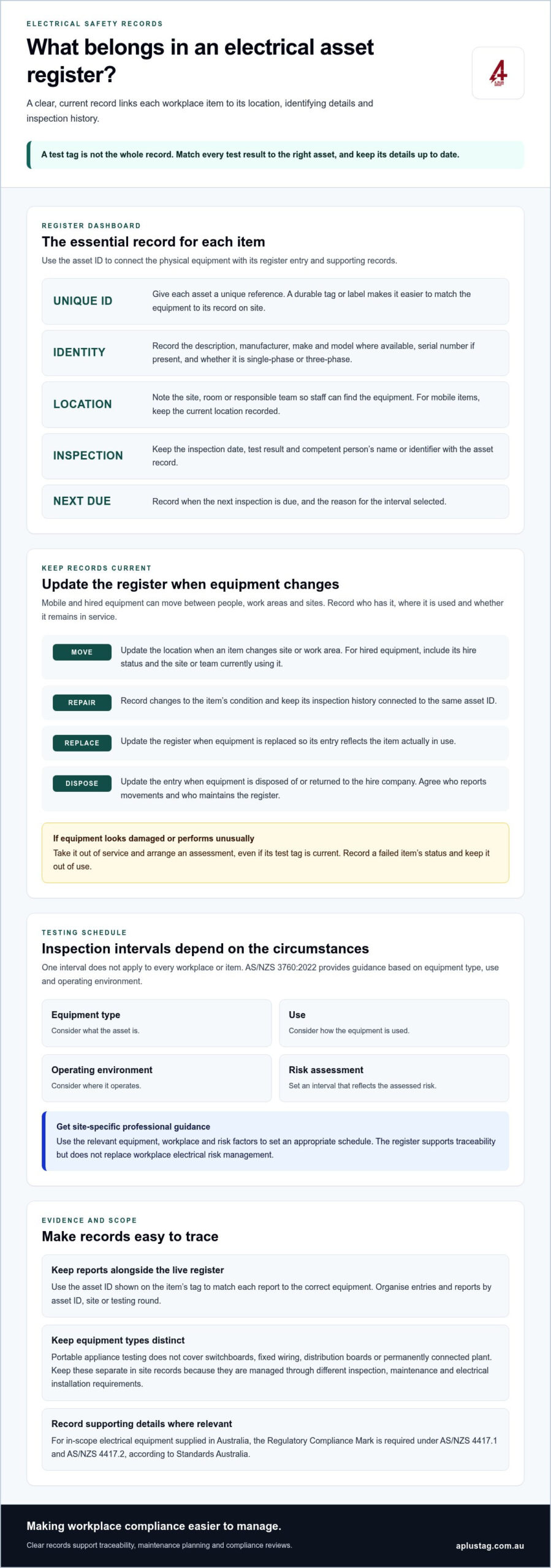
A test tag is not the whole record. For Australian workplaces, electrical asset register requirements centre on keeping clear, current information for each item: its unique ID, description, location, identifying details and relevant inspection and test history. A well-maintained register also shows the test result, who completed the work and when the next inspection is due.
It’s understandable to focus on whether equipment has been tested, but records are only useful when they can be matched to the right asset and kept up to date. Testing intervals vary with the workplace, equipment type, risk assessment and applicable standards; AS/NZS 3760:2022 provides guidance based on equipment type, use and operating environment.
This article explains what information to record in an electrical asset register, who should maintain it and how to track mobile or hired equipment. It also shows how test reports and other compliance records fit alongside the register, helping you understand equipment status and plan maintenance.
Key Takeaways
- Give each electrical asset a unique ID and record details that help identify it, locate it and track its inspection history.
- Keep mobile and hired equipment traceable by updating its location and register details when it moves, is repaired, replaced or disposed of.
- Assign clear responsibility for maintaining records so changes and completed maintenance are reflected in the register.
- Keep testing reports and supporting documents alongside the live register to make compliance evidence easier to retrieve.
- In-scope electrical equipment supplied in Australia must carry the Regulatory Compliance Mark under AS/NZS 4417.1 and AS/NZS 4417.2, according to Standards Australia.
What is an electrical asset register?
An electrical asset register is an ongoing record that identifies workplace equipment and tracks its condition, testing and maintenance. It links each physical item to its records, reports and next inspection due date.
Asset identifiers and location records
An asset identifier is a unique reference that links an electrical item to its register entry. A durable tag or label makes the reference easy to use on site, while a location field helps staff find the equipment.
Record the asset description, manufacturer, make and model where available, serial number if present, and whether it is single-phase or three-phase. Add the site, room or responsible team. Barcode, QR-code or RFID tags can connect the physical item to its unique register ID.
To create and maintain the register, identify each item, assign its ID, record its location and relevant details, then update the entry after a move, replacement or disposal. Set an inspection interval based on risk and record the reason for it. The register supports traceability, but does not replace workplace electrical risk management.
Testing records and reports
Testing records should document the inspection date, test result, competent person’s name or identifier, and next due date for each asset. Keep reports from each testing round alongside the current register so reviewers can match results to the correct equipment.
How often assets must be inspected and tested depends on equipment type, use, operating environment and risk assessment, rather than one interval applying to every state and territory. AS/NZS 3760:2022 provides guidance on intervals based on those factors; obtain site-specific professional guidance to set an appropriate schedule.
When recording a result, use the asset ID shown on the item’s tag. This makes it easier to identify equipment due for testing and distinguish a current report from an older record for the same location.
Compliance and audit evidence
Asset records support compliance reviews by showing which items are identified, maintained, inspected and recorded under a defined approach. Organise entries and reports by asset ID, site or testing round so a reviewer can trace the record from equipment to evidence.
Australian WHS laws do not set one universal format for electrical equipment registers. A register is a practical way to organise asset and testing information, but it does not replace broader workplace risk management.
In-scope electrical equipment supplied in Australia must be marked with the Regulatory Compliance Mark in accordance with AS/NZS 4417.1 and AS/NZS 4417.2, according to Standards Australia. A register may record identifying details such as the manufacturer and model alongside relevant supporting documents.
Unique IDs and physical tags help trace equipment through its lifecycle and reduce the chance of unrecorded moves or losses. Recording condition and current replacement values can also support insurance claims for damaged or destroyed assets. Keep these details current and retain the associated test reports for review.
Maintaining registers for mobile and hired equipment
Mobile and hired appliances change hands and locations more often than fixed equipment. Their register entries should show who has them, where they are used and whether they remain in service.
Mobile and hired equipment records
A mobile equipment record follows an item as it moves between people, work areas or sites. This helps teams identify the correct appliance when arranging inspections or responding to a reported issue.
For hired equipment, record its hire status and the site or team currently using it. Update the entry when it arrives, changes location, returns to the hire company or is replaced. For example, if a hired drill moves from a workshop to a construction site, update its location rather than leaving it recorded at its former site.
Agree who reports equipment movements and who updates the register. A simple handover between the person moving an item and the register keeper can help prevent it being overlooked. Distinguish hired equipment from owned items while using the same identification approach for both.
Register contents and management benefits
For portable equipment, useful register details include its identifier, description, location, current status and inspection history. For hired appliances, add details that distinguish them from similar equipment on site, such as the make, model or serial number where available.
Portable appliance testing does not cover switchboards, fixed wiring, distribution boards or permanently connected plant. Keep these asset types distinct in site records because they are managed through different inspection, maintenance and electrical installation requirements.
Current location and status details help site teams identify equipment in use, awaiting assessment or no longer present. They also make handovers clearer: a supervisor can compare items assigned to a work area with those physically there, then follow up on missing or relocated equipment.
Risks of missing electrical records
Incomplete mobile-equipment records can make it difficult to match a test report to the appliance in front of a worker. They can also leave managers unsure whether an item has moved, been returned or remains available for use.
If electrical equipment looks damaged or performs unusually, take it out of service and arrange an assessment, even if its test tag is current. Record a failed item’s status and keep it out of use promptly. Before it returns to the workplace after repair, record the retest result against the same asset history.
For construction and demolition work, link equipment records to the site where items are being used. This gives supervisors a clearer view of equipment on site and supports consistent handovers as work areas change.
Responsibility for maintaining asset information
Accurate asset information depends on a named owner and a reliable process for recording changes. For an operational building, register responsibility usually rests with the building owner, facilities management team or appointed maintenance provider.
Maintenance history and schedules
Maintenance history records completed work against an asset, giving the responsible team a record of its service life. Entries can include work-order dates, tasks performed, parts used and labour hours.
For example, after servicing a pump, record the work completed and parts used. Keep planned tasks separate from completed work so staff can see what remains scheduled. When the asset is replaced, update its entry and associated manuals, warranties and maintenance requirements.
Assign someone to review upcoming tasks and record completed work. This keeps the maintenance history useful for future planning instead of leaving it as a collection of disconnected work orders.
Planning maintenance with asset registers
An asset register can support maintenance planning by connecting equipment with its service history, expected lifespan and recurring problems. Managers can use these records to identify assets needing assessment or plan work around operational demands.
For example, a facilities team reviewing recurring pump faults can use the recorded history to inform its next maintenance decision. A register showing upcoming tasks can also help coordinate equipment access across work areas.
Update the record when an asset is installed, replaced, relocated, serviced or removed. Give a replacement its own entry and update the previous asset’s status to reflect its removal. This keeps planning focused on equipment currently in use.
Maintenance strategies and documentation
A maintenance strategy describes how an organisation plans, records and reviews work on its assets. The register provides a shared reference for planned tasks, completed maintenance and changes affecting equipment.
Link relevant documents to the asset record, such as service reports, manuals and maintenance requirements. A computerised maintenance management system can store asset details and add work history when a work order closes. A spreadsheet can serve the same purpose, but requires manual updates after maintenance events.
Choose a record-keeping method that suits the site, then assign responsibility for updating it. Missed spreadsheet updates can leave maintenance history incomplete, so include record entry in the work-order close-out process.
Who can inspect, test and maintain electrical assets?
Inspection and testing should be carried out by a person competent for the task. Record that person’s name or identifier alongside the test result so the organisation can trace who completed the work.
Maintenance responsibility may sit with the building owner, facilities team or appointed maintenance provider. Name a register owner and day-to-day record keeper, then define how staff report completed work and asset changes. A clear handover gives the keeper the information needed to update records promptly.
Evidence of compliance and Compliance Folders
A compliance folder brings together records that support the status of electrical equipment. Linking each document to an asset ID helps site managers retrieve relevant evidence without confusing similar items.
Organise records around the asset
Set a consistent folder structure by site, equipment type or asset ID. For a portable appliance, the folder entry could connect the register record to test reports from each testing round and documents associated with its model.
Keep the live register as the current index, then file supporting evidence so staff can follow each asset’s history. Useful records include:
- Inspection and test reports, with dates, results and the tester’s name or identifier.
- Manufacturer information, including make, model and serial number where available.
- Maintenance reports, work orders and documents relevant to the asset’s operation.
- Records showing an asset was replaced, relocated, repaired or removed from service.
Use the same unique asset ID in the register, on the equipment tag and in its electronic or paper folder. If an item has no visible serial number, its assigned ID still provides a consistent reference across records.
Keep reports ready for review
Keep the report from each testing round alongside the live asset register. A reviewer can then trace a result to the equipment, inspection date and responsible tester. For example, a report filed only under a site name may be difficult to match when several similar appliances are present.
After receiving a report, match its asset IDs against the register and file it under the relevant site or testing round. Record any missing or mismatched entry for follow-up rather than treating an unlinked report as evidence for another item. Keep previous reports accessible to show the history over time.
Use evidence to support compliance reviews
Asset records can support audit and compliance responses by documenting that equipment is identified, inspected and maintained. A clear folder lets a manager assemble evidence for a selected asset instead of searching through unrelated site documents.
Keep the register and supporting records aligned when equipment changes. If a replacement has a different model or serial number, update its asset entry and file relevant manufacturer documents with the replacement record. Clearly mark a removed item’s status so older test evidence is not mistaken for a current record.
Review folder access and naming conventions as part of routine record management. A consistent structure across sites helps staff find expected evidence, identify the latest report and recognise documents belonging to a different asset. This makes records easier to provide for review and supports a reliable picture of equipment status.
What an electrical asset register covers
An electrical asset register is a lifecycle record, not simply a list of equipment seen during a site walk. It connects each physical asset to information used to identify, locate and maintain it, and to plan for its future. Choose fields according to how the equipment is used and what decisions the record needs to support.
Identification and operational details
Start with fields that distinguish each item: its unique reference, standardised description, equipment type, manufacturer, model and serial number where available. Add its location, installation date and responsible team. For mobile equipment, record its home base or the person responsible for it rather than a fixed room.
Operational fields can show condition, expected lifespan, warranty details, maintenance requirements and service history. For example, a workshop appliance record could link its current condition with completed maintenance and relevant manufacturer documents. This gives staff planning context beyond a tag or isolated report.
Condition, maintenance and financial planning
Use the register to show an asset’s current status, such as in service, failed, repaired, retired or disposed of. Keep failed items in the record and update their status as circumstances change. This preserves the lifecycle history and helps prevent removed equipment appearing in active lists.
Where useful, add purchase cost, current replacement value, warranty expiry, depreciation information and expected useful life. These fields support replacement and financial planning, but do not replace inspection records. For example, a condition entry noting recurring faults can help managers consider further maintenance or replacement planning.
Register scope and supporting documents
Define which equipment the register covers, then apply the same fields across the relevant site or team. A building register records individual assets. An operations and maintenance manual has a broader purpose, bringing together information such as drawings, manuals, certificates, commissioning details and maintenance requirements.
Link supporting files to the relevant asset record rather than turning every document into a register field. A certificate or manual can be stored in a document system and referenced from the asset entry. This keeps the register readable while making related evidence easier to find.
A spreadsheet may suit a simple site register, while larger buildings or estates may benefit from a system that connects asset information with documents and maintenance history. Whatever the format, compare records with equipment physically present on site. Update entries when assets are installed, replaced, moved or removed so the register reflects the current installation.
A Plus Compliance Services: Test & Tag (Electrical Safety Testing)
A Plus Compliance Services provides Test & Tag (Electrical Safety Testing) to help businesses maintain testing records for workplace electrical equipment. This can be a practical next step when equipment needs testing or existing records need current results linked to the relevant items.
Clear records help site and facilities teams track testing status and plan upcoming work. Testing intervals vary according to the workplace, equipment type, risk assessment and applicable standards, so professional site-specific guidance can help shape a suitable schedule. A Plus Compliance Services also provides Compliance Reporting & Asset Registers to support organised records alongside testing.
For Victorian workplaces, coordinated testing and reporting can help keep equipment information consistent as records are updated. Contact A Plus Compliance Services to discuss your workplace testing and asset records.
Make asset records part of everyday site decisions
A practical approach to electrical asset register requirements is to build record updates into how your workplace manages equipment. Include asset information in handovers, procurement, maintenance and site changes so records stay connected to operational decisions rather than becoming a separate administrative task.
Choose a process that suits your organisation’s sites and systems. A facilities team might update asset records during equipment handovers, while a builder could record new electrical equipment as part of site documentation. What matters is that staff know who updates the information and when it fits into their workflow.
Review the process when responsibilities or equipment arrangements change. A consistent approach helps teams keep information useful as workplace needs evolve and gives managers a clear basis for planning the next review.
With a workable process in place, your records can keep pace with your site.
Frequently Asked Questions
What Happens When an Asset Is Replaced?
Record a replacement as a new asset and update the outgoing item’s status. For example, if a site replaces a damaged kettle, retain the old item’s history as removed or disposed of and create a separate entry for the replacement. Add its identifying details and link relevant manuals, warranty information and maintenance requirements. This helps staff distinguish documents for the new appliance from those for the previous one.
Who Is Responsible for Keeping It Up to Date?
Responsibility usually sits with the building owner, facilities management team or appointed maintenance provider. Assign a register owner and define how staff report changes. For instance, a technician completing a relocation or service can notify the nominated record keeper, who updates the entry. Clear handovers help prevent missed updates when several teams work across one site.
What is an electrical asset register in Australia, and what information should it contain?
An electrical asset register is an ongoing record of equipment and relevant operational information. A practical entry can include a unique ID, description, location, make and model, serial number where present, condition and inspection history. To meet electrical asset register requirements in practice, choose fields that support decisions at your site. For example, a multi-site organisation may also record each item’s site and responsible team.
Which Australian laws, regulations and standards require an electrical asset register?
AS/NZS 3760:2022 provides guidance on inspection and testing intervals; it is not a one-size-fits-all register template. Use the register to organise equipment identification, testing results and supporting evidence, and align its fields with your workplace procedures. The applicable legal and safety responsibilities depend on the work and equipment involved, so avoid assuming that one record format addresses every obligation.
What electrical assets must be recorded, including fixed installations and portable equipment?
Define the register’s scope around the equipment your organisation needs to identify and manage. Record portable appliances as individual items, and distinguish them from fixed wiring, switchboards, distribution boards and permanently connected plant. Portable appliance testing does not cover those fixed assets. For example, identify a mobile tool separately from the distribution board supplying its work area.
What inspection and testing intervals apply to electrical equipment under AS/NZS 3760?
AS/NZS 3760:2022 provides inspection and testing interval guidance. Use the applicable entry for each item to establish its due date, rather than copying one schedule across the entire inventory. Record the due date against the asset so supervisors can see upcoming work alongside completed results. Keeping the interval linked to the relevant equipment category also helps staff apply the schedule consistently across records.
What records, test results and maintenance history should an electrical asset register retain?
Link test reports to the relevant asset, including inspection dates, results and the tester’s name or identifier. Maintenance history can also record work-order dates, tasks completed, parts used and labour hours. If an item fails, retain its record and update its status as circumstances change. This gives managers a traceable history when reviewing work orders or deciding what to include in a maintenance handover.
How often must electrical assets be inspected and tested in each Australian state and territory?
There is no single inspection interval for every Australian state and territory. Intervals depend on equipment type, use, operating environment and risk assessment; AS/NZS 3760:2022 provides guidance, and site-specific professional guidance can help set a schedule.
