Workplace Electrical Safety Checklist Australia: The 2026 Compliance Guide
Did you know that over a ten-year period, more than half of all electrician fatalities in Australia were caused by electrocution? It’s a sobering reminder that while electricity powers our daily operations, it remains a high-risk hazard that requires systematic management. Most facility managers and business owners understand the importance of safety, yet they often feel overwhelmed by the complexity of competing Australian Standards and testing schedules. It’s common to worry about missing a critical deadline or failing to maintain the precise documentation needed for an audit.
This guide provides a comprehensive workplace electrical safety checklist Australia professionals can use to identify hazards and meet national safety obligations with confidence. We’ve designed this framework to simplify your compliance journey by breaking down exactly what’s required on a daily, monthly, and annual basis. You’ll gain clarity on the distinctions between AS/NZS 3760 and AS/NZS 2293, learn how to manage specialised testing for equipment, and understand the value of a professional asset register. By the end of this article, you’ll have a clear roadmap to maintain a safe, compliant, and organised workplace.
Key Takeaways
- Understand your legal duty of care under the WHS Act and how to align your facility operations with current national safety standards.
- Access a practical workplace electrical safety checklist australia managers can use to identify early warning signs like discoloured power points or frayed leads.
- Learn the specific testing intervals required by AS/NZS 3760 and AS/NZS 2293 to ensure portable equipment and emergency lighting remain compliant.
- Discover how professional RCD testing and systematic switchboard maintenance provide a critical layer of protection against electrical faults.
- Establish a robust long-term maintenance strategy using digital asset registers and automated reminders to simplify audit preparation and minimise operational downtime.
Understanding Your Electrical Safety Obligations in Australia
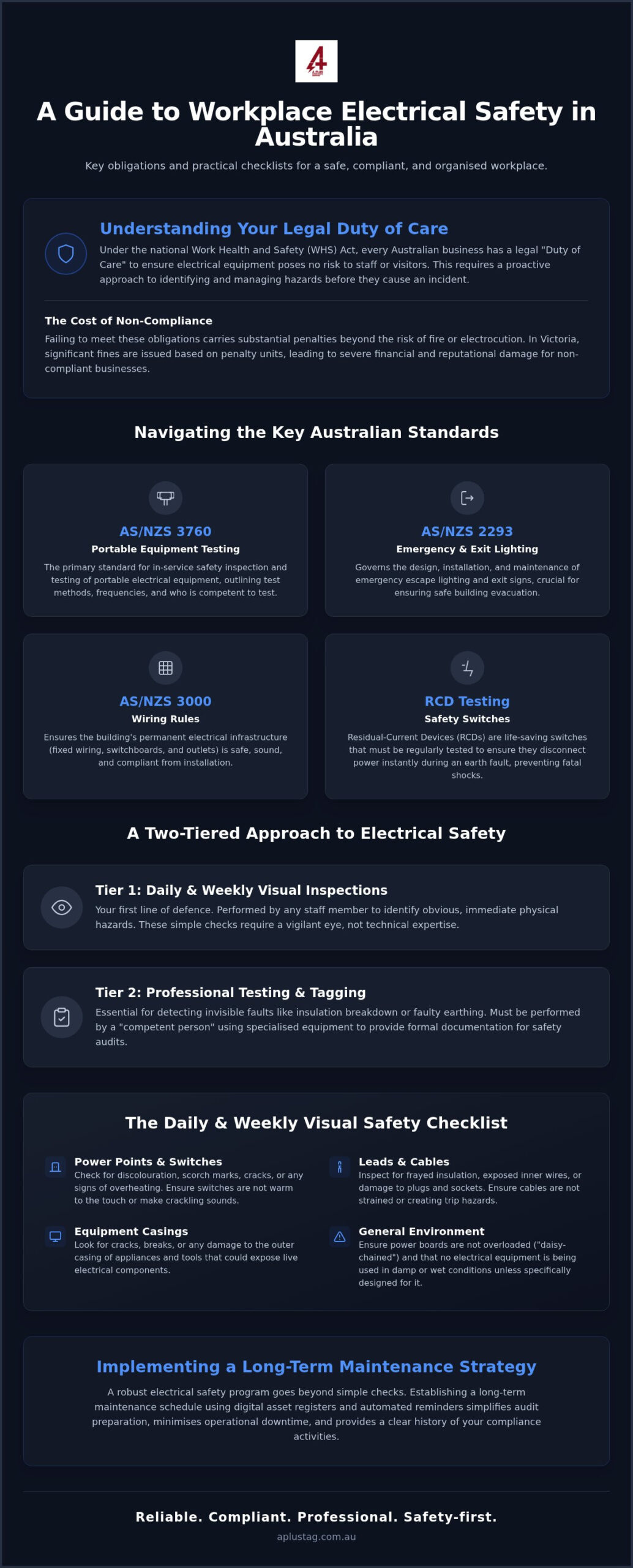
The Work Health and Safety (WHS) Act serves as the national foundation for workplace protection. Under this legislation, every Australian business owner holds a “Duty of Care” to ensure that electrical equipment doesn’t pose a risk to staff or visitors. This responsibility requires a proactive approach to hazard identification. Implementing a consistent workplace electrical safety checklist australia ensures that risks are managed before they escalate into incidents.
A preventative maintenance schedule acts as your primary line of defence. It demonstrates due diligence to regulators and provides a structured way to monitor the health of your assets. Failing to meet these obligations carries heavy costs. Beyond the devastating risk of electrocution or fire, Victorian businesses face substantial legal penalties. With the penalty unit value set at $209.10 for the 2026-2027 financial year, non-compliance can lead to significant financial strain and reputational damage.
To better understand the gravity of workplace electrical hazards, watch this helpful video:
The Difference Between Visual Checks and Professional Testing
Daily visual inspections are vital for spotting immediate hazards like frayed cords or cracked casings. However, many electrical faults are invisible to the naked eye. Internal insulation breakdowns or faulty earthing can only be detected through specialised equipment. While your team can perform basic visual sweeps, professional testing provides the formal documentation required during a safety audit. A “competent person” as defined by the latest standards must have the knowledge and tools to verify that an appliance is truly safe. Our specialised compliance services help bridge this gap by providing accurate reporting and asset registers.
Key Australian Standards to Recognise
Staying compliant involves adhering to several specific benchmarks. AS/NZS 3760:2022 is the primary standard for the in-service safety inspection and testing of electrical equipment. It outlines who can test, how to test, and how often. For buildings with public access or multiple levels, AS/NZS 2293 is equally critical, as it governs the maintenance of emergency escape lighting and exit signs. Following a workplace electrical safety checklist australia helps ensure these standards are applied consistently across all equipment types.
Fixed installations fall under AS/NZS 3000, commonly known as the Wiring Rules. This standard ensures that the building’s permanent electrical infrastructure is sound. A comprehensive safety program also includes testing for a Residual-current device (RCD). These safety switches are designed to disconnect power instantly if a leak to earth is detected, preventing fatal shocks. Balancing these various standards requires a methodical approach to ensure no piece of equipment is overlooked.
The Daily and Weekly Visual Safety Checklist
Routine visual inspections are the most effective way to identify immediate hazards before they cause an accident. While professional testing is essential for uncovering hidden faults, a daily workplace electrical safety checklist australia staff can follow ensures that obvious risks, like a frayed cord or a burnt-out socket, are addressed instantly. These checks don’t require technical expertise; they simply require a vigilant eye and a consistent habit.
Start with your power points and switches. Look for any signs of discolouration, such as brown or black scorch marks, which indicate overheating or internal arcing. If a switch feels warm to the touch or makes a faint crackling sound when turned on, it must be decommissioned immediately. According to guidance from Safe Work Australia, identifying these early warning signs is a critical component of managing risk in the workplace.
Lead and Cable Management
Flexible leads represent a common point of failure in any electrical system due to constant movement and the potential for mechanical damage. Use these points as part of your weekly review:
- Check for damage: Inspect the entire length of the cord for fraying, deep kinks, or exposed internal wiring.
- Avoid ‘piggy-backing’: Ensure power boards aren’t overloaded and double adapters aren’t stacked, as this creates a significant fire risk.
- Proper storage: Never wrap cables tightly around equipment; instead, coil them loosely to prevent internal core damage.
Trip hazards are another major concern. Leads should be routed away from walkways or secured with specialised covers to prevent both falls and damage to the cable’s insulation. Maintaining a consistent workplace electrical safety checklist australia helps you stay proactive between professional testing intervals.
Environmental Hazard Identification
The area surrounding electrical equipment is just as important as the equipment itself. Moisture is a primary conductor of electricity, so ensuring that appliances are never used in damp or wet environments is vital. If you work in a high-risk area like a commercial kitchen or a workshop, check that liquids are stored far from workstations and that RCDs are functioning correctly.
Heavy machinery requires adequate ventilation to prevent overheating. Clear away any dust, debris, or stacked materials that might block airflow around motors or cooling fans. Finally, maintain clear access to all switchboards and emergency shut-off buttons. In the event of a fault, every second counts. If you’re unsure how to integrate these checks into your operations, you can discuss a compliance schedule with our team to keep your facility organised and safe.
Professional Testing and Tagging: AS/NZS 3760 Requirements
While visual checks are your daily line of defence, professional verification is what confirms an appliance is electrically sound. AS/NZS 3760:2022 sets the benchmark for this process, covering everything from power tools to kitchen appliances. A robust Professional Test and Tag Services program ensures that equipment is tested for earth continuity, insulation resistance, and correct polarity. These technical tests identify faults that can’t be seen, such as internal insulation failure that could lead to a live casing.
Following a Managing electrical risks in the workplace approach involves more than just a pass/fail result. It’s about maintaining a systematic record. This is a core part of any workplace electrical safety checklist australia businesses use to prove compliance during an audit. By integrating these professional checks into your routine, you move from a reactive state to one of organised control.
The Testing Cycle and Frequency
The frequency of testing depends on the environment where the equipment is used. Hostile environments, such as construction sites or workshops where equipment is exposed to moisture, heat, or mechanical damage, require more frequent 3-month or 6-month checks. General office environments usually follow a 12-month cycle for equipment that is frequently moved. New equipment doesn’t always need a full test immediately, but it must be visually inspected and tagged before its first use. Second-hand items require a full safety test before being introduced to your workplace to ensure they meet Australian standards.
What Happens During a Failure?
Safety is the priority when an item fails a test. Any equipment that doesn’t meet the required standards must be immediately withdrawn from service and fitted with a “Danger” or “Failed” tag. This prevents accidental use while a decision is made on the next steps. Every failure is recorded in the asset register to track the history of the equipment and identify recurring issues. Depending on the fault, the item may follow a path to specialised repair or be decommissioned and replaced. This structured response ensures that your workplace electrical safety checklist australia remains effective in preventing accidents rather than just documenting them.
Beyond the Plug: RCDs, Emergency Lighting, and Switchboards
Electrical safety involves more than just the items plugged into the wall. Your building’s core infrastructure, including the switchboard and safety switches, requires regular verification to prevent catastrophic failures. A comprehensive RCD Testing Guide highlights how these devices act as a life-saving circuit breaker by detecting earth leakage. When integrated into a workplace electrical safety checklist australia businesses can ensure these components trip within milliseconds of a fault.
Thermal imaging is another specialised tool for switchboard maintenance. It allows technicians to identify hot spots caused by loose connections or overloaded circuits before they lead to a fire. This non-invasive check is an essential part of a safety-first approach, minimising operational disruption while providing deep insights into the health of your electrical system. Using this technology helps you move from reactive repairs to a structured, preventative maintenance cycle that protects both your staff and your property assets.
RCD Functionality and Push-Button Tests
Staff should perform basic push-button tests monthly to ensure the mechanical trip mechanism is working. However, this doesn’t replace the need for professional timing tests. A professional test measures the exact trip time in milliseconds, ensuring the device meets Australian Standards. These tests are especially critical for circuits supplying portable power tools, where the risk of cable damage is high. By keeping these records in your asset register, you maintain a clear history of compliance for every circuit in your facility. It’s a simple step that provides a high level of protection against electric shock and keeps your records audit-ready.
Emergency Exit Path Readiness
During a power failure or fire, clear exit paths are essential for a safe evacuation. According to Emergency Lighting Standards, all illuminated exit signs must be visible, undamaged, and correctly positioned. A mandatory 90-minute discharge test must be conducted every six months to verify that batteries can sustain the lights during an emergency. This testing cycle is a legal requirement under AS/NZS 2293.2 and ensures that your safety systems won’t fail when they’re needed most.
Coordinating these checks with your regular electrical maintenance and fire equipment inspections, such as fire blanket and extinguisher checks, simplifies your compliance schedule. It reduces the number of site visits and ensures your documentation is always consistent. Including these infrastructure checks in your workplace electrical safety checklist australia ensures that your facility remains prepared for any situation without an unnecessary administrative burden. This holistic approach to safety management reduces risk and demonstrates a high level of professional care.
Implementing a Long-Term Electrical Maintenance Schedule
A robust workplace electrical safety checklist australia businesses rely on is only as effective as the data management system behind it. Moving beyond paper logs to a digital asset register allows for a more transparent and systematic approach to compliance. This digital transition ensures that every piece of equipment, from a simple office kettle to complex industrial machinery, is tracked throughout its lifecycle. By centralising this data, you eliminate the risk of missing a testing date due to administrative oversight.
Setting up automated due-date reminders is a critical step for maintaining an uninterrupted safety cycle. These systems provide early notification for upcoming RCD tests, tag renewals, and emergency light discharges. For larger organisations, the benefits of multi-site compliance management are significant. It allows operations managers to oversee safety standards across several locations from a single dashboard. To learn more about these tools, explore our Compliance Monitoring Systems that help Victorian businesses stay organised.
Record Keeping and Audit Readiness
A compliant asset register must be detailed and precise. It should include a unique identification number for each item, its location, the date of the last test, the results, and the name of the person who performed the assessment. Accuracy is paramount here. WHS inspectors and insurance providers often require these records to be produced on short notice during an audit or following an incident. While general guidance suggests retaining records for seven years, keeping them for the life of the equipment is a safer practice. This level of documentation proves you have met your legal duty of care and provides a clear history of your safety performance.
Choosing a Compliance Partner
The transition from reactive repairs to a structured preventative model requires a dependable partner. An experienced compliance ally acts as a proactive extension of your team rather than a distant contractor. They manage the recurring schedule for you, ensuring that testing is carried out with minimal disruption to your daily site operations. This partnership focuses on professional, punctual, and safety-first service delivery. By integrating a digital workplace electrical safety checklist australia managers can access at any time, you gain peace of mind and long-term order. This methodical approach ensures your facility remains a safe and well-regulated environment for everyone.
Securing Your Workplace with Systematic Compliance
Maintaining a safe environment requires a blend of daily vigilance and professional rigour. By following a structured workplace electrical safety checklist australia businesses can identify immediate hazards like damaged leads while ensuring long-term adherence to AS/NZS 3760 and AS/NZS 2293. This systematic approach transforms compliance from a source of stress into a streamlined, predictable part of your facility operations. It ensures that every asset is accounted for and every risk is mitigated before it can escalate.
A Plus Compliance Services acts as your dependable partner, providing more than just a one-off assessment. Our approach prioritises high-quality documentation through Professional Asset Registers and the reliability of Automated Due-Date Reminders. With our Nationwide Compliance Support, we ensure your facility remains audit-ready and safe, regardless of your industry or location. We focus on minimising disruption while maximising protection for your team, allowing you to focus on running your business with confidence and peace of mind.
We’re here to help you build a safer, more compliant workplace for the long term. Our team is ready to support your safety journey with professional expertise and reliable service.
Frequently Asked Questions
What is the legal requirement for test and tag in Australia?
Under the Work Health and Safety (WHS) Act, employers must ensure that electrical equipment is safe for use. Test and tag is the primary method for demonstrating compliance in hostile environments and serves as a recommended risk management strategy for all other workplaces. Using a workplace electrical safety checklist australia helps businesses meet their duty of care. Specific requirements vary by state, so obtaining professional guidance for your site is always recommended.
How often should RCD testing be performed in a commercial office?
RCD testing frequencies depend on the specific environment and the type of equipment being used. In a standard commercial office, a push-button test is generally conducted every six months by the equipment user. Professional operating time tests, which measure the trip speed in milliseconds, are typically required every 12 months or two years depending on your risk assessment. Always check your specific site requirements against Australian Standards to ensure full compliance.
Can I perform my own electrical safety visual inspections?
Yes, any staff member can perform basic visual inspections as part of a daily safety routine. These checks involve looking for obvious damage like frayed cords or scorched sockets. However, these inspections do not replace the need for professional testing by a competent person. Technical verification requires specialised equipment to detect internal faults that are invisible to the eye, ensuring your workplace remains truly safe for all staff and visitors.
What happens if an item fails its electrical safety test?
Any item that fails its safety test must be immediately withdrawn from service and fitted with a “Danger” or “Out of Service” tag. This prevents accidental use while the equipment is being assessed for repair or disposal. The failure must be documented in your professional asset register to maintain an accurate compliance history. Only a qualified person should decide if the item can be safely repaired or if it must be replaced.
Do new electrical items need to be tested and tagged before use?
New equipment does not strictly require a technical test before its first use, but it must be visually inspected for damage and fitted with a specialised tag. This tag should indicate the date the item was placed into service and when the first professional test is due. Once that date arrives, the item enters the regular testing and tagging cycle alongside your existing electrical assets to maintain a high standard of safety.
How long must I keep records of workplace electrical testing?
You should keep electrical testing records for at least seven years to meet standard compliance and insurance requirements. Many organisations choose to maintain these records for the entire life of the equipment to ensure a complete history. Keeping a detailed digital asset register ensures that your history is easily accessible for WHS inspectors. This documentation is vital for proving you have met your national safety obligations during a formal audit.
Is emergency lighting testing mandatory for small businesses?
Yes, emergency lighting and exit sign testing is mandatory for all Australian businesses regardless of size if the building requires these systems for safe evacuation. AS/NZS 2293.2 specifies that these systems must undergo a 90-minute discharge test every six months. This ensures that lights will function correctly during a power failure. Small businesses must maintain these records to comply with fire safety regulations and national building codes.
What is the difference between AS/NZS 3760 and AS/NZS 3000?
AS/NZS 3760 governs the in-service safety inspection and testing of portable electrical equipment, such as laptops and power tools. In contrast, AS/NZS 3000, known as the Wiring Rules, sets the standards for the design and installation of fixed electrical wiring within a building. Both standards are essential for a complete workplace electrical safety checklist australia, as they address different parts of your facility infrastructure to ensure a safe and compliant working environment.
