
Biomedical Equipment Testing Requirements Australia: The Complete Compliance Guide
Could mistaking a medical device for a standard office appliance put your entire facility at risk? In the high-pressure environment of Australian healthcare, the line between routine maintenance and strict clinical compliance often feels blurred. It’s understandable to feel uneasy about the biomedical equipment testing requirements australia demands, particularly when a single missed deadline or an incorrectly applied standard could lead to failed accreditation audits or, more importantly, compromised patient safety.
You deserve a compliance partner that replaces uncertainty with a systematic, professional framework. We promise to help you navigate these complex standards and ensure your facility meets its clinical safety obligations with ease. This guide provides a clear roadmap for managing your diverse medical devices, explaining the vital distinction between AS/NZS 3760 and AS/NZS 3551. We’ll also examine the role of AS/NZS 3003 for patient areas and show you how to maintain the precise documentation needed to remain audit-ready at all times.
Key Takeaways
- Understand the fundamental role of specialised verification in protecting patients and operators from electrical and functional device failures.
- Learn how to navigate biomedical equipment testing requirements australia by aligning TGA regulations with the AS/NZS 3551 maintenance framework.
- Distinguish between individual device testing and AS/NZS 3003 patient area testing to ensure the entire clinical environment remains safe.
- Gain insight into the professional testing process, including physical inspections and critical measurements of insulation resistance and earth leakage.
- Implement a proactive compliance strategy using detailed asset registers to simplify recurring maintenance cycles and audit preparation.
What is Biomedical Equipment Testing and Why is it Essential?
Biomedical equipment testing is the specialised process of inspecting, testing, and verifying medical electrical devices to ensure they function exactly as the manufacturer intended. This process goes beyond basic safety to validate the clinical performance of the device itself. Meeting the biomedical equipment testing requirements australia mandates is not just a technical box-ticking exercise; it’s a fundamental safety protocol designed to protect both patients and healthcare operators from electrical shocks, burns, or functional failures during critical procedures.
Every healthcare provider has a legal “Duty of Care” under Australian Workplace Health and Safety (WHS) laws to provide a safe environment. This responsibility is overseen by various bodies, including the Therapeutic Goods Administration (TGA), which regulates the supply of these devices. Once a device is in use, however, the onus falls on the facility manager to maintain its integrity. Specialised biomedical testing is required over standard tagging in clinical settings because it confirms that a device will perform its intended medical function accurately rather than just confirming the absence of a fire hazard.
AS/NZS 3551 vs. AS/NZS 3760: Understanding the Difference
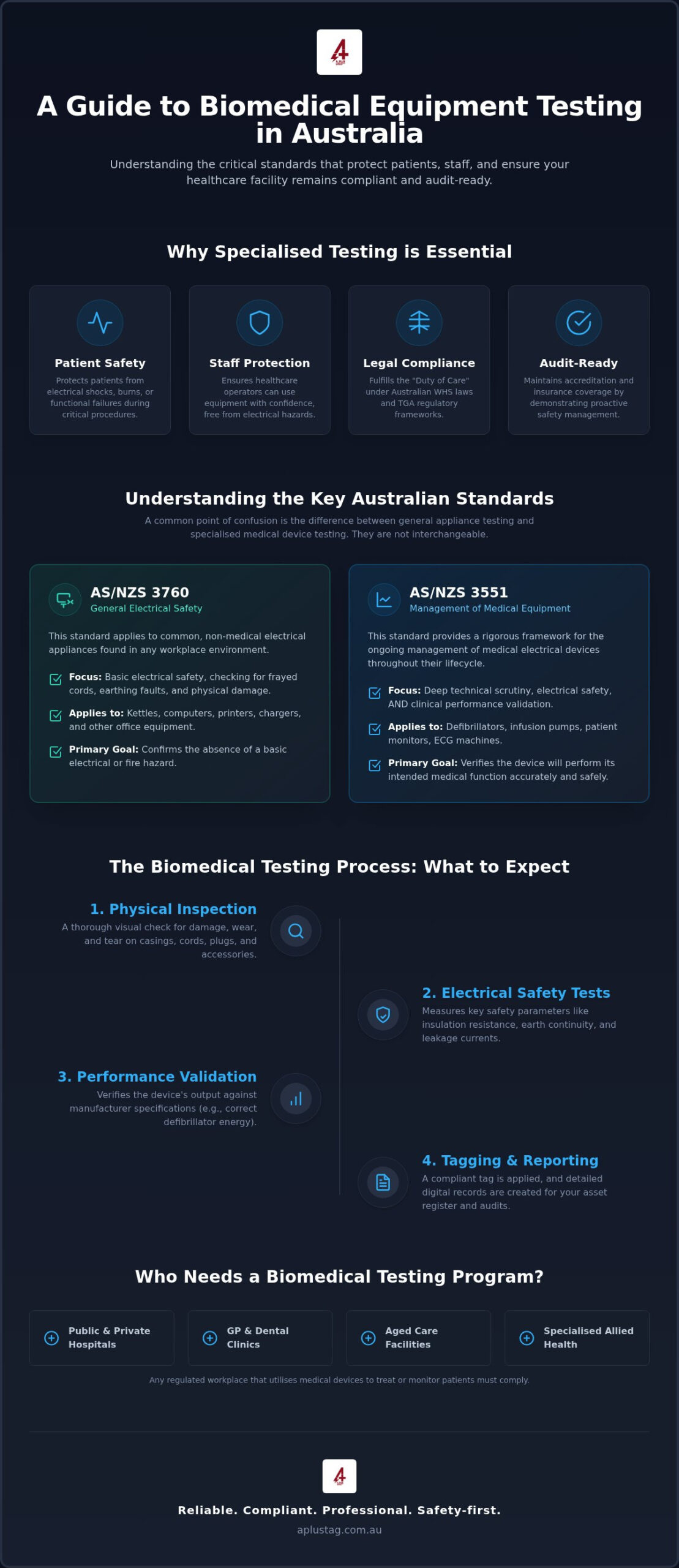
A common point of confusion for many facility managers is the difference between general electrical testing and medical-grade standards. AS/NZS 3760 is the standard for common office items like kettles, printers, or laptops. It focuses primarily on basic electrical safety. In contrast, AS/NZS 3551 is the dedicated Australian standard for the “Management programs for medical equipment.” It requires a deeper level of technical scrutiny. While AS/NZS 3760 looks for frayed cords or earthing issues, AS/NZS 3551 involves performance validation, ensuring that a defibrillator delivers the correct joules or an infusion pump provides the exact dosage required.
Who Needs to Comply with These Requirements?
Compliance isn’t optional for any regulated workplace that utilises medical devices to treat or monitor patients. This includes a wide range of facilities:
- General Practice (GP) and dental clinics.
- Public and private hospitals.
- Aged care facilities and day surgeries.
- Physiotherapy and specialised allied health centres.
Adhering to biomedical equipment testing requirements australia is often a prerequisite for professional accreditation and insurance coverage. By implementing a proactive biomedical testing program, you ensure your facility remains compliant, safe, and ready for any external audit.
Navigating Australian Standards: AS/NZS 3551 and the TGA
The Therapeutic Goods Administration (TGA) manages the pre-market entry of medical devices into the Australian market. However, the TGA doesn’t dictate how you maintain that equipment once it’s in your clinic. That’s where AS/NZS 3551:2012 steps in. This standard creates a rigorous framework for the ongoing management of medical technology. It ensures that the safety and performance levels established by the manufacturer are preserved throughout the device’s operational life. Understanding these biomedical equipment testing requirements australia relies upon is the first step toward creating a robust compliance monitoring strategy. It’s also worth noting that this standard is currently pending revision, so staying informed is vital for long-term order.
A critical part of this landscape involves the TGA’s “Essential Principles.” These are the legal requirements regarding the safety and performance characteristics of medical devices. While manufacturers must satisfy these principles to list a device on the Australian Register of Therapeutic Goods (ARTG), the facility manager must ensure these principles aren’t compromised by wear and tear. If you’re unsure where your current program stands, you can always speak with a compliance specialist to clarify your obligations.
The Role of the “Responsible Organisation”
Under AS/NZS 3551, the facility owner or manager is officially designated as the “Responsible Organisation.” This title carries specific legal weight. You are tasked with maintaining an accurate medical equipment management programme that spans the entire lifecycle of every device. This isn’t just about annual testing. It begins with procurement and acceptance testing, ensuring every new piece of kit meets safety standards before its first clinical use. From there, you must manage scheduled maintenance and eventually oversee safe disposal.
Accreditation and Regulatory Audits
For many clinics, the primary driver for compliance is the fear of failing an audit. Regular testing supports your standing with bodies like the RACGP or meeting NSQHS standards. Professional documentation serves as your only verifiable proof of compliance during these assessments. Because biomedical devices have complex internal electronics, verifying their safety requires specialised expertise. A standard electrician lacks the calibrated tools and specific training needed to meet the biomedical equipment testing requirements australia expects from modern healthcare providers.
Clinical Area Classifications: AS/NZS 3003 Patient Area Testing
The physical environment where clinical care occurs is just as critical as the devices themselves. While earlier sections focused on the individual units, the biomedical equipment testing requirements australia mandates also encompass the electrical installations within patient areas. AS/NZS 3003:2018 is the specific standard that governs these spaces. It ensures that the power supply and earthing systems are robust enough to support medical electrical equipment without posing a risk to the occupant. If the room’s wiring is faulty, even a perfectly maintained medical device could become a hazard.
Regular verification of these areas is essential to prevent micro-shocks. A micro-shock occurs when a tiny amount of electrical current, often too small to be felt by a healthy person, passes through a patient’s body. For patients with indwelling catheters or those undergoing surgery, these small currents can lead to cardiac arrest. Adhering to the biomedical equipment testing requirements australia demands for these clinical spaces requires specialised testing equipment, such as low-resistance ohmmeters and RCD testers. This level of precision is necessary because standard household electrical testers aren’t sensitive enough to detect the minute leakage currents that can threaten a vulnerable patient.
Body-Protected vs. Cardiac-Protected Electrical Areas
Clinical spaces are classified based on the level of risk associated with the procedures performed there. Body-Protected (BP) areas are standard in most GP clinics, dental surgeries, and general hospital wards. In these zones, patients may be connected to medical devices like blood pressure monitors or ECGs, but the procedures don’t involve direct access to the heart. The focus here is on ensuring that Residual Current Devices (RCDs) and earthing systems function correctly to prevent macro-shocks.
Cardiac-Protected (CP) areas, such as intensive care units (ICUs) and catheterisation labs, require a much higher level of electrical safety. Because patients in these zones often have direct electrical pathways to the heart, the tolerance for leakage current is significantly lower. These areas feature enhanced equipotential earthing systems and specific RCD configurations that must be tested with extreme precision to ensure total patient safety.
Testing Intervals for Patient Areas
The frequency of testing for AS/NZS 3003 compliance depends entirely on the classification of the area. For example, a Cardiac-Protected zone requires more frequent scrutiny than a standard Body-Protected consultation room. While you can refer to our national workplace compliance guide for a general understanding of testing intervals, clinical environments have their own specific set of rules. A professional site assessment remains the most reliable way to establish a recurring schedule that keeps your facility compliant and your patients secure.
The Biomedical Testing Process: What to Expect
A systematic approach is the only way to ensure full adherence to biomedical equipment testing requirements australia. This methodical process moves through several distinct phases to verify that every device is both electrically sound and clinically accurate. Our technicians follow a structured sequence to provide a transparent and reliable result for every asset in your facility. By breaking the process into logical stages, we maintain a high level of accuracy while minimising disruption to your clinical workflow.
- Physical Inspection: This initial phase involves checking for external damage, such as cracks in the casing, loose cord grips, or worn cables. We also verify the integrity of all accessories and leads.
- Electrical Safety Testing: We measure insulation resistance and earth leakage currents using calibrated equipment. This step confirms the device won’t pose a shock hazard to patients or staff.
- Performance Verification: We confirm the device performs its intended clinical function without error.
- Calibration Check: We verify that output parameters, such as energy levels for a defibrillator or flow rates for an infusion pump, are within the manufacturer’s specified limits.
- Compliance Reporting: We provide a comprehensive asset register and detailed testing results, ensuring you’re audit-ready.
Performance and Parameter Testing
A device might be electrically “safe” in that it won’t cause a fire or a short circuit, but it could still be clinically “unsafe” if it provides incorrect data. For example, an ECG monitor that displays an inaccurate heart rate due to poor calibration puts patients at significant risk. To prevent this, we use specialised simulators, such as ECG or defibrillator testers, to mimic clinical conditions and verify accuracy. Professional calibration is non-negotiable for patient safety because it ensures the equipment delivers the precise care intended by the clinician.
Managing Failed Equipment
When a piece of equipment doesn’t meet the required standards, it must be addressed immediately to maintain a safe environment. We follow a strict process for identifying and tagging failed items, ensuring they’re clearly marked and removed from service to prevent accidental use. Every failure is meticulously recorded in your master asset register. This documentation helps you track equipment reliability and identify patterns of wear across your facility. If a device fails, A Plus Compliance Services acts as your dependable partner by helping you organise the necessary repair or replacement to minimise clinical downtime.
Implementing a Long-Term Biomedical Compliance Strategy
Adopting a proactive compliance strategy is the most effective way to manage the inherent risks of medical technology. While a reactive approach waits for a device to fail before taking action, a proactive program identifies potential issues before they compromise patient care. Adhering to biomedical equipment testing requirements australia involves more than just a yearly visit from a technician; it requires a systematic commitment to safety that scales with your facility. This forward-thinking mindset reduces the stress of last-minute audit preparations and ensures your clinical team can work with total confidence in their tools.
A master asset register acts as the central nervous system of your facility management. It provides a transparent, live record of every medical device, its testing history, and its current compliance status. For large-scale or multi-site organisations, this level of organisation is essential. When combined with automated due-date reminders, the risk of a compliance lapse is virtually eliminated. These systems provide a structured safety net, ensuring no piece of equipment, from a standard thermometer to a complex life-support system, ever falls through the cracks.
Streamlining Multi-Service Testing
Managing multiple contractors for different safety requirements can be a logistical headache. We recommend streamlining your obligations by combining biomedical testing with other essential services like RCD testing and fire safety inspections, including ensuring your smoke alarm testing for workplaces meets current Australian Standards. Using a single provider for these diverse needs simplifies your reporting and provides a single point of contact for all compliance matters. This “minimal disruption” approach is particularly valuable in active clinical environments. By coordinating testing cycles, you minimise the time technicians spend on-site and reduce the impact on patient appointments and staff workflows. A comprehensive workplace safety programme should also account for emergency preparedness, including ensuring your workplace first aid kit requirements victoria regulations are met alongside your biomedical and electrical compliance obligations.
Selecting a Professional Compliance Partner
The technical complexity of modern medical devices means that not all testing providers are equal. When selecting a partner, prioritise those with a deep, verified understanding of both AS/NZS 3551 and AS/NZS 3003. A cheap-price option often lacks the sophisticated simulators and detailed reporting necessary to satisfy a rigorous accreditation audit. Look for a partner that values clear communication and provides organised, easy-to-read documentation that serves as a permanent record of your safety commitment. We encourage facility managers to book a site assessment to establish a recurring, dependable schedule that keeps your organisation compliant year-round.
Securing Your Clinical Environment for the Long Term
Maintaining a safe and compliant facility shouldn’t be a source of constant uncertainty. By mastering the biomedical equipment testing requirements australia expects, you transition from reactive fixes to a state of organised control. We’ve discussed how specialised testing for AS/NZS 3551 and AS/NZS 3003 standards ensures your medical devices and patient areas are both electrically safe and clinically precise.
Our methodology is built on being reliable, compliant, and professional, always putting a safety-first approach at the centre of our service. We simplify your long-term management through comprehensive asset registers and automated due-date reminders, ensuring you’re always prepared for accreditation audits without the last-minute rush.
This systematic framework allows your clinical team to focus on what matters most: delivering exceptional patient care in a secure, well-regulated environment.
Frequently Asked Questions
Is biomedical equipment testing a legal requirement in Australia?
Yes, testing is a requirement under Workplace Health and Safety (WHS) laws and specific clinical standards. Facility managers have a legal “Duty of Care” to provide a safe environment for both staff and patients. Adhering to the biomedical equipment testing requirements australia mandates is essential for maintaining clinical safety and meeting the professional accreditation standards set by bodies like the RACGP or NSQHS.
How often does biomedical equipment need to be tested under AS/NZS 3551?
Testing intervals are primarily determined by the manufacturer’s servicing requirements and a risk assessment of the device. While many medical devices require annual verification, some high-risk equipment may need more frequent scrutiny. AS/NZS 3551:2012 provides the framework for these management programs. It is vital to maintain a master asset register that tracks these specific cycles to prevent any compliance lapses in your facility.
What is the difference between AS/NZS 3760 and AS/NZS 3551?
AS/NZS 3760 is the general standard for office equipment like laptops and kettles, focusing on basic electrical safety. In contrast, AS/NZS 3551 is the specialised standard for medical electrical equipment. It requires deeper performance validation and calibration checks to ensure the device is clinically accurate. You cannot use a standard test and tag approach for clinical devices that monitor or treat patients.
Does a new medical device need to be tested before its first use?
Yes, AS/NZS 3551 requires “acceptance testing” for all new medical devices before they enter clinical service. This process verifies that the equipment arrived in good condition and meets all safety and performance specifications. Even if a device is straight from the manufacturer, you must document this initial check to establish a baseline for its future maintenance and long-term compliance history.
What is Patient Area Testing (AS/NZS 3003) and do I need it?
Patient Area Testing under AS/NZS 3003:2018 focuses on the electrical installations of the room, such as Body-Protected or Cardiac-Protected areas. You need this if you operate a clinical space where medical electrical equipment is used on patients. It ensures that the earthing and RCD configurations are sensitive enough to prevent micro-shocks, which standard electrical wiring is not designed to handle safely.
Who is qualified to perform biomedical equipment safety testing?
Testing must be performed by a “competent person” with specific training and calibrated equipment for biomedical standards. A standard electrician often lacks the specialised simulators needed to verify clinical performance accurately. Professional providers who specialise in biomedical equipment testing requirements australia bring the technical proficiency required to validate both the electrical safety and the functional accuracy of complex medical technology.
What documentation do I need for a medical accreditation audit?
You need a comprehensive asset register and detailed testing reports for every medical device and patient area. These records must include the date of testing, the specific results of safety and performance checks, and the date the next service is due. Clear, organised documentation is your only verifiable proof of compliance during a RACGP or NSQHS audit, demonstrating a proactive and methodical management program.
What happens if a piece of medical equipment fails its safety test?
Failed equipment must be immediately identified, tagged, and removed from clinical service to prevent accidental use. The failure should be recorded in your asset register to track the device’s reliability over time. Your compliance partner will then help you organise the necessary repair or replacement. This process ensures that only fully verified and safe devices remain available for patient care in your facility.
