Test and Tag Frequency Victoria: 2026 Workplace Compliance Guide
With corporate fines for electrical safety offences in Victoria now reaching up to $244,212, a “set and forget” approach to equipment maintenance is no longer a viable business strategy. Most facility managers find it challenging to track which items require attention every three months versus every five years, particularly when overseeing multiple sites with overlapping due dates. It’s a logistical hurdle that can leave your organisation vulnerable if a WorkSafe inspector arrives or an insurance claim is filed.
We understand that the complexity surrounding test and tag frequency Victoria often leads to unnecessary stress during a safety audit or internal review. This 2026 compliance guide provides a clear, reliable testing schedule to help you meet AS/NZS 3760:2022 and Victorian safety regulations with complete confidence. You’ll learn how to categorise your equipment accurately, maintain an audit-ready asset register, and implement a systematic maintenance cycle that prioritises safety while minimising disruption to your daily operations.
Key Takeaways
- Learn how the Victorian OHS Act 2004 and AS/NZS 3760:2022 define your legal obligations for maintaining electrical safety in the workplace.
- Understand how to determine the correct test and tag frequency victoria requires based on your specific environment, from high-risk workshops to low-risk office spaces.
- Identify standard testing intervals for your sector, including the mandatory three-month requirements for construction and demolition sites under AS/NZS 3012.
- Discover why a digital asset register is essential for tracking compliance and ensuring that failed items are accurately recorded and removed from service.
- Explore how a professional compliance partnership can simplify your safety requirements through automated reminders and specialised reporting.
Understanding Electrical Safety Regulations and Frequency in Victoria
In Victoria, maintaining a safe workplace is a legal requirement under the Occupational Health and Safety Act 2004 (Vic). Employers have a primary duty of care to provide and maintain a work environment that is safe and without risks to health. A critical part of meeting this obligation involves managing the test and tag frequency victoria businesses must adhere to for their electrical equipment. Essentially, this frequency refers to the predetermined period between safety inspections as outlined in the Australian Standard AS/NZS 3760. This process, often referred to globally as Portable Appliance Testing (Test and Tag), involves a visual inspection and electrical testing to identify potential faults before they cause injury.
While AS/NZS 3760 is a national standard, Victorian workplaces are specifically overseen by WorkSafe Victoria. WorkSafe uses the Standard as the benchmark to determine if an employer is fulfilling their duty of care. It’s vital to realise that testing intervals aren’t a one-size-fits-all requirement. Instead, the frequency of testing depends entirely on the type of equipment and the environment where it’s used. A laptop in a quiet office requires far less frequent checking than a power tool used daily on a busy workshop floor.
The Role of AS/NZS 3760:2022 in Victorian Workplaces
The 2022 update to AS/NZS 3760 refined testing requirements to better reflect modern workplace equipment and safety switches (RCDs). Following this Standard provides a “safe harbour” for Victorian organisations. By adhering to the recommended cycles, you demonstrate a proactive approach to safety that aligns with state-based codes of practice. This systematic management ensures that no piece of equipment is overlooked, reducing the risk of electrical incidents and providing a clear defence during a WorkSafe audit.
Who is a Competent Person Under Victorian Law?
Victorian regulations state that testing must be performed by a “Competent Person.” This is defined as someone who has acquired through training, qualification, or experience the knowledge and skills required to carry out the task safely. While some businesses consider training staff in-house, most choose professional test and tag services to ensure total accuracy. Professional technicians possess the specialised knowledge needed to interpret complex frequency tables correctly and identify subtle signs of wear that an untrained eye might miss. Partnering with an expert ensuring your asset register remains accurate and your workplace stays compliant without diverting your staff from their core roles.
How to Determine Your Specific Test and Tag Intervals
Determining the correct test and tag frequency victoria requires a careful assessment of the specific environment where your equipment operates. The Australian Standard AS/NZS 3760:2022 uses the “Environment Factor” as the primary yardstick for scheduling. It’s a risk-based approach that ensures high-risk equipment is checked more often than items in stable, protected settings. According to the WorkSafe Victoria electrical safety guidelines, employers must proactively manage these risks to prevent workplace injuries.
A critical rule for facility managers to remember is that the most hostile environment in a facility dictates the frequency for that specific area. If you have a partitioned office located within a large manufacturing warehouse, the vibration and dust from the warehouse floor may influence the testing requirements for the office equipment. This prevents confusion and ensures a uniform safety standard across a single operational zone. Accurate classification is the first step toward a stress-free compliance program.
Hostile vs. Non-Hostile Environments Explained
A hostile environment is any area where the electrical equipment is subject to conditions that could cause damage or reduce its lifespan. These conditions include exposure to moisture, heat, dust, corrosive chemicals, or physical vibration. While many people think of construction sites first, a commercial kitchen is often classified as a hostile environment due to the presence of steam, heat, and the constant movement of appliances. In these settings, the risk of a cord fraying or a seal failing is significantly higher.
Conversely, non-hostile environments are clean, dry areas where equipment and cords remain stationary. Modern office centres are the most common example. In these rooms, cords are rarely moved or unplugged, meaning the physical wear and tear is minimal. However, even in a non-hostile setting, certain items like shared kitchen kettles or vacuum cleaners may still require more frequent attention due to their high usage rates.
The Impact of Equipment Mobility on Frequency
Equipment mobility is the second major factor in your compliance schedule. Handheld tools and portable appliances are at a much higher risk of electrical failure than stationary equipment. Every time a cord is wrapped, pulled, or flexed, the internal copper strands undergo stress. Over time, this leads to internal breaks or insulation damage that isn’t always visible to the naked eye. Stationary items, such as a large photocopier or a staff refrigerator, carry a lower risk profile because their power leads remain undisturbed.
Professional compliance services play a vital role here by conducting a thorough site assessment to categorise every asset correctly. Because every workplace has unique layout challenges, you should request a site-specific assessment to ensure your testing intervals are both accurate and cost-effective. Relying on generic schedules can lead to over-testing in some areas while leaving critical risks unmanaged in others.
Standard Testing Intervals for Common Victorian Industries
Understanding the standard intervals for your industry is the most effective way to maintain a compliant workplace. In 2026, WorkSafe Victoria continues to use the recommendations in AS/NZS 3760 and AS/NZS 3012 as the primary evidence for safety management. The test and tag frequency victoria businesses follow is largely determined by the nature of the work performed on-site. While a one-off inspection offers a snapshot of safety, a scheduled recurring program is what provides long-term protection for your staff and assets.
A structured testing cycle ensures that every appliance is accounted for and that no due dates are missed across multiple departments. For most Victorian organisations, these cycles fall into predictable patterns based on the equipment’s exposure to wear and tear. Adhering to these industry benchmarks helps you stay organised and audit-ready throughout the year.
Construction and High-Risk Site Requirements
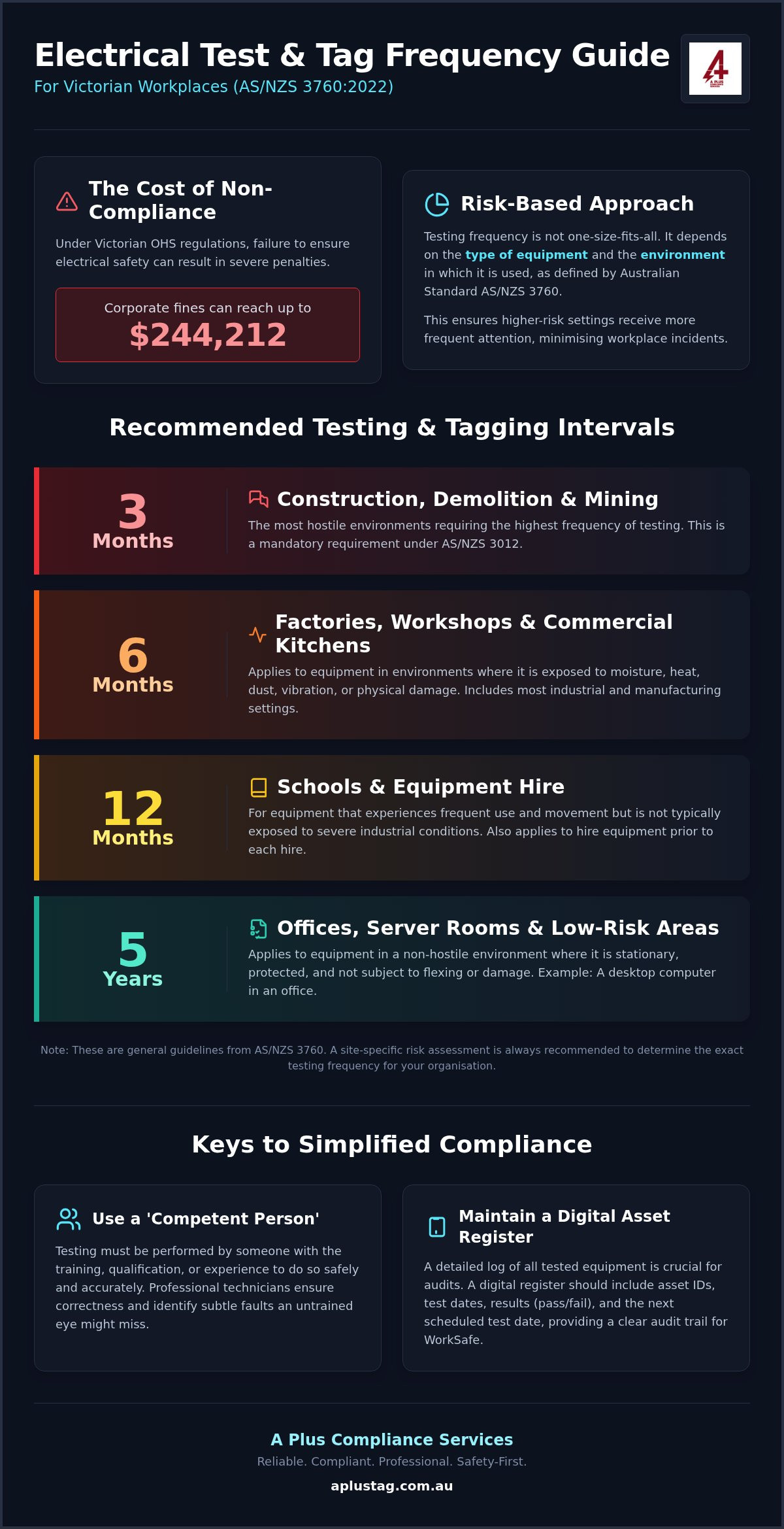
Construction and demolition sites operate under AS/NZS 3012, which mandates a strict three-month testing cycle. This high frequency accounts for the extreme physical stress placed on equipment in these environments. Victorian sites also utilise a quarterly colour-coding system for tags: Red (December to February), Green (March to May), Blue (June to August), and Yellow (September to November). This visual system allows site managers to verify compliance at a glance. Additionally, the 2022 update to the standards has refined RCD testing frequencies, requiring more frequent push-button and trip-time tests for portable safety switches used on-site to ensure they respond instantly in a fault condition.
Commercial, Healthcare, and Education Intervals
For factories, workshops, and production environments, a six-month interval is the standard. These areas are classified as hostile but typically involve less environmental volatility than a construction site. In contrast, commercial office spaces, schools, and retail environments generally require less frequent attention. Equipment with cords prone to flexing, such as vacuum cleaners, shared kitchen kettles, or portable heaters, requires testing every 12 months. Items in low-risk, protected environments, like server rooms or stationary desktop computers that are rarely moved, often move to a five-year cycle.
Clinical settings and aged care facilities require even more specialised attention. Compliance for biomedical devices is governed by AS/NZS 3551, which involves rigorous safety checks tailored specifically to patient-care environments. These intervals are strictly managed to ensure the reliability of life-supporting equipment and to meet the high standards of healthcare accreditation in Victoria. Healthcare facility managers seeking a comprehensive overview of their obligations should consult the full biomedical equipment testing requirements Australia mandates, which covers the critical distinctions between AS/NZS 3760, AS/NZS 3551, and AS/NZS 3003 for patient areas.
Managing Compliance Records and Asset Registers
Maintaining a physical tag on a power cord is only half of the compliance equation. To truly meet the requirements for test and tag frequency victoria, your organisation must maintain detailed, accessible records that prove your diligence over time. A digital asset register serves as the essential backbone of compliance monitoring, providing a transparent and chronological history of every safety check performed on your premises. This level of documentation is particularly critical for multi-site facility managers who need to oversee thousands of assets across different Victorian locations without losing track of individual due dates or site-specific requirements.
The Importance of Accurate Asset Tracking
Accurate asset tracking is your primary defence during a WorkSafe Victoria audit or when processing an insurance claim. The industry has moved away from manually updated paper logs, which are prone to human error and physical damage. Modern cloud-based compliance systems allow for seamless data management and instant retrieval of safety certificates. A professional compliance report must be thorough and easy to navigate. It should include:
- A unique identification number for every individual asset.
- The exact date of the last test and the specific pass/fail result.
- The name and credentials of the competent person who performed the check.
- The precisely calculated date for the next inspection based on the environment.
A Plus Compliance Services provides these structured reports for every job, ensuring you have a clear, audit-ready register that simplifies your long-term safety obligations. This systematic approach allows you to view the status of your entire organisation’s electrical safety through a single, organised lens. It’s a proactive way to manage risk rather than reacting to equipment failures as they happen.
Handling Failed Items and Repairs
When an item fails a safety test, the risk to your workforce is immediate and must be managed without delay. Victorian standards require that any failed equipment is clearly identified with a “Danger – Do Not Use” tag, recorded in the register, and removed from service instantly. This prevents accidental use by staff who may not be aware of a hidden internal electrical fault or a compromised insulation lead.
While the testing provider identifies the hazard, the business owner or manager is responsible for arranging the repair or disposal of the faulty equipment. Documenting these failures is just as important as recording passes. It creates a complete safety audit trail that demonstrates your organisation’s commitment to taking corrective action. Automated due-date reminders further support this process by alerting facility managers well in advance of expiring tags. This ensures your workforce remains protected and your operations continue with minimal disruption. A comprehensive workplace safety program also extends beyond electrical compliance; understanding your workplace first aid kit requirements Victoria mandates is equally essential for maintaining full audit readiness across all safety obligations.
Partnering for Long-Term Workplace Electrical Safety
Managing workplace safety isn’t a task that ends once the last tag is applied. It’s an ongoing commitment to the welfare of your staff and the continuity of your operations. A Plus Compliance Services positions itself as a professional partner rather than a simple contractor, focusing on building long-term safety programs that evolve with your business. Maintaining the correct test and tag frequency victoria requires is a recurring cycle; having a dependable expert to manage this cycle ensures that no piece of equipment ever falls out of compliance.
We recognise that for many Victorian businesses, particularly in hospitality or healthcare, the testing process can be disruptive. To address this, we offer the flexibility of scheduling safety checks outside normal operating hours. This approach allows us to conduct thorough inspections while you focus on serving your clients or patients. Clear communication remains at the heart of our service; we provide detailed briefings and professional reporting so you always know the exact status of your facility’s electrical health.
The Value of a Recurring Compliance Schedule
Managing a multi-site organisation involves juggling countless administrative deadlines. Relying on a long-term partnership for your electrical safety reduces the stress of tracking individual due dates for every asset. We implement a “set and forget” model where your maintenance cycles are automated and managed by our team. This systematic approach provides peace of mind, knowing that your organisation is constantly prepared for a WorkSafe inspection or an insurance audit. Our role is to act as a steady, proactive presence that simplifies complex regulatory requirements into a manageable routine.
Customised Solutions for Diverse Industries
Every sector has unique operational challenges that a standard checklist cannot always address. We provide specialised services such as RCD testing and emergency exit light checks, integrating these into your broader compliance plan. Whether you operate a high-risk construction site or a low-risk office environment, we work around your specific site needs to ensure total coverage. This level of customisation helps you stay organised and ensures that your safety protocols are as efficient as they are effective.
A professional compliance partner doesn’t just find faults; they help you build a culture of safety. By coordinating multi-site testing programs and providing centralised digital records, we help you maintain oversight across all your Victorian locations. We invite you to discuss a customised compliance plan that fits the specific rhythm of your organisation, ensuring your workplace remains safe, compliant, and productive for years to come.
Securing Your Workplace with Systematic Compliance
Maintaining a safe workplace is a continuous cycle of assessment, testing, and documentation. By understanding the specific test and tag frequency victoria requires for your industry, you move beyond basic legal obligations toward a proactive safety culture. Adhering to AS/NZS 3760:2022 through a risk-based approach ensures that high-use equipment is checked precisely when needed, while lower-risk items are managed without unnecessary operational costs.
A Plus Compliance Services acts as your long-term partner, providing professional testing and detailed asset registers that keep you audit-ready at all times. Our automated due-date reminders and specialised reporting take the guesswork out of compliance, allowing you to focus on your core business operations. We’ll help you stay organised by coordinating multi-site programs and identifying potential hazards before they escalate into significant risks.
Taking the time to implement a structured safety program today protects your workforce and your business for years to come. We look forward to helping you maintain a secure and compliant environment.
Frequently Asked Questions
How often do I legally need to test and tag in a Victorian office?
In a standard Victorian office, equipment with cords prone to flexing, such as vacuum cleaners or shared kitchen kettles, typically requires testing every 12 months. Stationary items like desktop computers or monitors in protected environments often move to a five-year cycle. However, the specific test and tag frequency victoria businesses must follow depends on a documented risk assessment. It’s best to consult a professional to ensure your office remains compliant with AS/NZS 3760 standards.
Does new electrical equipment need to be tested and tagged before use?
New equipment doesn’t require a full electrical test before its first use. Instead, the owner should visually inspect the item for damage and apply a “New to Service” tag. This tag must clearly state the date the item was put into service and when its first formal test is due. Once that initial period expires, the item enters the standard testing cycle based on its environment and equipment type.
What is the difference between a hostile and non-hostile environment?
A hostile environment is one where equipment is exposed to conditions that could cause damage, such as moisture, heat, or physical vibration. Commercial kitchens and workshops are prime examples. A non-hostile environment is a clean, dry area where cords are rarely moved, like a corporate office centre. Determining this classification is essential because it directly dictates how often your equipment needs to be inspected to maintain safety and compliance.
Are the test and tag intervals different for construction sites in Victoria?
Yes, construction and demolition sites have much stricter requirements under AS/NZS 3012. All portable electrical equipment and RCDs on these sites must be tested every three months. Victoria uses a specific colour-coding system for tags to indicate the current testing period. This frequent cycle accounts for the high-risk nature of the work and the increased likelihood of physical damage to tools and power leads on-site.
What happens if a piece of equipment fails its safety test?
If an item fails, it must be immediately withdrawn from service to prevent accidental use. The technician will apply a “Danger – Do Not Use” tag and record the failure in your asset register. It’s then the employer’s responsibility to either have the item repaired by a qualified person or disposed of safely. Maintaining these records is vital for proving your organisation took appropriate action to manage an identified electrical risk.
Do I need to test and tag equipment that is rarely used?
Yes, if the equipment is available for use in the workplace, it must be part of your regular testing schedule. Even if an item is rarely utilised, its internal components or insulation can degrade over time. Including these items in your test and tag frequency victoria program ensures that when they’re eventually needed, they’re safe for your staff to operate. Professional technicians can help you categorise these items correctly within your register.
Can testing be carried out after hours to avoid disrupting my staff?
Testing can definitely be arranged outside normal business hours to minimise operational disruption. Many Victorian businesses, especially those in healthcare, education, or high-traffic retail, prefer after-hours or weekend scheduling. This allows technicians to access all equipment, including stationary items and server room leads, without interrupting your team’s workflow. It’s a practical way to maintain safety standards while ensuring your business continues to run smoothly and efficiently.
Who is authorised to determine the testing frequency for my workplace?
A “Competent Person” with the necessary training and skills is authorised to determine testing intervals based on the Australian Standard AS/NZS 3760. While the Standard provides clear guidelines, the final schedule should reflect a thorough risk assessment of your specific workplace. Because requirements vary significantly between a workshop and a library, we always recommend obtaining site-specific professional guidance to ensure your compliance program is both accurate and legally robust.
