
Smoke Alarm Testing for Workplaces: The 2026 Compliance Checklist
If a fire audit happened at your premises tomorrow, would your records prove you’re compliant, or would they simply show you’ve been pressing a test button once a month? Managing fire safety across multiple sites is often more complex than it first appears, especially when commercial requirements differ so significantly from residential rules. We understand the pressure of maintaining a safe environment while juggling various legislative demands and site-specific needs.
This guide provides a clear 2026 compliance checklist to ensure your smoke alarm testing for workplaces meets current Australian Standards while keeping your staff safe. You’ll gain a methodical understanding of your obligations, from specific testing intervals to the necessity of detailed asset registers. We’ll also outline how to maintain audit-ready documentation that satisfies safety inspectors without disrupting your daily operations. By the end of this article, you’ll have a repeatable maintenance schedule that transforms fire safety from a source of stress into a streamlined, professional process for your organisation.
Key Takeaways
- Understand why professional smoke alarm testing for workplaces requires a systematic verification of hardware rather than just a simple monthly button press.
- Learn the importance of transitioning to photoelectric technology and adhering to AS 3786:2014 to ensure your hardware meets current safety requirements.
- Discover a structured “Clean, Test, and Record” methodology that helps maintain long-term safety and equipment reliability.
- Identify how site-specific factors, such as dusty environments or high-traffic areas, influence your required maintenance and testing frequencies.
- Recognise how accurate asset registers and professional compliance reporting provide essential protection for your business during OHS audits.
Understanding Smoke Alarm Testing for Workplaces
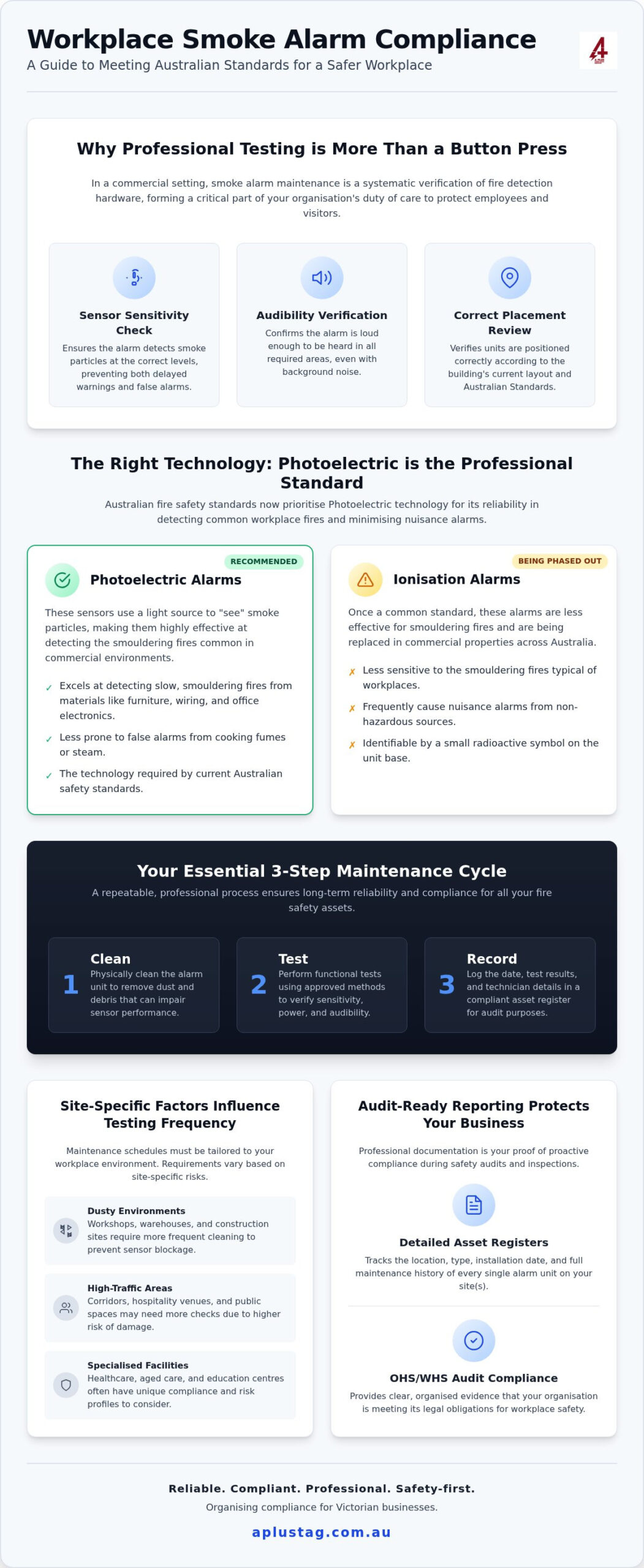
Professional smoke alarm testing for workplaces is a rigorous, systematic verification of fire detection hardware. It goes well beyond the casual “press and listen” approach many people use at home. In a commercial setting, this process involves checking the sensitivity of sensors, ensuring the alarm is audible in all necessary areas, and verifying that the unit’s placement still meets the building’s current layout. These devices are the critical front line of any fire protection strategy, serving as the primary trigger for evacuation procedures. When alarms are integrated correctly into a safety plan, they provide the earliest possible warning, which is essential for protecting lives and assets.
For facility managers and business owners, this maintenance falls under a broader “duty of care.” This legal and ethical responsibility requires you to take all reasonable steps to protect employees, visitors, and contractors from harm. Ensuring that detection systems work correctly isn’t just a technical task; it’s a fundamental part of managing workplace risk. By treating smoke alarm maintenance as a professional requirement rather than a chore, you create a more resilient and prepared organisation.
Why Smoke Alarms are Critical in Commercial Settings
In environments like high-rise offices, medical centres, or large-scale warehouses, the complexity of the building can make evacuation challenging. Early detection is vital because it provides the extra seconds needed for staff to follow emergency protocols before smoke affects visibility. Reliable systems also help minimise the risk of catastrophic property loss. A small fire detected early can often be contained, whereas a delayed response could lead to total business interruption. Beyond the physical protection, a well-maintained safety system reinforces a culture of professionalism and care, giving your staff peace of mind while they work.
The Legal Framework for Australian Workplace Safety
The requirement to maintain fire safety equipment is embedded in Australian OHS and WHS legislation. These laws mandate that employers provide a safe environment, which includes the regular testing and tagging of electrical items and the maintenance of fire detection systems. Compliance is often verified through detailed record-keeping and asset registers, which prove that the business is proactive rather than reactive. Australian Standards, such as AS 3786:2014, set the specific technical requirements for smoke alarm hardware and maintenance to ensure consistent safety levels across the country. You can learn more about how specialised safety testing fits into your broader compliance obligations by reviewing our full range of professional services.
Essential Standards and Smoke Alarm Types
Effective smoke alarm testing for workplaces begins with understanding the hardware installed across your facility. Compliance is not just about functionality; it’s about ensuring the technology meets current Australian Standards. The primary benchmark for hardware in Australia is AS 3786:2014, which specifies the requirements for smoke alarms using scattered light, transmitted light, or ionisation. When we conduct assessments, we verify that every unit carries the necessary certification marks to ensure they provide the protection your organisation expects.
Photoelectric vs Ionisation: What Your Business Needs
The Australian fire safety industry has seen a significant shift toward photoelectric technology. These sensors use a light source and a receiver to detect smoke particles. They’re particularly effective at identifying smouldering fires, which are common in office environments filled with synthetic materials, electronics, and wooden furniture. Smouldering fires can produce toxic smoke for hours before bursting into flames, making early detection from photoelectric units a life-saving advantage.
Ionisation alarms, which were once the industry standard, are being phased out across many Australian jurisdictions. These units use a small amount of radioactive material to detect fast-flaming fires but are often prone to nuisance alarms from cooking fumes or steam. Most modern workplace safety strategies now prioritise photoelectric units to minimise disruption and improve detection accuracy. If you’re unsure which technology your site uses, you can check the base of the unit for a radioactive symbol, which indicates an ionisation model, or speak with a compliance specialist to review your current installation.
Hard-wired vs Battery-Powered Systems
Reliability is the cornerstone of commercial fire safety. For most permanent workplaces, 240V mains-powered (hard-wired) alarms are the standard requirement. These systems offer consistent power and are typically equipped with a backup battery to ensure operation during a power failure. Modern units often feature 10-year non-removable lithium batteries, which eliminate the need for annual battery changes and reduce the risk of a unit being left unpowered due to human error.
In larger, multi-room facilities, interconnected alarms are essential. This configuration ensures that if smoke is detected in a remote warehouse or a closed office, every alarm in the building sounds simultaneously. This synchronised warning is crucial for high-occupancy sites where staff might not hear a single, isolated alarm. While battery-only units may be permitted in certain temporary structures or older buildings, hard-wired, interconnected systems remain the gold standard for robust workplace protection.
The Workplace Smoke Alarm Maintenance Checklist
Effective fire safety isn’t a matter of chance; it’s the result of a methodical “Clean, Test, and Record” approach. This structured methodology ensures that every component of your detection system remains functional and reliable. For many Victorian businesses, this maintenance is most efficient when integrated with other essential safety schedules, such as emergency lighting standards. Combining these services helps minimise operational downtime while ensuring your organisation meets its broader duty of care. While basic checks can be performed internally, professional inspections are necessary to verify sensor sensitivity and internal circuitry that a simple button press cannot detect.
Monthly and Six-Monthly Routine Tasks
Routine maintenance starts with the “press-to-test” function. This simple action verifies that the electronic circuitry and the audible alert are functioning correctly. Beyond the sound, cleaning protocols are vital for preventing nuisance alarms. Dust, cobwebs, and small insects often find their way into the sensor chamber, which can trigger false alerts and disrupt your business operations. A gentle vacuum or wipe around the unit every few months is usually sufficient. During these intervals, you should also perform a visual inspection to ensure no units have been damaged, covered by storage, or accidentally painted over during office renovations.
Annual Professional Testing Requirements
Comprehensive smoke alarm testing for workplaces requires an annual professional assessment to ensure the hardware actually detects smoke. We use specialised smoke dispensers that release a controlled amount of synthetic smoke to trigger the sensor. This is the only way to confirm the unit will respond correctly during a real fire. During this visit, technicians check the expiry dates of backup batteries and replace 9V cells where necessary. We also verify the interconnection functionality across the entire floor. If your system is designed so that one alarm triggers all others, it’s essential to confirm this communication is still active and hasn’t been compromised by electrical changes.
The 10-Year Replacement Cycle
Every smoke alarm has a finite lifespan of 10 years. Regardless of whether the unit appears to be working, the internal sensors degrade over time and become less reliable. You can usually find the manufacture date on the back of the unit or on a side label. If your hardware is approaching this decade mark, it’s time to plan for a full-site refresh. Proactive planning allows you to budget for the upgrade and ensures your facility remains compliant without the risk of sudden equipment failure. Maintaining an accurate asset register makes tracking these dates simple, allowing you to stay organised and prepared for future compliance requirements.
Testing Intervals and Site-Specific Factors
Frequencies for smoke alarm testing for workplaces are not a “one size fits all” requirement. While annual professional testing is a common baseline, the specific needs of your facility depend on its environmental conditions and operational risks. A clean, climate-controlled office has different requirements than a high-dust manufacturing plant or a commercial kitchen. It’s essential to consult with a professional compliance partner to establish a schedule that reflects these realities and keeps your organisation protected.
Integrating your fire safety with other electrical requirements is a smart way to stay organised. For example, aligning your smoke alarm checks with the recommended test and tag frequency victoria ensures that all safety hardware is reviewed in a single, efficient cycle. This holistic approach reduces the administrative burden and minimises disruption to your staff during business hours.
High-Risk vs Low-Risk Environments
Your workplace’s risk profile significantly influences your maintenance needs. In hospitality settings, airborne grease and steam can build up on sensors, potentially leading to false alarms or sensor failure. Similarly, in construction or woodworking sites, fine dust particles can settle inside the detection chamber. These environments often benefit from more frequent cleaning and sensitivity checks to ensure the hardware remains reliable despite the harsh conditions.
These site-specific factors also apply to other fire safety equipment. Understanding how your smoke detection works alongside fire extinguisher testing requirements victoria creates a comprehensive safety net for your property. By evaluating the specific hazards of your industry, you can tailor a maintenance plan that provides the highest level of protection without unnecessary costs or overlapping schedules.
Coordinating Multi-Site Compliance
Managing safety standards across several locations presents unique challenges for operations managers. Different sites may have varying alarm models, manufacture dates, and environmental risks. Centralising your smoke alarm testing for workplaces with one specialised partner simplifies this complexity. It ensures that every site follows the same high standard of documentation and reporting, which is vital for national organisations or Victorian businesses with multiple branches.
Automated reminders play a crucial role in this systematic approach, helping you avoid missed compliance deadlines and ensuring your asset register stays current. This proactive management allows you to focus on your core business while your safety partner maintains the recurring cycles of protection. By keeping all your records in one place, you’re always prepared for an audit or a safety review.
Professional Compliance Reporting and Asset Registers
An Asset Register is the foundational cornerstone of professional smoke alarm testing for workplaces. It’s a comprehensive database that tracks every piece of fire detection hardware across your facility, providing a clear history of maintenance and performance. While a handwritten log might have been acceptable in the past, modern OHS audits require a higher level of transparency and detail. A professional digital report provides a clear, tamper-proof record of your safety activities, ensuring you can demonstrate compliance instantly if an inspector visits your site.
We specialise in organising site-based records for facility managers, converting technical data into a structured asset register. This methodical management allows you to track the lifecycle of your equipment without the stress of manual record-keeping. By moving away from paper-based systems, you reduce the risk of lost data and ensure that your safety documentation is as professional as the rest of your business operations.
What Should Be Included in Your Safety Report?
A comprehensive report must provide a granular view of your fire safety infrastructure to be truly effective. It serves as your primary evidence of diligence during an audit or safety review. Every professional report should include:
- The precise location of every alarm to ensure no unit is missed during recurring cycles.
- The manufacture date of each device to manage the mandatory 10-year replacement window.
- Pass/Fail results for every specific test, including sensor response to synthetic smoke and battery health.
- Clear, actionable recommendations for any failed items that require immediate maintenance or replacement.
Audit Readiness and Long-Term Record Keeping
Maintaining an organised digital trail is essential for meeting your long-term compliance monitoring obligations. In the event of an insurance inquiry or a regulatory review, having easily accessible records can be the difference between a straightforward assessment and a complex legal challenge. Digital reports are far more secure than paper logs; they’re easier to store, search, and share with relevant stakeholders across your organisation.
Choosing a partner that provides “clear, reliable and professional support” ensures your safety obligations are managed with technical proficiency. This proactive approach to documentation doesn’t just satisfy the law; it creates a predictable environment where safety is a standard, not an afterthought. By centralising your compliance data, you protect your staff and ensure your business is always prepared for external scrutiny.
Maintaining Long-Term Fire Safety for Your Organisation
Effectively managing smoke alarm testing for workplaces is about more than meeting a legal requirement; it’s about creating a reliable safety net for your staff and assets. By adopting a systematic approach to maintenance and hardware upgrades, you minimise operational risks and ensure your building remains compliant with Australian Standards like AS 3786 and AS/NZS 3760. Our team specialises in providing the professional asset registers and clear reporting needed to keep your facility audit-ready at all times.
We understand that managing multiple safety schedules can be challenging. That’s why we offer scheduled maintenance and automated due-date reminders to ensure you never miss a critical deadline. This proactive management allows you to focus on your core business operations while we handle the technical details of your fire and electrical safety. Our methodical process ensures that your hardware is tested with precision and documented with total transparency.
Staying organised with your compliance is a straightforward process when you have a dependable partner by your side.
Frequently Asked Questions
Do I legally need smoke alarms in my small office?
Yes, Australian building codes and workplace health and safety laws require fire detection systems in almost all commercial premises, including small offices. The specific type and number of alarms depend on your building’s classification and size. Having a functional system is a fundamental part of your duty of care to protect staff and visitors from fire risks. It ensures you provide the earliest possible warning in an emergency.
How often should smoke alarms be professionally tested in a warehouse?
Professional smoke alarm testing for workplaces is generally required on an annual basis to ensure hardware responsiveness. However, warehouses often face higher levels of dust and debris, which can settle on sensors and cause malfunctions. We recommend obtaining site-specific guidance, as high-risk or dirty environments may necessitate more frequent professional cleaning and sensitivity checks to maintain reliable performance and minimise false alerts.
Can I test my workplace smoke alarms myself or do I need a pro?
You can perform basic monthly “press-to-test” checks internally to verify audible alerts, but professional testing is required for full compliance. Technicians use specialised equipment, such as synthetic smoke dispensers, to verify that the sensors actually trigger during a fire event. A professional service also provides the audit-ready documentation and asset registers necessary to prove your organisation has met its legislative obligations correctly.
What is the difference between photoelectric and ionisation smoke alarms?
Photoelectric alarms use light sensors to detect smouldering fires, which are the most common type in modern offices. Ionisation alarms use a small amount of radioactive material to detect fast-flaming fires but are more prone to nuisance alerts from steam or cooking. Most Australian jurisdictions now prioritise photoelectric technology because it provides earlier warnings for smoke-heavy fires and is generally more reliable for commercial settings.
What happens if a smoke alarm fails a professional test?
If an alarm fails, it must be replaced or repaired immediately to maintain your site’s safety and compliance status. Our technicians identify the specific cause of failure, whether it’s a sensor malfunction, expired battery, or end-of-life issue. We then record the failure and the subsequent resolution in your asset register, ensuring your safety report remains accurate and ready for an OHS audit at any time.
Do smoke alarms in workplaces need to be interconnected?
Interconnection is often a requirement under the National Construction Code, especially for newer buildings or significant renovations. This system ensures that if one alarm detects smoke in a remote area, all alarms across the facility sound simultaneously. This synchronised warning is vital in large or multi-room workplaces where a single, isolated alarm might not be heard by every staff member or visitor on-site.
Are hard-wired smoke alarms required for all Australian businesses?
Most permanent Australian workplaces require 240V mains-powered alarms with a battery backup. While battery-only units might be permitted in specific temporary structures or older buildings, hard-wired systems are the standard for commercial reliability. These units provide consistent power and reduce the risk of the system being disabled by a flat battery, which is a critical factor in long-term, professional safety management for your premises.
How long do I need to keep smoke alarm testing records for an audit?
You should generally keep safety and maintenance records for at least seven years to satisfy most Australian regulatory and insurance requirements. Maintaining a digital asset register makes this long-term record-keeping simple and organised. Having a clear historical trail of your smoke alarm testing for workplaces demonstrates a proactive approach to safety and provides essential protection during any official OHS or WHS review.
