Fire Blanket Testing Requirements: The 2026 Australian Compliance Guide
If a small kitchen fire broke out today, are you certain the fire blanket on your wall is actually fit for purpose, or is it just a red box gathering dust? It’s a question that often causes unnecessary stress for Victorian business owners and facility managers, especially when faced with the pressure of an upcoming OHS audit. You likely already understand that safety equipment is vital, but the specific fire blanket testing requirements outlined in AS 1851:2012 can feel like a moving target when you’re managing multiple sites and competing priorities.
This guide provides a definitive look at the 2026 compliance landscape to ensure your equipment is always ready for an emergency. We’ll explore the mandatory six-monthly inspection intervals, the essential five-year replacement cycle, and the documentation standards required to protect your organisation. By the end, you’ll have a clear strategy for managing your fire protection assets with minimal disruption to your daily operations. Our goal is to help you reduce risk and stay organised, moving from a state of uncertainty toward a position of total control over your workplace safety obligations.
Key Takeaways
- Understand your legal obligations under the Victorian OHS Act by adhering to the routine maintenance standards set out in AS 1851:2012.
- Identify the specific fire blanket testing requirements for your site, including the mandatory six-monthly technician inspections and the five-year replacement schedule.
- Ensure your equipment remains accessible and compliant by following strict installation guidelines for mounting heights, universal signage, and clear space.
- Recognise that fire blankets are strictly single-use safety assets that must be discarded and replaced immediately after any contact with fire or grease.
- Learn how professional asset registers and automated reminders from a dependable partner can simplify your compliance reporting and reduce the risk of equipment failure.
Understanding AS 1851:2012 and Fire Blanket Testing Requirements
AS 1851:2012 serves as the primary benchmark for the routine servicing of fire protection systems and equipment across Australia. For Victorian business owners, following this standard isn’t just about ticking a box. It’s a structured method to ensure that every safety asset, from extinguishers to fire blankets, performs exactly as intended during an emergency. Adhering to these fire blanket testing requirements helps you meet your duty of care under the Victorian OHS Act, which mandates a safe workplace for all employees and visitors. Failing to maintain these standards can leave your organisation vulnerable during WorkSafe inspections or following a fire incident.
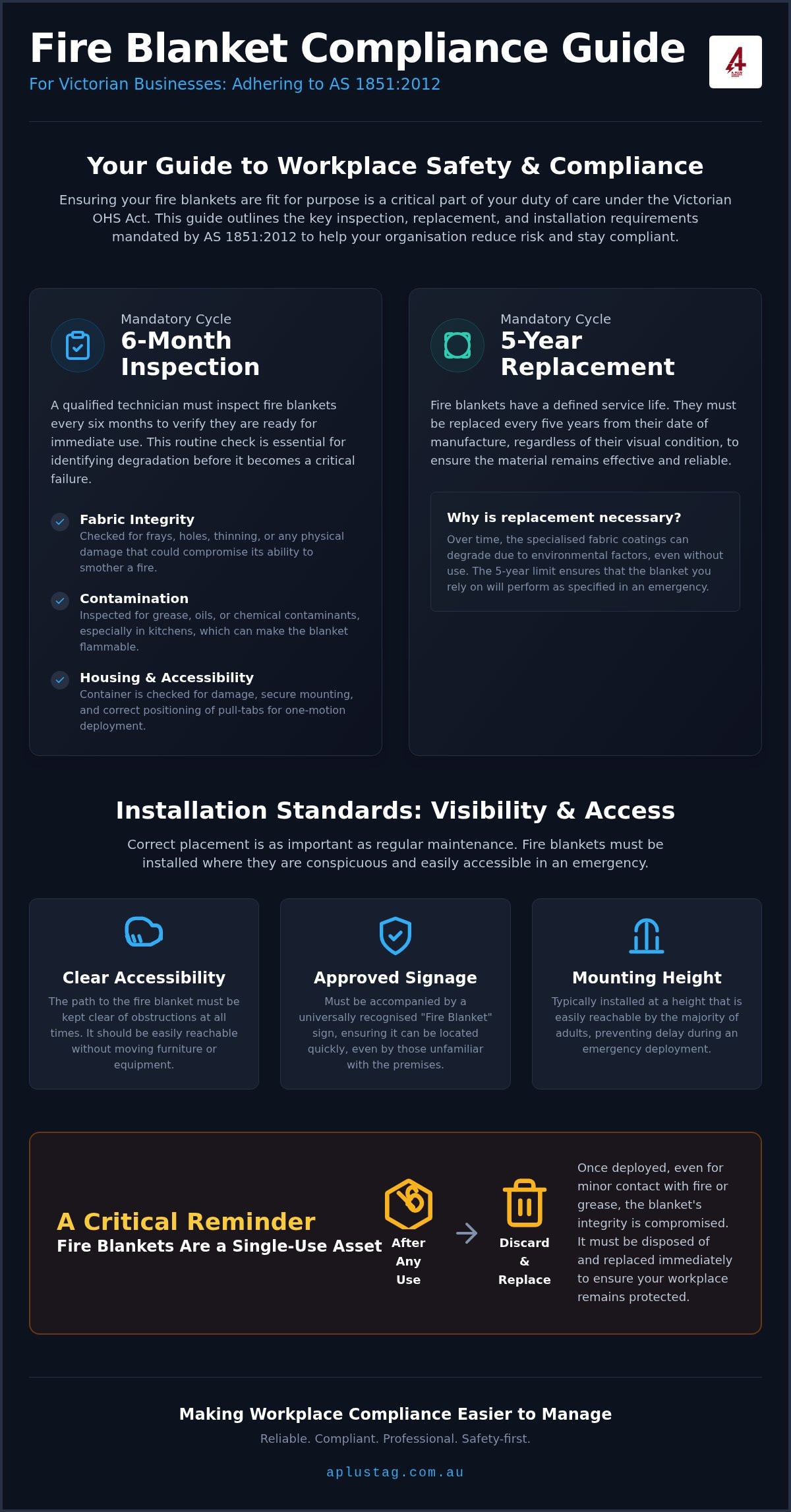
Fire blankets are specialised tools designed to smother small Class F fires involving cooking oils and fats, as well as Class A fires involving common combustibles like paper or wood. Understanding What is a Fire Blanket? is the first step in recognising its value in a commercial kitchen or office breakroom. Because these blankets can degrade over time or suffer damage in busy environments, AS 1851:2012 specifies a mandatory six-month inspection interval for all commercial installations. Regular checks ensure the fabric remains intact and the pull-tabs are accessible for immediate use.
To better understand how to verify if your equipment is fit for purpose, watch this helpful video:
The Role of Australian Standards in Workplace Safety
AS 1851:2012 provides a systematic approach to maintenance, moving away from guesswork and toward predictable safety cycles. It ensures that suppression equipment remains in a “ready-to-deploy” state at all times. This proactive strategy minimises the chance of equipment failure when it matters most. This information must be read in conjunction with AS/NZS 3760:2010 as a whole, and particularly clause 2.1, to ensure a holistic approach to site safety. By integrating these standards, you create a robust defence against workplace hazards and maintain a high standard of operational readiness.
Who is Responsible for Fire Safety Compliance?
In Melbourne’s diverse commercial landscape, the responsibility for fire safety lies squarely with facility managers and business owners. This duty of care extends to ensuring all safety equipment is maintained by competent persons. Neglecting these cycles can lead to severe consequences, including compromised insurance claims and increased physical risk to personnel. While internal staff can perform basic visual checks, professional verification is always preferred for compliance accuracy. A Plus Compliance Services acts as a dependable partner, providing the technical expertise needed to manage our services effectively. This professional oversight ensures your records are audit-ready and your workplace remains a secure, organised environment.
The 6-Month Fire Blanket Inspection and Testing Cycle
The six-month service interval is the cornerstone of effective fire equipment maintenance. Under AS 1851:2012, fire blankets in commercial settings must undergo a formal inspection every half-year to verify they are in peak condition. This frequency catches issues that often go unnoticed during a casual glance, such as subtle fabric decay or environmental damage. Technicians look specifically for physical degradation like frays, holes, or thinning areas that could allow flames to penetrate the material. In kitchen environments, contamination from fats and oils is a primary concern. These substances can soak into the fibres over time, potentially turning a safety device into a fire hazard if it’s deployed. Adhering to these fire blanket testing requirements ensures your equipment remains a dependable safety asset rather than a liability.
Beyond the fabric itself, the technician evaluates the entire housing unit. They verify that the container is securely mounted and that the pull tabs are positioned correctly for a quick, one-motion deployment. If a tab is tucked inside or the container is damaged, the blanket might not release when needed most. A service tag is then attached or updated, recording the specific date of the test and the technician’s details. This tag provides immediate visual proof to staff and auditors that the equipment is currently fit for use.
Step-by-Step: What Happens During a Professional Test?
During a professional assessment, the technician performs a meticulous visual check of the blanket material. They look for signs of chemical exposure, moisture damage, or simple age that might compromise the fire-retardant properties. A critical part of the process involves testing the release mechanism to ensure the blanket drops freely from its housing without snagging or sticking. The technician also cleans the exterior of the container, ensuring that the operating instructions remain clear and legible for a stressed user. This methodical approach guarantees that every component of the system is ready for action. If any defect is found, the blanket is flagged for immediate replacement to maintain site safety.
Documentation and Compliance Reporting
Reliable record-keeping is just as important as the physical test itself. A Plus Compliance Services provides detailed asset registers that track every piece of equipment across your Victorian sites. These digital records serve as a vital logbook, demonstrating your “due diligence” during OHS audits or insurance reviews. By linking this data with your broader compliance monitoring strategy, you ensure that no maintenance window is ever missed. This level of organisation helps Victorian businesses reduce risk and stay prepared for any regulatory scrutiny. If you are unsure when your equipment was last serviced, you might want to request a compliance assessment to bring your records up to date.
Installation Standards: Visibility, Signage, and Accessibility
Proper installation is just as essential as following the routine fire blanket testing requirements. A blanket that is hidden behind a fridge or mounted in an unreachable corner won’t help your team when a pan ignites. AS 2444-2001 provides the framework for where these assets should live, ensuring they are ready for immediate use. To remain compliant in Victoria, your fire blankets must be visible, accessible, and completely free from obstructions. This means keeping a clear space of at least 300mm around the container. This gap allows a staff member to grab the pull-tabs without hitting other equipment or snagging the material during deployment.
Mounting height is a key factor in accessibility for all personnel. The top of the fire blanket container should be positioned roughly 2 metres from the floor. This height ensures the blanket is visible across a busy commercial kitchen while remaining within reach for most adults. If the unit is mounted too low, it might be blocked by floor-level storage or furniture. If it’s too high, it becomes a struggle to deploy in a hurry. A methodical approach to mounting helps Victorian businesses reduce risk and stay organised by creating a predictable environment for safety equipment.
Signage Requirements for Victorian Workplaces
Visibility isn’t just about the red container itself. Compliant ID signage must be installed directly above or adjacent to the blanket. These signs feature a white flame graphic on a red background, adhering to the universal standards for fire protection equipment. In a commercial kitchen or laboratory, these signs should be positioned high enough to be seen from various angles, even if the room is filled with steam or smoke. All instructional labels on the container must be in English and remain legible. If the labels fade or peel over time, the unit will fail its inspection and requires immediate attention to maintain compliance.
Optimal Placement in Commercial Kitchens and Labs
Strategy is everything when choosing a location for suppression equipment. Never place a fire blanket directly above a stove, deep fryer, or laboratory burner. If a fire starts, the flames will likely block your access to the blanket, making it impossible to retrieve safely. Instead, position the unit along a safe egress route. This allows the user to move away from the hazard to grab the blanket before returning to suppress the fire. In Melbourne schools, hospitals, and aged-care facilities, consider these specific placement factors:
- Proximity to exit doors to ensure a clear path for the user at all times.
- Distance from high-heat zones to prevent the fabric from degrading due to constant temperature fluctuations.
- Ease of access for staff with varying physical abilities, ensuring the pull-tabs are always at a functional height.
By following these installation standards, you ensure that your safety equipment is not just present, but actually effective. This proactive planning is a hallmark of a well-regulated workplace and simplifies the process of meeting your long-term compliance obligations.
When to Replace: Managing Fire Blankets After an Incident
Understanding the lifecycle of your safety equipment is a core part of meeting fire blanket testing requirements. While these assets are durable, they aren’t permanent fixtures. Unlike some suppression tools that can be refilled or serviced, a fire blanket is strictly a single-use item. Once it’s been deployed to smother a fire, it must be discarded immediately. Even if the blanket looks intact after use, the intense heat of a Class F or Class A fire alters the integrity of the specialised fibres. Charring, grease soaking, or broken pull-straps are clear indicators of irreparable damage. Reusing a contaminated blanket is dangerous; trapped oils could ignite, or the compromised fabric might allow flames to pass through during a second incident.
Disposal of a used blanket should only happen once the material has cooled completely. It can generally be placed in general waste, provided it hasn’t been contaminated with hazardous chemicals. Managing these replacements promptly is part of a safety-first culture that protects both your staff and your property. It’s about being proactive rather than reactive, ensuring that a used or damaged unit never stays on the wall a day longer than it should.
Identifying “End of Life” for Fire Equipment
Manufacturers typically specify a functional lifespan between five and ten years, even if the blanket has never been removed from its container. Over time, the material can become brittle or the container seals may fail, allowing moisture and dust to enter. It’s common for these replacement cycles to align with fire extinguisher testing requirements Victoria, allowing you to manage all fire equipment maintenance in a single, organised visit. If a blanket is ever found outside its housing or has been misused as a makeshift welding shield, it must be replaced immediately. Such misuse compromises the thermal protection properties that are essential for fire suppression.
Post-Incident Compliance Procedures
After an incident, your compliance journey isn’t finished until the new unit is recorded in your system. You’ll need to update your asset register to reflect the replacement date and the technician’s details. This keeps your documentation audit-ready and ensures your automated reminders remain accurate for future cycles. It’s also a logical time to re-train staff on the location of the new unit, especially if the placement has shifted slightly to improve accessibility. Any replacement you install must meet AS/NZS 3504:2006 standards, which specify a minimum size of 1 metre by 1 metre for effective fire suppression. This ensures your Victorian workplace remains compliant and prepared for any future emergencies.
Professional Fire Equipment Maintenance in Melbourne
Managing fire blanket testing requirements doesn’t have to be a logistical burden for your team. At A Plus Compliance Services, we specialise in making workplace compliance easier to manage by acting as a dependable partner rather than a one-off contractor. We understand that your time is valuable, which is why we offer a comprehensive suite of safety services that can be bundled together. By grouping your fire blanket inspections with electrical test and tag, RCD testing, and fire extinguisher servicing, you achieve total site compliance in a single, efficient visit. This streamlined approach reduces the number of contractors on-site and ensures that all your safety assets are verified simultaneously.
Our service area is extensive, reaching Victorian businesses from the vibrant streets of St Kilda to the busy industrial hubs of Dandenong and beyond. We pride ourselves on a “set and forget” model that removes the stress of tracking maintenance dates. Our system uses automated reminders to notify you well before your next inspection is due, ensuring you never fall behind on your legal obligations. This proactive management is a hallmark of our professional service, providing you with the peace of mind that your facility remains safe and compliant year-round.
Helping Victorian Businesses Reduce Risk
We recognise that every sector has unique operational needs. For busy commercial kitchens in the hospitality industry or sensitive environments like healthcare and aged-care facilities, we prioritise a “minimal disruption” approach. Our technicians work methodically to complete assessments without interrupting your daily workflows. Following each visit, we provide the organised reports and asset registers you need for total audit readiness. These clear, professional documents demonstrate your commitment to safety and provide a transparent record for insurance providers and OHS inspectors. We are dedicated to helping Victorian businesses reduce risk and stay organised through clear reporting and ongoing compliance support.
Ready to Organise Your Next Assessment?
Choosing a compliance partner is about finding reliability and expertise you can trust for the long term. A Plus Compliance Services is built on a foundation of being reliable, compliant, professional, and safety-first. Our technicians are punctual, experienced, and committed to maintaining the highest standards of workplace safety. We invite you to discuss a recurring compliance schedule tailored to your specific site requirements, ensuring your fire protection equipment is always ready for an emergency. To arrange a comprehensive assessment or to request a quote for your facility, contact A Plus Compliance Services on 1300 427 158 or 1300 CAN TEST.
Maintaining Ongoing Compliance and Safety
Maintaining a safe workplace is a recurring commitment that relies on routine verification and professional oversight. By adhering to the mandatory six-monthly fire blanket testing requirements, you ensure your suppression equipment remains in a ready-to-deploy state. Whether it’s verifying the mounting height of your containers or replacing units immediately after an incident, every step contributes to a robust safety culture. A Plus Compliance Services is here to help Victorian businesses reduce risk and stay organised through clear reporting and dependable service.
Our team provides the ongoing compliance support you need to manage your fire protection assets without the stress of tracking every date yourself. We pride ourselves on being reliable, compliant, and professional, ensuring your site is always audit-ready. Making workplace compliance easier to manage is at the heart of what we do. Our punctual technicians and methodical approach ensure your facility remains a secure environment for everyone.
We look forward to partnering with you to create a safer environment for your team and visitors.
Frequently Asked Questions
How often do fire blankets need to be tested in Australia?
Fire blankets in commercial and regulated workplaces must be inspected every six months to comply with AS 1851:2012. These routine checks ensure the equipment is accessible and the fabric remains in good condition for immediate use. While the standard provides a framework, fire blanket testing requirements can vary based on your specific workplace, equipment type, and risk assessment. It’s always best to obtain site-specific professional guidance to ensure your Melbourne facility remains fully compliant.
Can I test my own fire blankets at my business?
While staff can perform basic visual checks to ensure equipment isn’t obstructed, formal six-monthly inspections must be carried out by a competent person or qualified technician. A Plus Compliance Services provides the professional verification needed to satisfy OHS audits and insurance requirements. This information must be read in conjunction with AS/NZS 3760:2010 as a whole, and particularly clause 2.1, when managing your broader electrical and fire safety obligations across Victorian sites.
What is the standard for fire blankets in Victoria?
The primary standard for routine servicing in Victoria is AS 1851:2012, which outlines the maintenance cycles for fire protection equipment. Additionally, fire blankets must be manufactured to meet AS/NZS 3504:2006. Adhering to these standards helps business owners meet their legal duties under the Victorian OHS Act. Following these benchmarks ensures your suppression tools are ready for action, reducing the risk of fire equipment failure during an emergency in your office or kitchen.
Do fire blankets expire if they have never been used?
Yes, fire blankets have a limited service life even if they’ve never been deployed. In commercial environments, they are typically replaced every five years. Over time, the fire-retardant fibres can become brittle or contaminated by dust and moisture, which compromises their effectiveness. Regular professional testing identifies when a blanket has reached its “end of life,” allowing you to replace it before it fails to perform during a critical moment for your staff.
Where is the best place to install a fire blanket in a commercial kitchen?
Install fire blankets in a conspicuous and readily accessible position along a safe exit path. You shouldn’t mount them directly above a stove or deep fryer, as flames could prevent you from reaching the unit safely. Instead, place them between 1 and 1.5 metres from the floor to ensure visibility and ease of access. Maintaining a clear space of 300mm around the container allows for a quick, unobstructed release when every second counts.
What size fire blanket is required for a commercial workplace?
For a commercial workplace in Australia, a fire blanket must have a minimum size of 1 metre by 1 metre to comply with AS/NZS 3504:2006. This size is designed to effectively smother small Class F and Class A fires. Larger blankets may be required for specific high-risk areas identified during your site assessment. Using an undersized or non-compliant blanket can lead to fire spread and increased risk to your personnel during an incident.
What happens if my fire blanket fails an inspection?
If a fire blanket fails an inspection due to damage, contamination, or age, it must be replaced immediately. Our technicians at A Plus Compliance Services will clearly identify the failed item and record the details in your asset register. This allows you to remove the faulty equipment and maintain an accurate compliance record for your organisation. Staying proactive with replacements ensures your Victorian business remains organised and prepared for any regulatory scrutiny or OHS audits.
Do I need a sign for my fire blanket?
Yes, a universal fire blanket sign is a mandatory requirement for workplace compliance. The sign should feature a white flame graphic on a red background, as specified in AS 1851-2012. It must be installed above or adjacent to the blanket container so users can identify the equipment quickly from a distance. Proper signage is essential in busy Melbourne kitchens or workshops where visibility might be obscured by steam, smoke, or other large equipment.
