Switchboard Thermal Imaging Services: A Victorian Business Guide to Preventative Safety
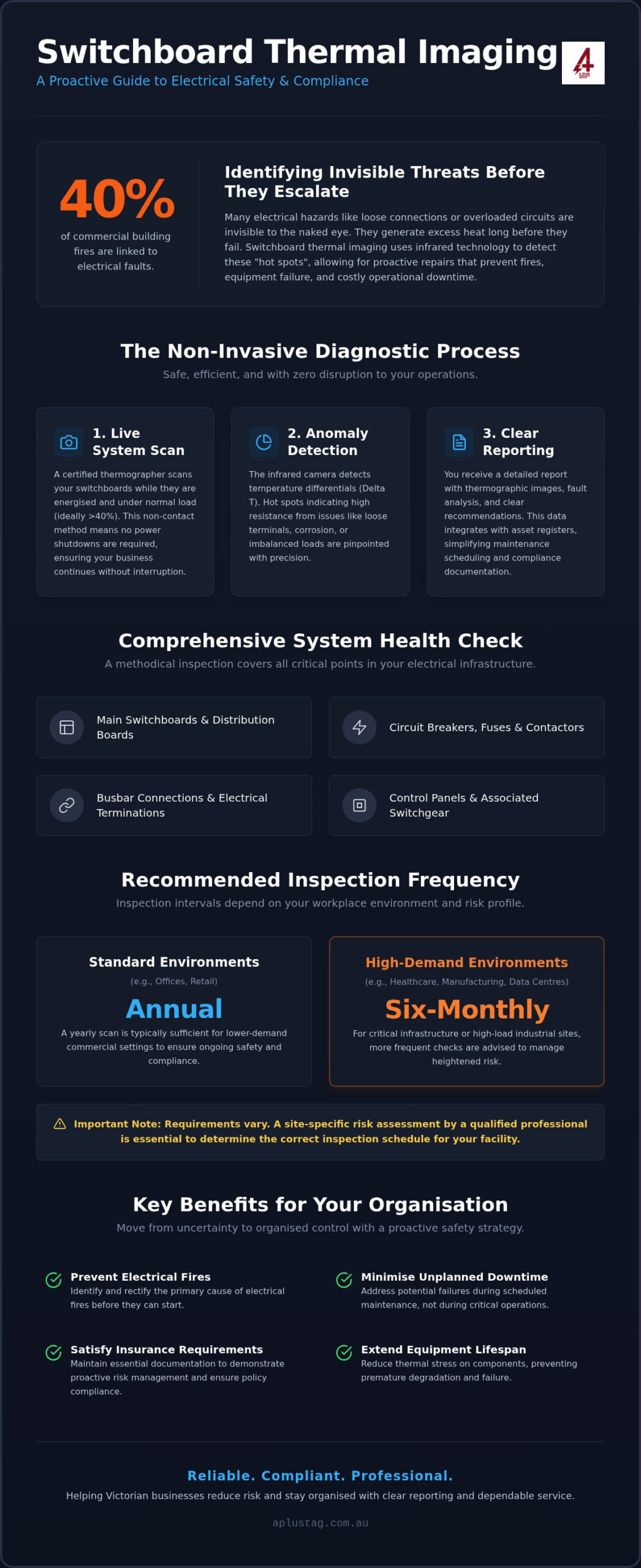
Did you know that electrical faults are responsible for roughly 40% of all commercial building fires in Australia each year? For many Melbourne facility managers, the persistent fear of an unexpected fire or a sudden operational shutdown is a significant source of stress. Professional switchboard thermal imaging services provide a non-invasive way to see what the naked eye cannot, identifying loose connections or overloaded circuits before they escalate into costly emergencies. This guide, which must be read in conjunction with AS/NZS 3760:2010 clause 2.1, explains how proactive scanning keeps your workplace safe and compliant.
We understand that navigating Australian Standards like AS/NZS 3019 or the specific qualification requirements for thermographers can feel complex. You need to satisfy your insurance provider and protect your staff while maintaining a productive work environment. This article explores how regular thermal inspections help Victorian businesses reduce risk and stay organised. We’ll preview the essential standards, the value of clear reporting, and how to establish a methodical maintenance cycle. Our goal is to help you move from uncertainty to a state of organised control, ensuring your workplace remains safety-first and fully compliant.
Key Takeaways
- Understand how thermal scanning identifies hidden faults while your equipment is under normal load, ensuring zero disruption to your Melbourne workplace.
- Learn how switchboard thermal imaging services help prevent electrical fires and operational failures by detecting invisible heat anomalies before they escalate.
- Clarify the relationship between infrared scanning and your insurance obligations, helping you maintain the documentation required for full policy compliance.
- Identify the correct inspection intervals for your specific site, ranging from standard annual reviews to specialised six-monthly checks for high-demand environments.
- Discover the benefits of consolidated reporting that links thermal data with asset registers to simplify your long-term workplace safety management.
Understanding Switchboard Thermal Imaging Services in Victoria
Switchboard thermal imaging services are a specialised diagnostic tool designed to maintain the integrity of your building’s electrical infrastructure. By using advanced infrared technology, our technicians can detect heat variations within your electrical system that are completely invisible to the naked eye. This method serves as a proactive health check, identifying potential issues before they develop into dangerous faults. It’s a key part of how we help Victorian businesses reduce risk and stay organised, providing a clear picture of system health without the guesswork associated with traditional maintenance.
One of the primary advantages of this service is that it’s entirely non-invasive. Scans are performed while your switchboards are energised and operating under a normal working load, ideally at least 40%. This is essential because temperature anomalies only become visible when current is flowing through the circuits. Because there’s no need to shut down power, your daily operations can continue without interruption. It’s a practical solution for busy Melbourne workplaces that require high levels of safety without the cost of unplanned downtime.
To better understand this concept, watch this helpful video:
A certified thermographer plays the role of a technical detective during these inspections. While a standard visual check might show a clean and tidy switchboard, the infrared scan can reveal “hot spots” caused by loose connections, corroded terminals, or imbalanced loads. These heat signatures are early warning signs of component failure or fire risks. By identifying these specific points of concern, you can address repairs during a scheduled maintenance window, keeping your facility safe and compliant with a professional, safety-first approach.
The Technology Behind Infrared Thermography
Modern infrared cameras convert thermal energy into visible light images called thermograms. The core metric used by our technicians is the temperature differential, known as “Delta T”. This represents the difference in temperature between a specific component and its surrounding environment or other similar components. A high Delta T indicates that a part is working harder than it should be, often due to high resistance. Using professional-grade equipment is vital for accurate compliance reporting, as high-resolution sensors ensure even minor temperature spikes are documented for your records.
Key Components Scanned During an Inspection
During a comprehensive assessment, we examine every critical point within your electrical distribution system. This methodical approach ensures that no hidden risks are left unaddressed. The inspection typically covers:
- Main switchboards and all sub-distribution boards.
- Circuit breakers, fuses, and contactors.
- Busbar connections and all electrical terminations.
- Control panels and associated switchgear.
Each component is checked for thermal anomalies, ensuring your maintenance documentation is thorough and reliable.
Why Infrared Scanning is Critical for Workplace Risk Management
Infrared scanning is more than just a technical check; it’s a way to translate raw thermal data into actionable safety steps for your facility. For a site manager, a “thermal anomaly” is simply a component that’s running hotter than its neighbours. This temperature spike often indicates a high-resistance connection, which is a primary catalyst for electrical fires in commercial buildings. By utilising switchboard thermal imaging services, you identify these invisible threats before they damage the surrounding insulation or trigger a circuit failure. It’s a precise method of seeing the “unseen” risks that standard visual inspections simply cannot detect.
Beyond fire safety, these services protect the long-term lifespan of your infrastructure. Excessive heat degrades expensive components like circuit breakers and contactors, leading to premature failure. When you catch these issues early, you avoid the cascading damage that occurs when one faulty part puts undue stress on the entire system. This proactive approach also ensures staff safety by reducing the risk of arc flash incidents, which can occur when components fail violently while under load. Maintaining a cool, balanced system is a fundamental part of a safety-first workplace.
Preventing Costly Operational Downtime
A sudden power failure in a Victorian warehouse, office, or aged-care facility does more than just turn off the lights. It stops production lines, compromises temperature-sensitive stock, and creates significant recovery costs. Switchboard thermal imaging services act as a predictive maintenance tool, allowing you to see a failure coming weeks or months in advance. Instead of reacting to an emergency after hours, you can schedule a simple tightening of a lug or a component replacement during a planned lunch break or off-peak period. This methodical approach is essential for helping Victorian businesses reduce risk and stay organised.
Enhancing Workplace Occupational Health and Safety
Under Victorian OHS legislation, employers have a clear duty of care to provide a safe working environment. This includes the systematic maintenance of electrical installations to prevent injury from fire or shock. Regular thermal scanning demonstrates a proactive commitment to safety, moving beyond the minimum requirements of basic testing. It provides site managers with the confidence that their electrical assets are being managed with professional authority and clear documentation. If you have concerns about your current switchboard health, you can discuss a compliance schedule with our team to ensure your workplace remains safe and compliant.
Navigating Insurance Requirements and Australian Standards
Insurance providers in Australia are increasingly specific about how businesses manage electrical risk. For many Victorian organisations, annual switchboard thermal imaging services are now a mandatory condition of their commercial property or business interruption insurance. This shift is driven by the reality that electrical faults are a leading cause of commercial building fires. Having a professional report on file provides tangible evidence of your due diligence; it shows that you have taken proactive steps to identify hidden hazards before they cause loss. This documentation acts as a vital paper trail during audits, proving that your facility is managed with a professional, safety-first approach.
This information must be read in conjunction with AS/NZS 3760:2010 as a whole, and particularly clause 2.1.
Meeting AS/NZS 3000 and Maintenance Expectations
AS/NZS 3000, commonly known as the Wiring Rules, establishes the foundational safety requirements for all electrical installations in Australia. While these rules govern the installation, periodic verification through thermal scanning supports the broader goals of safe operation. These services complement your existing electrical safety routine, ensuring that while your portable equipment is tested and tagged, the infrastructure powering it is equally secure. A qualified Victorian technician understands how these standards interact to ensure your switchgear remains safe for staff and compliant with state-specific safety expectations.
Protecting Your Insurance Policy Coverage
Most commercial insurance policies include clauses requiring the policyholder to take “reasonable precautions” to prevent damage. If a fire occurs and investigations reveal that a switchboard had not been inspected for several years, an insurer may question whether the business met its obligations. Conversely, a report showing a detected thermal anomaly that was promptly repaired serves as powerful proof of a systematic maintenance cycle. Using technicians certified under AS ISO 18436.7 is essential here. Using unqualified contractors for specialised thermal assessments can jeopardise the validity of your documentation, potentially complicating future insurance claims or compliance audits.
Determining the Ideal Inspection Frequency for Your Facility
Establishing a routine for switchboard thermal imaging services requires a careful balance between safety requirements and operational reality. While every site is different, industry best practice in Victoria suggests that frequency should be determined by a site-specific risk assessment rather than a generic template. This ensures that high-risk areas receive the attention they need without over-servicing lower-risk environments. It’s important to remember that requirements vary based on your specific workplace, equipment type, and the results of previous inspections.
Most Melbourne businesses follow a tiered approach to scheduling their scans. Annual inspections are the baseline recommendation for standard commercial environments like offices, retail shops, and schools. For facilities with higher electrical demands, such as manufacturing plants, hospitals, and aged-care centres, six-monthly scans are typically preferred. In heavy industrial sites where dust, vibration, and constant 24/7 operations are factors, quarterly reviews may be necessary to ensure long-term reliability and safety.
Factors Influencing Electrical Stress and Heat
Several variables can accelerate the wear of your electrical components. Facilities that run around the clock place constant stress on switchgear, leaving little time for components to cool down. Environmental factors in Melbourne, such as high dust levels in warehouses or restricted airflow in older Victorian buildings, can also hinder heat dissipation. Infrastructure age is another critical factor; older switchboards may struggle with modern electrical loads, making frequent monitoring an essential part of your preventative maintenance strategy.
Scheduling Around Your Business Operations
For a thermal scan to be accurate, it must occur while your system is under load. We recommend scheduling inspections during your peak operating hours to capture the most realistic data. If you manage multiple sites across Victoria, coordinating these inspections into a single compliance cycle can significantly simplify your administration and reporting. Setting up automated reminders for your next scheduled maintenance helps you stay organised and ensures that your insurance documentation remains current without any manual tracking.
The A Plus Compliance Approach to Professional Thermal Scanning
A Plus Compliance Services approaches switchboard thermal imaging services as one component of a broader, safety-first strategy. We don’t just scan and leave; we help Victorian businesses reduce risk and stay organised by viewing your electrical infrastructure as a whole. This means integrating thermal data with other essential services like RCD testing and comprehensive asset registers. By consolidating these records into a single, organised system, we are making workplace compliance easier to manage. This holistic view ensures that your documentation is always ready for an audit or insurance review, reflecting a high level of professional standards and technical proficiency.
Our technicians prioritise punctuality and responsiveness during every site visit. We understand that your Melbourne workplace needs to remain productive, so we’ve designed our workflow to ensure minimal disruption. Because infrared scans require the system to be under load to be effective, we work around your daily operations. You don’t need to power down or reschedule staff; we simply move through your facility methodically, documenting the health of your switchgear while you focus on your core work. This steady, predictable pace creates a narrative of efficiency that our clients value for long-term facility management.
What to Expect in Your Thermal Imaging Report
High-quality reporting is the cornerstone of our service delivery. You receive clear reporting, dependable service and ongoing compliance support through a digital document that is easy to interpret. Each report uses a structured problem-solution-benefit framework to ensure you have a clear path forward. Your report includes:
- High-resolution infrared and digital photos for easy fault identification.
- Detailed analysis of temperature rises and severity ratings.
- Practical, industry-literate recommendations for repairs or further investigation.
- Side-by-side visual comparisons to help non-technical managers understand the risks.
This transparency removes the guesswork, allowing you to address critical hot spots before they lead to failure.
Your Partner for Long-Term Workplace Compliance
We position ourselves as an essential ally for Victorian organisations rather than a distant contractor. Our team manages your recurring testing schedules automatically, taking the pressure off facility managers to track dates manually. Whether you operate a single office in St Kilda, a warehouse in Dandenong, or multiple sites across Melbourne and regional Victoria, we provide consistent, high-standard performance. We act as a dependable partner that is proactive rather than reactive, ensuring your facility remains: Reliable. Compliant. Professional. Safety-first.
Securing Your Workplace with Proactive Electrical Management
Implementing a systematic maintenance cycle is the most effective way to protect your infrastructure and your people. Professional switchboard thermal imaging services allow you to identify invisible heat anomalies before they lead to catastrophic equipment failure or fire. This proactive approach ensures your organisation remains compliant with both insurance requirements and Victorian safety standards. By maintaining clear reporting and an up-to-date asset register, you’re not just ticking a box; you’re building a more resilient business environment.
A Plus Compliance Services acts as your long-term partner, offering specialised expertise in AS/NZS 3760 and Victorian safety standards. We focus on minimising disruption while providing the clear reporting and ongoing compliance support you need to stay organised. Taking control of your electrical safety today prevents the stress of an emergency tomorrow.
We look forward to helping you maintain a safer, more compliant workplace for your entire team.
Frequently Asked Questions
What is switchboard thermal imaging?
Switchboard thermal imaging is a specialised diagnostic technique that uses infrared technology to detect heat variations within your electrical systems. It allows technicians to identify high-resistance connections, overloaded circuits, or failing components that are invisible to the naked eye. By capturing these thermal signatures, we can address potential fire hazards before they lead to a system failure. This preventative measure is a key part of maintaining a safety-first workplace for Victorian organisations.
Is thermal imaging a legal requirement for businesses in Victoria?
While there is no specific Victorian law that explicitly mandates thermal imaging for every business, it’s considered best practice under general Occupational Health and Safety (OHS) duty of care. Employers in Victoria are legally required to provide a safe working environment, which includes the systematic maintenance of electrical installations. Many facility managers use switchboard thermal imaging services to demonstrate their commitment to safety and to comply with the increasingly strict requirements of commercial insurance providers.
Will the thermal scan require us to turn off the power?
No, a thermal scan does not require a power shutdown. In fact, for the inspection to be accurate, your electrical system must be energised and operating under a normal load, ideally at least 40%. This allows the infrared camera to detect the heat generated by electrical resistance. Because there’s no interruption to your power supply, we can complete the assessment during normal business hours with zero impact on your daily productivity.
How often should my business have a thermal imaging inspection?
Intervals depend on your specific environment, equipment type, and risk management procedures. As a general guide, annual inspections are the standard for most Melbourne offices. However, high-load environments like hospitals or manufacturing plants often require six-monthly scans. We recommend obtaining site-specific professional guidance to determine the correct schedule for your facility. This information must be read in conjunction with AS/NZS 3760:2010 as a whole, and particularly clause 2.1.
Can thermal imaging lower my business insurance premiums?
While we cannot guarantee a direct reduction in premiums, many insurance providers now mandate regular thermal imaging as a condition of coverage for commercial policies. Providing a professional compliance report demonstrates that you are taking reasonable precautions to prevent electrical fires. This proactive documentation can be essential during a policy renewal or audit, ensuring your coverage remains valid and helping your Victorian business reduce risk and stay organised.
What happens if the scan identifies a fault in my switchboard?
If a thermal anomaly or “hot spot” is identified, it is documented in your report with a severity rating and a high-resolution infrared image. This allows you to understand the urgency of the issue. You can then arrange for a licensed technician to perform the necessary repairs or maintenance during a scheduled window. Addressing these faults early prevents the cascading damage and high costs associated with an emergency electrical failure or an unplanned outage.
Does thermal imaging replace the need for Test and Tag?
No, thermal imaging does not replace the need for regular electrical test and tag services. These two safety measures complement each other to provide a holistic compliance strategy. While test and tag focuses on the safety of portable appliances, switchboard thermal imaging services assess the permanent electrical infrastructure that powers those devices. Both are essential for ensuring your Melbourne workplace remains fully compliant and safe for all staff and visitors.
How long does a typical switchboard thermal scan take?
The duration of a scan depends on the size of your facility and the number of distribution boards requiring inspection. A typical commercial office or retail site in Melbourne can often be completed within one to three hours. Our technicians work methodically and quickly to ensure minimal disruption to your operations. Once the physical scan is finished, we focus on generating a clear, actionable report that details our findings and any recommended maintenance.
