Fire Extinguisher Testing Requirements Victoria: The 2026 Compliance Guide
Could a single missed logbook entry really leave your Victorian business vulnerable to fines exceeding $88,000 per breach? It’s understandable that many facility managers feel a sense of pressure when managing fire extinguisher testing requirements Victoria mandates, especially when balancing six-monthly inspections with the broader demands of the Annual Essential Safety Measures Report (AESMR). Keeping track of varying intervals and maintenance cycles across multiple sites doesn’t have to be a source of stress or confusion for your team.
This 2026 compliance guide will help you master Victorian fire safety standards and ensure your workplace meets all AS 1851 maintenance obligations with ease. We’ll provide a clear breakdown of your legal responsibilities, from five-yearly pressure testing schedules to precise documentation standards. You’ll gain the knowledge needed to maintain an audit-ready asset register and the confidence that your organisation is fully prepared for any WorkSafe Victoria inspection or municipal building surveyor audit.
Key Takeaways
- Understand the mandatory intervals for fire extinguisher testing requirements Victoria businesses must follow, including the critical 6-monthly inspections and 5-yearly pressure tests.
- Learn how to maintain an audit-ready asset register and essential safety measures logbook to protect your organisation from significant WorkSafe penalties.
- Identify the unique maintenance needs for different equipment types, such as managing powder compaction in ABE extinguishers and high-pressure checks for CO2 units.
- Discover how a scheduled maintenance programme and automated reminders can eliminate the risk of missed deadlines and ensure continuous site safety.
- Gain clarity on the Annual Essential Safety Measures Report (AESMR) and the documentation required to demonstrate compliance to building surveyors.
Understanding Fire Extinguisher Testing Standards in Victoria
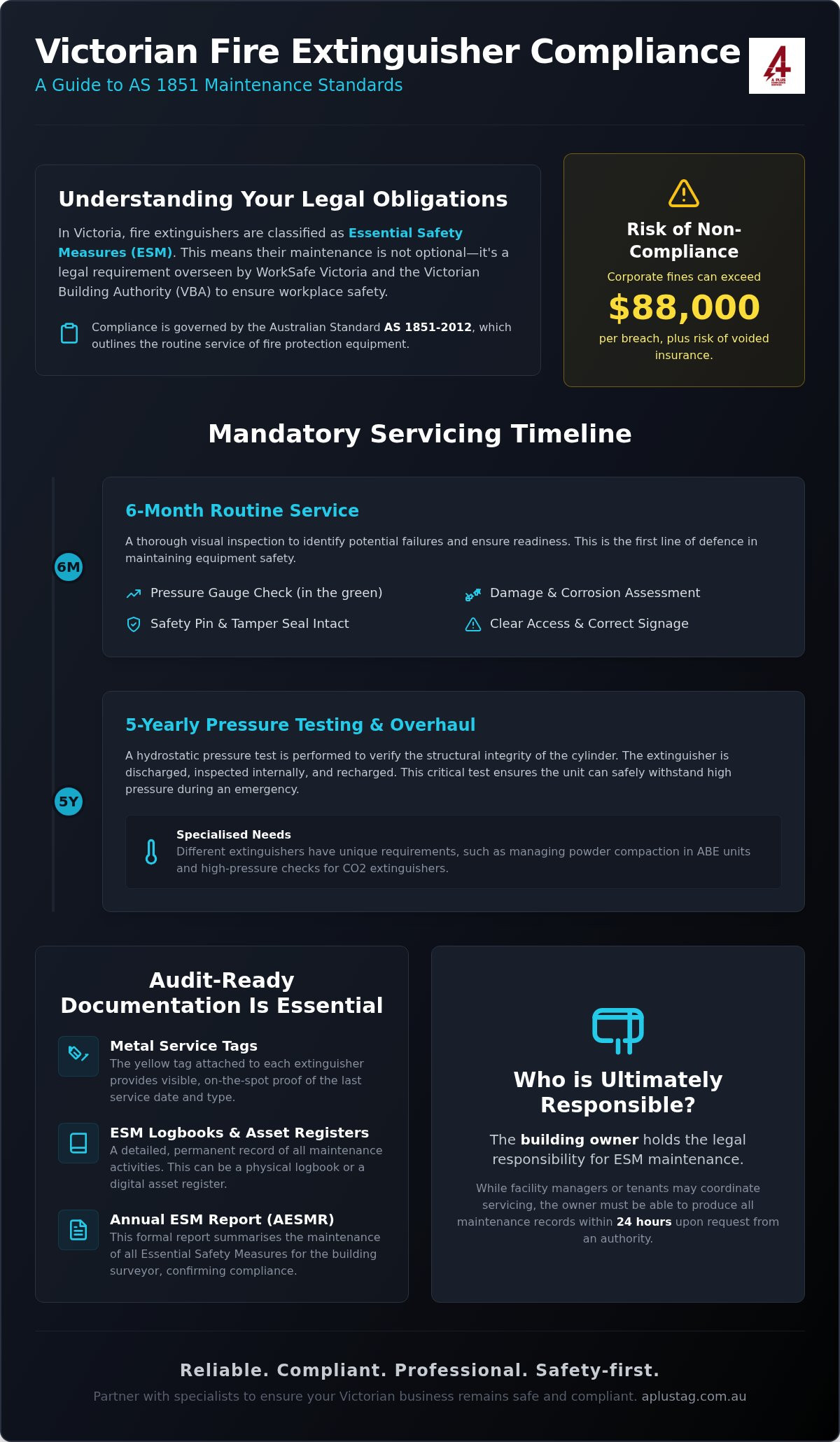
Victorian building regulations are specific and rigorous. Fire extinguishers are legally classified as Essential Safety Measures (ESM). This classification means they’re regarded as critical life-safety components that must function correctly during an emergency. The fire extinguisher testing requirements victoria expects from business owners ensure that every device is maintained through a disciplined cycle of inspection. Compliance is actively overseen by the Victorian Building Authority (VBA) and WorkSafe Victoria to maintain high safety standards across the state.
Neglecting these obligations carries heavy risks. Beyond the immediate danger to staff and property, failing to maintain ESMs can result in significant financial penalties. For a corporation, these fines can exceed $88,000 per breach according to current Victorian regulations. There’s also the risk of voided insurance policies, as most providers require proof of up-to-date maintenance to honour a claim after a fire incident.
To see a critical part of the maintenance process in action, watch this demonstration of a hydrostatic pressure test:
The Role of AS 1851-2012
The core document governing these activities is AS 1851-2012, “Routine service of fire protection systems and equipment”. Professionals use the term “routine service” because it describes a methodical process of testing, inspecting, and recording data. Different Types of fire extinguishers have varying service needs based on their internal agents and pressure levels. A technician who understands these nuances ensures that your equipment isn’t just tagged, but genuinely capable of suppressing a fire when it’s needed most.
Who is Responsible for Compliance?
Legally, the building owner is responsible for ensuring all fire safety equipment is maintained. While facility managers or tenants often coordinate the actual visits, the owner must be able to produce maintenance records within 24 hours if requested by a fire brigade officer or building surveyor. Utilising professional fire equipment inspection services is the most reliable way for owners to meet these obligations. This partnership ensures that all required documentation, including logbooks and asset registers, remains accurate and audit-ready throughout the year.
Testing Intervals: How Often is Required in 2026?
Maintaining safety standards isn’t a “set and forget” task. The fire extinguisher testing requirements victoria enforces are built on a recurring schedule designed to catch potential failures before an emergency occurs. This systematic approach ensures that every piece of equipment is not only present but fully operational. Under Australian Standard AS 1851, Victorian businesses must adhere to a strict servicing timeline that includes six-monthly, annual, and five-yearly milestones.
Every successful service is documented on the yellow metal tag attached to the cylinder. This tag provides immediate, visible proof of compliance for any visiting inspector or building surveyor. However, the tag is only part of the story; these entries must also be mirrored in your site’s permanent logbook or digital asset register to satisfy Victorian Essential Safety Measures (ESM) regulations.
The 6-Month Routine Service
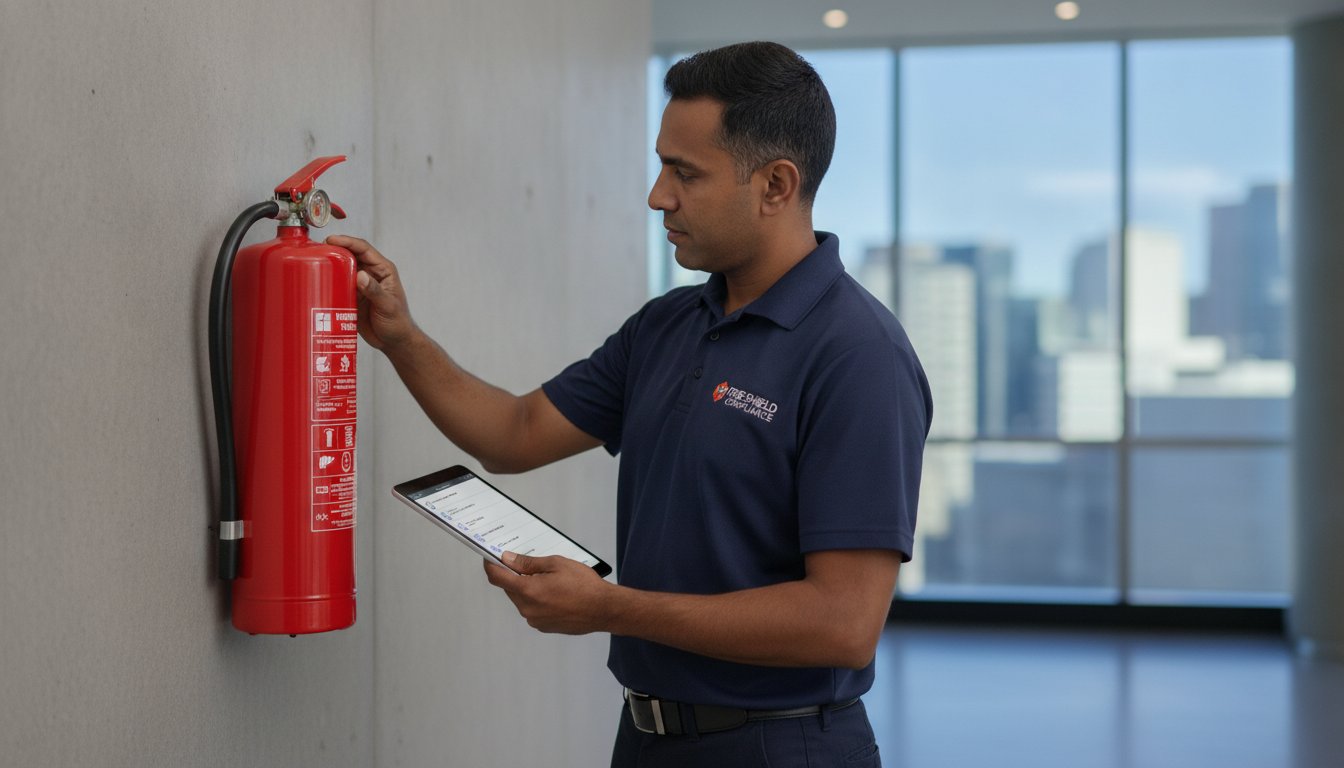
This inspection serves as the primary line of defence against equipment failure. During a six-monthly visit, technicians conduct a thorough visual assessment of every unit on your site. We look for signs of tampering, corrosion, or physical damage that could compromise the cylinder. Key checks include:
- Verifying the pressure gauge is in the “green” zone.
- Ensuring the safety pin and anti-tamper seal are intact.
- Confirming the extinguisher is unobstructed and correctly mounted.
- Checking that the correct location signage is visible and legible.
These checks are vital because extinguishers are often moved or accidentally damaged in busy environments like warehouses, schools, or kitchens. Catching these issues early prevents small problems from becoming major safety liabilities during a WorkSafe audit.
The 5-Year Pressure Test and Recharge
While annual services involve more detailed weight checks and integrity assessments, the five-year service is the most comprehensive requirement in the cycle. At this interval, most extinguishers must be discharged and undergo hydrostatic testing. Hydrostatic testing is a safety verification for high-pressure cylinders where the vessel is filled with water and pressurised to ensure it can safely hold its contents without leaking or rupturing.
Following a successful test, the unit is recharged with a fresh agent. This process is mandatory to ensure the internal components, like valves and seals, haven’t degraded over time. For many organisations, managing these five-year rotations across multiple sites can be complex. We provide detailed asset registers that track these dates automatically, so you never have to worry about an expired unit. If your current logbook is looking a little out of date, it’s a good idea to discuss a compliance schedule that keeps your site protected year-round.
Not all fire safety equipment is created equal. While the general fire extinguisher testing requirements victoria specifies apply to all units, the technical service steps vary significantly depending on the extinguishing agent used. Understanding these differences is a core part of any Essential Safety Measures (ESM) schedule, as it ensures each device remains fit for its specific purpose.
Dry Powder (ABE) extinguishers are common across Victorian industrial sites. In environments with high vibration, such as workshops or near heavy machinery, the powder can compact at the bottom of the cylinder, potentially preventing discharge. Our technicians ensure the powder remains free-flowing by inverting the unit during service. Conversely, Carbon Dioxide (CO2) extinguishers require specialist attention to high-pressure discharge horns and precise weight checks to ensure no gas has leaked. Water and foam units need inspection for internal lining degradation and biological growth, while wet chemical extinguishers undergo rigorous checks to ensure they’re ready for the unique demands of commercial kitchen fires. For a comprehensive overview of how systematic maintenance of fire equipment applies across different extinguisher types and business environments, our dedicated guide for Australian businesses provides the detailed roadmap you need.
Fire Blanket Testing Requirements
Fire blankets are essential for managing small fat fires or protecting individuals during an evacuation. Under AS 1851, these must be inspected every six months alongside your extinguishers. We check for fraying, contamination from cooking oils, and ensure the blanket can be deployed instantly from its container. A contaminated blanket is a safety hazard; if it’s soaked in grease, it may fail to smother the flames effectively. Proper folding is also verified during every visit to ensure the pull-tabs are accessible for a stress-free response. For a comprehensive overview of selection, placement, and maintenance obligations, our fire blanket compliance checklist for Australian workplaces provides the detailed guidance you need to keep your site audit-ready.
Signage and Accessibility Standards
Having the right equipment doesn’t matter if your staff can’t find it in an emergency. AS 2444 outlines strict requirements for mounting heights and location signage. We verify that all extinguishers are mounted at the correct height and that signs are visible from a distance, even in crowded warehouses or retail spaces. Our team also checks that extinguishers haven’t been obstructed by new stock or office furniture. During every visit, we inspect anti-tamper seals; if a seal is broken, it indicates the unit may have been used or tampered with, necessitating a full recharge. Maintaining this level of organisation is part of our comprehensive compliance reporting for Victorian businesses.
Documentation and Victorian ESM Logbooks
In Victoria, the physical service is only half the battle. To satisfy the fire extinguisher testing requirements victoria mandates, every action must be meticulously documented. This creates a clear paper trail for municipal building surveyors and fire brigade officers who may visit your site. A technician’s signature on a yellow metal tag is the first step, but Victorian law requires more robust record-keeping to ensure long-term site safety.
Every service event must be mirrored in a permanent logbook or a digital asset register maintained on-site. These records are legal documents and must be retained for at least 10 years. They must include the date of service, the specific type of maintenance performed, and the technician’s details. If an authority requests these documents, you’re legally required to produce them within 24 hours. Having an organised system in place prevents the last-minute scramble that often leads to compliance gaps.
Building an Audit-Ready Asset Register
We help Victorian managers move away from messy, handwritten notes toward structured, audit-ready asset registers. Each piece of fire equipment on your site is assigned a unique ID tag. This allows us to track the specific age, location, and service history of every unit. When managing multiple sites, this level of detail is invaluable. It provides a birds-eye view of your compliance status and helps you budget for future equipment replacements or the mandatory five-yearly pressure tests we discussed earlier. Healthcare facilities managing biomedical devices alongside fire safety equipment will find that the same principles of structured asset tracking and rigorous documentation apply equally to clinical compliance obligations.
The AESMR: Your Annual Compliance Obligation
All the data collected throughout the year feeds into a critical document: the Annual Essential Safety Measures Report (AESMR). In Victoria, building owners must complete this report within 28 days of the anniversary of the building’s occupancy permit. It’s a legal declaration stating that all essential safety measures, including extinguishers and exit signs, have been maintained to the required standards. Using a provider that offers detailed reporting makes this process straightforward. You can learn more about our professional test and tag services to see how we integrate fire and electrical safety into one cohesive reporting framework.
Partnering for Long-Term Fire Safety Compliance
Managing fire extinguisher testing requirements victoria entails more than just ticking a box once a year. It’s about establishing a relationship with a provider who understands the cyclical nature of Victorian safety laws. By implementing a recurring compliance schedule, you eliminate the risk of forgotten deadlines and the subsequent legal exposure that follows a missed inspection. Compliance is a continuous journey, not a one-off event, and having a systematic process in place is the only way to ensure your site remains audit-ready at all times.
Efficiency is a priority for any facility manager. Choosing a partner that handles multi-service testing—including fire equipment, electrical test and tag, RCD testing, and emergency light checks—saves significant administrative time. This integrated approach ensures all your AS 1851 and AS/NZS 3760 obligations are met in a single, coordinated visit. It’s a practical way to maintain a high standard of safety across your entire infrastructure without managing multiple contractors and conflicting schedules. Our fire equipment maintenance guide for Australian businesses outlines how a structured, ongoing programme can simplify this process and keep every asset tracked and compliant.
We understand that site operations shouldn’t stop for maintenance. Our technicians are trained to work with minimal disruption, ensuring that your staff can continue their duties while we secure the premises. A safety-first mindset doesn’t just protect your people; it protects your bottom line by preventing costly WorkSafe interventions and maintaining insurance validity. When safety is handled professionally, it becomes a seamless part of your business operations rather than a burden.
Scheduled Maintenance and Reminders
A Plus Compliance Services provides automated reminders well in advance of your next six-monthly check. This proactive communication is especially beneficial for multi-site managers who require centralised reporting across various Victorian locations. It offers the peace of mind that comes from having a dependable partner who tracks every expiry date and pressure test on your behalf. You’ll never have to worry about whether your logbooks are up to date or if a specific unit is overdue for its five-yearly hydrostatic test.
The A Plus Difference: Clear and Reliable Support
Our team is composed of industry-literate experts who are punctual, professional, and methodical. We maintain a strict commitment to Australian Standards and Victorian state regulations, providing you with transparent results and clear documentation every time. We act as an essential ally to your business, helping you stay organised and informed. If you’re ready to secure your workplace, you can request a quote or book a site assessment to organise your fire safety schedule today.
Securing Your Workplace Safety for the Long Term
Maintaining a compliant workplace in Victoria requires a disciplined approach to maintenance and record-keeping. The foundation of a robust safety strategy lies in understanding specific service intervals and maintaining an audit-ready asset register. By staying organised, you protect your staff and ensure your organisation remains fully prepared for any regulatory scrutiny or WorkSafe inspection.
Managing the fire extinguisher testing requirements victoria expects from business owners doesn’t have to be a source of stress. Our team specialises in AS 1851 and Victorian ESM requirements, providing the detailed reporting and automated due-date reminders you need to stay ahead of your obligations. This proactive approach minimises risk and ensures your essential safety measures are always functional and documented correctly in your logbooks.
Take the uncertainty out of your safety schedule. We’re here to help you build a reliable, long-term compliance programme that keeps your Victorian site secure and professional.
Frequently Asked Questions
How often do fire extinguishers need to be tested in a Victorian office?
Fire extinguishers in a Victorian office must be inspected and tested every six months in accordance with AS 1851-2012. This routine service ensures the equipment is in its designated location and remains fully operational. Every 12 months, a more comprehensive annual service is required to check weights and physical integrity. These intervals are standard across most commercial environments to ensure the fire extinguisher testing requirements victoria mandates are consistently met.
Is it a legal requirement to have fire blankets tested every 6 months?
Yes, it’s a legal requirement under AS 1851 to have fire blankets inspected and maintained to Australian workplace compliance standards every six months. During this service, technicians check for physical damage, contamination from fats or oils, and ensure the blanket is folded correctly for rapid deployment. Proper documentation of these inspections is essential for your site’s compliance records and contributes to your overall workplace safety strategy and essential safety measures reporting.
What happens if my fire extinguisher fails its 6-monthly inspection?
If an extinguisher fails its inspection, the technician will mark it as non-compliant and record the specific defect in your logbook. Depending on the nature of the issue, the unit may need a simple recharge or a complete replacement. It’s critical to rectify these failures immediately to maintain your site’s safety and ensure your documentation remains audit-ready for any visiting Victorian building surveyors or fire brigade officers.
Can any electrician perform fire extinguisher testing in Victoria?
While some electricians hold the necessary qualifications, fire extinguisher testing should be performed by a technician who is specifically trained and competent in AS 1851 standards. Victoria’s regulations require a “competent person” to carry out these services. Using a specialised compliance partner ensures that all technical nuances, such as powder compaction and pressure testing, are handled with professional accuracy and recorded correctly for your asset register.
Do I need to replace my fire extinguishers every 5 years?
You don’t necessarily need to replace extinguishers every five years, but they must undergo a mandatory hydrostatic pressure test and recharge at this interval. For some smaller units, it’s often more cost-effective to replace the extinguisher with a new one rather than paying for the specialised testing and recharging process. A professional assessment will help you determine the most practical and compliant approach for your specific equipment.
What is an AESMR and how does fire equipment testing relate to it?
The Annual Essential Safety Measures Report (AESMR) is a legal declaration that Victorian building owners must complete each year. It confirms that all Essential Safety Measures, including extinguishers and exit signs, have been maintained according to the relevant Australian Standards. The data from your six-monthly and annual fire equipment testing feeds directly into this report, providing the necessary proof that you’ve met your legal obligations.
What are the penalties for non-compliance with fire safety testing in Victoria?
Failure to comply with fire safety maintenance requirements in Victoria can lead to severe financial penalties. For an individual, fines can exceed $17,000, while corporations can face penalties of over $88,000 for each breach according to current Victorian building regulations. Beyond these fines, non-compliance can lead to the Victorian Building Authority issuing building notices or orders, which can significantly disrupt your business operations and void your insurance.
How do I know if my fire extinguisher requires a hydrostatic pressure test?
You can determine if a hydrostatic test is due by checking the manufacture date stamped on the extinguisher cylinder or the service history on the yellow metal tag. These tests are mandatory every five years for most types of extinguishers. If you’re unsure of your equipment’s history, our technicians can review your asset register to identify which units are approaching their five-year milestone, ensuring your site remains safe and compliant.
