Electrical Safety Check: The 2026 Workplace Compliance Checklist for Australian Businesses
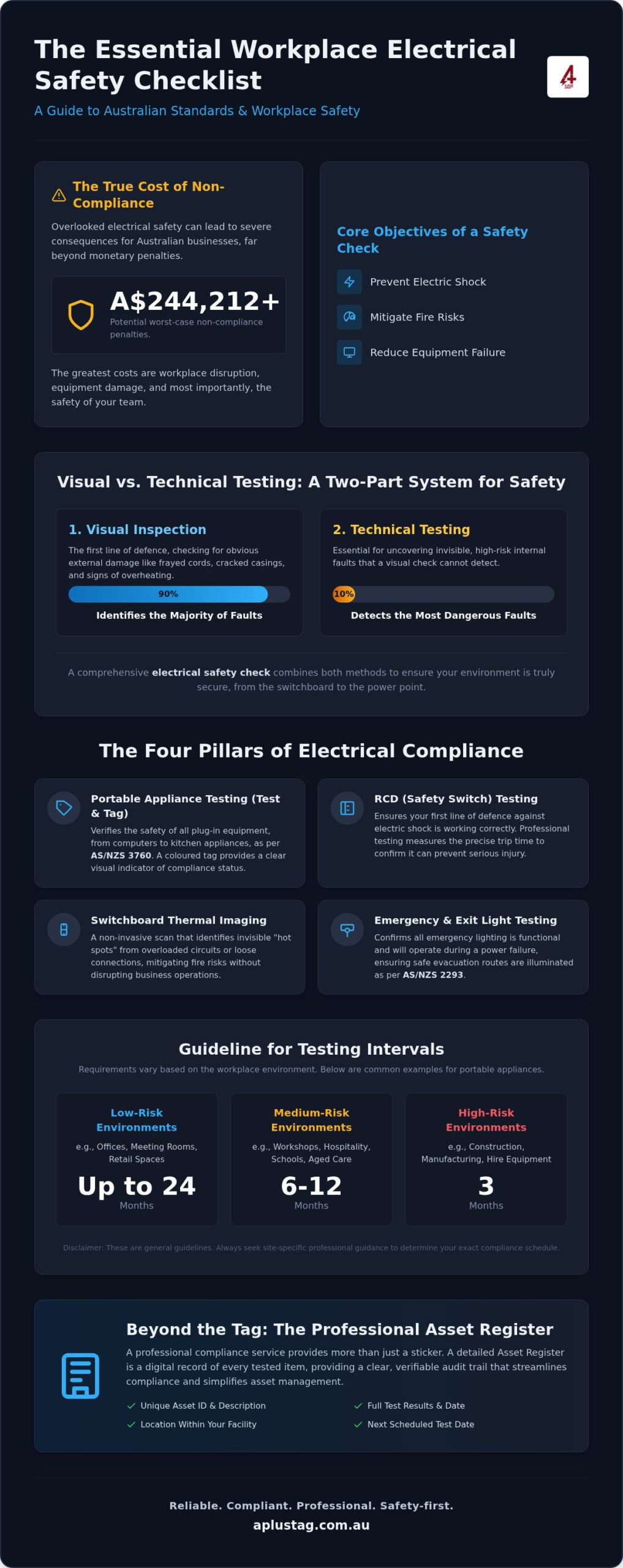
Could a single overlooked power lead really cost your Australian business more than A$244,212 in non-compliance penalties? While that figure represents a worst-case legal reality, the true cost of a neglected electrical safety check is often measured in workplace disruption or, more importantly, the safety of your team. You likely already know that staying on top of your obligations is vital, but the shifting requirements of AS/NZS 3760:2022 can make it difficult to keep track of what needs testing and when. It is common to feel overwhelmed by different testing intervals or the sheer volume of paperwork required to prove you have done the right thing.
We understand that you want a workplace that is both safe and audit-ready without having to become a technical expert yourself. This article provides a clear, manageable checklist to ensure your business meets current Australian standards and mitigates the risk of fire or shock. We will walk you through the essential phases of a professional inspection, from RCD testing to thermal imaging, while explaining how a systematic asset register can turn a complex requirement into a streamlined, stress-free routine.
Key Takeaways
- Understand the mandatory requirements of AS/NZS 3760:2022 to protect your business from significant non-compliance penalties.
- Learn how to conduct a systematic electrical safety check that balances routine visual inspections with precise technical testing.
- Discover the benefits of non-invasive thermal imaging for identifying invisible switchboard hazards without disrupting your business operations.
- Identify the specific testing intervals required for your unique workplace environment to ensure continuous protection and cost-efficiency.
- Establish a professional Asset Register to provide a clear, verifiable audit trail that goes beyond simple physical tags.
What is a Comprehensive Electrical Safety Check?
A comprehensive electrical safety check is more than just a quick glance at a power board. It’s a systematic, multi-stage inspection designed to verify the integrity of your entire electrical network. This process ensures that every component, from the main switchboard to individual portable appliances, operates within safe parameters. By identifying potential hazards before they escalate, you protect your staff and your physical assets from avoidable harm.
The core objectives of this systematic approach include:
- Preventing electric shock: Identifying damaged insulation or faulty earthing that could lead to direct contact with live parts.
- Mitigating fire risks: Detecting overloaded circuits or loose connections that generate excessive heat.
- Reducing equipment failure: Ensuring voltage levels and circuit protection are stable to prevent damage to sensitive office technology.
The Legal Duty of Care for Australian Employers
Under Australian Work Health and Safety (WHS) laws, employers have a primary duty of care to provide a safe workplace. Implementing a regular electrical safety check is considered a “practicable” step in managing risk. It isn’t just about avoiding fines; it’s about establishing a culture of safety. Adhering to the AS/NZS 3760:2022 standard provides a clear benchmark for compliance. This standard acts as the industry yardstick, ensuring that your maintenance cycles meet the expectations of regulators and insurance providers alike.
Visual vs. Technical Testing: Why Both Matter
It’s a common industry observation that roughly 90% of electrical faults are identified during a thorough visual inspection. This stage involves checking for frayed cords, cracked casings, and signs of overheating around plugs. While these checks are vital, they can’t see through the plastic casing of an appliance. Electrical safety testing provides the technical verification needed to uncover hidden dangers.
Non-negotiable tests like earth continuity and insulation resistance are essential because they detect internal faults that no human eye can spot. For example, a “live” chassis on a metal toaster or a faulty internal component in a computer power supply won’t show external damage. These invisible issues are often the most dangerous. A professional electrical safety check combines these technical measurements with visual scrutiny to ensure your office environment remains truly secure from the switchboard right down to the power point.
Your Workplace Electrical Safety Checklist
A systematic electrical safety check is the backbone of workplace risk management. It ensures that every device, from the kitchen microwave to the server room power supply, meets the rigorous standards set by Australian regulators. By following a structured checklist, you can transform a complex compliance task into a predictable part of your maintenance cycle. This proactive approach identifies hazards before they result in injury or equipment damage.
Portable Appliance Verification (Test and Tag)
Test and Tag is the process of electrical verification and physical labelling used to confirm an appliance is safe for continued use. In a standard office, the environment is generally considered “non-hostile,” meaning testing intervals are typically longer than those in high-risk settings like workshops or construction sites. However, even in a modern office, flexible cords and extension leads are prone to fraying from chair wheels or heavy foot traffic. The tagging system uses specific colours to indicate when an item was last tested and when its next check is due. This visual system allows your staff to identify compliant equipment at a glance, providing immediate peace of mind for everyone in the building. For a deeper understanding of how this process works across different industries, the complete guide to professional test and tag services covers everything from RCD testing to asset documentation in detail.
Fixed Installation and RCD Testing
While portable items are highly visible, your fixed protection systems require equal attention. Residual Current Devices (RCDs), often called safety switches, are designed to disconnect power in milliseconds if a fault is detected. Professional diagnostic testing goes beyond the standard “push-button” test to measure actual trip times under load conditions. This ensures the device reacts fast enough to prevent a fatal shock. According to Safe Work Australia, businesses must ensure that RCDs are tested regularly by a competent person to maintain a safe environment. Relying solely on the manual test button doesn’t provide the technical data needed to prove the switch will function during a genuine surge or fault.
Beyond these specific tests, a comprehensive electrical safety check should include a review of the main switchboard. It must be clear of debris, properly labelled, and secured against unauthorised access. Emergency and exit lighting must also be assessed for battery health and visibility. These units are your team’s lifeline during a fire or power outage, and a professional discharge test ensures the batteries can sustain illumination for the full duration required by Australian standards. If you find managing these various requirements difficult, you might consider how professional compliance reporting can simplify your documentation process and keep your records audit-ready.
Understanding Australian Standards and Testing Intervals
AS/NZS 3760:2022 is the primary standard governing the in-service safety inspection and testing of electrical equipment in Australia. It provides a structured framework for businesses to follow, ensuring that an electrical safety check is performed at appropriate frequencies. These intervals are not arbitrary. They are determined by the ‘environment’ in which the equipment is used. For instance, a drill on a building site faces significantly more wear and tear than a monitor in a corporate office.
Publicly accessible areas also carry a higher risk profile. Equipment in these zones, such as a kettle in a reception area or a shared charging station, often requires more frequent verification than items in restricted staff zones. Additionally, specialised environments like medical clinics must adhere to AS/NZS 3003. This standard covers patient areas where even minor electrical faults can have critical consequences for biomedical equipment. Managing these varying requirements is a core part of maintaining a compliant workplace.
Standard Testing Intervals at a Glance
The frequency of your testing cycle depends on the likelihood of equipment damage. Construction and demolition sites require a 3-month cycle due to the harsh, “hostile” nature of the work. In contrast, factories and warehouses typically operate on 6-month or 12-month intervals, depending on the specific use of the tools and the potential for moisture or heat exposure.
For modern office environments, the requirements are generally more relaxed but no less important. Most portable appliances require a 12-month check. However, stationary equipment that isn’t moved, such as a desktop computer or a heavy photocopier, may only require testing every 5 years. Following the Safe Work Australia electrical safety guidelines helps you determine the correct category for each asset. This ensures you don’t over-test your equipment while still maintaining a robust safety record.
The Role of the Competent Person
A “competent person” is legally defined as someone who has the necessary practical and theoretical knowledge, training, and experience to carry out the task. While this person doesn’t always need to be a licensed electrician, they must be trained to use calibrated testing equipment correctly. They must also stay updated with the latest amendments to Australian Standards to ensure every electrical safety check is valid.
Attempting DIY checks often fails to meet the stringent requirements of insurance providers and legal auditors. Without professional documentation and the use of specialised diagnostic tools, a business remains vulnerable to claims of negligence. A professional partner ensures your compliance is proactive rather than reactive, protecting your long-term operational stability and the safety of your team.
Thermal Imaging: The Modern Standard for Safety
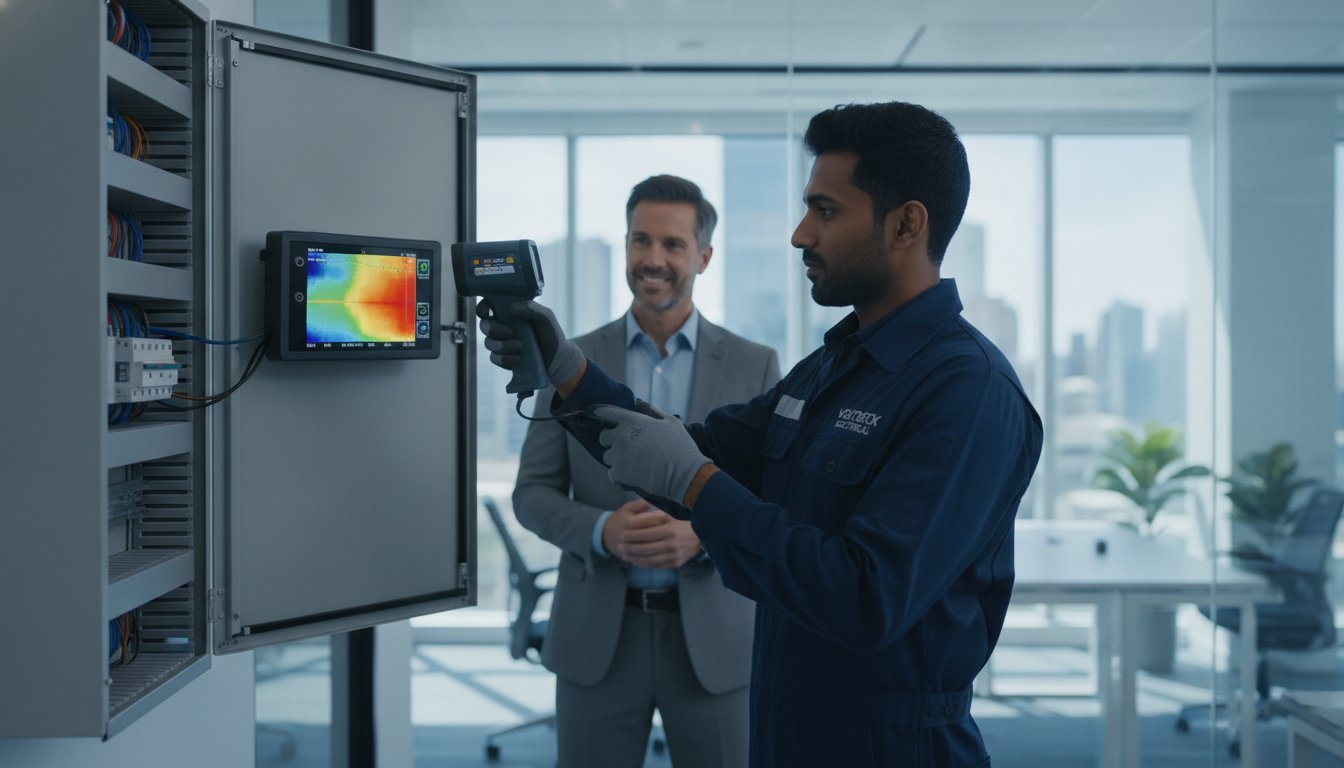
While the visual and technical tests mentioned previously are vital for individual appliances, a truly modern electrical safety check must look deeper into the heart of your building’s infrastructure. Thermal imaging has emerged as the gold standard for preventative maintenance in commercial settings. By using specialised infrared cameras, technicians can identify ‘hot spots’ that are completely invisible to the naked eye. This technology is particularly valuable because it is non-invasive. You don’t need to shut down power or disrupt your team’s workflow to get a clear picture of your switchboard’s health.
Loose connections, overloaded circuits, and faulty breakers are the primary culprits behind electrical fires. In a commercial switchboard, these issues often manifest as heat before they ever lead to a spark. Thermal imaging allows you to see this heat buildup in real-time. It acts as an early warning system, allowing you to address a minor connection issue before it escalates into a catastrophic fire or a total building blackout. This proactive approach is essential for maintaining the operational continuity of a busy office.
Preventing Switchboard Failures
A thermal scan can predict a component failure months before it actually happens. This level of foresight transforms your maintenance strategy from reactive to proactive. The cost-benefit ratio is clear. A minor preventative fix identified during a routine electrical safety check is significantly cheaper than the emergency electrical repairs required after a switchboard fire. Thermal imaging detects heat signatures caused by electrical resistance. By identifying these signatures early, you avoid the massive operational losses associated with unplanned downtime and equipment replacement.
Insurance Requirements and Risk Mitigation
The landscape of commercial insurance in Australia is changing. Many insurers now require annual thermal imaging reports as a condition of coverage for large office buildings or industrial sites. Providing professional documentation of these scans demonstrates a high level of diligence. It lowers your overall risk profile and can lead to more favourable insurance premiums. For facility managers, ‘before and after’ thermal evidence is an invaluable tool. It proves that repairs were effective and provides a clear historical record of the building’s electrical integrity. This transparency builds trust with both insurers and stakeholders. If you want to ensure your infrastructure is fully protected, you can book a professional thermal imaging survey to secure your facility’s future.
Managing Your Compliance and Asset Register
A physical tag on a power cord is a vital visual indicator, but it isn’t enough to satisfy a comprehensive safety audit. For a business to be truly compliant, you need a robust, verifiable audit trail that documents every single electrical safety check performed across your facility. If a tag is torn off or becomes illegible, your digital Asset Register serves as the definitive proof of your diligence. It transforms a scattered collection of stickers into an organised, professional database.
A professional Asset Register should be highly detailed. It needs to include a unique ID for every item, its specific location, the test results, and the scheduled date for the next inspection. This level of transparency is especially beneficial for national operations with multi-site footprints. Digital reporting allows head office to monitor compliance levels across various branches in real-time, ensuring that no location falls behind on its safety obligations.
When an appliance fails its inspection, the documentation is just as important as the physical removal of the item. A “failed item” report documents the specific fault and the corrective action taken, such as the item being decommissioned or sent for professional repair. This shows regulators that your safety system isn’t just a box-ticking exercise, but a functional process that actively removes hazards from the workplace. Without this documentation, you have no way to prove that a faulty item was ever identified or managed correctly.
Audit Readiness: What Happens When WorkSafe Visits?
When a WorkSafe inspector arrives at your premises, they typically look for three key pieces of evidence: physical tags on equipment, a complete asset register, and your overall electrical safety plan. Centralising these records in a digital format avoids the common pitfall of lost logbooks or incomplete spreadsheets. It allows you to provide instant verification of compliance, turning a potentially stressful visit into a routine demonstration of your high standards. Well-managed records are your best defence against claims of negligence or non-compliance.
Organising a Hassle-Free Safety Schedule
The most effective way to manage these recurring cycles is through a “set and forget” partnership. Instead of trying to track hundreds of different testing intervals yourself, you can rely on a dedicated compliance partner to handle the logistics. This proactive approach ensures you never miss a deadline, keeping your staff safe and your business protected from liability. A Plus Compliance Services manages these recurring cycles so you don’t have to worry about the details. You can organise your national electrical safety check with A Plus Compliance Services today to ensure your workplace remains compliant and secure for the long term.
Securing Your Workplace with Proactive Compliance
Maintaining a safe office environment in 2026 requires more than just reactive repairs. By integrating systematic testing cycles and advanced technology like thermal imaging, you transform your safety obligations into a streamlined business asset. A comprehensive electrical safety check does more than just tick a regulatory box; it protects your team from harm and secures your infrastructure against costly downtime. Transitioning to a digital asset register ensures you’re always prepared for an inspection, effectively removing the administrative burden from your daily operations.
A Plus Compliance Services acts as your dependable partner, providing specialised thermal imaging reports and detailed asset registers with every service. Our experienced technicians cover all Australian states, ensuring consistent standards and audit-readiness for every site you manage. Secure your workplace with a professional electrical safety check from A Plus Compliance Services to ensure your business remains safe, compliant, and focused on growth. Taking these steps today provides the peace of mind you need to lead with confidence.
Frequently Asked Questions
Is an electrical safety check mandatory for Australian businesses?
Yes, performing a regular electrical safety check is mandatory for all Australian businesses under Work Health and Safety (WHS) legislation. Every employer has a legal duty of care to provide a safe workplace, which includes ensuring all electrical equipment is fit for use. Failing to maintain these safety standards can lead to significant corporate penalties and increased liability in the event of a workplace accident.
How often should my office equipment be tested and tagged?
Testing intervals are determined by the type of environment where the equipment is used. In a standard office, most portable appliances require testing every 12 months, while stationary equipment like desktop computers may only need a check every five years. Conversely, hostile environments like construction sites require a three-month cycle. Following the AS/NZS 3760:2022 standard ensures your maintenance schedule matches your specific risk profile.
What is the difference between an electrician and a test and tag technician?
A licensed electrician is qualified to perform electrical installations and complex repairs, whereas a test and tag technician is a “competent person” specifically trained in safety verification. Technicians use specialised equipment to conduct an electrical safety check without needing the full scope of an electrician’s licence. This specialisation often makes technicians more efficient and cost-effective for routine compliance tasks like appliance testing and RCD verification.
Do new electrical appliances need to be tested before use?
New appliances don’t require technical testing before their first use, but they must still be visually inspected and tagged. Under Australian Standards, these items are labelled as “New to Service” to record when they entered the workplace. This initial step ensures the item is entered into your asset register, allowing you to track its future testing requirements and maintain a complete audit trail from day one.
What happens if an item fails an electrical safety check?
If an item fails, it must be immediately withdrawn from service to prevent accidental use. The technician will typically apply a “Danger” or “Failed” tag and move the item to a secure area. You then have the choice to either dispose of the faulty equipment or have it repaired by a licensed electrician. Professional test and tag services will document the failure, providing evidence that you’ve proactively managed the risk during your electrical safety check.
Are RCD tests required if we have a modern switchboard?
Yes, RCD testing remains a mandatory requirement even if your building features a modern switchboard. While newer boards have advanced protection, the mechanical components within a safety switch can still fail over time. Regular trip-time testing verifies that the device will disconnect power fast enough to prevent a fatal shock. Relying on the age of the board without technical verification leaves your team at unnecessary risk.
Does an electrical safety check include emergency lighting?
A comprehensive safety package often includes emergency and exit lighting, though it is a separate requirement from standard appliance testing. Australian Standards mandate that these lights undergo a discharge test every six months to ensure the batteries can sustain illumination during a power failure. Including this in your regular safety schedule simplifies your compliance management and ensures your evacuation paths are always clearly lit and functional.
Can I use a digital asset register for my safety audits?
You can and should use a digital asset register to manage your safety audits. Digital records are far more reliable than paper logbooks, as they provide a centralised, searchable database that can be accessed instantly during a WorkSafe visit. These registers track the history of every asset, including its location and past test results, making it much easier to demonstrate your long-term commitment to workplace safety.
