Emergency Lighting Testing: Australian Compliance Guide
That glowing green light on your exit sign might look reassuring, but it doesn’t guarantee your building will stay lit during a genuine power failure. Many facility managers assume a visual check is enough, yet the reality of emergency lighting testing and Australian safety requirements is far more rigorous. We understand that deciphering technical jargon can feel like a daunting task, especially when the safety of your team and the success of your next audit are on the line. It’s natural to feel uncertain about the specific differences between a quick check and a full six-monthly discharge test.
This guide simplifies the complexities of AS/NZS 2293, providing you with a clear, step-by-step path to maintaining Australian compliance without the stress. You’ll learn how to implement a repeatable process that ensures your equipment performs when it matters most. We’ll break down the essential maintenance cycles, explain how to keep your logbooks audit-ready, and help you establish a reliable routine that keeps your workplace secure and your documentation precise.
Key Takeaways
- Gain a clear understanding of AS/NZS 2293 standards and the specific role the National Construction Code plays in your building’s safety requirements.
- Implement a methodical emergency lighting testing sequence that focuses on proper preparation and safe isolation to ensure accurate results.
- Identify the critical importance of six-monthly discharge tests in detecting battery degradation early, rather than relying on simple visual checks.
- Understand the common causes of non-compliance and how to efficiently organise repairs when a system fails to meet its required duration.
- Learn how professional asset registers and systematic documentation can simplify your next safety audit and ensure long-term compliance.
The Foundations of Emergency Lighting and AS/NZS 2293 Standards
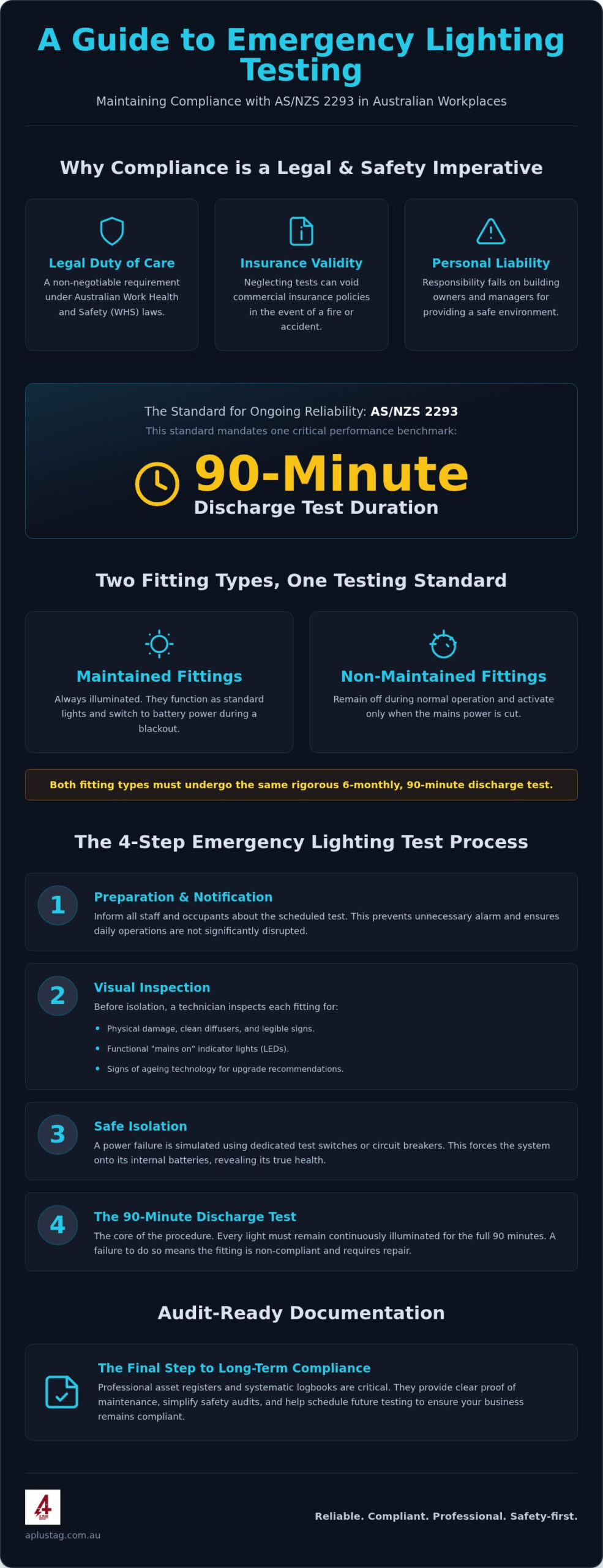
Emergency lighting acts as a critical safety net for your building. It’s a battery-backed system designed to activate automatically the moment the main power supply fails. While it might seem simple, the regulatory framework behind it is rigorous. The National Construction Code (NCC) sets the initial requirements for where these lights must be installed to ensure safe passage. However, the ongoing reliability of these systems is governed by AS/NZS 2293. This standard provides the blueprint for emergency lighting testing and maintenance, ensuring that every exit sign and emergency luminaire is ready for a crisis. It’s vital to understand that “functional” in this context goes beyond a light simply turning on. To meet Australian Standards, a unit must be capable of 90 minutes of continuous operation on battery power alone.
Why Compliance with AS/NZS 2293 is Non-Negotiable
Adhering to AS/NZS 2293 isn’t just a best-practice recommendation; it’s a legal necessity under Australian Work Health and Safety (WHS) laws. Building owners and employers hold a duty of care to provide a safe environment for occupants. If a failure occurs during an evacuation and the records show that emergency lighting testing was neglected, the consequences are severe. Beyond potential fines, non-compliance often voids commercial insurance policies. Most insurers require proof of regular maintenance to settle claims related to fire or workplace accidents. Ultimately, a lack of compliance places personal liability on those responsible for the building’s safety, making a methodical approach to testing essential for both physical and financial security. For a comprehensive overview of your obligations, reviewing the current emergency lighting standards Australia compliance guide is an essential starting point for any facility manager.
Maintained vs. Non-Maintained Fittings
You’ll encounter two primary types of fittings in most Australian workplaces. Maintained fittings remain illuminated at all times, functioning as standard lighting during the day and switching to battery power during a blackout. Non-maintained fittings stay dormant during normal operation, only activating when the mains power is cut. Despite these operational differences, both types require the same rigorous testing regime. Every six months, both maintained and non-maintained units must undergo a discharge test to verify their battery health. This ensures that the entire egress path remains visible during an emergency. An egress path is defined as the continuous and unobstructed way of exit travel from any point within a building to a place of safety.
A Step-by-Step Guide to the Emergency Lighting Testing Process
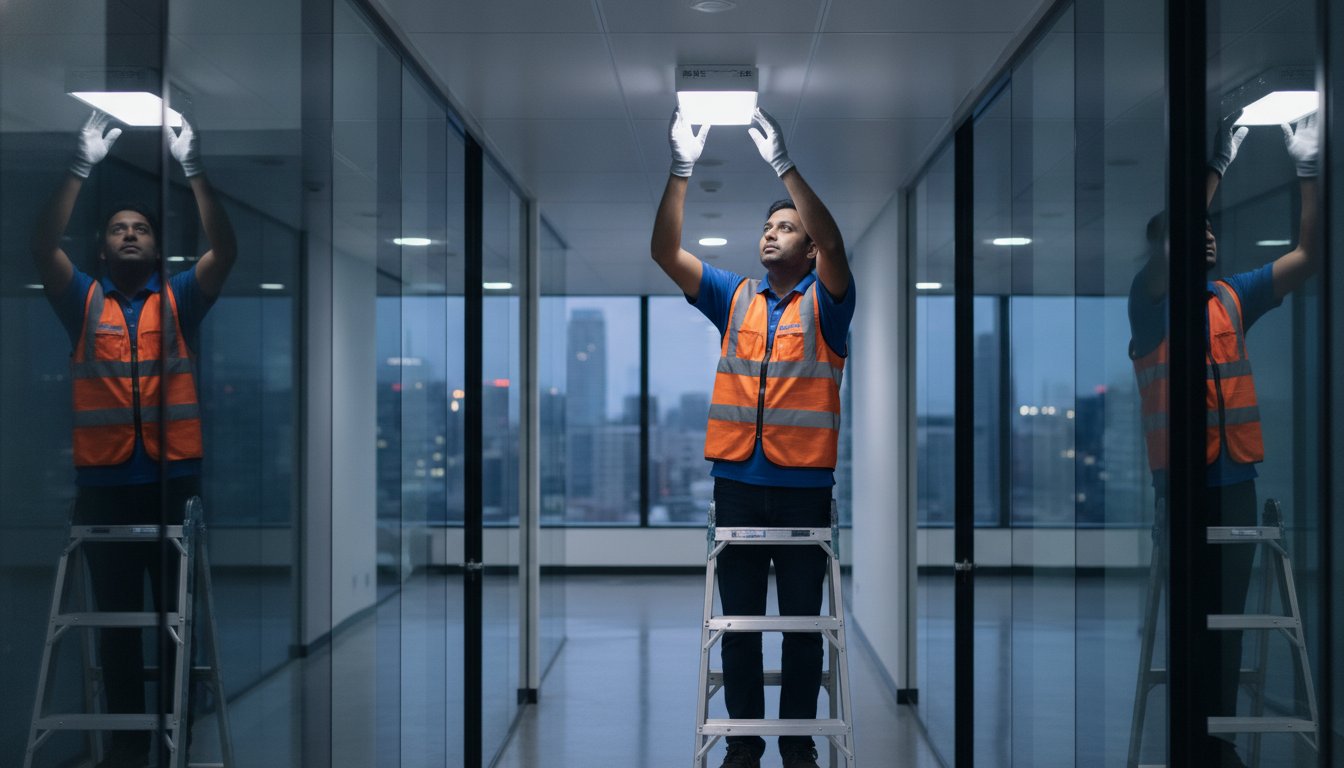
Effective emergency lighting testing begins well before the power is cut. It’s a systematic operation that requires careful coordination to avoid disrupting your daily business activities. First, notify all staff and occupants about the upcoming test. This prevents unnecessary alarm when lights shift to battery power or if the testing process triggers integrated safety systems. Providing this notice ensures that everyone remains calm and understands that the building’s safety features are being proactively managed.
Once preparation is complete, the isolation phase begins. Technicians use dedicated test switches or circuit breakers to simulate a total mains power failure. This forces the internal batteries to take over the load. It’s during this transition that the true health of your emergency system is revealed. A methodical approach ensures that no fitting is overlooked and that the simulation accurately reflects how the system would perform during a genuine emergency.
The Visual Inspection Phase
Before the clock starts on the discharge duration, a thorough visual assessment is required. Technicians check each fitting for physical damage, ensuring diffusers are clean and signs are clearly legible. The “mains on” indicator light, usually a small red or green LED, must be verified as functional before isolation begins. This is also the ideal time to identify ageing technology; older fluorescent tubes often show blackening at the ends and should be flagged for replacement with modern, energy-efficient LED fittings which offer superior reliability and lower maintenance costs.
Conducting the 90-Minute Discharge Test
The core of the procedure is the 90-minute discharge test. A precise timer is started the moment the mains power is isolated. Every individual fitting in the building must be monitored throughout this period. If any light dims significantly or fails completely before the 90-minute mark, it’s recorded as a failure. Documentation is critical here. Each fitting must have its own entry in the compliance logbook to satisfy audit requirements. Accurate record-keeping is the only way to prove that your emergency lighting testing meets the rigorous Australian Standards. Understanding the full procedure and common failure points is made easier with a dedicated AS 2293 discharge test guide that walks through every stage of the compliance process.
After the 90 minutes have elapsed, the mains power is restored. This final step is just as important as the test itself. Batteries require a full recharge cycle, typically 16 to 24 hours, to return to their peak readiness. Managing this entire cycle can be complex, which is why many businesses choose to outsource their compliance requirements to experienced professionals who ensure every step is documented correctly and every battery is given the time it needs to recover.
Frequency and Timing: Navigating 6-Monthly and Annual Requirements
Consistency is the backbone of any safety programme. Under the AS/NZS 2293 standards, emergency lighting testing is not a one-off event but a recurring cycle that must be performed every six months. This frequency is specifically designed to address the chemical reality of battery storage. Lead-acid and nickel-cadmium batteries, which power most emergency units, naturally degrade over time due to constant charging and ambient temperature fluctuations. By mandate, these six-monthly intervals ensure that failing components are identified and replaced well before a real power outage occurs.
While the six-monthly test focuses on performance, the annual inspection introduces a higher level of scrutiny. It’s a comprehensive audit of the entire system’s environment and physical condition. Many facility managers find it most efficient to coordinate these mandatory visits with other essential safety services. For example, aligning your lighting schedule with RCD testing or other electrical safety checks minimises workplace disruption and ensures that all compliance documentation is updated in a single, organised window.
The Six-Monthly Routine
The six-monthly routine centres on the 90-minute discharge test. This is a functional verification to ensure every battery-backed unit can sustain its required light output for the full duration. Documentation is just as important as the physical test. Your logbook must record the specific date of the test, the name of the qualified technician, and the individual results for every fitting. Accurate record-keeping is your primary defence during a safety audit. This visit also provides an ideal opportunity to review your fire extinguisher testing schedules, ensuring all life-safety equipment is serviced simultaneously.
The Twelve-Month Annual Audit
The annual audit goes beyond the battery discharge. It requires a detailed physical cleaning of all diffusers and reflective surfaces. Dust and grime accumulation can significantly reduce the effective light output, potentially leaving egress paths too dark for safe navigation. Technicians also perform a “Relationship Check” during this phase. This involves verifying that the emergency lights still correspond correctly to their designated normal lighting zones. It’s a critical step if your building has undergone any internal renovations or layout changes. We also conduct a full system audit to ensure that new shelving, partitions, or signage haven’t obstructed the visibility of exit signs from any point on the escape route.
Identifying Failures and Organising Essential Maintenance
A common objection raised during emergency lighting testing is that a fitting appears functional because it is currently illuminated. However, being “on” under mains power is not the benchmark for safety. Battery failure remains the most frequent cause of non-compliance in Australian buildings. These batteries are often subjected to harsh environmental factors, particularly heat trapped in ceiling cavities, which accelerates chemical degradation. Constant charging also takes a toll on battery life over time. When a unit fails to meet the 90-minute requirement, it must be clearly tagged. Repairs should be organised promptly to ensure the building remains compliant with Australian Standards.
Common Failure Points in Emergency Systems
Older systems often rely on Nickel-Cadmium (NiCd) batteries. These are prone to “memory” issues if they aren’t cycled correctly during regular maintenance. Modern Lithium-ion units offer better resilience, but even they aren’t immune to the effects of age and heat. Sometimes, the battery itself is healthy, but a failed ballast or faulty internal circuitry prevents it from receiving a charge from the mains. It is a critical compliance fact that a light passing a 30-minute discharge test still fails AS/NZS 2293 requirements if it cannot sustain the full 90-minute duration. Reliability depends on every internal component working in unison.
The Repair and Re-Testing Cycle
Identifying a fault is only the first step in the maintenance cycle. Once a fitting is repaired, it must undergo a fresh discharge test to confirm the fix was successful. Simply swapping a part doesn’t guarantee the unit will now last the required 90 minutes. Many facility managers find this the perfect time to upgrade to LED fittings. LEDs significantly reduce long-term maintenance costs and provide superior illumination during a power failure. After any major repairs, your technician must update your asset register and logbook. If you are dealing with recurring failures, you can book a professional compliance audit to get your system back to standard efficiently.
Streamlining Your Compliance with A Plus Compliance Services
Managing a building’s safety requirements shouldn’t be a source of constant stress. A Plus Compliance Services adopts a methodical approach to emergency lighting testing, transforming a complex regulatory burden into a predictable, transparent process. We act as a dependable partner, taking ownership of the recurring maintenance cycle so you never have to worry about missing a mandatory deadline. Our focus remains on providing a stress-free experience that prioritises the safety of your occupants and the integrity of your documentation.
Total site safety often involves multiple layers of protection. By combining your lighting schedule with specialised services like Thermal Imaging, we help you identify potential electrical faults before they lead to system failures or fire hazards. This proactive strategy ensures that every component of your electrical infrastructure is monitored by experts who value long-term reliability. We provide a grounded, practical solution that leads your facility from a state of uncertainty toward a state of organised control.
Digital Asset Registers and Audit Readiness
Our digital documentation is designed for immediate audit readiness. Facility managers benefit from a complete historical record of every fitting, which allows for precise long-term budgeting and replacement planning. This systematic reporting significantly reduces your administrative workload, ensuring you always have the right data at your fingertips during a safety inspection. Having a clear, transparent asset register means you can track the performance of every unit in the building, making it easy to identify which areas require future investment or upgrades.
National Reach and Expert Technicians
We provide consistent safety standards for businesses with operations across Australia. Our technicians are compliance specialists who understand the nuances of AS/NZS 2293, offering a level of expertise that goes beyond general electrical work. This specialised focus gives you peace of mind, knowing that your emergency lighting testing is being handled by professionals who prioritise accuracy and thoroughness. We are committed to maintaining high standards across every site we service, ensuring your compliance is managed with punctuality and professional care. Organise your next emergency lighting test with A Plus Compliance Services today to ensure your workplace remains safe and fully compliant.
Securing Your Workplace Through Methodical Compliance
Maintaining safety standards requires more than just a passing glance at an exit sign. It involves a systematic commitment to the AS/NZS 2293 maintenance cycle, ensuring every battery is capable of the mandatory 90-minute discharge. By identifying failures early and keeping precise records, you protect your occupants and satisfy the rigorous requirements of safety auditors. Establishing a repeatable, professional routine for emergency lighting testing provides the ultimate peace of mind for facility managers.
A Plus Compliance Services acts as your dependable partner, simplifying complex WHS obligations through national service coverage and specialised expertise. Our methodical approach combines detailed compliance reporting and asset registers with advanced techniques like specialised thermal imaging testing to identify potential faults before they escalate. It’s a proactive strategy that ensures your building remains a controlled and safe environment at all times.
Ensure your workplace is safe and compliant with a professional emergency lighting audit from A Plus Compliance Services. With the right systems in place, your facility remains ready for any emergency.
Frequently Asked Questions
Is emergency lighting testing mandatory for all Australian businesses?
Yes, testing is a mandatory requirement under Australian Work Health and Safety laws and state-based building regulations. Every commercial building must adhere to AS/NZS 2293 to ensure that safety systems are operational for occupant evacuation. Failure to maintain these systems can lead to significant fines and may void your commercial insurance coverage.
How long does a discharge test actually need to last?
A formal discharge test must last for a minimum of 90 minutes. This specific duration is set by Australian Standards to ensure that even in a prolonged power outage, there’s sufficient illumination for everyone to exit the building safely. If a light fails at the 85-minute mark, it’s considered non-compliant and requires immediate maintenance.
Can I perform emergency lighting testing myself or do I need a professional?
While a building owner can perform basic visual checks, the standard requires a “competent person” to conduct the formal emergency lighting testing. Professionals provide the technical expertise and calibrated equipment needed for accurate discharge testing. They also ensure your documentation is audit-ready, which is difficult to achieve without specialised compliance software or asset registers.
What is the difference between a 6-monthly and an annual emergency light test?
The six-monthly test focuses on the 90-minute battery discharge and a visual inspection of the fittings. The annual test is more comprehensive, requiring the cleaning of all diffusers and reflective surfaces to maintain light output. It also includes a “Relationship Check” to verify that the emergency units still correctly align with the building’s current lighting zones and floor plan.
What happens if one of my exit lights fails the 90-minute test?
If a fitting fails, it must be repaired or replaced promptly to restore building safety. Once the repair is finished, the unit must undergo another full 90-minute discharge test to confirm the fix was successful. All failures and subsequent repairs must be recorded in your compliance logbook to maintain a complete audit trail.
How long do the batteries in emergency lights typically last before needing replacement?
Most emergency lighting batteries have a service life of three to five years. However, environmental factors like high temperatures in ceiling cavities or frequent power fluctuations can cause batteries to degrade much faster. Regular emergency lighting testing is the only way to catch these failures early before they compromise your safety during a real blackout.
Do I need to keep a physical logbook of all emergency lighting tests?
You must maintain a record of all tests, but it doesn’t have to be a physical book. Digital asset registers and electronic logbooks are becoming the standard because they’re easier to update and harder to lose. The key requirement is that the records are accurate, up-to-date, and readily available for inspection by fire authorities or safety auditors.
What is the “Egress path” and why does it matter for light placement?
The egress path is the designated, unobstructed route that occupants must follow to exit a building safely during an emergency. Emergency lights and exit signs are strategically placed to illuminate this specific path. If you renovate your office or move large shelving units, you must ensure they don’t block the visibility of these lights or the egress path itself. Understanding the full scope of emergency lighting standards in Australia can help you make informed decisions when planning any building modifications that may affect your egress routes.
