Residential Smoke Alarm Testing in Victoria: What to Check and When
Could a smoke alarm respond to a quick button test while still needing a more thorough check? Residential smoke alarm testing in Victoria depends on the property and who occupies it, so pressing the test button may not be the whole picture.
It’s understandable to be unsure who should arrange checks, what they should cover and how often to follow up. For Victorian rental properties, rental providers are responsible for ensuring alarms are checked at least every 12 months in line with the manufacturer’s instructions. Other homes may have different considerations, including the alarm’s age, type and installation.
This guide explains what to clarify when arranging a check, how a button test differs from a provider’s service, and what information to have ready. It also covers practical ways to record checks and follow up on faults. A Plus Compliance Services is based in Melbourne and offers residential smoke alarm testing across Victoria. Confirm the service scope for your property before arranging a check.
Key Takeaways
- Residential smoke alarm testing victoria depends on the home’s circumstances, so check which guidance applies before setting a testing plan.
- A household button check can show whether an alarm responds to that control, but ask what a provider’s service covers.
- Before arranging a visit, note the property type, occupancy and any known alarm concerns so the testing scope can be discussed clearly.
- Ask how faults or follow-up needs will be communicated, and keep a record to help organise future checks.
- A Plus Compliance Services is based in Melbourne and offers residential smoke alarm testing across Victoria.
Residential smoke alarm testing in Victoria: what it checks and why it matters
Residential smoke alarm testing checks an alarm’s condition and operation to assess whether it is working as expected. The specific checks depend on the provider’s service scope and the property, so ask what the visit includes before booking.
Homeowners and rental providers should distinguish testing from installation, repair or replacement. A Plus Compliance Services lists residential smoke alarm testing as a service, but confirm the procedure and any follow-up work directly rather than assuming they are included.
For background on how smoke detectors work, you can read more about common detector types and their operation.
For additional context on household smoke alarm advice, watch this 7NEWS report:
What is included in a residential smoke alarm test?
A test may involve checking an alarm’s operation and visible condition, but the precise method varies by provider. A household button check is not automatically the same as a provider’s service, and there is no provider-specific checklist that should be treated as a universal Victorian requirement. Before arranging a visit, ask which alarms will be checked, what the test covers and how any concerns will be communicated.
Testing also has limits. It does not, by itself, mean an alarm has been installed, repaired or replaced. A Plus Compliance Services offers residential smoke alarm testing. Confirm whether a separately identified issue requires other work and who can arrange it. You can view the company’s residential smoke alarm testing service information when making an enquiry.
Why does a working smoke alarm matter at home?
A functioning alarm can provide an early warning, giving people in the home an opportunity to respond. Fire Rescue Victoria (FRV) recommends smoke alarms in every bedroom and living area. FRV also cautions that an alarm outside a closed bedroom may not activate for a fire inside, so placement matters as well as operation. This is practical safety guidance, separate from any legal obligations that may apply to a particular property.
If you’re unsure what your home needs, note the alarm locations and any known issues, then ask about the service scope for the property. This makes it clearer what will be checked and what follow-up, if any, to organise.
How Victorian smoke alarm testing requirements depend on the property
The appropriate testing plan depends on how a property is used and which rules apply. Rental-provider responsibilities should not automatically be applied to an owner-occupied home or a rooming house. Before booking residential smoke alarm testing in Victoria, identify the property category and check current guidance for that situation.
What should rental providers and property managers confirm?
Consumer Affairs Victoria guidance states that Victorian rental properties require a smoke alarm safety check at least every 12 months from 25 November 2025. It identifies the rental provider as responsible for ensuring alarms are correctly installed, working and checked in line with manufacturer instructions. Requirements can change, so verify the current guidance with Consumer Affairs Victoria before relying on this information to plan a check.
Property managers and rental providers can also clarify practical arrangements with the relevant contacts. Confirm how access will be organised, how residents will be informed and where check records will be kept. If there’s a known fault, raise it promptly with the responsible property contact rather than treating it as a routine booking detail.
Do owner-occupied homes and rooming houses follow the same guidance?
Do not assume the rental-property check cycle applies to every home or occupancy type. An owner-occupied property, a rooming house and a standard rental may involve different considerations. Check the applicable Victorian government guidance for the specific property, and seek site-specific advice if the category or responsibility is unclear.
Fire-safety recommendations are useful context, but they are not a substitute for checking legal obligations. For example, the CFA smoke alarm recommendations can help households consider alarm placement alongside the requirements that apply to their property.
Before arranging a check, confirm:
- Whether the property is owner-occupied, rented or a rooming house.
- Who is responsible for arranging and recording checks.
- When the last check took place, if known, and whether any alarm concerns have been reported.
- Who will coordinate access and communicate with residents.
- What the provider’s testing scope includes and how any follow-up needs will be raised.
These details help establish a clear scope without assuming every property has the same requirements. A Plus Compliance Services offers residential smoke alarm testing in Melbourne and throughout Victoria. Discuss the property circumstances and confirm the service scope before arranging a check.
Smoke alarm testing versus a quick button check: what should you compare?
A household button check and a booked testing service are not automatically equivalent. Pressing an alarm’s test button can show whether it responds to that control, but it should not be treated as proof that every aspect of the alarm’s operation or condition has been assessed. When arranging residential smoke alarm testing in Victoria, compare the proposed service scope with the needs of your property and any applicable requirements.
| Check or service | What it may cover | What to clarify |
|---|---|---|
| Household check | Checks carried out in line with the alarm manufacturer’s instructions, including a button test if directed. | How often to check and what to do if the alarm doesn’t respond. |
| Professional testing | The checks agreed with the provider for the property and alarm types. | Which alarms and functions are included, and how results or concerns will be communicated. |
| Repair or replacement | Separate work to address a fault or replace an alarm, if available from the provider. | Whether this work is offered, who will arrange it and what happens if a fault is found. |
What can a resident check between professional visits?
Follow the alarm manufacturer’s instructions for routine checks rather than relying on a one-size-fits-all method. A button test is one part of that routine, not a complete assessment of every alarm function. Look out for visible damage or an apparent fault. If an alarm will not operate, raise the issue promptly with the responsible property contact and ask what follow-up is needed.
What should you ask a smoke alarm testing provider?
Before booking, ask the provider to define the service in plain terms. A Plus Compliance Services offers residential smoke alarm testing, but confirm its current testing procedure and the scope for your home directly. Do not assume that testing includes repairs, replacement or a particular report unless the provider confirms this.
- Which alarms and functions are included in the agreed scope?
- How will access be arranged, and what happens if an alarm can’t be reached or checked?
- How will a fault or recommended follow-up be communicated?
- Are repair or replacement options included, or would these need to be arranged separately?
It may seem unnecessary to arrange professional help if an alarm responds to its button test. However, a button response alone does not establish that all relevant checks have been completed. Whether a provider visit is appropriate depends on the property, its occupancy and the requirements that apply. Confirm those details, then choose a scope that addresses the actual need rather than assuming every home requires the same service.
How to prepare for residential smoke alarm testing in Victoria
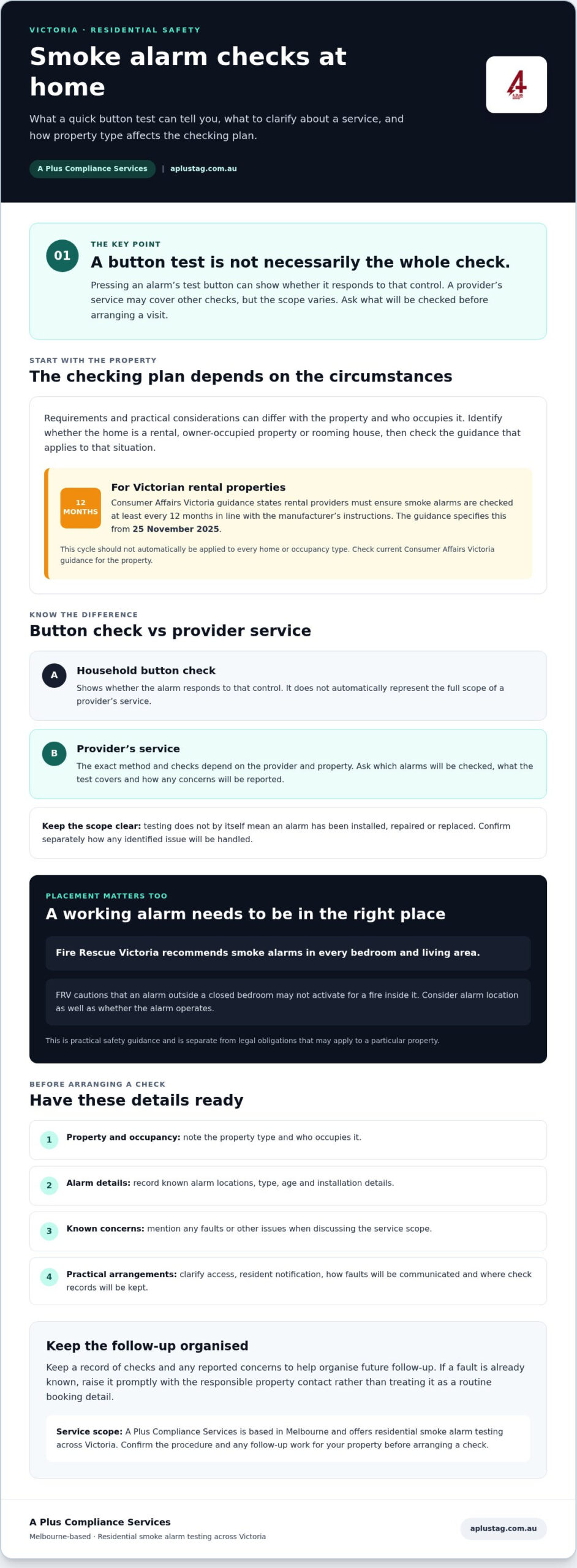
A practical plan for residential smoke alarm testing in Victoria starts with gathering the details a provider needs to understand your property. This helps you discuss the scope and access before arranging a visit. Requirements vary according to the property and applicable rules, so confirm the guidance relevant to your home or rental.
Booking checklist
- Identify the property. Note whether it’s owner-occupied, rented or another type of residence, such as a rooming house. If it’s a rental, confirm with the property manager or rental provider who is responsible for arranging the check.
- Gather alarm details and concerns. List any known issues, such as an alarm that doesn’t appear to operate or visible damage. If you know where the alarms are located, note the rooms or areas involved.
- Confirm the service scope. Ask which devices and areas the proposed service will cover, what checks are included and whether anything is outside scope. Don’t assume testing includes repairs, replacements or a particular report.
- Arrange access and communication. Confirm who will provide access, whether residents need to be notified and how the provider should raise any access issue. Tell the provider about restrictions or concerns in advance.
- Record the outcome and follow-up. Ask how findings and any recommended next steps will be communicated. Keep relevant service information with the property records so it’s available when planning future checks.
This checklist gives the provider useful context without assuming every Victorian home has the same testing needs. For rental properties, check current Consumer Affairs Victoria guidance on applicable responsibilities and check frequency. If the property type or responsible contact is unclear, confirm those details before booking.
What should happen if a concern is identified?
Ask the testing provider to explain what was found, which alarm or area is affected and what follow-up they recommend. Confirm directly whether any next step is included in the testing service or needs to be arranged separately. A Plus Compliance Services offers residential smoke alarm testing in Melbourne and throughout Victoria, but don’t assume it carries out repairs or replacements. Clarify the scope with the provider and the relevant property contact.
Once you’ve confirmed the property details and service scope, you can organise the next step with a clearer understanding of what to expect.
Arrange residential smoke alarm testing with a Victorian provider
Arranging a check is more straightforward when you can explain the property, confirm what the service covers and agree how any concerns will be followed up. For residential smoke alarm testing in Victoria, first check which requirements apply to your property and occupancy. Then discuss those details with a provider before confirming a booking.
What to look for in a local smoke alarm testing service
Choose a provider that can explain its testing scope clearly and discuss how the property’s circumstances may affect the service. A useful conversation should establish which alarms or areas are included, what the check involves and how the provider will communicate if an alarm can’t be assessed or a concern is identified.
Before making arrangements, confirm that the provider services your location and ask about access requirements. This matters whether you’re a homeowner organising access yourself or a rental provider or property manager coordinating with residents. Don’t assume availability, appointment times or follow-up work; check those details directly.
Discuss a testing plan for your property
A Plus Compliance Services is based in Melbourne and offers residential smoke alarm testing in Melbourne and throughout Victoria. Homeowners, rental providers and property managers can explain the property type, occupancy, known alarm concerns and access arrangements when making an enquiry. This gives the provider a practical starting point for discussing the service scope without assuming every residence needs the same approach.
Before you proceed, consider asking:
- Which alarms and areas are included in the proposed check?
- What should be accessible on the day?
- How will any concerns or recommended next steps be communicated?
- Should any repair or replacement be arranged separately?
Keep the agreed scope and any relevant follow-up information with your property records. For rental properties, check current official Victorian guidance about responsibilities and testing frequency, and seek advice that reflects your specific circumstances if anything is unclear.
Make your smoke alarm checks easier to manage
A practical testing plan starts with the property: confirm which guidance applies, identify who will arrange access and agree exactly what the provider will check. A button test can be part of routine checking, but it should not be treated as proof that every alarm function or concern has been assessed.
For residential smoke alarm testing in Victoria, homeowners, rental providers and property managers should confirm the service scope and how any faults or follow-up needs will be communicated. Requirements can vary with property type and occupancy, so check current official guidance for your circumstances.
A Plus Compliance Services lists residential smoke alarm testing among its services. Based in Melbourne, the business serves customers across Victoria and can discuss your property’s testing needs.
Clear property details and an agreed scope make it easier to plan follow-up and keep future checks organised.
Frequently Asked Questions
How often should residential smoke alarms be tested in Victoria?
Testing frequency depends on the property, its occupancy and the requirements that apply. Victorian rental properties require a smoke alarm safety check at least every 12 months, in line with the manufacturer’s instructions. For other homes, don’t assume the rental schedule applies. Check current official Victorian guidance and the alarm manufacturer’s instructions, or seek site-specific advice about the appropriate testing plan for your property.
Are annual smoke alarm checks required for Victorian rental properties?
Yes. Consumer Affairs Victoria guidance states that rental properties must have a smoke alarm safety check at least every 12 months from 25 November 2025. This applies to rental agreements regardless of when they began. Rental providers should confirm the latest official guidance before arranging checks, as requirements may change. Keep relevant check information with the property records so it can be referred to when organising future checks.
Can I test a smoke alarm by pressing its button?
You can use the test button as part of routine checking if the alarm manufacturer’s instructions direct you to do so. A response to the button doesn’t prove that every alarm function or its overall condition has been assessed. Follow the instructions for your specific alarm, and arrange follow-up if it doesn’t respond, appears damaged or raises another concern. A household button check and a provider’s service may have different scopes.
What does professional residential smoke alarm testing include?
The exact scope depends on the provider and should be confirmed before booking. Ask which alarms and areas will be checked, what functions the service assesses and how concerns will be communicated. Don’t assume testing includes installation, repair, replacement or a particular report unless the provider confirms this. A Plus Compliance Services lists residential smoke alarm testing as a service, but you should ask directly about its current procedure.
Who is responsible for smoke alarm checks in a Victorian rental property?
The rental provider is responsible for ensuring smoke alarms in a Victorian rental property are correctly installed, working and checked at least every 12 months according to the manufacturer’s instructions. Property managers may coordinate access and communication, so confirm arrangements with the relevant contact. Renters should notify the landlord or agent in writing as soon as possible if an alarm isn’t working, and shouldn’t tamper with or remove it.
What should I do if a smoke alarm does not work during a check?
Notify the responsible property contact promptly if an alarm doesn’t work. In a rental property, a faulty or non-working smoke alarm is classified as an urgent repair, and the rental provider must arrange immediate repair or replacement. Ask the testing provider to explain what was found and clarify next steps. Don’t assume testing includes repair or replacement; keep relevant communications with your property records for follow-up.
Can I arrange residential smoke alarm testing in Melbourne or elsewhere in Victoria?
Yes. A Plus Compliance Services is based in Melbourne and offers residential smoke alarm testing to customers across Victoria, including Melbourne, St Kilda, Caulfield, Oakleigh, Clayton, Springvale, Mulgrave, Dandenong, Berwick, Mount Waverley, Cranbourne, Bayswater, Notting Hill, Scoresby, Officer, Pakenham and Keysborough. Contact the provider to confirm availability, access arrangements and the proposed scope for your property.
