
Complete Guide to Exit Light Testing and Australian Compliance Standards
Maintaining a safe workplace is often viewed as a series of technical hurdles, but the true value of exit light testing lies in the integrity of your documentation, not just the function of a bulb. It’s understandable why many facility managers feel overwhelmed by the specific technicalities of AS/NZS 2293. Between inconsistent reporting from previous contractors and the constant worry of failing a fire safety audit, the process can feel like an unnecessary disruption to your daily operations.
We believe that safety compliance should provide peace of mind rather than a headache. This guide will help you master the essentials of exit light testing to ensure your workplace remains fully compliant and safe for all occupants. We’ll outline the exact requirements of Australian Standards, explain how to maintain audit-ready asset registers, and show you how a systematic testing cycle keeps your business protected without the stress.
Key Takeaways
- Identify the specific regulatory obligations under AS/NZS 2293 and the National Construction Code to maintain building compliance.
- Understand the critical role of the mandatory 90-minute discharge test as the core component of your exit light testing schedule.
- Compare the operational differences between manual and monitored systems to choose the most effective maintenance path for your site.
- Recognise common failure points, such as battery depletion and LED faults, to proactively manage repairs and avoid audit failures.
- Discover how a detailed asset register serves as your primary defence during safety audits and ensures consistent standards across all Australian sites.
Understanding Exit Light Testing Standards in Australia
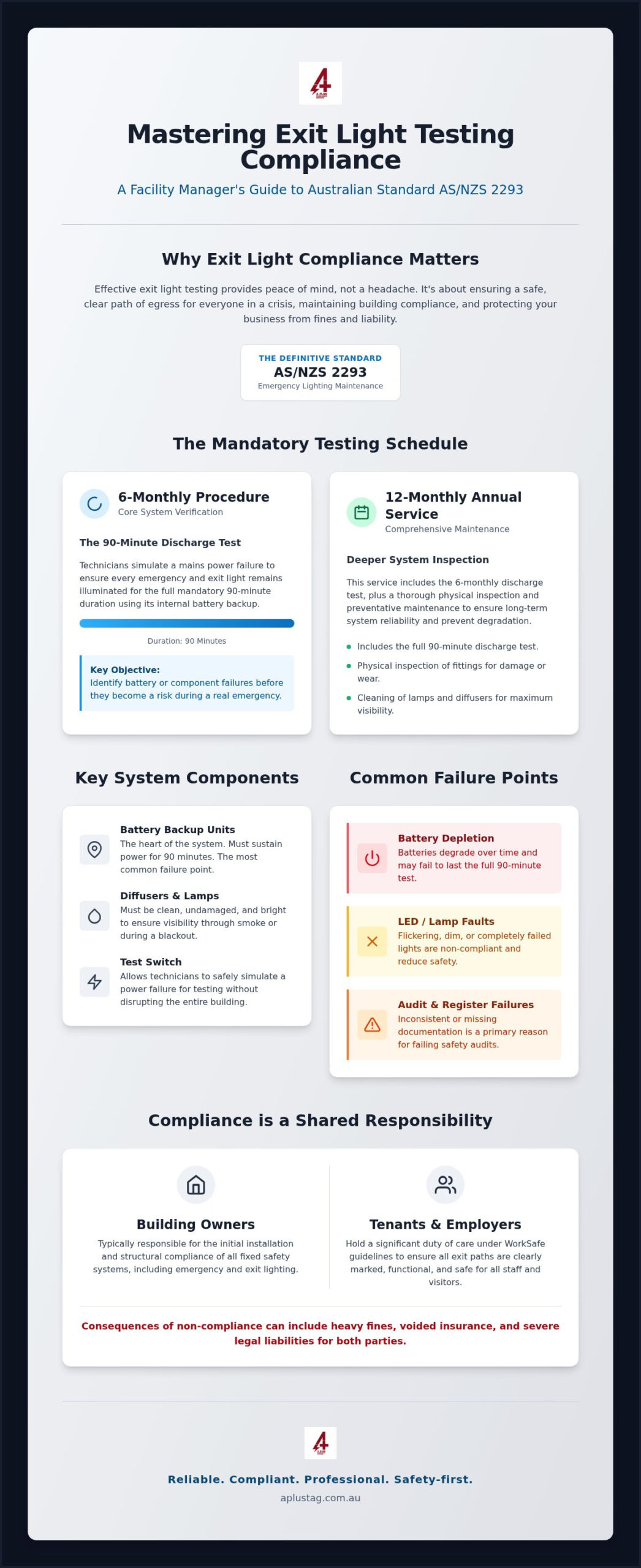
AS/NZS 2293 is the definitive standard for emergency lighting across Australia. It provides a systematic framework to ensure safety systems function correctly when they’re needed most. While the National Construction Code (NCC) dictates where these lights must be installed based on building classification, AS/NZS 2293 Part 2 focuses specifically on ongoing maintenance. Every commercial building and multi-residential structure must adhere to these regulations to maintain a safe egress path for all occupants. This isn’t just about ticking a box; it’s about ensuring that in a crisis, the way out is clearly visible. For a detailed breakdown of how these regulations apply in practice, the emergency lighting standards Australia 2026 compliance guide provides a comprehensive step-by-step framework for facility managers.
Understanding the difference between maintained and non-maintained fittings is vital for effective site management. A maintained fitting stays illuminated at all times, drawing power from the mains during normal operation. In contrast, a non-maintained fitting only switches on when the local power supply fails. Both systems rely on an internal battery backup to function during an emergency. Regular exit light testing is the only way to verify that these batteries can sustain the light for the legally required duration, regardless of the fitting type.
Who is Responsible for Compliance?
Responsibility for workplace safety is rarely a solo endeavour. While building owners are typically responsible for the installation and structural compliance of safety systems, tenants share a significant duty of care. Under WorkSafe Australia guidelines, employers must ensure that all exit paths are clearly marked and functional for their staff. If a fire safety audit reveals missing records or faulty equipment, both parties may face heavy fines. In the event of an actual emergency, the lack of a verified testing history can lead to severe legal liabilities and may even void insurance policies. It’s a shared responsibility that requires clear communication and consistent scheduling.
Key Components of an Exit Light System
A reliable exit light is more than just a glowing sign. It’s a specialised piece of electrical equipment designed to operate under duress. The system consists of several critical parts:
- Battery backup units: These are the heart of the system and the most common failure point. They must provide at least 90 minutes of power during a discharge test to meet Australian standards.
- Diffusers and lamps: These components must be kept clean and free from damage. If a sign is too dim, discoloured, or flickering, it won’t be visible through thick smoke or during a total blackout.
- The test switch: This allows technicians to simulate a power failure for a specific circuit. It ensures the lights activate as intended without the need to shut down power to the entire building.
The Testing Schedule: 6-Monthly and Annual Procedures
AS/NZS 2293.2 mandates a strict routine to ensure your safety systems remain operational. This isn’t a random check; it’s a systematic cycle designed to catch potential battery failures before they become a liability. The primary mechanism for this is the 90-minute discharge test. This procedure must occur every six months, with a more comprehensive service performed annually. Consistency is the key to maintaining a compliant workplace that stands up to scrutiny during any fire safety audit.
The 6-Month Discharge Test Explained
Technicians begin the process by isolating the power to the emergency lighting circuits. This safely simulates a complete mains failure without needing to shut down the entire building’s electrical supply. During this mandatory 90-minute window, every single exit light must remain fully illuminated. If a light dims or cuts out before the timer reaches zero, the unit is recorded as a failure. We don’t just note the fault; we identify the specific cause, such as a depleted battery or a faulty inverter, to allow for immediate rectification. This thorough approach to exit light testing ensures your asset register is transparent and your site remains audit-ready at all times. For a complete walkthrough of the step-by-step procedure and what inspectors look for, the AS 2293 discharge test essential guide to emergency lighting compliance covers every stage of the process in detail.
The 12-Month Annual Service
The yearly inspection builds upon the six-monthly discharge test by adding layers of preventative maintenance. It’s a deeper dive into the system’s physical condition to prevent long-term degradation. During this service, we focus on three main areas:
- Cleaning and Visibility: Dust and grime build up on diffusers over twelve months, which can significantly reduce light output. We clean all reflective surfaces and covers to ensure maximum clarity during an evacuation.
- Zone Assessment: We verify the relationship between your emergency fittings and the normal lighting zones. If your office layout has changed or partitions have been moved, the emergency lighting may no longer provide the required coverage for the egress path.
- Battery Health and Terminals: Technicians perform a detailed inspection of battery terminals for signs of corrosion or leakage. Securing these connections is vital for the long-term reliability of the system.
Once the testing concludes, the final step is restoration. Our technicians ensure every fitting is switched back to mains power and that the charging indicators are active. This guarantees the system is recharging and ready to protect your occupants immediately after we leave the site. Managing these recurring cycles can be complex, but partnering with an expert for your emergency lighting compliance makes the process entirely stress-free.
Choosing between manual and monitored systems is a strategic decision that affects your long-term compliance labour. While the end goal of exit light testing remains the same, the path to achieving it depends on your building’s scale and your budget for maintenance automation. Manual systems are the traditional standard, whereas monitored systems offer a high-tech, data-driven approach to safety management.
Self-testing fittings provide a middle ground for many businesses. These units perform their own internal diagnostic checks at regular intervals. If a fault is detected, such as a battery failure or a lamp malfunction, a small LED indicator on the fitting will change colour or flash. This simplifies the inspection process, as technicians can quickly identify which units require attention without waiting for a full discharge cycle to reveal every issue. It’s an efficient way to stay on top of maintenance between formal testing dates.
When to Choose Manual Testing
Manual testing is often the most practical choice for smaller sites, such as local retail shops or small office suites with fewer than 20 exit lights. The hardware is significantly more affordable, making it ideal for budget-conscious fit-outs where the cost of a centralised monitoring network isn’t justified. However, this method requires a technician to physically operate a test switch and walk the site to verify every unit. Even with self-testing fittings, a physical visual inspection is still required to ensure the diffusers are clean and the signage is unobstructed. It’s a hands-on approach that works well when the facility’s footprint is manageable.
The Benefits of Monitored Emergency Lighting
For large-scale facilities like hospitals, shopping centres, or high-rise commercial towers, monitored systems are the superior option. These systems connect every fitting to a central computer or cloud-based platform that logs data automatically. The benefits include:
- Real-time fault detection: You don’t have to wait for the next six-monthly cycle to find a dead battery; the system alerts you the moment a fault occurs.
- Automated compliance logging: The system generates digital reports that are instantly audit-ready, reducing the risk of human error in manual record-keeping.
- Reduced labour costs: Because the system initiates the 90-minute discharge test and records the results remotely, on-site labour is focused solely on fixing known faults rather than searching for them.
Ultimately, the upfront investment in a monitored system pays for itself through reduced service time and enhanced data accuracy. When planning your next exit light testing schedule, consider whether the convenience of automation outweighs the initial savings of a manual setup. A well-chosen system ensures your documentation remains precise and your building stays safe with minimal disruption.
Common Failure Points and Maintenance Requirements
Identifying faults during scheduled exit light testing is only the first step in a robust safety strategy. To prevent recurring issues and avoid the stress of a failed audit, facility managers must recognise the environmental and technical stressors that compromise these systems. Most failures aren’t random; they’re the result of predictable wear and tear that can be managed through proactive servicing. Understanding these common failure points allows you to move from a reactive “fix-on-fail” approach to a more reliable, systematic maintenance cycle.
Maximising Battery Life
Australian climates present a unique challenge for emergency lighting. High ambient temperatures in ceiling spaces can significantly shorten the lifespan of traditional Nickel Cadmium (NiCd) batteries, often leading to premature depletion. Modern installations are increasingly shifting toward Lithium (LiFePO4) technology, which offers better thermal stability and a longer service life. Interestingly, the mandatory 90-minute discharge test serves a dual purpose. Beyond verifying compliance, it actually helps maintain battery health by exercising the cells and ensuring the charging circuit is functioning correctly. If a battery fails to hold its charge during this cycle, it’s a clear signal that the unit has reached the end of its functional life and requires immediate replacement.
Visual and Physical Inspections
Technical functionality is irrelevant if the sign isn’t visible to occupants during a power failure. We frequently encounter diffusers that have become yellowed or brittle due to UV exposure or age, which significantly dims the light output. Regular cleaning is essential to prevent dust build-up on reflective internal surfaces, ensuring the sign remains bright enough to cut through smoke. Beyond the fitting itself, physical inspections must account for:
- Vandalism and Impact: Units in high-traffic areas or loading docks often suffer physical damage that can compromise the internal circuitry or dislodge the battery.
- Moisture Ingress: In warehouses or damp environments, corrosion on terminals can lead to intermittent faults or total circuit failure.
- Path Obstructions: An exit sign is useless if the egress path is blocked by pallets, office equipment, or temporary displays.
The key to navigating these challenges is detailed documentation. Simply replacing a battery isn’t enough to satisfy a fire safety inspector; you need a comprehensive record that tracks every fault, repair, and replacement across your entire facility. This is why we provide a professional compliance reporting and asset register service with every inspection. It transforms exit light testing from a technical chore into a transparent, audit-ready management system that protects both your occupants and your legal standing.
Professional Compliance Management with A Plus Compliance
National consistency is essential for businesses operating across multiple locations. We provide a uniform standard of service throughout Australia, ensuring that whether your facility is in a major capital city or a regional centre, the quality of exit light testing remains identical. Our team acts as a dependable partner by managing the complex logistics of your safety schedule. We track your recurring cycles and contact you when inspections are due, so you don’t have to worry about missing a mandatory six-monthly or annual deadline. This proactive approach keeps your building compliant without adding to your administrative workload.
The cornerstone of our service is the asset register. This detailed document serves as your primary defence during a fire safety audit or insurance review. It provides a transparent history of every fitting on your site, including its location, test results, and any repairs performed. By maintaining this level of systematic documentation, we transform a technical requirement into an organised management tool that provides total peace of mind for building owners and tenants.
Audit-Ready Compliance Reporting
A professional report must go beyond a simple pass or fail mark. Our compliance reporting includes a comprehensive breakdown of every unit, ensuring that every asset is verified and recorded. We provide digital asset registers that give you instant access to your safety data whenever it’s required. This digital-first approach eliminates the risk of lost paperwork and ensures that your records are always ready for inspection. Having a clear, verifiable trail of exit light testing is the most effective way to demonstrate your commitment to workplace safety and regulatory standards.
A Holistic Approach to Electrical Safety
Managing multiple contractors for different safety tasks is often inefficient and disruptive. We advocate for an integrated safety strategy that combines emergency light maintenance with other essential services. Bundling your requirements is a practical way to streamline operations. Our technicians are equipped to handle a range of tasks in a single visit, including:
- Test & Tag: Verifying the electrical safety of all portable appliances.
- RCD Testing: Ensuring your safety switches trip within the required timeframes.
- Thermal Imaging: Using infrared technology to identify overheating components in switchboards before they fail.
This holistic method reduces the number of site visits, lowers call-out fees, and minimises the impact on your daily operations. It allows for a more thorough assessment of your site’s overall electrical health. If you’re ready to simplify your safety obligations and ensure your workplace meets every Australian standard, it’s time to organise your next compliance check with A Plus Compliance Services. We’ll help you move from a state of uncertainty to a state of organised, audit-ready control.
Securing Your Workplace Compliance
Ensuring your facility meets AS/NZS 2293 standards is a vital step in protecting both your occupants and your legal standing. By adhering to the mandatory 90-minute discharge cycles and maintaining detailed asset registers, you transform a complex regulatory requirement into a manageable, transparent process. A systematic approach to safety doesn’t just prevent audit failures; it builds a foundation of reliability for your entire building’s emergency systems.
A Plus Compliance Services acts as your dependable partner in this journey. We combine our expertise in Australian standards with national coverage and comprehensive reporting to keep your business moving without disruption. Maintaining a rigorous schedule for exit light testing is far simpler when you have a professional team managing the documentation and recurring cycles on your behalf.
Take the first step toward a stress-free safety strategy today. Get a Professional Exit Light Compliance Quote and ensure your site remains fully protected and audit-ready. We’re here to help you organise a safer, more compliant future for your workplace.
Frequently Asked Questions
How often is exit light testing required in Australia?
Exit light testing must be conducted every six months to comply with AS/NZS 2293.2. This six-monthly interval involves a mandatory discharge test to ensure the battery backup functions correctly. Every twelve months, a more thorough annual service is required, which includes a physical inspection and cleaning of all fittings to maintain maximum visibility.
Do I really need to run the test for a full 90 minutes?
Yes, the 90-minute duration is a non-negotiable legal requirement under Australian standards. This specific timeframe ensures that the internal battery has enough capacity to guide occupants to safety during a prolonged power outage. If a light fails at any point before the 90-minute timer finishes, the unit is non-compliant and requires immediate maintenance.
Can any electrician perform exit light testing?
Testing must be performed by a competent person who is familiar with the specific requirements of AS/NZS 2293. While many general electricians offer this service, specialised compliance technicians are often better suited for the task. These experts focus on providing the detailed asset registers and systematic documentation that fire safety auditors look for during an inspection.
What happens if an exit light fails the discharge test?
When a unit fails, it must be repaired or replaced to restore the building’s safety status. Often, the issue is a simple battery depletion, but it could also be a fault in the inverter or the lamp itself. Our technicians record the specific failure in your asset register and provide a clear path for rectification to ensure your site returns to full compliance quickly.
Is a manual logbook still acceptable for compliance?
Manual logbooks are still legally acceptable, but they are no longer the most efficient way to manage safety data. Digital asset registers have become the industry standard because they are easier to maintain and much harder to lose. They provide a transparent, organised history of your exit light testing that can be accessed instantly during an audit.
How much does exit light testing typically cost for a small office?
The cost varies based on the number of fittings at your site and the complexity of your building’s layout. Because every workspace has a different number of exit paths and emergency zones, we don’t offer a generic flat rate. We recommend requesting a tailored quote so we can provide an accurate price based on your specific asset count and service requirements.
Do LED exit lights still need to be tested for 90 minutes?
Yes, LED fittings must undergo the same 90-minute discharge test as older fluorescent models. While LED technology is more energy-efficient and requires less frequent lamp changes, the battery backup must still prove it can sustain the light for the legally required duration. The bulb type doesn’t change the safety standards set by the National Construction Code.
What is the difference between an exit light and an emergency light?
Exit lights are signs that feature the “running man” symbol or directional arrows to mark the path to an exit. Emergency lights are generally plain white lamps designed to provide broad illumination in stairwells, hallways, and large open areas. Both systems are vital for a safe evacuation, and both must be tested simultaneously during the 90-minute discharge cycle.
