AS 2293 Discharge Test: The Essential Guide to Emergency Lighting Compliance
A green status light on your emergency exit sign doesn’t guarantee the unit will function during a real power failure. While a visual check confirms power is reaching the battery, only a formal AS 2293 discharge test reveals if that battery can actually sustain the light for the required 90-minute duration. For most Australian workplaces, this mandatory safety procedure is required every six months; however, it’s essential to obtain site-specific professional guidance as requirements vary based on your equipment and workplace type.
We understand that navigating these technicalities can be frustrating, especially when you’re worried about failing a fire safety audit or managing business disruptions. This guide explains exactly what the test involves, why it’s essential for your duty of care, and how to maintain an accurate compliance record. You’ll learn the step-by-step procedure, common failure points, and the most efficient way to organise your long-term safety schedule with minimal impact on your daily operations.
Key Takeaways
- Understand why a visual check is insufficient, as the AS 2293 discharge test is the only way to confirm batteries can sustain lighting for the full 90-minute safety benchmark.
- Learn the systematic procedure used to simulate power failure, which identifies hidden faults in lamps and LEDs before they become critical safety risks.
- Clarify your legal obligations under AS/NZS 2293.2, which requires professional testing every six months to maintain a compliant and safe workplace.
- Discover the importance of maintaining an accurate onsite logbook and digital asset register to ensure you’re always prepared for a fire safety audit.
- See how scheduled maintenance and automated reminders can minimise disruption to your business operations while keeping your safety records up to date.
What is the AS 2293 Discharge Test?
The AS 2293 discharge test is a systematic safety procedure designed to verify that your emergency lighting system will perform exactly as intended during a total power failure. It involves isolating the emergency lighting circuits from the mains power supply, forcing the internal batteries of each unit to take over. This process isn’t merely a brief check; it’s a sustained endurance test that mirrors the stresses of a real-life emergency.
Under the Australian Standard AS/NZS 2293.2, this procedure is mandatory for all commercial and public buildings. The primary objective is to ensure that every emergency light and exit sign can operate for a minimum of 90 minutes on battery power alone. We refer to it as a ‘discharge’ test because we are effectively draining the stored energy in the battery to confirm it hasn’t degraded to a point of failure. Batteries naturally lose their capacity over time due to heat, age, and chemical changes. Without this 90-minute drain, there is no way to know if a light that appears functional will actually die after only five minutes of use. This level of thoroughness is required by Work Health and Safety (WHS) regulations, the National Construction Code, and most commercial insurance providers across Australia to minimise the risk of injury during an evacuation.
The Difference Between Manual and Automatic Testing
In many older Victorian buildings, technicians perform manual testing by physically activating a specialised test switch located at the switchboard. This triggers the 90-minute countdown for all units on that circuit. Modern facilities often utilise self-testing or “smart” lighting systems that run internal diagnostic programmes automatically. While these systems provide an extra layer of security, they don’t replace the need for professional oversight. A qualified technician must still verify the system’s reports, inspect the physical condition of the hardware, and ensure the results are accurately recorded in the onsite logbook.
Key Terminology: Luminaires and Exit Signs
Compliance documentation often uses specific terms that can be confusing for facility managers. ‘Emergency escape luminaires’ refer to the lights positioned along the ‘means of egress’ or the path people take to exit a building. Their job is to provide enough light to prevent trips and falls. In contrast, ‘exit signs’ are the illuminated green signs that clearly mark the doors and directional changes in the path. Both components must work in unison to provide a safe, clear route to the assembly point. Our specialised testing services ensure that both types of equipment are maintained to the highest safety standards, providing you with a reliable asset register for your long-term records.
Why the 90-Minute Discharge Test is Critical for Safety
The 90-minute benchmark isn’t an arbitrary number. It’s the calculated duration required to ensure everyone can safely exit a building, while also allowing emergency services enough time to enter and conduct their operations. In larger or more complex structures, a shorter window simply doesn’t provide the necessary margin for error. Relying on a system that hasn’t undergone a formal AS 2293 discharge test means you’re operating on guesswork. This duration is the established Australian Standard because it accounts for the potential chaos of an evacuation, where delays and obstacles are common.
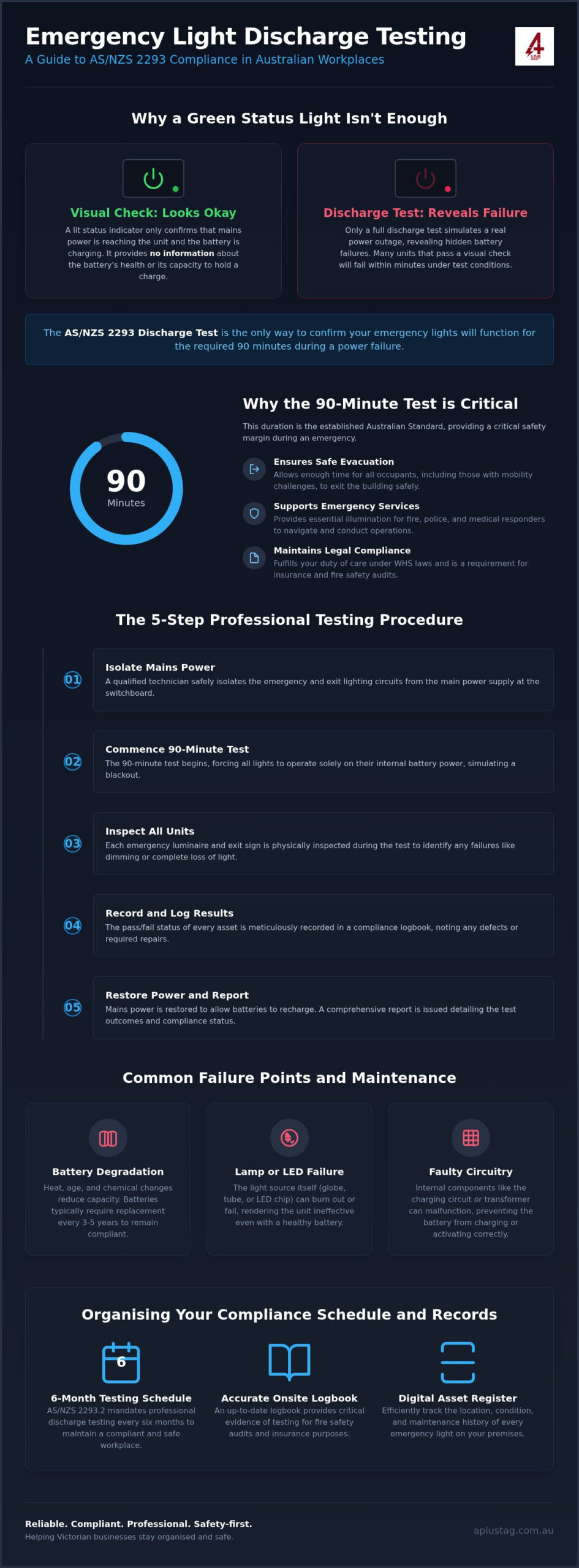
One of the most dangerous misconceptions in facility management is that a lit status lamp equals a functional unit. That small green LED only confirms the circuit is healthy and the battery is charging; it says nothing about the battery’s ability to hold a load. Many units pass a visual inspection but fail an AS 2293 discharge test within the first ten minutes. These hidden failures are only exposed when the mains power is cut and the battery is forced to perform under pressure. Maintaining a rigorous testing schedule fulfills your legal duty of care under Australian WHS laws and provides the documentation required to protect your business from liability claims. Without a verified testing log, insurance providers may have grounds to dispute claims following an incident.
The Science of Battery Degradation
Emergency lighting typically relies on Nickel-Cadmium (NiCd) or Lithium-based batteries, both of which are sensitive to the high-temperature environments often found in ceiling cavities. Over time, chemical degradation reduces their storage capacity. While NiCd batteries can suffer from ‘memory effect’ if not cycled, modern Lithium units are prone to capacity loss through heat exposure. Regardless of how often they’re used, emergency batteries typically require replacement every three to five years to maintain compliance. Regular discharge cycles help identify these declining units before they reach a state of total failure, allowing for planned, cost-effective maintenance rather than emergency repairs.
Risk Management and Audit Readiness
Fire brigade inspections and council audits can occur with little notice. Having a complete history of your testing results ensures you remain in a state of constant readiness rather than scrambling for records at the last minute. Integrating the emergency lighting standards into your broader safety strategy is particularly vital for high-risk environments like hospitals or warehouses, where power failures create immediate hazards. If you’re unsure about your current compliance status, you can discuss a tailored testing schedule with our team to ensure your site meets every regulatory requirement.
The Step-by-Step Emergency Lighting Test Procedure
Performing an AS 2293 discharge test requires a methodical sequence to ensure accuracy and safety. It begins with a thorough visual inspection where we look for physical damage to luminaires, blackened diffusers, or expired lamps that might hinder visibility. Once the hardware is confirmed to be in good physical condition, the technician initiates the simulation. This careful preparation prevents unnecessary failure reports caused by simple maintenance issues like a dirty lens or a loose fitting.
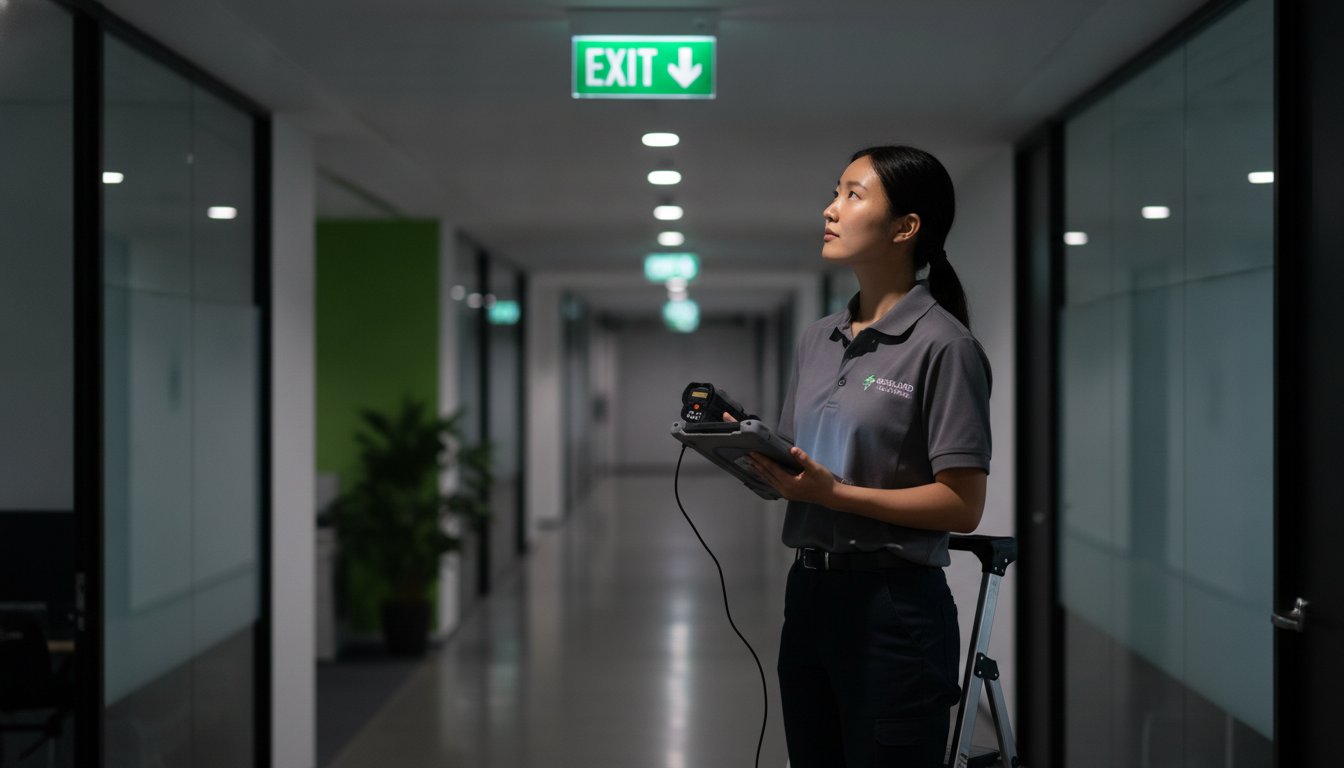
By activating the specialised test switch, the emergency lighting circuit is isolated from the mains power. This starts the mandatory 90-minute countdown. During this period, our technicians walk the entire site to monitor every fitting, ensuring they maintain the required illumination levels without flickering or dimming. It’s a precise observation phase where we identify any battery that fails to go the distance. After the 90 minutes have elapsed, we restore the mains power and verify that every unit has switched back to its charging state. The final step involves meticulous documentation. We record all findings in your mandatory onsite logbook and update our digital asset register, providing you with a clear, transparent history of your building’s safety status.
The Role of the Emergency Test Switch
AS/NZS 2293.1 mandates the installation of a dedicated test switch within the main switchboard or distribution board. This component is vital because it allows for a controlled AS 2293 discharge test without needing to shut down the entire building’s power supply. It keeps your computers, servers, and essential equipment running while only the lighting circuits are tested. If your building currently lacks a compliant test switch, it’s a significant safety gap that needs addressing to meet modern Australian Standards.
Minimising Disruption During Your Appointment
We recognise that a 90-minute test period can be inconvenient for a busy workplace. To manage this, we focus on scheduling visits during low-occupancy periods or after hours to ensure minimal impact on your daily operations. Clear communication is essential. We help you inform your staff about the ‘simulated failure’ in advance, preventing unnecessary concern when the lights switch to battery power. Our team works methodically to ensure the process is quiet, efficient, and completely stress-free for your facility management team.
Common Failures and Maintenance Requirements
During a standard AS 2293 discharge test, several factors can lead to a non-compliant result. Battery failure is the most frequent culprit. Batteries are chemical storage devices that naturally degrade over time. Even if a battery appears to be charging, it may lack the depth of discharge required to power a luminaire for the full 90-minute safety duration. This is precisely why the simulation is so critical; it’s the only way to prove the battery’s health under load.
Lamp and LED failures also present significant risks. A flickering or dimming unit isn’t just an eyesore; it’s a safety hazard that can cause confusion during an evacuation. We also frequently encounter diffuser degradation. In many older Victorian buildings, the plastic covers on emergency lights have turned yellow or become brittle due to heat and UV exposure. This discolouration significantly reduces the light output, meaning the unit may no longer provide the minimum required lux levels on the floor. Finally, damaged or missing signage remains a common failure point. Exit signs must be clearly visible and unobstructed from all directions of approach to ensure a safe means of egress.
What Happens When an Item Fails?
When a unit fails the AS 2293 discharge test, our technicians provide immediate, clear identification. We tag the failed unit and record its location in your digital asset register. This transparency allows you to see exactly which items require attention. We then help you decide between a simple battery replacement or a full unit upgrade. For older fluorescent fittings, it’s often more cost-effective to replace the entire unit with a modern LED equivalent rather than performing recurring maintenance on outdated technology. Every failure is documented in a detailed defect report, providing you with a clear roadmap for restoration.
The Benefits of Upgrading to LED Emergency Lighting
Switching to LED emergency lighting offers significant long-term advantages for Victorian business owners. These units consume far less energy and have a much lower environmental impact than traditional fluorescent tubes. Because LEDs generate less heat, the internal batteries often last longer, which directly reduces your ongoing maintenance costs. The light produced by modern LEDs is also significantly brighter and clearer, ensuring that your exit paths are well-lit and easy to follow during a crisis. This transition helps your facility stay organised and reduces the frequency of component failures in future testing cycles.
Organising Your Compliance Schedule and Records
Under AS/NZS 2293.2, a routine AS 2293 discharge test is generally required at six-monthly intervals to ensure system reliability. It is essential to recognise that specific testing frequencies vary depending on your particular workplace environment and the type of equipment installed. We always recommend obtaining site-specific professional guidance to determine the exact schedule required for your facility. Maintaining an onsite logbook remains a mandatory part of this process, providing a physical record that emergency services and building inspectors can review during an audit.
Beyond the physical logbook, modern compliance relies on digital asset registers to provide a transparent, searchable history of your safety checks. Integrating your emergency lighting testing with other essential maintenance, such as RCD or fire equipment checks, is an effective way for Victorian businesses to stay organised. This consolidated approach reduces the number of site visits and minimises disruption to your daily operations while ensuring all safety-first obligations are met.
The Value of Automated Reminders
Managing recurring safety cycles shouldn’t be a source of stress for facility managers. We provide automated reminders that alert you well before your next interval is due, ensuring you never fall behind on your compliance schedule. This proactive management fosters a dependable partnership, where the responsibility for tracking dates shifts from your desk to ours, allowing you to maintain a consistent safety record without manual effort.
Choosing a Professional Compliance Partner
A high-quality compliance partner should offer more than just a checklist; they should provide punctuality, clear reporting, and technical proficiency. It’s essential to engage a technician who understands the nuances of Victorian safety regulations and can provide specialised compliance services tailored to your site. Requesting a comprehensive assessment or a quote for a recurring program is the best way to ensure your facility remains safe, compliant, and professionally managed over the long term.
Maintain Long-Term Safety with Professional Compliance
Maintaining a safe workplace requires more than just functional lighting; it demands a systematic approach to technical verification. By committing to a regular AS 2293 discharge test, you ensure that your building remains prepared for any emergency while fulfilling your legal duty of care. This proactive strategy identifies failing components before they become critical risks, allowing you to manage maintenance budgets effectively and avoid the stress of a failed safety audit.
Our team provides a professional, punctual service that prioritises your site’s operational needs. With automated due-date reminders and detailed digital asset registers, we handle the complexities of documentation so you can focus on running your business. We act as your long-term safety partner, ensuring every luminaire and exit sign is ready to perform when it matters most. This methodical approach transforms compliance from a recurring headache into a reliable, organised system.
Taking control of your compliance schedule is a straightforward way to protect your people and your property. We look forward to helping your organisation stay safety-first and fully prepared throughout the year.
Frequently Asked Questions
How often is an AS 2293 discharge test required in Australia?
A routine AS 2293 discharge test is generally required every six months according to AS/NZS 2293.2. However, it is important to note that specific testing frequencies can vary based on your workplace type and the specific equipment installed on your site. We always recommend obtaining site-specific professional guidance to ensure your maintenance schedule meets all local safety obligations.
Can I perform the 90-minute discharge test myself?
No, this procedure must be conducted by a qualified professional to ensure the results are legally valid and accurately recorded. Professional testing involves more than just flicking a switch; it requires a detailed understanding of circuitry and the ability to identify subtle battery degradation. Using a specialised service provider ensures your business remains compliant and your safety records are audit-ready.
What happens if my emergency lights fail the 90-minute test?
If a unit fails to meet the 90-minute benchmark, it must be clearly identified in a defect report and scheduled for repair or replacement. Our technicians tag failed units immediately and update your digital asset register so you can prioritise maintenance. This transparency helps you manage risk and ensures your exit paths remain safe for all occupants.
Is a logbook mandatory for emergency lighting compliance?
Yes, keeping an onsite logbook is a mandatory requirement under Australian Standards for all commercial buildings. This document provides a physical history of your testing regime for emergency services and building surveyors. While we maintain digital backups of your compliance reporting, the hard-copy logbook must remain accessible on your premises at all times.
Do I need to turn off all the power in my building for the test?
No, you do not need to cut power to your entire facility during an AS 2293 discharge test. We utilise the dedicated test switch located in your electrical switchboard to isolate only the emergency lighting circuits. This allows your computers, machinery, and general lighting to continue operating normally, ensuring minimal disruption to your daily business activities.
What is the difference between a 6-monthly and an annual emergency light test?
While both intervals require a full 90-minute discharge, the annual inspection involves a more comprehensive physical assessment of the system. This includes checking for lamp discolouration and ensuring all diffusers are clean and secure. Both tests are essential for identifying components that may be nearing the end of their functional life.
How long does a typical emergency lighting battery last?
Most emergency lighting batteries have a functional lifespan of three to five years, though this can be shortened by high temperatures in ceiling spaces. Regular testing is the only reliable way to monitor this decline. By identifying batteries that are losing capacity early, you can plan replacements as part of your routine maintenance rather than dealing with unexpected failures.
Are LED exit signs better than older fluorescent models?
LED exit signs are a superior choice for modern workplaces because they offer significantly higher reliability and lower energy consumption. They generate very little heat, which helps protect the internal battery and extends the overall life of the unit. Transitioning to LED technology is a practical way to reduce long-term maintenance costs and improve the clarity of your evacuation signage.
