
Workplace First Aid Kit Requirements Victoria: The 2026 Compliance Guide
With 146,700 serious workers’ compensation claims recorded across Australia in the 2023-24 period, the margin for error in workplace safety remains razor-thin. For facility and operations managers, keeping pace with workplace first aid kit requirements victoria often feels like a complex balancing act between legislative duty and daily operational reality. You likely recognise that a “set and forget” approach to medical supplies isn’t just risky; it’s a significant liability for your organisation.
It’s understandable to feel frustrated when trying to distinguish between a “prescribed” approach and a “risk-assessment” strategy, especially while tracking expiry dates across multiple kits or sites. This guide simplifies those complexities by providing a clear roadmap through the Victorian First Aid Compliance Code. You’ll learn how to align your safety protocols with current standards and establish a seamless resupply programme that ensures total audit readiness for 2026. We’ll examine the specific contents required for your industry and outline a methodical process to keep your equipment compliant and your team protected.
Key Takeaways
- Understand your legal obligations under the 2021 WorkSafe Victoria Compliance Code and how it interacts with the OHS Act 2004.
- Identify the specific workplace first aid kit requirements victoria mandates for your industry, including additional modules for high-risk environments like construction or manufacturing.
- Determine whether the Prescribed Approach or the Risk-Assessment Approach is the most efficient compliance pathway for your organisation’s size and complexity.
- Learn how to establish a systematic resupply programme that tracks expiry dates and maintains stock levels to ensure you are always audit-ready.
- Discover the operational benefits of integrating first aid kit servicing into a broader scheduled maintenance cycle alongside electrical and fire safety testing.
Navigating the Victorian First Aid Compliance Code
The Compliance code: First aid in the workplace (2021) serves as the essential practical guide for every Victorian employer. While the code itself isn’t a mandatory law, following its recommendations provides a clear “safe harbour” for businesses. If you adhere to the code, you’re considered to have met your legal duties under the Occupational Health and Safety Act 2004. Understanding workplace first aid kit requirements victoria is about more than ticking a box; it’s a foundational part of your broader safety strategy alongside specialised compliance services.
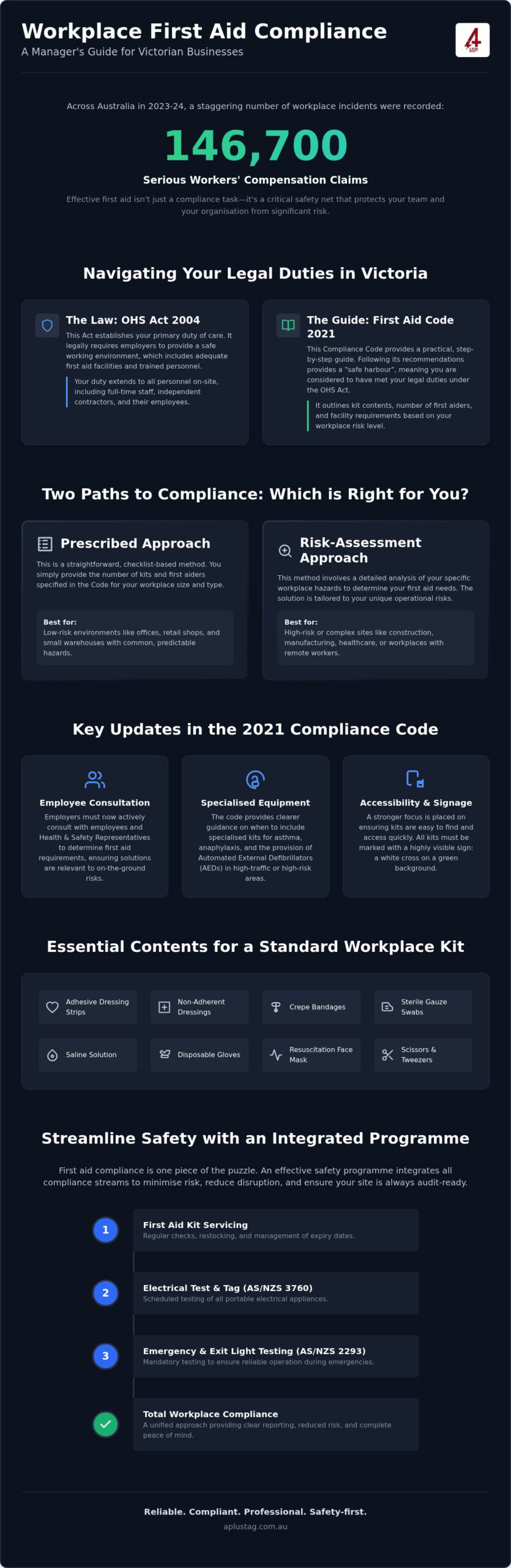
For 2026, the focus on employee welfare is sharper than ever. With 146,700 serious workers’ compensation claims recorded nationally in the 2023-24 period, the ability to provide immediate, effective medical response is critical. Whether you manage a high-risk manufacturing plant or a low-risk office, the code scales to your specific environment, ensuring that first aid kit contents and facilities are appropriate for the hazards present.
To better understand this concept, watch this helpful video:
Duty Holders and Legal Obligations
The primary responsibility for first aid rests with the employer. This duty of care isn’t limited to full-time staff. Under Section 21(3) of the OHS Act, your obligations extend to independent contractors and their employees. You must ensure they have access to adequate first aid facilities while working at your site. Ensuring your organisation meets workplace first aid kit requirements victoria for all personnel is vital. Ignoring these requirements leads to more than just potential fines; it leaves your organisation vulnerable to litigation and puts lives at risk during the critical minutes following an incident.
The 2021 Code Updates: What Has Changed?
The 2021 update introduced a stronger emphasis on consultation. Employers must now involve their employees and health and safety representatives when determining first aid needs. This collaborative approach ensures that the people facing the risks have a voice in the solutions. The updated code also provides clearer guidance on the inclusion of Automated External Defibrillators (AEDs) and the management of asthma and anaphylaxis kits. Accessibility is another key focus. Kits must be clearly signposted and located where they can be reached quickly, especially in large or multi-level buildings. These changes reflect a move toward a more proactive and responsive safety culture.
Essential Contents: What Your Victorian Workplace First Aid Kit Must Contain
The 2021 update provided a standard list of recommended items that every employer should maintain. While the Australian Standard AS 2675-1983 remains a foundational reference for the construction of portable kits, WorkSafe Victoria’s First Aid Compliance Code offers the most current guidance on quantities and specific items. For a standard office environment, the kit must be robust enough to handle common injuries like cuts, grazes, or minor burns. Visibility is just as important as the contents. Every kit location must be clearly marked with a green sign featuring a white cross. In large facilities, you should use directional signage so the nearest kit can be found within seconds during an emergency.
The Basic Kit Checklist for 2026
A standard kit in a low-risk Victorian workplace should include a specific range of dressings and tools. At a minimum, you’ll need adhesive dressing strips, non-adherent wound dressings in various sizes, and conforming crepe bandages. Sterile gauze swabs and saline solution for wound irrigation are also essential. To protect the first aider, the kit must contain disposable nitrile gloves and a resuscitation face mask. High-quality stainless steel scissors and tweezers are required for managing dressings and removing debris.
Beyond physical supplies, documentation is a core part of workplace first aid kit requirements victoria. Your kit must include a notebook and pen to record every use of supplies in an incident log. This isn’t just for stocktaking; it’s a legal requirement to document injuries and treatments. Keeping these records helps identify recurring hazards and ensures you know exactly when to restock. If you’re managing multiple sites, maintaining a digital asset register for these logs can significantly simplify your audit process.
Specialised Modules and Additional Equipment
High-risk environments, such as commercial kitchens, workshops, or construction sites, require more than the basics. You’ll likely need to add specialised modules for burns, eye injuries, or severe bleeding based on your hazards. For example, hospitality businesses should prioritise hydrogel burn dressings, while outdoor workers require protection against stings and snake bites. Automated External Defibrillators (AEDs) are now strongly recommended for workplaces where the risk of cardiac arrest is identified, such as gyms or high-traffic public spaces.
Regarding medications, the code suggests that mild analgesics like paracetamol or aspirin should only be included if a risk assessment deems it necessary. These must be kept in their original packaging and only administered by following strict protocols to avoid allergic reactions or misuse. If your site has complex needs, it’s often helpful to discuss a compliance schedule with a professional to ensure no specialised module is overlooked. Meeting workplace first aid kit requirements victoria involves a precise balance of general supplies and hazard-specific equipment tailored to your team’s daily activities.
Prescribed vs Risk-Assessment: Choosing Your Compliance Pathway
Victorian employers have a choice between two distinct pathways to reach compliance. Deciding which route to take depends on your specific operational environment, the number of staff, and the physical layout of your site. Regardless of the path you choose, you must consult with your employees and health and safety representatives. This collaborative process ensures that the people closest to the risks are involved in the safety solutions. Selecting the right strategy is the first step toward meeting workplace first aid kit requirements victoria without overcomplicating your internal processes.
Option 1: The Prescribed Approach
The Prescribed Approach is the most straightforward method for achieving compliance. It relies on predetermined ratios for first aid kits and trained officers based on your workplace’s risk profile. For low-risk environments, such as a professional office or a retail shop, the guideline is one first aider for every 50 workers. In high-risk settings, such as manufacturing or construction, the ratio tightens to one first aider for every 25 workers. This method is ideal for micro-businesses and standard offices because it provides a clear, easy-to-follow framework without the need for extensive safety audits.
While simplicity is a significant advantage, the prescribed method has limitations. It’s a generalised model that might not account for specialised hazards unique to your industry. If your team works with specific chemicals or high-voltage equipment, simply meeting the minimum workplace first aid kit requirements victoria through the prescribed route might leave gaps in your emergency response capability. It’s a solid starting point, but it requires careful consideration of whether the “standard” kit truly protects your people in a real-world crisis.
Option 2: The Risk-Assessment Approach
Large organisations and multi-site businesses often find the Risk-Assessment Approach more effective. This method allows you to tailor your first aid provision to the actual hazards present on-site. When conducting a formal assessment in 2026, you’ll evaluate factors like the severity of potential injuries, the size and “remoteness” of the workplace, and the time it would take for emergency services to arrive. If your facility is located far from a hospital or has a complex layout that could delay paramedics, your assessment will likely indicate a need for more kits or advanced equipment like AEDs.
This tailored approach offers a higher level of precision. It moves away from arbitrary ratios and focuses on practical safety outcomes. By examining your specific incident history and the nature of your daily tasks, you can create a first aid strategy that’s both compliant and highly functional. It’s the preferred method for Victorian organisations that value a proactive safety culture and want to ensure their resources are allocated exactly where they’re needed most. This approach ensures your safety investment is proportional to the actual risks your team faces every day.
How to Organise an Effective First Aid Resupply Programme
Establishing a systematic resupply programme ensures your organisation stays ahead of workplace first aid kit requirements victoria without the stress of last-minute scrambles. It transforms a reactive chore into a predictable, managed cycle that prioritises staff safety. This methodical approach minimises the risk of having empty bandage dispensers or expired saline during a workplace emergency. By treating first aid maintenance as a recurring business process, you create a culture of safety that’s both reliable and transparent.
Managing the lifecycle of your medical supplies requires more than just a quick glance inside the box. It involves a structured workflow that moves from audit to replenishment, ensuring every kit remains fully functional and compliant. This process is especially vital for multi-site organisations where consistency is key to meeting workplace first aid kit requirements victoria across different environments. A professional resupply programme provides the documentation necessary to prove your commitment to safety during any future audit or inspection.
Step 1: The Monthly or Quarterly Audit
The foundation of any resupply programme is a thorough audit. Use a standardised checklist to verify every item against the required stock levels for your specific risk profile. You’re looking for more than just missing items; you must check the integrity of seals, look for signs of moisture damage, and ensure all packaging remains sterile. High-traffic workplaces like warehouses, construction sites, or busy retail centres should ideally conduct these audits on a monthly basis to account for frequent kit use and potential damage.
Step 2: Inventory Management and Ordering
Once the audit is complete, organise a precise resupply list to avoid the common mistake of overstocking items with long shelf lives while neglecting those that expire quickly. This systematic approach ensures your inventory remains fresh and functional. Every replacement item must meet current Australian Standards to maintain the quality of your medical response. You can learn more about our compliance services to see how professional oversight simplifies this procurement process and ensures you always have the right supplies on hand.
Step 3: Maintaining the Asset Register
Transitioning from paper logs to a digital asset register is a significant step toward total audit readiness. Digital records allow you to track the service history of every kit across multiple locations and set automated reminders for the next scheduled check. Recording the date of service, the items replaced, and the technician responsible provides a clear paper trail for WorkSafe inspectors. For a broader look at how to manage your safety obligations, see our guide on Compliance Monitoring: Australian Workplace Safety 2026.
Streamlining Workplace Safety: Integrating First Aid with Electrical Compliance
Managing various compliance streams often creates a fragmented safety culture. When you treat each requirement as a separate task, it’s easy for small but critical details to be overlooked. Adopting a “whole-of-site” approach allows you to consolidate your safety obligations into a single, manageable schedule. This strategy ensures that your workplace first aid kit requirements victoria are addressed alongside your electrical safety testing, providing a comprehensive safety net for your team.
First Aid and Test & Tag: The Perfect Pair
Aligning your first aid kit servicing with your electrical testing cycles is a practical way to minimise site disruption. Rather than hosting multiple contractors throughout the year, you can coordinate visits to cover both medical and electrical compliance. This synchronisation is particularly effective when you consider the test and tag frequency victoria mandates for different environments. By scheduling these services together, you ensure that fire blankets, first aid supplies, and electrical appliances are all inspected and ready for use in one efficient sweep. A similarly methodical approach applies to smoke alarm testing for workplaces, where audit-ready documentation and scheduled maintenance intervals are equally critical to meeting your 2026 compliance obligations.
This integrated method also improves the quality of your documentation. Instead of chasing separate reports from different providers, you receive a consolidated compliance record. Professional asset registers that track both electrical items and first aid stock levels help you maintain total audit readiness. It’s a proactive way to manage your facility, ensuring that no expiry date or testing deadline falls through the cracks due to administrative fatigue.
Choosing a Long-Term Compliance Partner
The transition from a one-off contractor to a dedicated compliance partner is the key to long-term safety. A professional partner doesn’t just restock a kit; they provide the methodical oversight needed to keep your organisation protected year after year. When looking for a provider in 2026, prioritise those who offer transparent reporting and proactive scheduling. This ensures you’re never caught off guard by an expired item or an outdated safety tag.
A Plus Compliance Services supports Victorian businesses by acting as a dependable ally in workplace safety. Our approach focuses on reliability and minimal disruption, allowing you to focus on your core operations while we manage the complexities of workplace first aid kit requirements victoria. By integrating medical resupply with our broader suite of our services, we help you maintain an organised, safety-first workplace with calm, professional expertise. This partnership builds a foundation of trust and predictability that single-visit contractors simply cannot match.
Securing Your Workplace Compliance for 2026
Managing workplace first aid kit requirements victoria mandates doesn’t have to be a source of administrative stress. By choosing the right compliance pathway and integrating medical resupply with your existing electrical testing cycles, you create a safer environment with significantly less disruption. Transitioning to a systematic, digital asset register ensures that every bandage, dressing, and AED is ready for use and fully documented for audit purposes.
A Plus Compliance Services provides specialised Victorian compliance expertise to help your organisation stay organised and protected. Our methodical approach includes automated due-date reminders for all testing and resupply, backed by comprehensive asset registers and clear compliance reporting. We act as your dependable partner, ensuring your safety protocols are proactive rather than reactive.
Taking these steps today builds a foundation of long-term safety and operational efficiency. We look forward to helping you maintain a compliant and professional workplace throughout the coming year.
Frequently Asked Questions
How many first aid kits are required in a Victorian workplace?
The number of kits depends on the size and risk profile of your workplace. Under the prescribed approach for low-risk sites, you generally need one kit for every 50 workers. High-risk sites require one for every 25 workers. You must also consider the physical layout; if your workplace has multiple levels or separate buildings, each distinct area should have its own kit to ensure immediate access during an emergency.
What are the first aid training requirements for Victorian employees in 2026?
Victorian employers must ensure an adequate number of staff are trained to administer first aid. For low-risk environments, the ratio is typically one first aider for every 50 workers, while high-risk environments require one for every 25 workers. Training should be provided by a registered training organisation and usually includes a HLTAID011 Provide First Aid certificate. It’s best practice to refresh these qualifications every three years, with CPR components updated annually.
Does a small Victorian business with only one employee still need a first aid kit?
Yes, the OHS Act 2004 requires all employers to provide adequate first aid facilities, regardless of staff numbers. Even a micro-business or a sole trader with one employee must have a basic kit that meets workplace first aid kit requirements victoria standards. This ensures that help is available for the employee or any visitors and contractors on-site. The kit’s contents should be tailored to the specific risks of the work being performed.
How often should first aid kits be checked and resupplied?
First aid kits should be inspected at least every three to six months, though monthly checks are recommended for high-use environments. Regular audits ensure that used items are replaced and that no supplies have passed their expiry dates. Sterile items like saline and eye pads often have specific shelf lives that must be monitored. Establishing a recurring schedule helps maintain compliance and ensures your equipment is always functional when an incident occurs.
Can I include medications like paracetamol in my workplace first aid kit?
You can include mild analgesics like paracetamol or aspirin, but they must be managed with strict protocols. The 2021 Compliance Code suggests these only be included if a risk assessment identifies a need. They must remain in their original manufacturer’s packaging and be stored securely. First aiders should only provide these medications if they’re certain the person isn’t allergic and it’s appropriate for their condition, often following medical advice.
Is an AED (defibrillator) a legal requirement for Victorian workplaces?
An Automated External Defibrillator (AED) isn’t a universal legal requirement, but it’s strongly recommended for many sites. Your risk assessment should determine if an AED is necessary based on the number of workers, the nature of the work, and the proximity of emergency services. Workplaces with high public traffic or those where the risk of cardiac arrest is elevated, such as gyms or aged care facilities, should prioritise AED installation.
What documentation must I keep for first aid compliance in Victoria?
You must maintain several types of documentation to demonstrate compliance with workplace first aid kit requirements victoria. This includes an incident log that records every injury and the treatment provided, as well as a register of first aid kit inspections. You should also keep copies of current first aid certificates for all designated officers. Using a digital asset register simplifies this process by providing a clear, centralised record for safety audits and inspections.
Can I perform my own first aid resupply or do I need a professional?
While an employer can perform internal audits, many Victorian businesses prefer professional servicing to ensure nothing is overlooked. A professional compliance partner provides methodical inspections, tracks expiry dates across multiple sites, and maintains accurate asset registers on your behalf. This approach reduces the administrative burden on facility managers and provides peace of mind that your kits always meet Australian Standards. It also ensures your medical resupply is integrated with broader safety testing cycles.
