Workplace Electrical Safety Audit: 2026 Compliance Guide
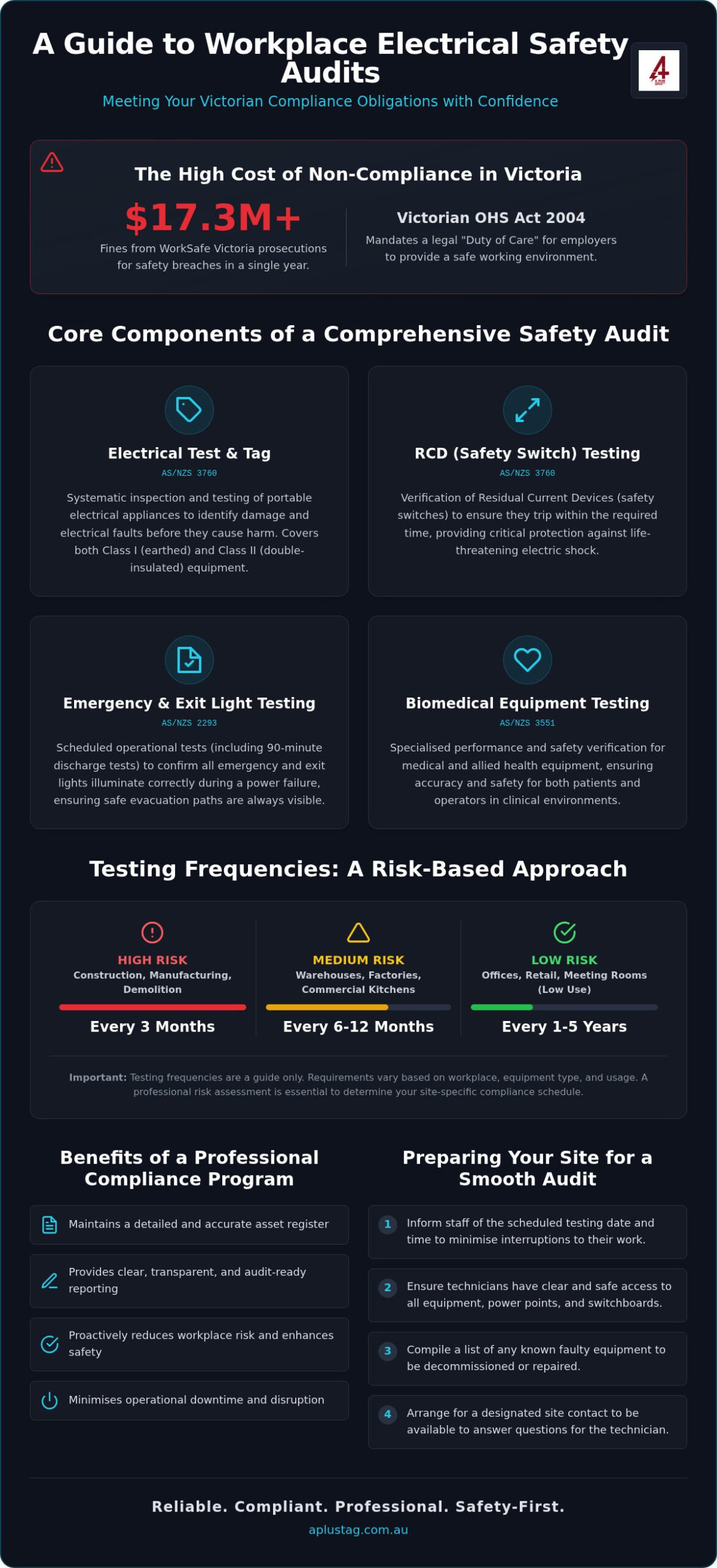
With WorkSafe Victoria completing 137 prosecutions in 2025 that resulted in $17,391,325 in total fines, the financial risk of a neglected electrical safety audit for your workplace has never been more apparent. It’s common to feel a sense of uncertainty when trying to interpret the updated AS/NZS 3760:2022 standards or the 2026 revisions to emergency lighting requirements. You want to ensure your team is protected without causing unnecessary friction in your daily operations or falling behind on complex documentation.
This guide provides a practical, grounded roadmap to help you manage your Victorian compliance obligations with confidence and precision. We’ll break down the specific testing intervals for different equipment types, explain how to build a reliable asset register, and show you how a systematic approach can minimise downtime. Our goal is to help you transition from a state of potential risk to one of organised, professional control. By understanding these requirements, you can focus on your core business while we help you maintain a safe and compliant environment.
Key Takeaways
- Understand how a professional electrical safety audit for workplace environments ensures you meet Victorian OHS Act obligations and duty of care requirements.
- Identify the essential components of a robust compliance framework, including specialised Electrical Test and Tag, RCD testing, and emergency lighting inspections.
- Learn how testing intervals are determined by your specific environment and equipment types, noting that requirements must be read in conjunction with AS/NZS 3760:2010, particularly clause 2.1.
- Discover practical strategies to prepare your site for testing to ensure minimal disruption to your daily operations and staff productivity.
- Recognise the long-term value of accurate asset registers and clear reporting in maintaining a safe, well-organised, and audit-ready workplace.
Understanding the Workplace Electrical Safety Audit in Victoria
An electrical safety audit for workplace environments is a systematic verification process designed to secure your facility against hidden hazards. It involves a methodical inspection and testing of all electrical assets, including both portable appliances and fixed equipment. This verification ensures every item functions correctly and meets current Australian Standards. Rather than waiting for a fault to occur, a professional audit identifies risks before they lead to operational downtime or injury. It’s about creating a transparent record of safety that protects your staff and your property while maintaining long-term order.
Under the Victorian Occupational Health and Safety Act 2004, employers have a legal “Duty of Care” to provide a safe work environment for their employees and contractors. This obligation isn’t just about reacting to broken equipment; it’s about maintaining a proactive compliance framework that identifies potential faults before they escalate. Moving from reactive repairs to scheduled monitoring is essential for understanding electrical injuries and preventing them entirely. By partnering with a long-term compliance expert, you shift the burden of tracking cycles to a dependable ally. This approach is fundamental to helping Victorian businesses reduce risk and stay organised.
The Legal Framework: Why Compliance Matters
Meeting your Victorian safety obligations requires more than a simple checklist. It involves adhering to rigorous benchmarks like AS/NZS 3760:2022, which outlines the requirements for in-service safety inspection and testing. These standards provide the accepted roadmap for what is considered “safe” in a professional setting. The consequences of neglecting these standards are significant. In 2025, WorkSafe Victoria completed 137 prosecutions resulting in over $17 million in fines for safety breaches. Regular audits also play a critical role in managing insurance risks. Most commercial insurance policies require businesses to demonstrate that they have taken all reasonable steps to prevent electrical accidents. A Plus Compliance Services provides clear, reliable, and professional compliance support, ensuring your documentation is always accurate and audit-ready.
Who is Responsible for Electrical Safety?
Responsibility for maintaining a safe site is shared among facility managers, operations supervisors, and business owners. Each role must ensure that testing cycles are met and that any failed equipment is immediately removed from service. While it’s sometimes tempting to use a general contractor for various tasks, specialised technicians are necessary for accurate and reliable testing results. A specialist understands the nuances of different environments, from high-risk construction sites to low-risk office spaces. A Plus Compliance Services offers specialised testing services across Melbourne and regional Victoria, acting as a professional partner that simplifies complex requirements for your management team. Making workplace compliance easier to manage starts with choosing an experienced ally who prioritises punctuality and responsiveness.
Core Components of a Comprehensive Safety Audit
A thorough electrical safety audit for workplace environments acts as a multi-layered shield against operational hazards. It moves beyond a simple visual check, incorporating technical verification of both visible and hidden infrastructure. By aligning with WorkSafe Victoria’s electrical safety guidelines, businesses can establish a systematic approach to risk management. This process focuses on the physical integrity of equipment and the reliability of safety systems that protect your team from harm. A comprehensive audit typically includes portable appliance testing, safety switch verification, and emergency system checks to ensure total site coverage.
Electrical Test & Tag (AS/NZS 3760)
The inspection and safety testing of portable electrical equipment is a fundamental pillar of workplace safety. This involves a two part process: a detailed visual inspection to identify physical damage and a series of electrical tests using specialised equipment. It is essential to differentiate between Class I (earthed) and Class II (double insulated) equipment, as the testing procedures for each vary significantly. We provide clear, itemised reporting for every asset tested, ensuring your records are accurate and transparent. For a more detailed look at these technical requirements, you can explore our guide to Test and Tag Services. Reliable documentation is the key to maintaining a long-term compliance cycle.
RCD and Emergency Light Testing
Residual Current Devices (RCDs), often called safety switches, are critical for preventing electric shock by instantly disconnecting power when a fault is detected. Regular push-button and trip-time testing ensure these devices remain responsive. Alongside RCDs, emergency and exit lighting must be maintained to provide safe egress during power failures. Following the Emergency Lighting Standards for AS/NZS 2293 compliance, these systems require a 6-month discharge test. This procedure verifies that batteries can sustain the lights for the required duration during an actual emergency. These recurring cycles are vital for keeping Victorian businesses prepared for any situation.
Thermal Imaging and Switchboard Maintenance
Switchboard thermal imaging is a highly effective, non-invasive method for identifying potential electrical faults before they cause failures or fires. By using infrared technology, technicians can detect “hot spots” caused by loose connections, overloaded circuits, or faulty components while your equipment remains fully operational. This “safety-first” approach is particularly important for high-load environments like warehouses or healthcare facilities where downtime is costly. Because the testing is non-disruptive, it allows you to maintain productivity while proactively addressing hidden risks. Identifying these issues early is a practical way of making workplace compliance easier to manage. If you haven’t reviewed your switchboard health recently, you might consider how arranging a thermal assessment could protect your infrastructure.
Every component of the audit contributes to a robust asset register. This register creates a definitive “paper trail” that demonstrates your commitment to safety during internal reviews or external audits. It simplifies the management of recurring testing cycles and ensures no piece of equipment is overlooked. Helping Victorian businesses reduce risk and stay organised is at the heart of this systematic documentation process.
Testing Intervals and Environment Classifications
Determining the frequency of your safety checks is a critical part of a successful electrical safety audit for workplace compliance. These intervals aren’t arbitrary; they’re based on the level of risk associated with your specific environment and the type of equipment in use. It’s essential that this information is read in conjunction with AS/NZS 3760:2010 as a whole, particularly clause 2.1, which provides the foundation for these requirements. By following WorkSafe Victoria’s electrical safety guidelines, business owners can ensure they’re meeting their duty of care while maintaining a methodical testing cycle. Because every site has unique challenges, we recommend that you check your specific tag and test intervals with a professional technician to ensure total accuracy.
High-Risk vs. Low-Risk Environments
Different workplaces present varying levels of wear and tear on electrical assets. Category (a) covers environments like factories, workshops, and manufacturing plants where equipment is often subject to harsh conditions or heavy use. These areas require a 6-month interval for portable equipment testing to identify faults early. In contrast, Category (c) addresses low-risk office environments where cables are rarely moved or stressed. These typically follow a 12-month interval. For construction sites and commercial cleaning equipment, the risk is significantly higher. These environments demand a strict 3-month testing cycle to account for the constant movement and potential for physical damage. This systematic approach helps Victorian businesses reduce risk and stay organised by ensuring no environment is under-tested.
Specialised Intervals for Hire and Accommodation
Specific industries have unique requirements that fall outside standard office or factory settings. Category (f) applies to hire equipment, which must be inspected prior to each hire and then at 6-month intervals while in service. This ensures the equipment remains safe for every new user. Category (d) covers residential-type areas such as hotels, hostels, and boarding houses. Depending on the specific risk assessment and equipment type, these areas often have 3-month or 6-month requirements. If any piece of equipment undergoes a repair or service, businesses must refer to AS/NZS 5762 for the appropriate re-testing procedures before the item returns to use. Maintaining these precise cycles is a core part of our commitment to safety-first service delivery. By understanding these categories, you can ensure your electrical safety audit for workplace assets is both compliant and efficient.
A Plus Compliance Services uses these standard categories to help Victorian businesses build a robust framework for safety. This methodical classification ensures that your asset register is accurate and that every testing date is accounted for. Making workplace compliance easier to manage starts with a clear understanding of these intervals and a dependable partner to track them for you.
Organising Your Site for a Stress-Free Audit
Preparing for an electrical safety audit for workplace sites requires coordination between our technicians and your management team. Clear communication is our brand promise, ensuring everyone knows what to expect on the day. We act as a dependable partner to simplify the process, moving methodically through your facility to verify every asset without creating chaos. By establishing a clear plan before the technician arrives, you can ensure the audit is completed efficiently and with total accuracy. Helping Victorian businesses reduce risk and stay organised starts with this collaborative preparation phase.
To help us maintain a steady pace and minimise interruptions, we recommend that staff take a few simple steps to prepare their workstations. Providing clear access to power points and equipment is the most effective way to speed up the testing process. We suggest the following checklist for your team:
- Save all digital work and close open applications before the technician arrives at your desk.
- Power down computers, monitors, and sensitive electronic devices to allow for safe unplugging.
- Clear access to power boards, wall outlets, and cable runs by moving any personal items or furniture.
- Identify critical equipment that must remain powered, such as servers or medical devices, so the technician can plan accordingly.
Minimising Operational Disruption
We understand that every Victorian business has different requirements. For schools, gyms, or healthcare facilities, testing during peak hours isn’t always feasible. We can arrange testing outside normal operating hours to ensure your team remains productive and your clients are not inconvenienced. For multi-site organisations across Melbourne and regional Victoria, we coordinate testing programs that align with your specific maintenance cycles. Automated due-date reminders then ensure you stay proactive rather than reactive, making workplace compliance easier to manage. This systematic management creates a narrative of efficiency and predictability for your facility management team.
Managing Failed Items and Compliance Records
When a piece of equipment fails a safety test, immediate action is necessary to maintain a safe environment. Our technicians clearly identify the item with a specialised ‘failed’ tag and record the details in your digital asset register. It’s then the client’s responsibility to remove the failed item from service for repair or replacement. This clear reporting and dependable service help you manage risks without the guesswork. Digital asset registers simplify compliance monitoring, providing a transparent paper trail for any future audits. This thoroughness ensures that every step of the process is accounted for, leaving you with a well-regulated and safe workplace.
Choosing a Long-Term Compliance Partner in Melbourne
Selecting a partner for an electrical safety audit for workplace compliance is a decision that impacts your long-term operational security. It’s not just about ticking a box; it’s about finding a steady, dependable presence that simplifies complex requirements. A Plus Compliance Services acts as a knowledgeable ally rather than a distant contractor. We focus on being proactive rather than reactive, ensuring that your facility remains safe and well-regulated through every recurring cycle. This methodical approach allows you to focus on your core operations while we maintain the documentation and testing standards required by Victorian law. Our goal is to lead you from uncertainty toward a state of organised control.
The A Plus Compliance Services Advantage
Our team provides a straightforward client experience that avoids confusing technical jargon. We communicate with clarity, ensuring you understand your obligations without feeling overwhelmed by the standards. From large-scale hospitals and aged-care facilities to busy construction sites and warehouses, we support diverse sectors across Melbourne and regional Victoria. Our mission is centred on helping Victorian businesses reduce risk and stay organised by providing a systematic management framework for all electrical assets. We pride ourselves on being punctual and responsive, values that underpin our role as a long-term compliance partner. This reliability ensures that your safety protocols are never left to chance.
Next Steps for Your Workplace Safety
Arranging a comprehensive electrical safety audit for workplace sites is the first step toward a more secure environment. Whether you manage a single office or multiple industrial locations, we can develop a scheduled maintenance plan tailored to your specific environment and risk level. Our service delivery is built on the promise of “Reliable. Compliant. Professional. Safety-first.” This includes providing clear reporting and ongoing compliance support to ensure your asset registers are always up to date and audit-ready. You can explore our full range of Our Services to see how we can assist with everything from RCD testing to specialised thermal imaging.
To move your workplace toward a safer and more compliant future, we invite you to contact our professional team. We’re ready to discuss your specific requirements, provide a transparent quote, or arrange a comprehensive site assessment to help you maintain a high standard of workplace safety. Making compliance easier to manage starts with a single, dependable conversation.
Securing Your Workplace Compliance for 2026 and Beyond
Maintaining a systematic electrical safety audit for workplace environments is a continuous process of risk reduction rather than a one-off task. By categorising your equipment correctly and adhering to the specific intervals outlined in AS/NZS 3760 and AS/NZS 2293, you protect both your team and your operational continuity. Our expert knowledge of these Australian Standards ensures your facility remains compliant while minimising disruption to your daily productivity.
A Plus Compliance Services acts as your dependable partner, offering professional, punctual, and safety-first service delivery across Melbourne and Victoria. We provide comprehensive asset registers and clear compliance reporting, making workplace compliance easier to manage for facility managers and business owners alike. Moving toward a state of organised control allows you to focus on your core business with the reassurance that your electrical infrastructure is verified and secure.
We look forward to helping you stay organised and compliant throughout the coming year.
Frequently Asked Questions
What is an electrical safety audit for a workplace?
An electrical safety audit for workplace environments is a systematic verification process involving the inspection and testing of all portable and fixed electrical assets. It ensures that your equipment meets current safety standards and identifies potential hazards before they cause injury. Our technicians conduct these audits across Melbourne, from St Kilda to Dandenong, helping businesses maintain a transparent record of safety and stay organised through methodical documentation and reporting.
How often does equipment need to be tested and tagged in Victoria?
Testing intervals depend on your specific workplace environment, equipment type, and risk management procedures. For example, construction sites require 3-month cycles, while factories often need 6-month checks. This information must be read in conjunction with AS/NZS 3760:2010 as a whole, particularly clause 2.1. We recommend obtaining site-specific professional guidance to organise the correct schedule for your facility in Melbourne, Clayton, or Mount Waverley to ensure your electrical safety audit for workplace compliance is accurate.
Can electrical testing be completed outside normal business hours?
Yes, we can arrange testing outside normal operating hours to minimise operational disruption. We understand that schools, healthcare facilities, and hospitality venues in areas like Caulfield and Oakleigh often need to maintain productivity during the day. By scheduling our safety assessments during quieter periods or after hours, we provide a stress-free experience for your staff and clients while ensuring your workplace remains safe and fully compliant.
What happens if an electrical item fails the safety audit?
When an item fails the audit, our technician clearly identifies it with a failed tag and records the details immediately. It’s then the client’s responsibility to remove the faulty item from service to prevent use. This process allows you to arrange for repair or replacement while maintaining an accurate compliance record. We provide clear reporting so you can manage these risks effectively at your site in Springvale or Mulgrave.
Do you provide compliance reports and asset registers after the audit?
We provide comprehensive compliance reporting and detailed asset registers after every audit. These documents create a definitive paper trail that simplifies your safety management and helps you prepare for external reviews. Our reports include due-date tracking and automated reminders to support your recurring compliance programs. Whether you’re in Berwick or Pakenham, these structured records help you keep track of every tested item and stay organised long-term.
Is thermal imaging included in a standard electrical safety audit?
Thermal imaging is a specialised service we offer to identify hidden electrical faults in switchboards before they cause failures. While it’s often part of a comprehensive safety strategy, it is usually requested alongside standard testing. This non-invasive method is particularly valuable for high-load environments in Dandenong or Scoresby, as it detects hot spots without requiring a power shutdown. It’s a proactive way to reduce risk and protect your infrastructure.
How do we manage electrical compliance across multiple sites?
We specialise in managing multi-site compliance by coordinating testing programs across all your locations in Victoria. Our team tracks individual due dates and provides centralised reporting, making it easier for facility managers to oversee safety standards from a single point of control. Whether your sites are in Clayton, Bayswater, or Officer, we ensure that every location follows a consistent, professional testing schedule that reduces business risk and simplifies management.
What standards govern workplace electrical safety in Australia?
Workplace electrical safety is primarily governed by the AS/NZS 3760 standard for in-service safety inspection and testing of electrical equipment. Additionally, emergency lighting is regulated by AS/NZS 2293, and biomedical equipment must meet AS/NZS 3551 requirements. These standards provide the accepted framework for demonstrating compliance with the Victorian Occupational Health and Safety Act. Following these benchmarks is the most reliable way for businesses in Melbourne and surrounding suburbs to ensure safety.
