Microwave Leakage Testing: Guide for Victorian Workplaces
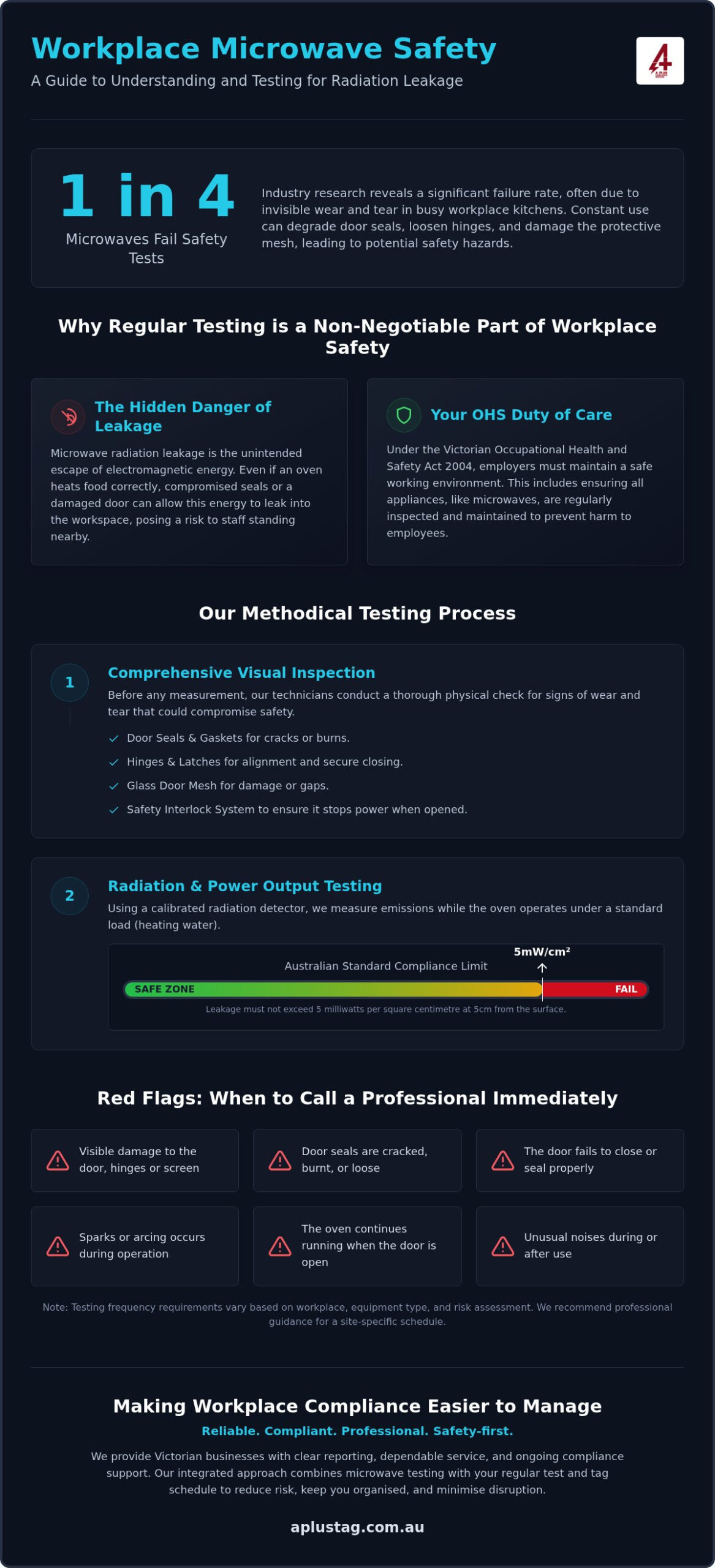
Did you know that industry research has found one in four microwaves fail safety tests? In a busy Victorian staff kitchen, it’s easy for door seals to become worn or hinges to loosen through constant use, making regular microwave radiation leakage testing a critical safety step. You probably already prioritise the safety of your team, yet keeping track of specific OHS requirements and maintenance schedules often feels like a complex task for any facility manager or business owner.
This guide explains why testing is a vital part of your workplace safety strategy and how you can meet your compliance obligations in Victoria. We’ll outline the relevant standards, such as AS/NZS 3760:2010, which should be read as a whole including clause 2.1, and clarify how often your equipment needs professional attention. By the end, you’ll have a clear path toward maintaining a safer environment and documented proof for your next audit. A plus compliance services is here to help Victorian businesses reduce risk and stay organised with a dependable, professional approach to safety.
Key Takeaways
- Understand why invisible damage to door seals and hinges makes professional testing essential for detecting electromagnetic energy leaks.
- Learn how microwave radiation leakage testing is integrated with your regular electrical safety checks to ensure thorough compliance with minimal disruption.
- Identify the specific red flags and physical faults that indicate your workplace microwave may be a safety risk.
- Understand your obligations under Victorian OHS standards and how to determine the correct testing frequency based on your unique environment.
- Discover how clear reporting and automated asset registers from A plus compliance services help Victorian businesses reduce risk and stay organised.
Understanding Microwave Radiation Leakage in Professional Environments
Microwave radiation leakage refers to the unintended escape of electromagnetic energy from an oven’s internal cavity. While most people assume a microwave is safe if it heats food correctly, the containment of energy depends on the integrity of the door, hinges, and seals. Standard electrical safety testing, often called test and tag, focuses on the electrical current and earthing of the appliance. In contrast, microwave radiation leakage testing is a specialised procedure that measures the actual emissions escaping the unit while it’s in operation.
The information provided here must be read in conjunction with AS/NZS 3760:2010 as a whole, and particularly clause 2.1. This standard outlines the requirements for the safety inspection and testing of electrical equipment, and for microwaves, it’s essential to look beyond the power cord. Understanding how microwave ovens work helps illustrate the risk; they use high-frequency radio waves to agitate water molecules. If the mesh screen or door seals are compromised, these waves can leak into the workspace.
Why Microwave Safety Matters for Victorian Staff
Victorian employers have a clear duty of care under the Occupational Health and Safety Act 2004 to maintain a safe working environment. This responsibility includes ensuring that kitchen appliances don’t pose a health risk to employees. While the immediate effects of radiation leakage might not be felt, long-term exposure to high levels of emissions can lead to biological heating of body tissues. In high-traffic staff rooms or commercial kitchens, where appliances are used dozens of times a day, the cumulative risk to staff increases. Regular microwave radiation leakage testing ensures that these risks are managed proactively. Helping Victorian businesses reduce risk and stay organised is a core focus of A plus compliance services, ensuring that safety-first protocols are always in place.
The Hidden Risks of High-Use Microwaves
Appliances in schools, hospitals, and busy Melbourne office hubs often face significant wear and tear. Frequent slamming of the door or a build-up of dried food on the seals can prevent a microwave from closing with the precision required to contain radiation. It’s a common misconception that a faulty microwave will look damaged; in reality, radiation leakage can occur even in visually perfect appliances where the internal safety interlocks have slightly shifted. Regular checks identify these invisible faults before they become a liability. By integrating these checks into your compliance services schedule, you ensure a safer environment with minimal disruption to your daily operations.
The Microwave Testing Process: What to Expect During a Site Visit
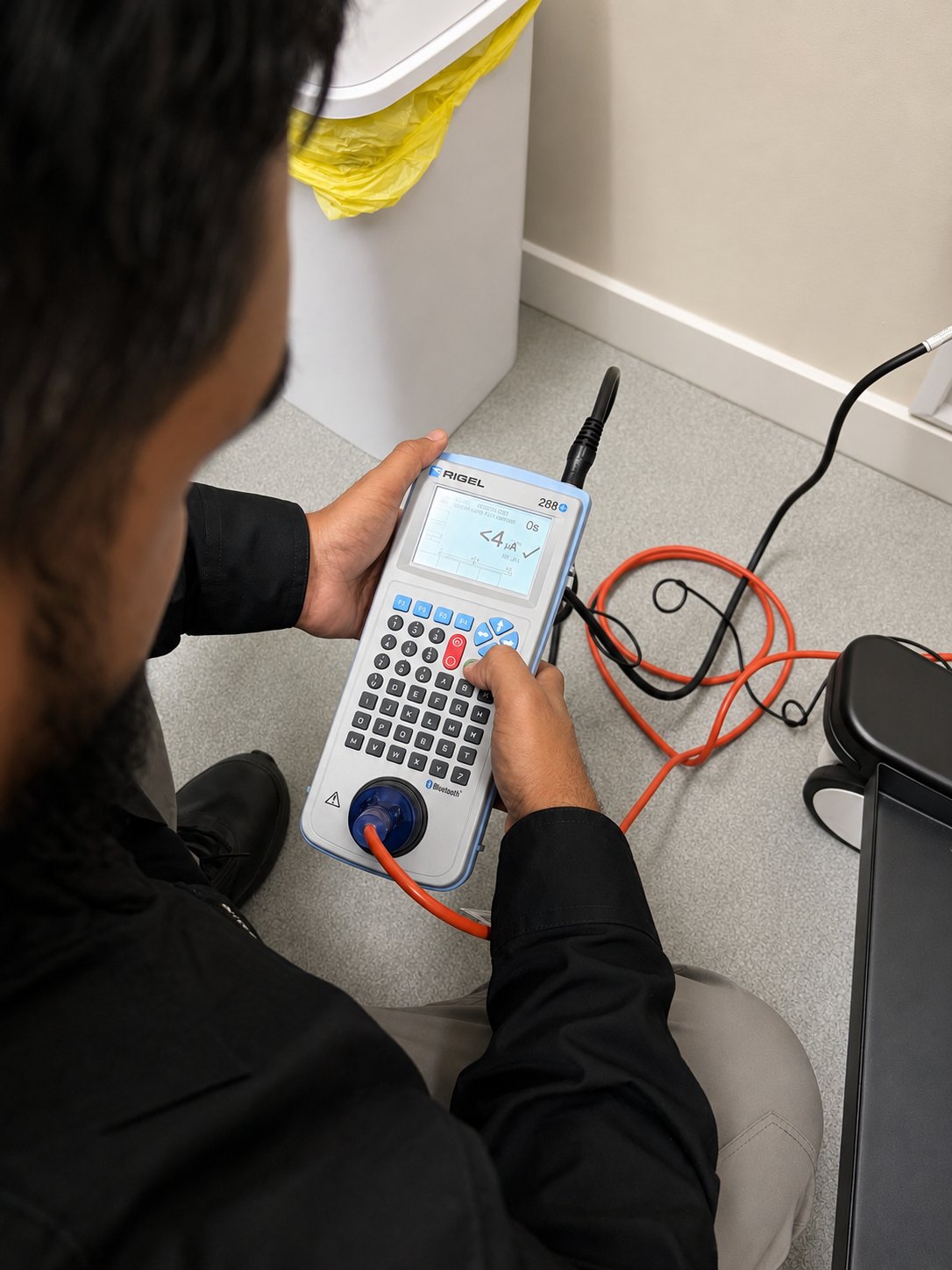
A plus compliance services follows a methodical approach designed to provide certainty without hindering your daily operations. We understand that Victorian workplaces are busy environments; therefore, we typically synchronise microwave radiation leakage testing with your regular electrical test and tag schedule. This integrated service model ensures all compliance needs are met in a single, efficient visit. Our technicians arrive with specialised, calibrated radiation detectors that are specifically engineered to pick up frequencies escaping the oven’s shielding. The entire process is quick, clean, and professional, leaving you with clear documentation for your safety records.
Step 1: Comprehensive Visual Inspection
Every assessment begins with a thorough physical examination of the appliance. We prioritise checking the door seals, hinges, and the glass mesh for any signs of physical wear, misalignment, or damage that could allow energy to escape. Technicians also inspect the internal cavity for pitting or rust, as even minor surface degradation can compromise the unit’s ability to contain radiation. Finally, we verify the safety interlock system. This system is designed to stop the microwave immediately when the door is opened; if it fails, the risk of exposure increases significantly.
Step 2: Radiation Leakage and Power Output Testing
Once the visual check is complete, we perform the actual measurement of emissions while the microwave is under load. This is usually done by heating a specific volume of water to simulate real-world use. We ensure that leakage levels do not exceed the strict limit of 5mW/cm² at a distance of 5cm from the surface, which aligns with international and federal safety standards for microwave leakage. Additionally, we conduct power output testing to verify that the unit is heating efficiently. A microwave that requires excessive time to heat may indicate failing internal components, which can lead to overheating or electrical faults. Professional microwave radiation leakage testing is the only way to confirm these internal components are operating within safe parameters.
If you are unsure about the current safety status of your kitchen appliances, you can speak with our team to arrange a site-specific assessment.
Identifying Signs of a Faulty Microwave: When to Call the Professionals
Recognising the early symptoms of a failing appliance is a core skill for any proactive facility manager. While some faults are obvious, many issues that lead to unsafe emissions are subtle and easily overlooked during a busy workday. Relying on a visual check alone is often a false economy; while a microwave might still heat food, it could simultaneously be failing to contain energy. Professional microwave radiation leakage testing remains the only definitive method to ensure your equipment meets the safety standards required for a Victorian workplace. By identifying these red flags early, you can prevent minor issues from becoming significant safety breaches.
Physical Red Flags for Facility Managers
Physical wear is the most common precursor to leakage. You should regularly check for visible cracks in the door glass or loose hinges that prevent the door from sitting flush against the chassis. Even a millimetre of misalignment can compromise the unit’s shielding. Another frequently ignored issue is the build-up of grease or burnt food on the door seals. This debris creates a physical gap, preventing a tight seal and allowing radiation to escape. If you notice unusual noises or sparking, known as arcing, during a cycle, the unit should be decommissioned immediately for professional assessment. These physical defects often indicate that the internal containment is no longer reliable.
Operational Warning Signs
Operational faults often point to internal component failure or a breakdown in safety logic. One of the most dangerous signs is an interlock failure, where the microwave continues to run even after the door has been opened. This indicates a critical breakdown in the safety mechanisms designed to protect users. You should also monitor the time required to heat standard items; a significant increase in heating time suggests the magnetron is failing or the unit is losing power. Finally, any “burning” smell that isn’t clearly linked to the food inside is a major red flag. These signs indicate that the appliance is no longer fit for purpose and requires immediate attention. To maintain a safe and well-regulated environment, you can explore our full range of compliance services to see how we help Victorian businesses stay organised and reduce risk.
A plus compliance services acts as a dependable partner, helping you manage these risks through systematic checks and clear reporting. While staff may report obvious faults, regular microwave radiation leakage testing catches the invisible risks that standard inspections miss. Taking a proactive approach ensures your organisation remains compliant and your team stays protected from unnecessary exposure.
Compliance Intervals and Workplace Safety Obligations in Victoria
Determining the correct schedule for microwave radiation leakage testing is not a one size fits all process. Frequency is primarily determined by your specific workplace environment, the type of equipment in use, and a thorough risk assessment. Under Victorian OHS obligations, employers must ensure that all electrical plant is maintained in a safe condition. To achieve this, industry best practice relies on the frameworks provided in AS/NZS 3760:2010. It is essential that this information is read in conjunction with the standard as a whole, particularly clause 2.1, which outlines the scope for safety inspections. Because every site has unique operational demands, obtaining professional guidance is the most reliable way to set an appropriate compliance schedule.
A plus compliance services acts as a knowledgeable ally in this process, helping you move from uncertainty toward organised control. You can learn more about these requirements by exploring our guide on how often should you perform tag and testing. By establishing a routine that matches your site’s risk profile, you minimise the chance of equipment failure and ensure staff safety is never left to chance.
Standard Testing Intervals for Victorian Workplaces
In a typical Melbourne office environment, a 12 month interval is often sufficient for microwaves located in low use staff kitchens. However, high risk sites or those with heavy commercial usage require more frequent intervention. For example, equipment used on construction sites or hire equipment often requires 3 month checks to comply with the rigorous demands of those environments. A plus compliance services helps Victorian businesses stay organised by providing automated due date reminders, ensuring you never miss a critical safety milestone. This proactive management style is part of our commitment to making workplace compliance easier to manage for facility managers across the state.
The Importance of Accurate Compliance Reporting
Maintaining a digital asset register is a critical component of audit readiness for modern Melbourne businesses. If a WorkSafe inspector or insurance auditor requests proof of maintenance, having a disorganised pile of paper receipts is rarely sufficient. A professional compliance report should be transparent and methodical, clearly listing each asset ID, the specific test results, and the next scheduled due date. This level of detail provides documented proof of your commitment to safety. We specialised in building a digital asset register for audit readiness, which allows you to access your safety data whenever it is needed. Clear reporting and dependable service are the foundations of a safe, well regulated workplace.
Why Choose A Plus Compliance Services for Your Microwave Testing?
A plus compliance services acts as a knowledgeable and supportive expert for businesses across the state. We position ourselves as an essential ally rather than a distant contractor, focusing on qualities like punctuality, responsiveness, and ease of collaboration. Our Melbourne-based headquarters allows us to provide comprehensive coverage to suburbs such as Clayton, Dandenong, and Mulgrave, as well as regional Victorian areas. By specialising in microwave radiation leakage testing, we help you navigate complex OHS requirements with a grounded, practical energy that prioritises clarity over marketing hyperbole. We understand that your priority is a safe workplace, and our methodical approach ensures that every step of the process is accounted for and explained.
Our team is experienced and methodical, projecting the image of a well-regulated entity that values long-term relationships and consistent performance. We don’t just perform a test; we provide a steady, dependable presence that simplifies complex requirements for the reader. This focus on a stress-free experience means you can focus on your core business operations while we handle the technical details of your safety obligations. By choosing a partner that emphasises accuracy and thoroughness, you ensure that your workplace remains a secure environment for all staff and visitors.
Clear Reporting and Dependable Service
We believe that clear communication before, during, and after a job is the best way to reduce stress for facility and operations managers. This transparency allows you to stay informed about the status of your appliances without needing to chase updates. For multi-site organisations across Victoria, we offer a coordinated approach that simplifies the management of diverse compliance schedules. Our commitment to providing clear reporting, dependable service, and ongoing compliance support is what makes workplace compliance easier to manage. Every assessment we conduct is guided by our core values: Reliable. Compliant. Professional. Safety-first.
Organised Compliance for Peace of Mind
Helping Victorian businesses reduce risk and stay organised is a fundamental part of our mission. We design recurring service schedules that work around your site operations, ensuring that your microwave radiation leakage testing is performed at the correct intervals without causing unnecessary downtime. When a technician identifies a failed item, it is immediately recorded and clearly tagged, allowing you to take swift action to maintain safety. This systematic management creates a narrative of efficiency and predictability for your business. If you’re looking for a reliable partner to manage your recurring safety checks, contact 1300 427 158 or 1300 CAN TEST to arrange a site assessment.
Request a quote for your microwave and electrical testing today
Securing Your Workplace with Professional Compliance
Maintaining a safe environment for your staff involves more than just a visual check of kitchen appliances. Professional microwave radiation leakage testing ensures that invisible faults, such as degraded seals or failing interlocks, are identified before they pose a health risk. By integrating these specialised checks into a structured safety schedule, you meet your Victorian OHS obligations while minimising operational disruption. It’s about moving from uncertainty toward a state of organised control and long-term reliability.
A plus compliance services acts as a dependable partner for Melbourne-based businesses and organisations across Victoria. We provide the clear reporting, asset registers, and automated due-date reminders needed to ensure you’re always audit-ready. Our team focuses on a safety-first approach that helps you reduce risk and stay organised without the stress of managing complex compliance schedules. Taking a proactive approach to appliance safety protects your team and reinforces a high standard of professional care in your workplace.
We look forward to helping you maintain a compliant and safe environment for your organisation.
Frequently Asked Questions
Is microwave radiation leakage testing a legal requirement in Australia?
In Victoria, microwave testing falls under an employer’s general duty of care under the Occupational Health and Safety Act 2004. While no specific law mandates radiation checks, following Australian Standards is the accepted way to prove you’ve provided a safe workplace. This information must be read in conjunction with AS/NZS 3760:2010 as a whole, and particularly clause 2.1, to ensure your organisation stays compliant and helps Victorian businesses reduce risk and stay organised.
How much radiation is considered dangerous from a microwave?
The Australian Radiation Protection and Nuclear Safety Agency (ARPANSA) defines the safety limit for microwave radiation leakage as 5 milliwatts per square centimetre (5 mW/cm²). This measurement is taken at a distance of 5 cm from the external surface of the oven. If a unit exceeds this threshold, it’s considered unsafe for use. Professional microwave radiation leakage testing is the only reliable way to measure these invisible emissions accurately using calibrated equipment.
What happens if my microwave fails the radiation leakage test?
If an appliance fails, it’s clearly identified with a failed tag and recorded in your digital asset register. You must remove the unit from service immediately to prevent staff exposure. A plus compliance services documents these results to help you maintain an accurate compliance history. Once an item is decommissioned, you can decide whether to arrange a professional repair or replace the unit to ensure your kitchen remains safe for everyone.
Can I test for microwave leakage myself with a home kit?
You shouldn’t rely on home kits because they lack the precision and calibration required for workplace compliance. Professional technicians use specialised radiation detectors that are regularly calibrated to ensure they provide accurate readings. A home kit doesn’t provide the documented proof or the detailed reporting needed for an OHS audit. Engaging a professional partner ensures your results are industry-literate and that your safety records meet the necessary Australian Standards.
Does a brand new microwave need to be tested before use?
It’s highly recommended to test brand new microwaves before they enter service. Appliances can sustain internal damage or misaligned doors during transit that isn’t visible to the naked eye. Testing upon arrival allows you to establish a baseline for the unit in your asset register and ensures it meets the 5 mW/cm² safety limit from day one. This proactive step helps Victorian businesses reduce risk and stay organised from the very beginning.
How long does a microwave radiation leakage test take to complete?
A professional microwave radiation leakage testing procedure is quick, usually taking only a few minutes per unit. The technician performs a visual inspection followed by a radiation measurement while the unit is under load. Because the process is efficient, it causes minimal disruption to your site operations. When we visit your facility, we work methodically to ensure each appliance is verified thoroughly without keeping your staff out of the kitchen for long.
Why is microwave testing often done with electrical test and tag?
Synchronising microwave testing with your regular electrical test and tag is the most efficient way to manage workplace safety. While test and tag focuses on the electrical current and earthing, the radiation test checks for actual energy emissions. Combining these services reduces the number of site visits and ensures all your compliance obligations are met at once. It’s a practical, service-focused approach that keeps your maintenance records organised and up to date.
What areas of Melbourne does A plus compliance services cover?
A plus compliance services provides comprehensive coverage across Melbourne and throughout the state of Victoria. We frequently support organisations in suburbs like Clayton, Dandenong, Mulgrave, Scoresby, and Mount Waverley. Our team also travels to areas such as Pakenham, Berwick, and Keysborough to help facility managers maintain their safety standards. Whether you’re based in the south-eastern suburbs or regional Victoria, we act as a dependable partner for your recurring compliance programs.
