Test and Tag Requirements Victoria: The 2026 Workplace Safety Guide
Imagine walking into your facility on a Monday morning only to find that a minor, undetected electrical fault has caused significant operational downtime. For many facility managers and business owners across Melbourne, the complexity of test and tag requirements victoria mandates often creates a persistent sense of uncertainty. You likely agree that maintaining a safe workplace is a non-negotiable priority, yet conflicting advice regarding testing intervals and compliance documentation can make the process feel overwhelming, especially when preparing for a WorkSafe audit.
At A Plus Compliance Services, we specialise in making workplace compliance easier to manage by providing clear, reliable, and professional support. This guide clarifies your legal obligations under Victorian OHS laws and the specific testing intervals required by AS/NZS 3760:2010. This information must be read in conjunction with AS/NZS 3760:2010 as a whole, and particularly clause 2.1, to ensure your site remains fully compliant and your documentation is ready for any inspection.
By the end of this article, you will understand how to categorise your environment, identify who is qualified to perform inspections, and implement a managed compliance schedule that reduces risk. We focus on helping Victorian businesses stay organised, ensuring that recurring safety cycles are handled with minimal disruption to your daily operations.
Key Takeaways
- Understand your primary obligations under the Occupational Health and Safety Act 2004 and how WorkSafe Victoria oversees electrical safety in the workplace.
- Learn how to determine the specific test and tag requirements victoria mandates for your site by identifying hostile and non-hostile operating environments.
- Clarify the definition of a ‘competent person’ to ensure your equipment is inspected by someone with the appropriate training and skills required by Australian Standards.
- Master the essential documentation standards, including the correct application of the RGBY tag colour sequence for Victorian construction and demolition sites.
- Discover the benefits of a managed compliance schedule and detailed asset registers in maintaining long-term safety while minimising operational downtime.
Understanding Your Electrical Safety Obligations in Victoria
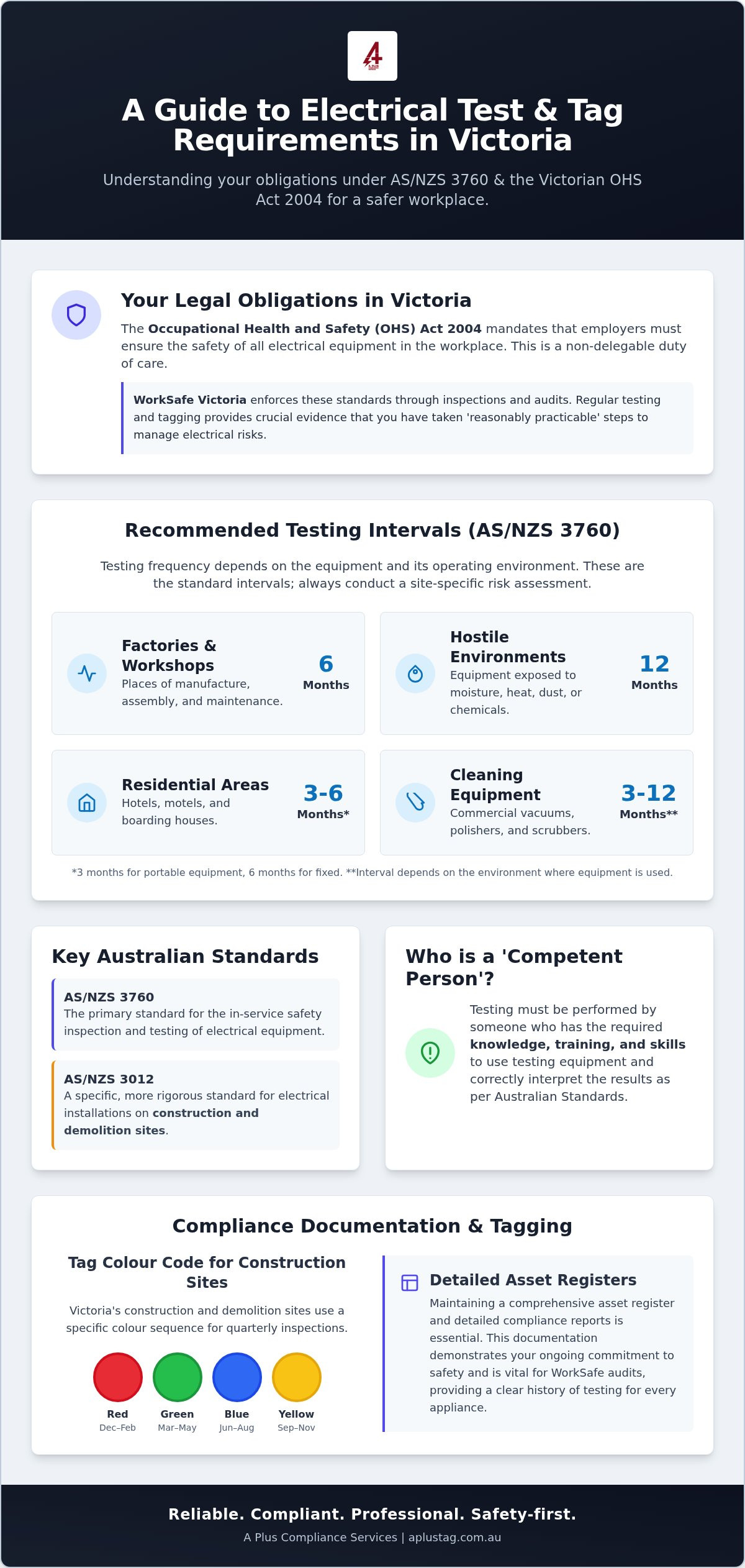
The Occupational Health and Safety (OHS) Act 2004 establishes the legal framework for workplace safety across the state. Under this Act, employers have a non-delegable duty to ensure the health and safety of their employees, so far as is reasonably practicable. This responsibility extends to the maintenance of all electrical plant and equipment. WorkSafe Victoria serves as the enforcement body, conducting inspections and audits to ensure Victorian businesses meet these rigorous standards. Relying on visual inspections alone is a common mistake; many dangerous faults, such as insulation breakdown or poor earthing, aren’t visible. Professional Portable Appliance Testing (Test and Tag) is the only reliable way to identify these hidden hazards before they cause harm.
Mandatory Warning: This information must be read in conjunction with AS/NZS 3760:2010 as a whole, and particularly clause 2.1.
Duty of Care and ‘Reasonably Practicable’ Measures
Maintaining a safe workplace isn’t a one-off task but an ongoing commitment. To meet the test and tag requirements victoria expects, employers must implement a systematic approach to risk management. Regular testing and tagging provides tangible evidence that you’ve taken reasonably practicable steps to manage electrical risks. This documentation is vital for protecting your people and your business. Non-compliance can lead to severe penalties, but more importantly, it increases the risk of preventable electrical accidents. A Plus Compliance Services works with you to simplify this process, ensuring your site stays organised and audit-ready at all times.
Applicable Standards: AS/NZS 3760 and Beyond
While AS/NZS 3760:2010 is the primary standard for in-service safety testing, it’s not the only one you need to know. This standard provides the foundation for testing intervals and procedures in most commercial environments. However, if you’re operating in the construction or demolition sectors, you must also comply with AS/NZS 3012. This specific standard accounts for the higher risks found on building sites, where equipment is frequently moved and exposed to damage. Using the correct standard for your industry is a critical part of your safety strategy. You can explore our specialised compliance services to find the right testing regime for your specific workplace.
Determining Testing Intervals for Victorian Workplaces
Identifying the correct frequency for inspections is a critical component of your safety strategy. Under the test and tag requirements victoria enforces, the interval between tests isn’t arbitrary. Instead, it depends on the nature of the equipment and the environment where it’s used. A site-specific risk assessment helps determine these frequencies by evaluating factors like equipment mobility and potential for damage. Following WorkSafe Victoria’s Electrical Safety Guidelines ensures you’re managing these risks effectively while staying compliant. You can explore our full range of compliance services to see how we help businesses manage these recurring cycles.
Standard Testing Intervals by Environment Category
AS/NZS 3760:2010 categorises environments to provide a clear framework for testing. In Category (a), which includes factories, workshops, and places of manufacture, equipment is often subject to heavy use. Consequently, the interval is 6 months for both portable and fixed items. Categories (b) and (c) cover hostile and non-hostile environments. A hostile environment is one where equipment is exposed to moisture, heat, or dust. For most equipment in these settings, a 12 months interval applies. Category (d) relates to residential-type areas like hotels or motels. Here, portable equipment requires testing every 3 months, while fixed equipment is tested every 6 months. Finally, Category (e) covers commercial cleaning equipment. Depending on the specific environment, these items need testing every 3 months or 12 months.
Specialised Intervals: Construction and Hire Equipment
Specific industries and equipment types have more rigorous demands. Category (f) hire equipment requires inspection every 6 months for general hire. If the equipment has undergone a repair or major service, it requires testing every 2 years per AS/NZS 5762. Construction and demolition sites are high-risk zones. All portable equipment on these sites must meet a strict 3 months testing interval. Portable RCDs (Residual Current Devices) also have unique requirements, often needing a push-button test daily or before every use for specific categories. Fixed RCDs typically follow a 6 months or 12 months schedule for operating time tests depending on the environment.
If you’re unsure which category your workplace falls into, it’s best to discuss a compliance schedule with a professional to ensure nothing is overlooked.
Who is Qualified to Test and Tag in VIC?
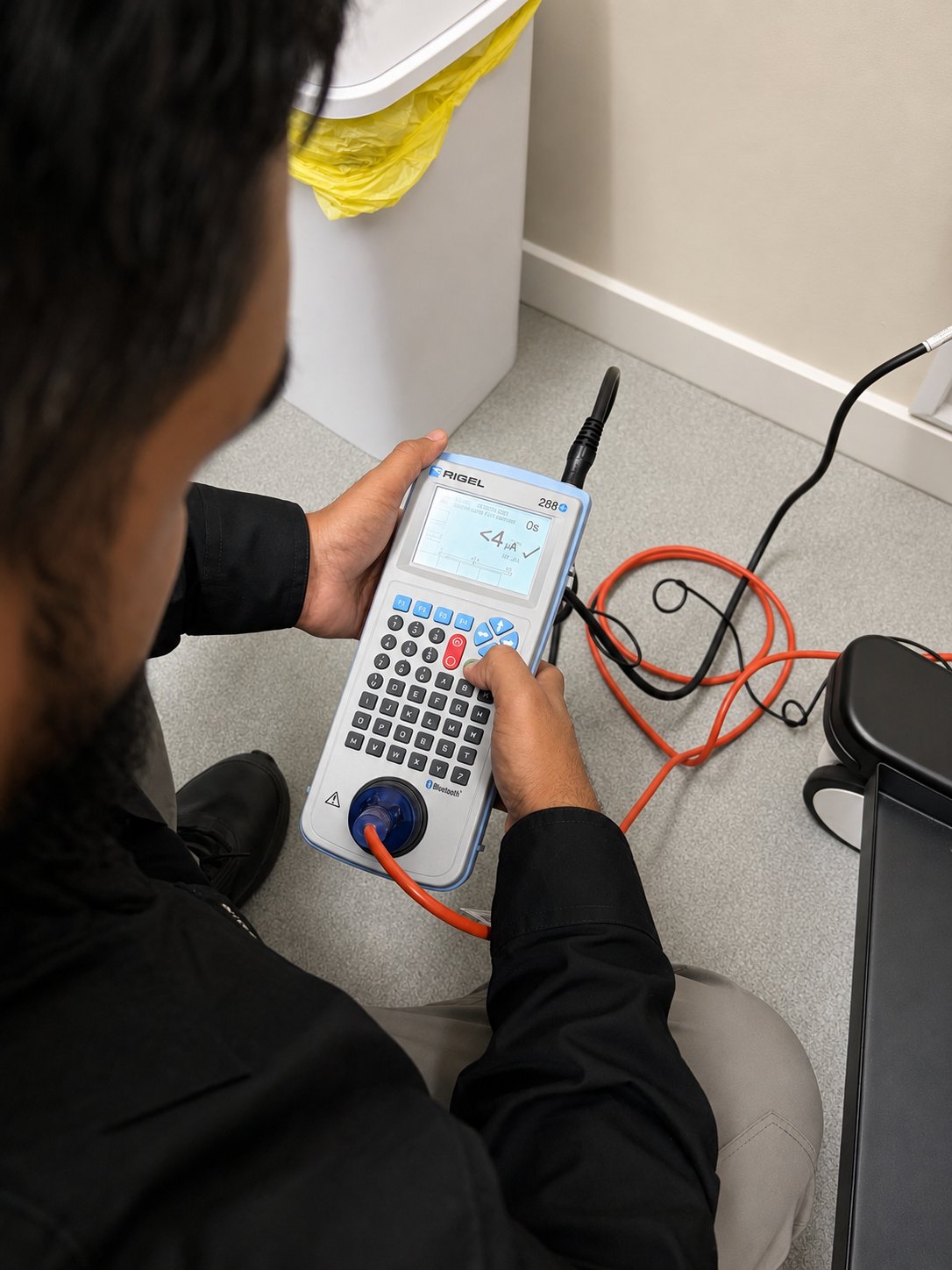
Identifying the right person for inspections is a key part of test and tag requirements victoria. According to Australian Standards, these safety checks must be carried out by a ‘competent person’. This is someone who has the necessary practical and theoretical knowledge, acquired through training, qualifications, or experience, to perform the task correctly. While a licensed electrician is inherently qualified, a certified technician who has completed a specific competency course can also perform these tests. The quality of the inspection relies heavily on the use of specialised, calibrated equipment like a Portable Appliance Tester (PAT), which provides accurate readings that a simple visual check cannot detect.
The ‘Competent Person’ Requirement
A competent person must understand how to perform both visual inspections and electrical tests safely. They need to identify physical damage, such as frayed cords or cracked casings, while also interpreting the complex data provided by a PAT device. The limitations of training are often overlooked; a brief course doesn’t necessarily prepare an internal staff member for the complexities of a large-scale industrial site or a high-risk workshop. At A Plus Compliance Services, we prioritise technician proficiency to ensure every inspection meets the highest safety standards. We believe that true competence involves a methodical approach to identifying hazards that others might miss.
Why Professional Services Outperform DIY Testing
Choosing a professional partner over in-house testing offers significant advantages in risk management and operational efficiency. DIY testing often lacks the rigorous documentation required for a WorkSafe audit, and internal staff may struggle to keep up with evolving safety standards. Professional services provide access to advanced reporting tools and structured asset registers, making it easier to track every piece of equipment across multiple Victorian sites. Relying on an external expert also reduces the risk of human error, such as missed testing dates or incomplete logs. We provide automated reminders to ensure you never miss a compliance deadline, keeping your workplace safe without adding to your internal workload. For more detail on the broader landscape, see The Ultimate Guide to Test and Tag Services in Australia.
Compliance Documentation and Tagging Standards
A compliance tag is more than just a sticker; it’s a visual confirmation of safety. Under the test and tag requirements victoria mandates, these tags provide immediate clarity for both workers and safety inspectors. Every tag must clearly display the test date, the technician’s name, and the date the next inspection is due. If an item fails, it must be immediately identified with a ‘failed’ tag and removed from service to prevent accidental use. This proactive approach ensures that faulty equipment doesn’t remain a hidden hazard on your site.
For construction and demolition sites, Victoria follows the RGBY colour-coding sequence. This quarterly system, involving Red, Green, Blue, and Yellow tags, allows for quick visual verification that equipment is within its three-month testing window. Using the correct colour for the current period is a simple but effective way to maintain site-wide safety standards and demonstrate compliance at a glance.
The Asset Register: Your Audit Trail
While tags are visible, the asset register is the backbone of your compliance documentation. It serves as a comprehensive audit trail that proves your organisation is meeting its duty of care. A structured register should include the unique asset ID, the specific test date, the detailed result, and the scheduled next due date. You can learn about our compliance reporting and asset registers to see how we help businesses stay organised. Digital registers are particularly valuable during WorkSafe audits, as they provide instant access to historical safety data across your entire inventory.
Managing Equipment Failure and Repairs
When an item fails an inspection, the process doesn’t end with its removal. Every failure must be recorded in your compliance report to maintain a complete safety history. If you choose to have the item repaired, it can’t simply be plugged back in. You must refer to AS/NZS 5762 for testing requirements before re-introducing the equipment to the workplace. This ensures the repair itself meets rigorous safety standards. A plus compliance services helps Victorian businesses manage this transition by providing clear reporting on failed items and helping you coordinate the necessary re-testing cycles. Our goal is to ensure your workplace remains safe while minimising the downtime caused by equipment faults.
Implementing a Managed Compliance Schedule in Melbourne
Managing test and tag requirements victoria across a growing organisation requires more than just reactive testing. A managed compliance program shifts the focus from a one-off task to a structured, recurring safety cycle. This approach ensures that every item is inspected at the correct intervals; whether that is 3 months, 6 months, 12 months, 2 years, or 5 years. By establishing a long-term partnership, we help Victorian businesses reduce risk and stay organised through predictable scheduling and proactive maintenance.
Mandatory Warning: This information must be read in conjunction with AS/NZS 3760:2010 as a whole, and particularly clause 2.1.
Multi-Site and Site-Based Compliance
For organisations with multiple Victorian sites, coordinating safety checks can become an administrative burden. We specialise in multi-site management, centralising all data into a single, accessible asset register. This allows facility managers to oversee compliance across an entire network without having to manage individual site logs. Whether you manage a network of schools, a chain of healthcare clinics, or multiple warehouse facilities, consistency is vital. We coordinate testing across different locations to align with your operational downtime, ensuring that safety checks never interfere with your core business activities. By centralising your reports, we make workplace compliance easier to manage for facility managers who need a high-level view of their safety status across Victoria. For more on the evolving landscape, see Compliance Monitoring: Australian Workplace Safety 2026.
Next Steps: Getting Your Workplace Compliant
Staying ahead of test and tag requirements victoria doesn’t have to be stressful. We provide automated due-date reminders that alert you well before your next inspection is due, preventing any gaps in your safety record. This proactive system is essential for busy operations managers who need to focus on daily tasks rather than tracking expiry dates on individual tags. Our team works with you to arrange professional site assessments at times that cause minimal disruption to your operations. We act as a dependable partner that is proactive rather than reactive, helping you feel informed and prepared for any audit. Our technicians evaluate your specific environment to confirm the necessary testing frequencies, taking the guesswork out of the process.
Contact A plus compliance services on 1300 427 158 to discuss your compliance schedule and arrange a comprehensive assessment for your workplace.
Securing Your Workplace Through Managed Compliance
Navigating the electrical safety landscape in Melbourne requires a methodical approach to risk management. By understanding the test and tag requirements victoria mandates, you’ve taken the first step toward protecting your staff. It’s essential to ensure your business meets its duty of care under the OHS Act 2004. A critical takeaway is that all testing must align with AS/NZS 3760:2010, particularly clause 2.1, using the correct intervals for your specific environment. Maintaining a detailed asset register is equally vital, as it provides the audit trail necessary for WorkSafe compliance.
At A plus compliance services, we focus on making workplace compliance easier to manage. Our expert knowledge of Victorian OHS requirements allows us to act as a dependable partner for your organisation. We provide clear reporting and ongoing support, helping Victorian businesses reduce risk and stay organised. Our service is reliable, compliant, professional, and always safety-first.
Securing your workplace today ensures operational continuity and peace of mind for the years ahead.
Frequently Asked Questions
Is testing and tagging legally required for all Victorian businesses?
Yes, all Victorian employers must provide a safe work environment under the Occupational Health and Safety Act 2004. Meeting the test and tag requirements victoria mandates is a primary way to demonstrate you’ve taken reasonably practicable steps to manage electrical risks. While the Act doesn’t explicitly name ‘test and tag’ in every clause, it requires the maintenance of safe plant and equipment. Professional testing provides the necessary evidence for WorkSafe audits and insurance purposes.
How often does my office equipment need to be tested in Melbourne?
Office equipment in a non-hostile environment typically requires testing every 12 months. This applies to both portable items and fixed equipment that aren’t subject to abuse or constant flexing. However, if the equipment is used for commercial cleaning within that office, the interval changes to 3 months or 12 months depending on the specific environment. This information must be read in conjunction with AS/NZS 3760:2010 as a whole, and particularly clause 2.1.
Do I need a licensed electrician to test and tag in Victoria?
No, you don’t specifically need a licensed electrician to perform these safety checks in Victoria. The task must be completed by a ‘competent person’ who has the knowledge and skills acquired through training or experience. While electricians are qualified, a certified technician using a calibrated Portable Appliance Tester (PAT) is often more efficient for large-scale compliance. A plus compliance services ensures all technicians are proficient and follow the strict procedures outlined in Australian Standards.
What are the specific tag colour requirements for construction sites in VIC?
Construction and demolition sites in Victoria must use the RGBY tag colour sequence to allow for easy visual identification of the current testing period.
- Red: December to February
- Green: March to May
- Blue: June to August
- Yellow: September to November
This quarterly rotation ensures all portable equipment on high-risk sites is tested every 3 months as required by the relevant safety standards.
What happens if an electrical item fails the safety test?
Failed items must be clearly identified with a ‘failed’ tag and immediately removed from service. This prevents accidental use while you decide whether to repair or replace the asset. Every failure is recorded in your asset register to maintain a complete compliance history. If you choose to have the item repaired, it must be tested in accordance with AS/NZS 5762 before it can be re-introduced to your workplace.
How long should I keep my test and tag records for compliance audits?
You should maintain your test and tag records for the entire life of the equipment to ensure a complete audit trail. Accurate record-keeping is a core part of test and tag requirements victoria, providing proof of safety management during WorkSafe inspections. A plus compliance services provides structured asset registers and automated reminders to help you keep these records organised. This approach ensures you’re always ready for a surprise audit without needing to search for old paperwork.
Can testing be performed outside of normal business hours to avoid disruption?
Yes, testing can be performed outside of normal business hours to minimise operational disruption. A plus compliance services understands that busy Victorian sites like hospitals, schools, and 24-hour warehouses need flexible scheduling. We can arrange site access during evenings or weekends to ensure your electrical safety checks are completed without interrupting your team’s productivity. This service-focused approach is designed to make compliance as stress-free as possible for facility and operations managers.
Does new electrical equipment need to be tested and tagged immediately?
Yes, equipment should be tested and tagged before it’s used in a Victorian workplace. Even brand-new items can have manufacturing defects or transit damage that isn’t visible to the naked eye. Ensuring that every asset is entered into your register and tested upon arrival is the best way to maintain a safe environment. For hire equipment, a general inspection and test must be performed prior to every hire to ensure the safety of the user.
