AS/NZS 3003 Guide for Victorian Medical Facilities
Could your medical or dental clinic pass a surprise accreditation audit tomorrow if an inspector asked to see your latest certification for body-protected areas? For many Victorian facility managers, the complexity of patient area testing requirements under AS/NZS 3003:2018 is a frequent source of uncertainty. It’s common to feel overwhelmed when trying to distinguish between the safety of the medical devices themselves and the specialised electrical infrastructure they plug into. You aren’t alone if you find the overlap between biomedical standards and installation rules confusing.
We believe that maintaining a clinical environment should be about patient care, not paperwork stress. This guide simplifies the compliance process by providing a clear roadmap for your annual testing obligations. You’ll discover how to navigate the differences between cardiac and body-protected classifications, what Victoria’s Electricity Safety (General) Regulations 2019 specifically require of your facility, and how to maintain an organised asset register. Please note that this information must be read in conjunction with AS/NZS 3760:2010 as a whole, and particularly clause 2.1. By following this structured approach, you can ensure your facility remains safe, compliant, and ready for any regulatory inspection with minimal disruption to your daily clinical operations.
Key Takeaways
- Understand the mandatory 12-month routine testing interval required for both body-protected and cardiac-protected areas across Victorian healthcare facilities.
- Learn how the Electricity Safety (General) Regulations 2019 mandate strict compliance with AS/NZS 3003 for all electrical installations in clinical settings.
- Discover how to correctly classify your facility’s treatment rooms to ensure your patient area testing requirements align with the specific medical procedures performed.
- Identify the critical differences between biomedical equipment testing and patient area infrastructure testing to ensure total facility safety.
- Find out how a professional asset register and compliance log can simplify your next healthcare accreditation audit and reduce operational risks.
Understanding Patient Area Testing and AS/NZS 3003 Compliance
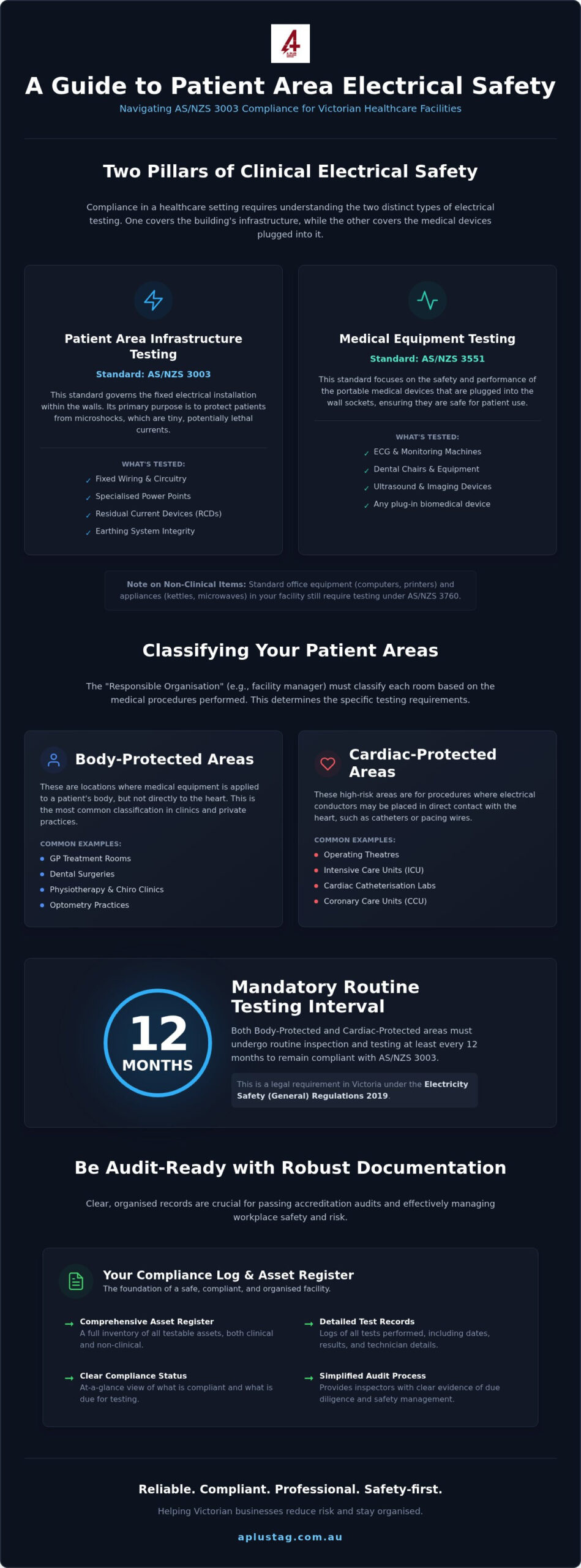
Patient area testing involves the rigorous verification of electrical safety in any location where medical equipment is intended to be used on a person. While standard electrical safety focuses on preventing macroshocks, patient area testing requirements are designed to mitigate much smaller, potentially lethal currents known as microshocks. These requirements are governed by AS/NZS 3003:2018, a standard maintained by Standards Australia that specifically addresses the electrical installations in hospitals, dental surgeries, and medical clinics.
It’s vital to distinguish between the two pillars of clinical safety. AS/NZS 3003 covers the fixed electrical installation, including the wiring, power points, and residual current devices (RCDs) within the walls. Conversely, AS/NZS 3551 focuses on the safety of the biomedical devices that plug into these sockets. A Plus Compliance Services provides both specialised services to ensure your facility remains audit-ready and safe. This information must be read in conjunction with AS/NZS 3760:2010 as a whole, and particularly clause 2.1.
Why Clinical Environments Require Specialised Testing
Patients in medical or dental settings are often more vulnerable to electrical hazards than people in a typical office. During procedures, skin resistance might be bypassed by conductive gels or invasive instruments, making the heart susceptible to even tiny electrical leakages. In Victoria, the Electricity Safety (General) Regulations 2019 mandate that these areas meet specific safety benchmarks. We help Victorian healthcare providers meet these legal obligations through precise testing of earthing systems and RCD trip times, ensuring the environment remains safe for both staff and patients. This “safety-first” approach is essential for any organisation that values long-term risk reduction.
The Intersection of AS/NZS 3760 and AS/NZS 3003
A common point of confusion for facility managers is how general safety rules interact with clinical ones. While AS/NZS 3003 manages the treatment zones, the rest of your facility still needs to comply with AS/NZS 3760, the standard for general in-service safety inspection. Managing these overlapping patient area testing requirements requires a systematic approach to ensure nothing is missed during an audit.
- Standard office equipment like computers and printers must be tested and tagged under AS/NZS 3760.
- All power boards and extension leads used within a patient area must meet the stricter clinical standards to minimise fire and shock risks.
- A holistic approach ensures that every asset, from a staff room kettle to a surgery light, is documented in a single, organised register.
By integrating these standards, you create a seamless safety net for your practice. This dual-standard approach helps Victorian businesses stay organised and reduces the likelihood of failing a healthcare accreditation audit due to overlooked non-clinical equipment.
Body-Protected vs. Cardiac-Protected Electrical Areas
The safety of a clinical environment depends on correct classification. Under the guidelines published by Standards Australia, medical spaces are divided into two distinct categories based on the level of risk to the patient. It’s the duty of the “Responsible Organisation” (the facility owner or manager) to determine which classification applies to each room before any testing begins. This decision is based on the specific medical procedures performed and the level of electrical risk to the patient. Our team helps you verify these choices to ensure your patient area testing requirements are met with precision.
Body-Protected Areas (Type B)
Body-protected areas are the most frequent type of installation we see in Victorian suburban clinics. These spaces are used for procedures where medical equipment is used on a person’s body, but not directly on or near the heart. You’ll find these classifications in GP treatment rooms, dental surgeries, optometry practices, and physiotherapy clinics. The patient area testing requirements for these zones focus heavily on the integrity of the earthing system and the reliable operation of Residual Current Devices (RCDs). These safeguards ensure that if a fault occurs, the power is cut almost instantly, protecting both the patient and the clinician from shock.
Cardiac-Protected Areas (Type CF)
Cardiac-protected areas have the most stringent safety protocols because the risk of a micro-shock is a critical concern. These zones are reserved for locations where electrical conductors might be placed inside or very close to a patient’s heart, such as operating theatres, intensive care units, and cardiac catheter laboratories. To mitigate this risk, these areas require equipotential earthing and the installation of Line Isolation Monitors (LIMs). These specialised systems provide an extra layer of protection by constantly monitoring the electrical supply and ensuring that no dangerous leakage currents can reach the patient during a sensitive procedure.
Clear signage is a mandatory part of maintaining a compliant facility. Every Body-Protected area must be marked with a green sign, while Cardiac-Protected zones require a blue sign to alert staff to the level of protection provided. A Plus Compliance Services acts as a professional ally by verifying these signs and classifications during our regular site assessments. This visual confirmation is a key part of staying audit-ready and maintaining a safe workplace for your staff. If you’re unsure about your current room classifications, you can arrange a site assessment with our experienced Victorian team to ensure every zone is correctly identified and tested.
Mandatory Testing Intervals and Commissioning Requirements
Consistency is the backbone of electrical safety in a clinical setting. To maintain a compliant facility in Victoria, routine inspection and testing of patient areas must be carried out at intervals not exceeding 12 months. This annual cycle ensures that the safety measures installed during the initial commissioning remain effective despite the heavy use common in medical environments. Adhering to these patient area testing requirements isn’t just about passing an audit; it’s a proactive strategy to minimise risk to your patients and staff.
Compliance also extends beyond the calendar. Any significant electrical renovation, alteration, or repair within a patient zone triggers an immediate requirement for re-testing before the area is returned to service. When equipment is reintroduced after a fault or maintenance, we refer to AS/NZS 5762 to guide post-repair testing protocols. This safety-first approach ensures that no hidden faults are introduced during the repair process, keeping your workplace organised and secure.
What Happens During an Annual Inspection?
A professional annual inspection is a methodical process designed to verify every safety layer within the installation. Our technicians perform a thorough visual inspection of all sockets and switches, looking for signs of thermal damage or physical wear. We also confirm that mandatory green or blue signage is clearly visible and correctly placed. Following the visual check, we perform technical tests including:
- RCD Testing: Verifying that residual current devices trip within healthcare-specific time and current limits to prevent electric shock.
- Earth Continuity: Measuring the resistance of earthing paths to ensure they can safely dissipate fault currents.
- Insulation Resistance: Checking for any breakdown in wiring insulation that could lead to leakage currents.
Commissioning New Medical Suites in Victoria
If you’re opening a new clinic or expanding an existing facility, a full electrical verification is required before any patient area can be legally used. This commissioning process confirms that the builder’s electrical installation meets the precise standards of AS/NZS 3003. A Plus Compliance Services works closely with builders, site managers, and business owners to ensure day-one compliance. We provide the detailed documentation needed to satisfy Victorian regulators and healthcare accreditors. Integrating this with our Professional Test and Tag Services ensures that both your fixed installation and your portable assets are ready for clinical operation from the moment you open your doors.
Building a Robust Compliance Log and Asset Register
A detailed asset register serves as the definitive proof of your facility’s safety culture. For Victorian medical providers, this document is often the first thing requested during a clinical accreditation audit or a visit from a regulatory body. Maintaining a systematic log ensures that every facet of your patient area testing requirements is accounted for, moving your facility from a state of reactive repair to one of organised control. A Plus Compliance Services provides comprehensive reporting that transforms raw data into a clear, audit-ready roadmap for your site. This level of transparency is the gold standard for modern healthcare facilities, ensuring that compliance is a continuous state rather than a once-a-year panic.
Key Data Points for Medical Asset Registers
Every socket, RCD, and medical device requires a unique identifier to ensure total traceability. For instance, assigning a Unique Asset ID like 26050181 allows us to track the specific history of a power point or piece of equipment over several years. Our reports don’t just provide a simple “Pass” result; they record the exact measured values required by the standards to demonstrate thoroughness. We focus on critical metrics including:
- Earth Bond Resistance: Ensuring values remain ≤ 0.20 Ω to provide a safe path for fault currents.
- Insulation Resistance: Verifying that values are > 100 MΩ to prevent any dangerous leakage.
- Visual Inspection Results: Documenting the physical condition of the asset and its surrounding signage.
Any item that fails to meet these precise parameters is immediately flagged. We provide clear instructions for the immediate removal from service of any faulty equipment, helping you minimise risk before an incident occurs.
Audit Readiness for Victorian Clinics
Organised reporting is about more than just satisfying a checklist. It’s about having the confidence that your safety data is accurate and instantly accessible. Digital records allow for rapid retrieval during an inspection, providing a site-wide overview of your compliance status across multiple Victorian locations. By integrating Compliance Monitoring Australia protocols, we help you manage recurring cycles with ease. Our system uses automated reminders to ensure no testing interval is ever missed. This proactive approach keeps your facility audit-ready and ensures that your long-term safety obligations are met without disrupting your clinical workflow.
Reliable Patient Area Testing Across Melbourne and Victoria
A Plus Compliance Services has deep roots in the Victorian business community. We aren’t a distant national chain; we’re a local partner with service hubs in Clayton, Mulgrave, Dandenong, and Berwick. This local presence allows us to respond quickly to the specific patient area testing requirements of clinics across Melbourne and regional Victoria. Our technicians understand the local regulatory landscape and the high standards expected by Victorian healthcare accreditors. We position ourselves as an essential ally, ensuring your facility remains a safe environment for every patient who walks through your doors.
We understand that a busy medical or dental practice cannot simply stop operating for electrical testing. Our technicians are experienced in working around complex clinical schedules, often performing assessments outside peak hours to ensure minimal disruption to your patients. This commitment to flexibility is part of our brand promise: providing clear, reliable, and professional compliance support that respects your operational needs. By lead-managing the scheduling process, we take the burden of coordination off your shoulders, making workplace compliance easier to manage.
Specialised Support for Victorian Healthcare Sectors
Different medical sectors face unique challenges when managing electrical safety. We provide tailored solutions for dental practices, aged-care homes, and specialist surgical centres. A key advantage of partnering with us is our ability to integrate Biomedical Device Testing with your patient area inspections. This holistic approach is especially beneficial for multi-site medical groups, where coordinated scheduling and centralised reporting are essential for maintaining oversight. By synchronising these services, we help you meet all your safety obligations in a single, efficient visit, ensuring both your infrastructure and your devices are fully compliant.
Why Victorian Managers Trust A Plus Compliance Services
Reliability in the compliance industry is built on punctuality and technical proficiency. Our technicians arrive on time and follow a safety-first methodology that protects both your staff and your equipment. We prioritise no-nonsense communication, explaining our findings in plain English rather than hiding behind excessive technical jargon. This transparency helps Victorian managers make informed decisions about their facility’s maintenance without feeling overwhelmed by the complexity of the standards.
We act as a dependable partner, helping Victorian businesses reduce risk and stay organised through every stage of the compliance cycle. Whether you manage a single treatment room in Dandenong or a large medical centre in Mulgrave, our focus remains on delivering a stress-free experience. We provide the clear reporting and ongoing support needed to ensure your facility is always prepared for an audit. Our goal is to maintain a long-term relationship built on trust, precision, and a shared commitment to workplace safety.
Securing Your Facility’s Compliance Future
Navigating the technical complexities of AS/NZS 3003 doesn’t have to be a source of stress for your clinical team. By correctly classifying your treatment zones and adhering to the mandatory 12-month routine inspection cycle, you protect both your patients and your professional reputation. Maintaining an organised asset register remains the most effective way to demonstrate that you’ve met all patient area testing requirements during a formal accreditation audit. This systematic approach transforms compliance from a reactive burden into a manageable, recurring cycle that supports long-term safety.
A Plus Compliance Services acts as your dependable partner across Victoria, providing specialised support to suburbs from St Kilda to Pakenham. Our approach is built on being reliable, compliant, professional, and safety-first. We provide clear reporting and automated due-date reminders so you can focus on patient care while we lead-manage the technical details of your electrical safety. Staying ahead of your compliance obligations ensures a safer, more predictable environment for your staff and patients alike.
We’re ready to help your Victorian facility stay organised, compliant, and audit-ready throughout the year.
Frequently Asked Questions
How often must patient areas be tested in Australia?
Routine inspection and testing of patient areas must be carried out at intervals not exceeding 12 months to verify ongoing compliance with AS/NZS 3003:2018. This annual requirement ensures that the electrical installation remains safe for clinical use. Testing is also mandatory after any significant electrical renovation or repair. A Plus Compliance Services provides automated reminders to help Victorian facility managers maintain this schedule without missing critical deadlines.
What is the difference between a Body-Protected and Cardiac-Protected area?
The primary difference lies in the level of electrical protection provided to the patient. Body-protected areas (Type B) are for procedures where equipment touches the body but not the heart, such as in dental surgeries or GP clinics. Cardiac-protected areas (Type CF) are for more invasive procedures involving the heart, requiring stricter measures like equipotential earthing and Line Isolation Monitors to prevent lethal micro-shocks from tiny leakage currents.
Who is responsible for classifying a patient area under AS/NZS 3003?
The “Responsible Organisation,” which is the healthcare facility owner or manager, is legally responsible for classifying each patient area. This classification must be determined based on the intended medical procedures before any testing begins. While our technicians can verify classifications during a site assessment, the initial designation remains the facility’s duty. Clear communication between the facility and the assessor ensures all patient area testing requirements are correctly applied to each room.
Does my dental surgery count as a Body-Protected electrical area?
Yes, most modern dental surgeries in Victoria are classified as body-protected areas. This means the installation must meet specific standards for RCD protection and earthing integrity. Because dental procedures often involve electrical equipment entering the mouth, the risk of shock is higher than in a standard office. We regularly service dental practices in suburbs like Clayton and Mulgrave to ensure their treatment rooms remain compliant with current Victorian safety regulations.
Can patient area testing be performed after hours in Melbourne?
Yes, we understand that clinical operations are the priority. A Plus Compliance Services can arrange testing outside your normal operating hours to minimise disruption to your patients and staff. Whether your facility is in St Kilda or Pakenham, we work around your schedule to ensure comprehensive testing is completed without interfering with daily appointments. This flexible approach helps Victorian managers maintain safety standards while keeping their clinics running smoothly.
What happens if a medical socket fails the annual earth bond test?
If a socket fails the earth bond test, exceeding the 0.20 Ω limit, it’s immediately identified as a hazard and recorded in your compliance report. The faulty outlet must be removed from service to prevent risk to patients. We provide clear reporting so you can arrange for a licensed electrician to perform repairs. Once fixed, the installation should be re-tested to confirm it meets the necessary safety benchmarks before being reintroduced to clinical use.
Is AS/NZS 3003 testing different from biomedical equipment testing?
Yes, they are distinct but related services. AS/NZS 3003 governs the fixed electrical installation, such as the wiring and power points in the walls. Biomedical equipment testing, governed by AS/NZS 3551, focuses on the safety of the actual medical devices plugged into those sockets. For total compliance, your facility needs both. This information must be read in conjunction with AS/NZS 3760:2010 as a whole, and particularly clause 2.1, to ensure a complete safety strategy.
What documentation do I need to show for a healthcare accreditation audit?
For a successful audit, you must provide a detailed asset register and compliance log. This should include unique asset IDs for every tested point, exact measured values for earth bond and insulation resistance, and clear “Pass” results. Having these digital records organised and easily accessible demonstrates your commitment to patient area testing requirements. A Plus Compliance Services provides structured reports and automated reminders to ensure your documentation is always current and ready for inspection.
