Fire Equipment Maintenance: Guide for Australian Businesses
If a fire occurred in your facility tomorrow, could you prove that every extinguisher and fire blanket was ready to perform exactly as intended? For many Australian business owners and facility managers, the pressure of maintaining a safe environment is often weighed down by the complexity of shifting national regulations and the logistical challenge of tracking dozens of individual assets. It’s common to feel a sense of unease when considering the potential for fines or the uncertainty of whether your last inspection was truly comprehensive. You likely recognise that safety is paramount, yet the confusion over different testing intervals can make the process feel overwhelming.
At A Plus Compliance Services, we understand that you’re looking for more than just a checklist; you need a dependable system that ensures nothing is overlooked. This guide provides a clear roadmap for the systematic maintenance of fire equipment, helping you manage your schedules with precision while meeting rigorous Australian compliance standards. By the end of this article, you’ll have a thorough understanding of AS 1851 requirements and a streamlined process for equipment inspections. We’ll show you how to transform a confusing list of tasks into a predictable, manageable cycle that gives you total confidence in your workplace safety and the protection of your staff.
Key Takeaways
- Understand the essential requirements of AS 1851:2012 to ensure your business remains compliant with national safety standards.
- Identify the specific testing frequencies and procedures required for different portable fire assets, including extinguishers and fire blankets.
- Develop a proactive schedule for the maintenance of fire equipment to eliminate the risk of missed inspections and potential fines.
- Learn how to maintain accurate asset registers and compliance documentation to simplify your annual reporting process.
- Discover the benefits of consolidating your fire and electrical safety services to reduce administrative burden and minimise site disruption.
Understanding the Importance of Maintenance of Fire Equipment
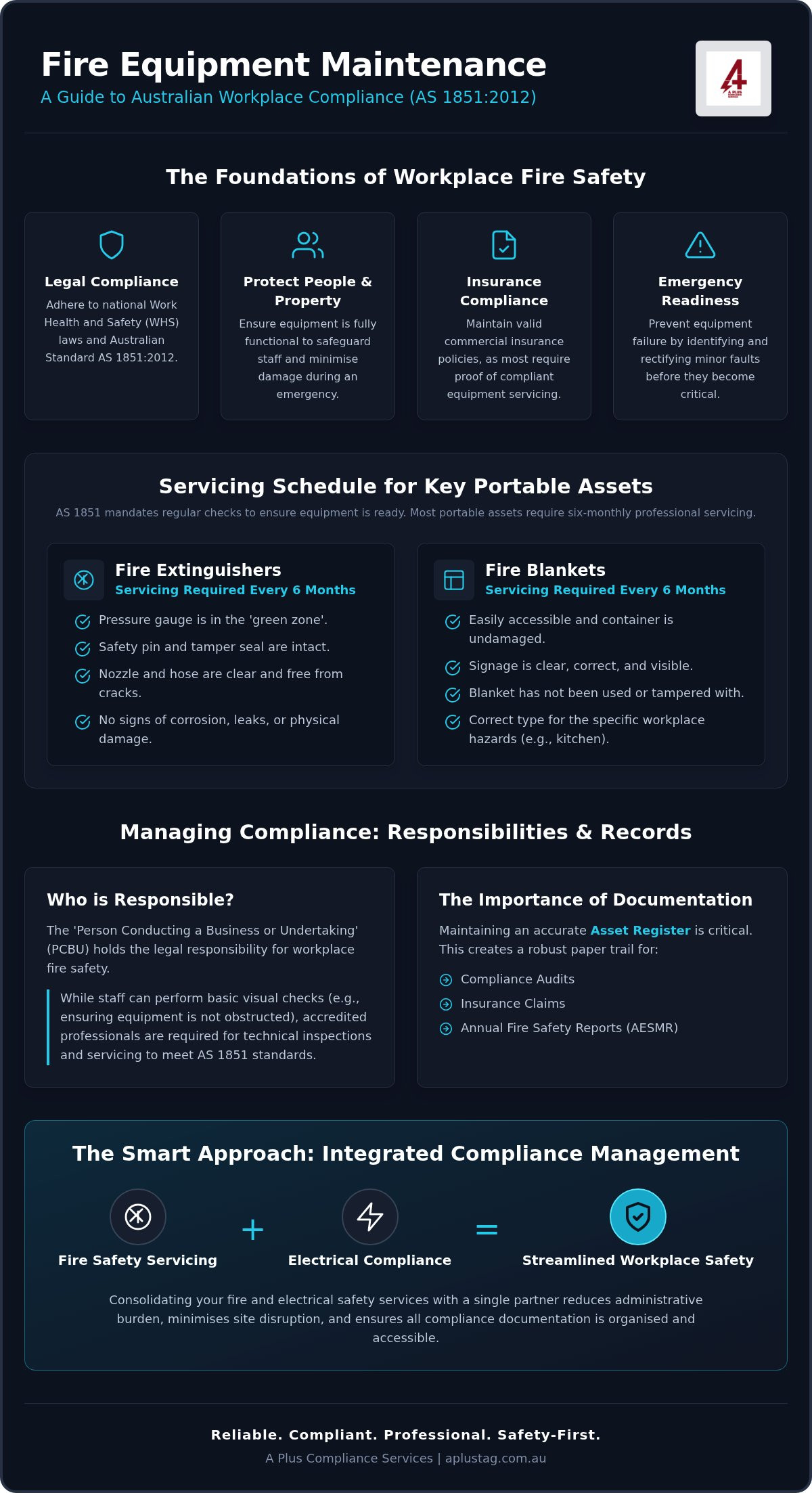
Maintenance of fire equipment involves the systematic inspection, testing, and servicing of life-safety assets to ensure they function correctly during an emergency. In Australia, this process is strictly governed by Australian Standard AS 1851:2012, which provides the essential framework for managing active fire protection systems. Adhering to these requirements isn’t just about following a manual; it’s a fundamental obligation under national Work Health and Safety (WHS) and Victorian OHS laws.
Business owners face significant responsibilities when it comes to site safety. Regular servicing acts as a safeguard against equipment failure, ensuring that tools like extinguishers or fire blankets are ready for immediate use. Beyond the physical protection of staff, consistent upkeep helps manage insurance risks. Most commercial policies require proof of compliance to remain valid, meaning a lack of documented maintenance could lead to a denied claim after a fire incident.
The Core Objectives of AS 1851
The primary goal of AS 1851 is to ensure that every safety asset is fit for purpose and ready for deployment. This standard outlines recurring cycles of verification that allow technicians to identify and rectify minor faults before they escalate into critical failures. By maintaining a rigorous schedule, businesses create a robust paper trail that demonstrates a commitment to high professional standards. This documentation is vital for compliance audits and provides the necessary evidence for annual fire safety reports, such as the Annual Essential Safety Measures Report (AESMR) required for Victorian commercial buildings.
Who is Responsible for Workplace Fire Safety?
Legally, the responsibility for fire safety lies with the ‘person conducting a business or undertaking’ (PCBU). While staff can perform basic visual checks to ensure equipment isn’t obstructed, professional accredited testing is necessary for technical compliance. A ‘set and forget’ mentality often leads to significant risks, as equipment can degrade or lose pressure over time without any visible signs. Engaging with professional compliance services ensures your site stays organised and that all assets are tracked through a formal register. This proactive partnership ensures your maintenance of fire equipment stays on track, moving your business from a state of reactive uncertainty to one of controlled safety.
Key Fire Safety Assets Requiring Regular Servicing
Australian businesses must manage a diverse range of portable assets, each designed to tackle specific fire risks. Because these assets use different suppression agents, such as dry powder, CO2, or wet chemical, the maintenance of fire equipment requires unique testing procedures and strict adherence to the Australian Standard AS 1851. Frequencies for these tests vary; while most portable equipment requires a six-monthly inspection, certain environments or asset types may demand more frequent verification to ensure reliability. Matching the right extinguisher type to your specific risks, such as electrical or chemical hazards, is a critical step in your safety strategy.
It’s also highly efficient to coordinate these checks with your general electrical safety and compliance schedule. By aligning fire testing with your regular test and tag cycles, you reduce site visits and keep your compliance documentation organised in one place. This integrated approach ensures that both your fire protection and your electrical infrastructure are managed by a single, dependable partner, minimising disruption to your daily operations.
Fire Extinguishers and Fire Blankets
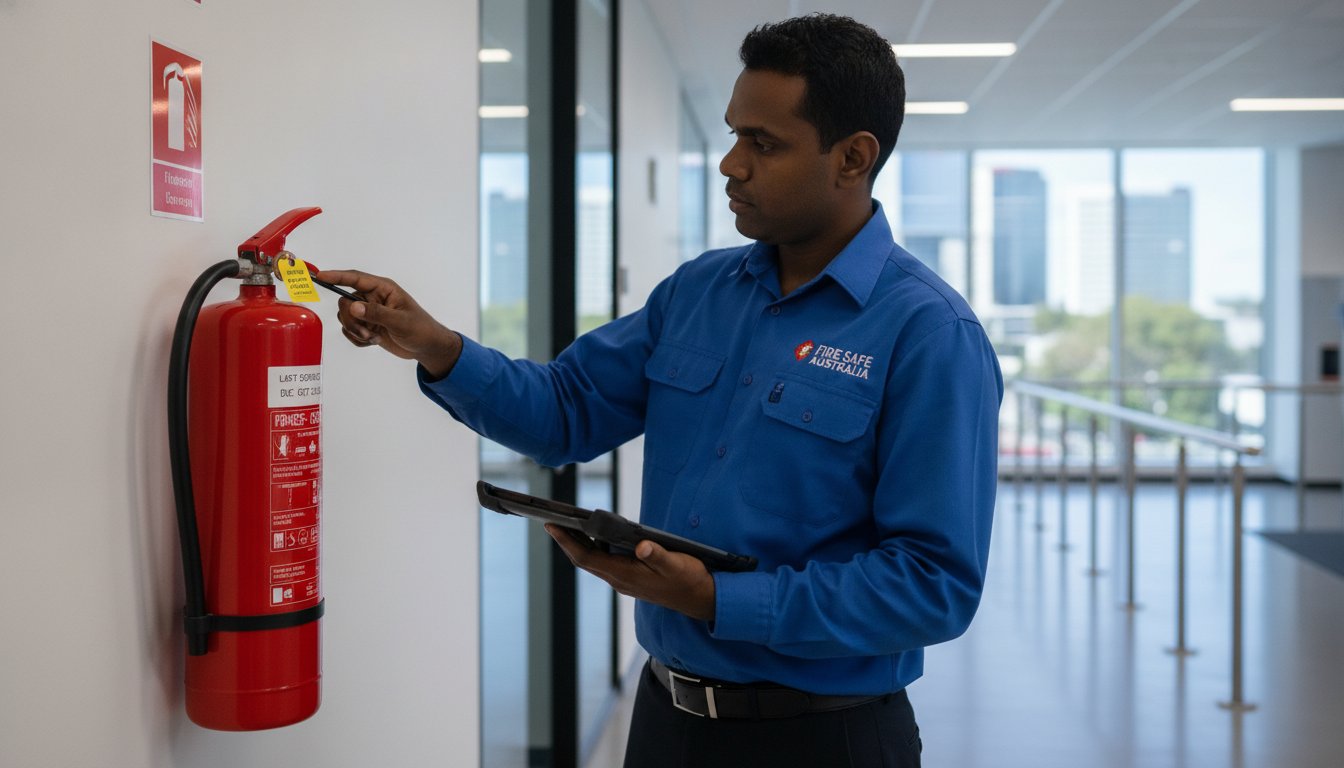
Portable fire extinguishers and blankets are your first line of defence. Routine servicing ensures these items haven’t been tampered with or damaged by their environment. Technicians perform visual inspections to check for corrosion, blocked nozzles, or cracked hoses. They also verify that pressure gauges are in the ‘green zone’ and that safety pins and tamper seals remain intact. For businesses with kitchenettes or commercial cooking areas, following a specific fire blanket requirements list is essential to ensure these items are correctly mounted and accessible for staff.
Fire Hose Reels and Signage
Fire hose reels require a different technical approach. Maintenance involves unrolling the hose to test water flow and checking for leaks within the assembly or the nozzle itself. It’s not just about the hardware; visibility is equally important. Every piece of equipment must be clearly identified with signage that complies with Australian Standards. Ensuring that access and egress routes remain clear of obstructions is a simple but vital part of the maintenance cycle. If you’re unsure about the placement or condition of your current assets, you can discuss a compliance schedule with a qualified technician to ensure your site meets all necessary standards.
How to Organise Your Fire Equipment Maintenance Schedule
Organising a systematic approach to the maintenance of fire equipment ensures that no piece of safety gear is overlooked during the calendar year. A chaotic or reactive method often leads to missed deadlines, which increases your risk profile and potential for non-compliance fines. By establishing a structured calendar, you move from a state of uncertainty to one of organised control. Portable fire equipment requires a basic professional service every six months to verify its immediate readiness and a more detailed annual inspection to ensure the long-term integrity of the suppression agent and the vessel itself.
Many Victorian facility managers find that grouping fire testing with other essential safety duties, such as electrical test and tag, simplifies the compliance calendar significantly. This consolidation reduces the number of site visits required and ensures that all safety documentation is generated simultaneously. Utilising resources like a Small business fire safety checklist can help you keep track of these overlapping responsibilities while maintaining a high professional standard across your site.
Step 1: Conduct a Comprehensive Site Audit
The foundation of a reliable schedule is a thorough site audit that identifies every fire asset’s exact location and current service status. During this phase, you should map out equipment to ensure adequate coverage for all floor areas, paying close attention to travel distances between extinguishers. It’s also vital to identify environmental factors that may demand increased testing frequency. Assets located in corrosive, vibrating, or dusty environments often degrade faster than those in climate-controlled offices. Having a clear, detailed asset register from the outset prevents individual items from being missed during recurring service visits.
Step 2: Establish a Routine Inspection Cycle
Once your assets are identified, you must implement a routine cycle that balances professional servicing with internal oversight. While professional 6-monthly and annual inspections are mandatory under AS 1851, implementing simple monthly visual walk-throughs by your own staff helps catch obvious issues, such as blocked access or damaged brackets. If you need clarity on how often fire extinguishers need to be tested in Australia across different equipment types and environments, a detailed breakdown of each maintenance interval can help you build a fully compliant schedule. Proactively scheduling your fire extinguisher testing well in advance avoids last-minute rushes and ensures your business remains continuously compliant. This proactive strategy allows you to address equipment repairs or replacements in a controlled manner, rather than reacting to a failed audit or an emergency situation.
Managing Compliance Records and Asset Registers
Proving the maintenance of fire equipment through rigorous documentation is as vital as the physical testing itself. In the eyes of fire authorities and insurance providers, an undocumented test is a test that never occurred. A compliant service record in Australia must be both traceable and transparent, providing a clear history of every asset on your site. For facility managers, this documentation acts as your primary defence during a safety audit, demonstrating that you’ve met your legal obligations under the relevant Australian Standards.
In Victoria, detailed reporting is the backbone of your Annual Essential Safety Measures Report (AESMR). This annual statement requires business owners to confirm that all safety measures, including portable fire equipment, have been maintained to the required standard throughout the year. Digital asset registers are particularly transformative for multi-site organisations, allowing managers to oversee compliance across several locations from a single dashboard. This systematic approach to the maintenance of fire equipment ensures your records are always audit-ready and helps you identify recurring faults that may require equipment replacement rather than simple repair.
Components of a Professional Asset Register
A professional asset register goes beyond a simple list of equipment; it’s a comprehensive database of your safety infrastructure. Every item, from the smallest fire blanket to the largest extinguisher, should be assigned a unique identification number. This allows for precise tracking over the equipment’s lifespan. A high-quality register includes:
- Unique ID numbers and precise location descriptions for every asset.
- Specific equipment types and capacities (e.g., 4.5kg ABE Dry Powder).
- The date of the last service and the scheduled date for the next inspection.
- Clear ‘pass’ or ‘fail’ results with detailed notes on any corrective actions taken.
The Importance of Maintenance Tags
While digital records are essential for management, the physical maintenance tag remains the primary indicator of compliance for on-site staff and fire inspectors. In Australia, these yellow fire service tags utilise a dot-punch system to indicate the month and year of the last service. It’s critical that these tags remain legible and securely attached to the equipment at all times. A missing or unreadable tag is frequently treated as a non-compliance by fire authorities during site inspections, as it suggests the equipment hasn’t been verified by a competent person. Ensuring your compliance reporting and asset registers are kept up to date is the most effective way to avoid these preventable safety risks.
Partnering with A Plus Compliance for Total Peace of Mind
A Plus Compliance Services offers a systematic approach to workplace safety that prioritises clarity and reliability. We act as an essential ally for Victorian businesses, simplifying the maintenance of fire equipment through a methodical and transparent service model. By choosing a single, specialised provider for your fire extinguishers, fire blankets, and test and tag services, you significantly reduce the administrative burden of managing multiple site visits. This integrated approach ensures that your RCD testing and fire safety checks are perfectly aligned, keeping your compliance records organised and your site continuously protected.
Our service is built on the principle of providing a stress-free experience. We understand that facility managers are often juggling multiple priorities across complex sites; therefore, our role is to act as a steady, dependable presence. To help you stay ahead of your responsibilities, we implement automated reminders for all recurring maintenance cycles. This takes the guesswork out of your next deadline, ensuring that the maintenance of fire equipment remains a predictable part of your operations rather than a last-minute concern. Our communication is always jargon-free, providing you with the practical information you need to make informed decisions about your safety infrastructure.
A Professional and Punctual Service
Our technicians are experienced and methodical, working around your operational schedule to ensure minimal disruption to your daily activities. Whether you manage a school, a healthcare facility, or a busy hospitality venue, we provide a punctual and responsive service tailored to your specific environment. We deliver comprehensive reporting that adheres to all regulatory requirements, providing the clear documentation needed for your AESMR or internal audits. This level of thoroughness reflects our commitment to being a dependable partner that values long-term relationships and consistent performance across all Victorian and national sites.
Ready to Organise Your Next Assessment?
It’s vital to remember that fire safety equipment is only effective if it’s verified and ready for use. You shouldn’t wait for an emergency or a surprise audit to discover a fault in your suppression systems. We’re here to help you move from a state of reactive uncertainty to one of organised control. Contact our team today for a straightforward quote and a reliable service schedule that ensures your workplace remains a safe environment for every staff member and visitor.
Securing Your Workplace with Systematic Compliance
Managing the maintenance of fire equipment shouldn’t be a source of stress or uncertainty for your business. By establishing a clear schedule based on AS 1851:2012 and maintaining a detailed asset register, you ensure that every extinguisher and fire blanket is ready for immediate use. This systematic approach not only protects your staff and visitors but also provides the robust documentation required for annual reporting and insurance validity.
Partnering with a professional compliance expert allows you to consolidate your fire safety and electrical testing into one manageable cycle. You’ll benefit from automated due-date reminders and comprehensive reporting that keeps your site organised without unnecessary disruption. Taking these proactive steps today creates a safer, more compliant environment for the long term.
We’re ready to help you simplify your safety requirements and maintain a high standard of protection across your facility.
Frequently Asked Questions
How often does fire equipment need to be serviced in Australia?
Most portable fire equipment requires servicing every six months according to the AS 1851-2012 standard. This cycle involves a routine inspection twice a year, while more intensive testing or recharging typically occurs every one to five years depending on the asset. Frequencies can vary based on your specific environment; for instance, harsh industrial sites might require more frequent checks. It’s best to consult a professional for a site-specific maintenance schedule.
Can I maintain my own fire extinguishers at work?
No; the professional maintenance of fire equipment must be carried out by a competent person with the correct training and specialised tools. While staff can perform basic monthly visual checks to ensure extinguishers are visible and unobstructed, they aren’t qualified to verify internal pressures or agent integrity. Engaging an accredited technician ensures your business meets legal safety standards and remains compliant with your insurance policy requirements at all times.
What is the difference between a 6-month and a 12-month fire service?
A six-monthly service is a routine level-one inspection that focuses on equipment accessibility, external damage, and pressure levels. The annual service is more comprehensive; it includes all six-monthly checks plus a detailed assessment of the suppression agent and mechanical components. This yearly verification ensures the internal contents haven’t settled or degraded over time, which is critical for the equipment’s reliability during an actual fire emergency in your workplace.
What happens if a fire extinguisher fails its inspection?
If an extinguisher fails, it must be clearly labelled as ‘out of service’ and either repaired or replaced immediately. Technicians will record the failure in your asset register and explain the specific reason, such as a loss of pressure or a damaged hose. You cannot leave a site unprotected; therefore, a compliant replacement must be installed straight away to maintain the required safety coverage for that specific area of your building.
Is a fire blanket required in an office kitchenette?
Yes; a fire blanket is an essential safety requirement for any area where cooking or food heating occurs, including small office kitchenettes. These blankets are specifically designed to smother small fat or oil fires that shouldn’t be tackled with water or standard extinguishers. They must be mounted in an accessible location, typically near the exit of the kitchen area, so staff can reach them easily without having to pass through the fire itself.
What are the record-keeping requirements for fire safety equipment?
Australian regulations require businesses to maintain accurate, up-to-date records of all fire safety inspections and servicing. This includes a physical service tag attached to the equipment and a detailed asset register that lists the test dates, results, and the technician’s credentials. These records are vital for proving compliance during audits and are necessary for the preparation of your Annual Essential Safety Measures Report (AESMR) in Victoria and other states.
How do I know if my fire equipment meets Australian Standards?
Compliant fire equipment will feature a stamp or label indicating it was manufactured to Australian Standard AS/NZS 1841. Additionally, the ongoing maintenance of fire equipment must be documented on a yellow service tag with a clear record of recent inspections. If you’re unsure about the status of your gear, a professional compliance audit can verify that your assets are correctly rated for your specific workplace risks and installed according to current regulations.
Do fire hose reels need to be tested if they have never been used?
Yes; fire hose reels must be tested every six months regardless of whether they have ever been used. Routine testing involves unrolling the entire hose to check for leaks, verifying water pressure, and ensuring the nozzle operates correctly. Over time, rubber hoses can perish and valves can seize; therefore, regular servicing is the only way to guarantee the system will function effectively when it is needed most in an emergency.
