2026 Workplace Electrical Safety Audit Checklist
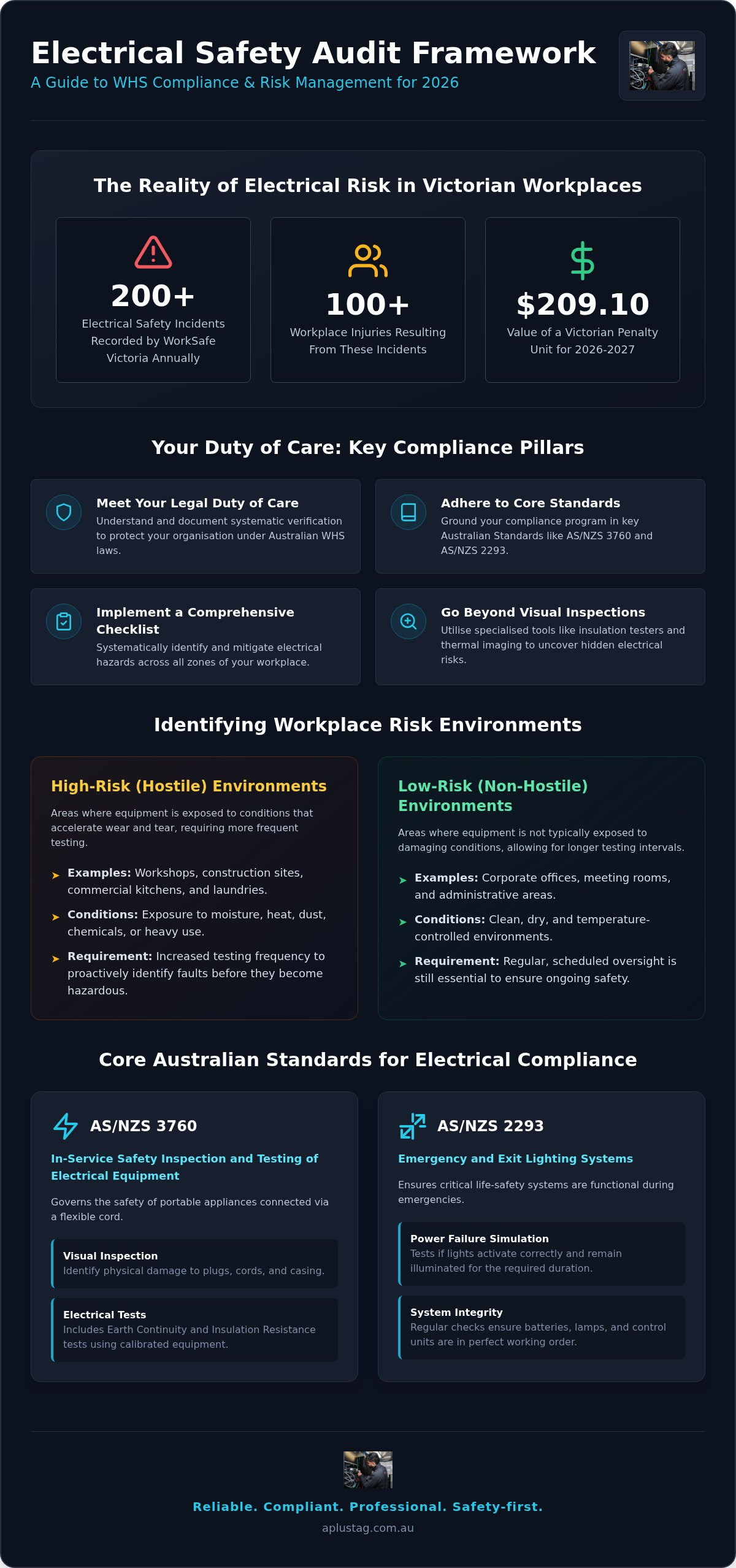
Did you know that WorkSafe Victoria recorded over 200 electrical safety incidents in a single year, resulting in more than 100 injuries? For facility managers and business owners, the responsibility of ensuring every lead and RCD is safe can feel overwhelming, especially with the 2026-2027 Victorian penalty unit rising to $209.10. Maintaining a robust electrical safety audit checklist for workplaces 2026 isn’t just about avoiding fines; it’s about protecting your team from hidden faults that lead to fire or injury.
We understand that tracking varying testing intervals and managing a complex asset register often feels like a heavy administrative burden. This guide simplifies your obligations by providing a clear, standard-aligned framework that ensures you meet AS/NZS 3760:2022 and AS/NZS 2293 requirements with total confidence. You’ll find a printable site walkthrough checklist and a streamlined system for recurring maintenance that keeps your operations running with minimal disruption. We’ll break down essential testing cycles, documentation needs, and the professional standards required to keep your workplace organised, safe, and fully compliant.
Key Takeaways
- Understand your legal duty of care and the systematic verification required to protect your organisation under Australian WHS laws.
- Identify the core Australian Standards, including AS/NZS 3760 and AS/NZS 2293, that form the foundation of a professional compliance program.
- Implement a comprehensive electrical safety audit checklist for workplaces 2026 to systematically identify hazards across all site zones.
- Recognise why visual inspections are only the first step and how specialised tools like thermal imaging uncover hidden electrical risks.
- Establish a clear reporting framework and asset register to ensure long-term safety and a streamlined approach to recurring maintenance.
Understanding Your Duty of Care: Why an Electrical Safety Audit is Critical in 2026
An electrical safety audit is a systematic verification of your entire facility’s electrical infrastructure, encompassing everything from portable appliances to fixed RCDs. In 2026, this process has evolved from a simple compliance task into a vital component of risk management and operational continuity. As a Person Conducting a Business or Undertaking (PCBU), you are legally required to provide a safe environment for your employees and visitors. Utilising a professional electrical safety audit checklist for workplaces 2026 allows you to document your due diligence and ensure no asset is overlooked across our services and your broader site requirements.
Electrical hazards are uniquely dangerous because they are often invisible. A power lead might look perfect on the outside while having a broken internal earth wire that could prove fatal. Understanding Electrical Injury Risks involves recognising that visual inspections alone cannot detect insulation resistance failures or timing issues with safety switches. A comprehensive audit uses specialised equipment to find these faults, reducing the risk of electrical fires and protecting your business from the costs of unplanned downtime or insurance claim denials.
The Legislative Framework: WHS Act and Regulations
The primary duty of care under Australian WHS laws requires PCBUs to manage electrical risks so far as is reasonably practicable. This isn’t just about fixing things when they break; it’s about a proactive approach to safety. Modern regulations place a heavy emphasis on regular testing and detailed record-keeping. By moving toward a scheduled safety monitoring program, you satisfy the expectations of regulators and ensure your organisation remains compliant as standards like AS/NZS 3760:2022 continue to set the benchmark for workplace safety.
Identifying High-Risk vs Low-Risk Environments
The frequency of your safety checks depends largely on the environment where equipment is used. Hostile environments, such as workshops or commercial laundries, involve exposure to heat, moisture, or dust, which accelerates wear and tear. Conversely, non-hostile environments like corporate offices present lower risks, though they still require regular oversight. Integrating an electrical safety audit checklist for workplaces 2026 helps you distinguish between these zones, allowing you to allocate resources efficiently while maintaining total safety. Proper categorisation ensures that high-use equipment is tested frequently enough to catch faults before they cause disruption.
The Core Pillars of Electrical Compliance: AS/NZS Standards to Meet
Adhering to Australian Standards is the most effective way to demonstrate that you’ve met your legal obligations. These standards provide a structured methodology for testing, ensuring that your electrical safety audit checklist for workplaces 2026 is grounded in technical rigour. True compliance goes beyond simply applying a tag. It requires the use of calibrated diagnostic tools and a deep understanding of how different electrical systems interact. Relying on qualified technicians ensures that these nuances are managed correctly, providing a level of security that basic checks cannot match.
AS/NZS 3760: In-Service Safety Inspection and Testing
This standard governs the safety of portable electrical equipment, which includes any device that connects to a power supply via a flexible cord. The process involves a thorough visual inspection to identify physical damage, followed by electrical tests for earth continuity and insulation resistance. Implementing professional test and tag services ensures your equipment remains safe in its specific environment. Following the Code of Practice for Managing Electrical Risks helps you determine the correct testing frequency for your site, which varies depending on the level of risk in your workplace.
AS/NZS 2293: Emergency and Exit Lighting Systems
Emergency lighting is a critical life-safety system that must function perfectly during a power failure. AS/NZS 2293 requires functional inspections and 90-minute discharge tests every six months to ensure batteries can sustain the lights for long enough to allow safe evacuation. If these systems fail during an emergency, the consequences for occupant safety are severe. You can find specific details on maintenance intervals and reporting in our Emergency Lighting Standards Australia guide.
Residual Current Devices (RCDs) and Functional Testing
Professional RCD testing is a non-negotiable component of any electrical safety audit checklist for workplaces 2026. RCDs act as the last line of defence against fatal shocks by cutting power instantly when a fault is detected. While a user-led push-button test checks the mechanical switch, professional trip-time testing measures how quickly the device actually disconnects in milliseconds. This precision is vital for high-risk areas. Our RCD Testing Guide provides a deeper look at these requirements. If you aren’t sure whether your current schedule meets these pillars, it may be time to speak with a compliance expert to review your site requirements.
Workplace Electrical Safety Audit Checklist: A Practical Walkthrough
A site walkthrough allows you to spot immediate hazards before they escalate into incidents. While professional testing is essential for detecting internal faults, a visual electrical safety audit checklist for workplaces 2026 empowers facility managers to maintain a baseline of safety between scheduled visits. By organising your walkthrough into specific zones, you ensure that no area of the facility is overlooked. This systematic approach helps you identify physical wear and tear that could compromise your compliance with Australian Standards.
It’s vital to remember that this walkthrough is a support tool. It identifies obvious risks but does not replace the calibrated diagnostic testing required by AS/NZS 3760. Use the following criteria to evaluate each zone. If an item fails a visual check, it should be removed from service immediately and reported for professional assessment as part of our services and your broader maintenance plan.
Zone 1: Power Points, Leads, and Portable Appliances
This zone covers the most frequently handled equipment in any workplace. Visual failures here are often the most common cause of electrical shocks. When inspecting this zone, look for the following:
- Physical Integrity: Check for frayed lead insulation, exposed internal wires, or cracked plug casings. Any sign of copper wire is an automatic fail.
- Test Tags: Verify that every appliance has a current, legible tag. If a tag is missing or past its re-test date, the item is non-compliant.
- Circuit Loading: Identify “daisy-chained” power boards, where one board is plugged into another. This practice creates a high risk of overloading the circuit and should be corrected immediately.
Zone 2: Distribution Boards and Switchgear
The switchboard is the heart of your electrical system and requires a clear, safe perimeter. A failure in this zone can lead to facility-wide outages or fires. Key checks include:
- Accessibility: Ensure switchboards are not obstructed by boxes, furniture, or equipment. They must be easily accessible for emergency shut-off.
- Thermal Indicators: Check for discolouration on the board or unusual odours, such as a “fishy” or burning plastic smell. These are signs of overheating that require urgent attention.
- Labelling: Confirm that all circuits are correctly and clearly labelled, allowing for fast identification during maintenance or emergencies.
Zone 3: Environment and Specialised Areas
Environments with moisture or outdoor exposure require additional oversight. These areas are considered “hostile” and can cause equipment to degrade faster. Your electrical safety audit checklist for workplaces 2026 should include:
- Wet Areas: In kitchens and bathrooms, ensure power points are located away from water sources and are protected by RCDs.
- Weatherproofing: Verify that all external outlets have intact weatherproof covers and showing no signs of water ingress or corrosion.
- Outdoor Safety: Check for visible service markers for underground or overhead lines in outdoor work zones to prevent accidental contact during site works.
Beyond the Visual Check: Advanced Testing and Specialised Environments
Visual inspections are the starting point, but they represent only the tip of the iceberg. Many critical faults occur within components that are physically inaccessible or hidden behind switchboard covers. Integrating advanced diagnostics into your electrical safety audit checklist for workplaces 2026 ensures you catch these invisible risks before they escalate into costly failures. This preventative approach is essential for maintaining business continuity and protecting your infrastructure from the inside out.
Thermal Imaging for Switchboard Safety
Thermal imaging testing uses infrared technology to identify heat signatures that suggest loose connections, corroded components, or unbalanced loads. These hot spots often precede component failure or electrical fires. By detecting these issues early, you avoid the massive disruption of an unplanned power outage. Many modern commercial insurance policies now require documented thermal scanning of switchboards as a condition of coverage, making it a vital part of your compliance framework.
Clinical Compliance: AS/NZS 3551 for Biomedical Devices
Healthcare and clinical settings demand a specialised level of technical oversight that goes beyond standard office requirements. AS/NZS 3551:2012 governs the management and testing of medical electrical equipment to ensure patient safety. This standard distinguishes between Body Protected electrical areas and Cardiac Protected electrical areas, each requiring specific testing protocols for RCDs and equipotential bonding. Refer to our Biomedical Devices Safety Guide for a detailed breakdown of these clinical obligations.
Microwave Radiation and First Aid Kit Servicing
Staff kitchens are another area where specialised testing is required. Microwave radiation testing ensures that door seals remain effective and that radiation leakage does not exceed safe limits. To minimise site disruption, we recommend a one-stop compliance approach that includes workplace first aid kit servicing alongside your electrical testing. This keeps your organisation organised and safe without the need for multiple contractor visits throughout the year.
Streamlining Your Compliance: Organising a Long-Term Safety Partner
Moving from one-off testing to a managed compliance program is the most effective way to reduce corporate risk. While an electrical safety audit checklist for workplaces 2026 helps you identify immediate site hazards, the long-term challenge lies in maintaining that standard year after year. A professional partnership shifts the burden of scheduling and documentation from your desk to ours. This ensures that every RCD, emergency light, and portable appliance is tested exactly when required by Australian Standards, without disrupting your daily operations.
Digital Asset Registers and Compliance Reporting
A structured asset register is the backbone of any professional safety program. Rather than relying on physical tags alone, digital reporting provides a searchable, permanent record of every electrical asset on your site. This transparency is invaluable during insurance renewals or safety audits, as it demonstrates a consistent history of due diligence. If an item fails testing, the digital register tracks the remediation process, ensuring that faulty equipment is not accidentally returned to service. Automated due-date reminders further simplify the process, allowing you to plan for future maintenance cycles well in advance.
Managing Multi-Site Compliance Programs
Coordinating safety checks across multiple locations presents significant logistical challenges for operations managers. Without a centralised system, reporting often becomes fragmented, making it difficult to verify compliance across the entire organisation. A dedicated compliance partner provides a unified approach, ensuring that every site follows the same rigorous testing protocols and specialised reporting standards. This consistency gives you total visibility over your regional or state-wide footprint from a single dashboard. We invite you to discuss a recurring compliance schedule that aligns with your specific operational needs and risk management strategy.
Establishing a structured system involves three clear steps. First, we conduct a comprehensive site audit to identify and tag all assets. Next, this data is uploaded into a secure digital register. Finally, we establish a recurring maintenance cycle based on the environment and equipment type. This methodical transition, supported by a clear electrical safety audit checklist for workplaces 2026, replaces the uncertainty of ad-hoc testing with a reliable, professional framework that keeps your workplace organised and safe.
Securing Your Workplace with a Professional Compliance Strategy
Ensuring your facility remains safe and compliant requires a transition from reactive repairs to a methodical, data-driven strategy. By implementing a robust electrical safety audit checklist for workplaces 2026, you move beyond simple visual inspections and address the hidden risks that threaten your operational continuity. We’ve explored how adhering to AS/NZS 3760, AS/NZS 2293, and specialised clinical standards like AS/NZS 3551 provides a clear framework for long-term safety and insurance readiness.
A Plus Compliance Services acts as your dependable partner, delivering punctual and safety-first service that minimises disruption to your busy team. Our organised digital reports and automated due-date reminders ensure you never miss a critical testing interval, keeping your organisation organised and protected against evolving risks. We specialise in maintaining professional standards while lead times and reporting remain transparent and reliable.
We’re here to help you simplify your safety obligations and build a more secure, well-regulated future for your workplace.
Frequently Asked Questions
What is an electrical safety audit for workplaces?
An electrical safety audit is a systematic and documented verification of all electrical systems, appliances, and safety devices within a facility to ensure they meet Australian Standards. It involves a combination of visual inspections and technical diagnostic tests, such as earth continuity and insulation resistance checks. This process forms the basis of your electrical safety audit checklist for workplaces 2026, helping you identify potential hazards before they cause injury or fire.
How often should electrical equipment be tested in an Australian workplace?
Testing intervals vary significantly based on the environment and the type of equipment being used. For example, equipment in hostile environments like construction sites may require testing every three months, while office equipment might only need checks every 12 to 60 months. It’s essential to follow the risk management guidelines in AS/NZS 3760:2022. We always recommend obtaining site-specific professional guidance to determine the exact schedule for your organisation’s unique requirements.
Does a licensed electrician need to conduct the electrical safety audit?
Not necessarily; however, the person must be a “competent person” as defined by Australian Standards. A competent person has the necessary knowledge, skills, and training to perform the inspection and testing safely. While a basic test and tag might be performed by a trained technician, more complex assessments like thermal imaging or biomedical testing often require specialised expertise to ensure accuracy and meet the rigorous requirements of AS/NZS 3551 or AS/NZS 2293.
What happens if an item fails during the safety audit?
If an item fails, it must be withdrawn from service immediately to prevent accidental use. The technician will typically apply a “Failed” tag and notify the site manager. You should then decide whether to repair the item through a qualified service provider or dispose of it safely. Our digital reporting system tracks these failures, ensuring you have a clear record of the remediation steps taken to maintain your overall workplace safety and compliance.
Can electrical testing be completed outside of normal operating hours?
Yes, testing can be scheduled during evenings or weekends to minimise disruption to your business operations. This is particularly beneficial for high-traffic environments like hospitality or healthcare where daytime access to equipment is limited. We work closely with facility managers to arrange a time that suits your schedule, ensuring a stress-free experience while maintaining a high level of professional thoroughness across all your essential electrical safety checks and reporting.
Is thermal imaging a mandatory part of a workplace electrical audit?
Thermal imaging isn’t strictly mandatory under the standard AS/NZS 3760, but it’s increasingly required by commercial insurance providers and as part of a comprehensive risk management strategy. It allows for the detection of “hot spots” in switchboards that visual checks can’t see. Including this as part of your electrical safety audit checklist for workplaces 2026 helps prevent catastrophic failures and ensures your facility meets modern safety expectations for preventative maintenance and fire prevention.
What records must a business keep to prove electrical compliance?
You must maintain a detailed record of all testing, which should include an asset register, test results, and a schedule of future testing dates. These records serve as your proof of due diligence in the event of an incident or a WorkSafe inspection. A professional compliance partner provides digital reports that are easy to store and retrieve, replacing messy paper logs with a clear, organised system that supports your long-term safety goals.
How do I manage electrical safety for a business with multiple locations?
The most effective way to manage multiple sites is through a centralised compliance program and a digital asset register. This allows you to track the safety status of every location from a single point of truth. By partnering with a national-standard provider, you ensure consistency in testing quality and reporting across your entire footprint. This streamlined approach reduces the administrative burden on regional managers and guarantees that no site falls behind on its safety obligations.
