
How to Develop a Workplace Electrical Safety Plan: A Professional Guide
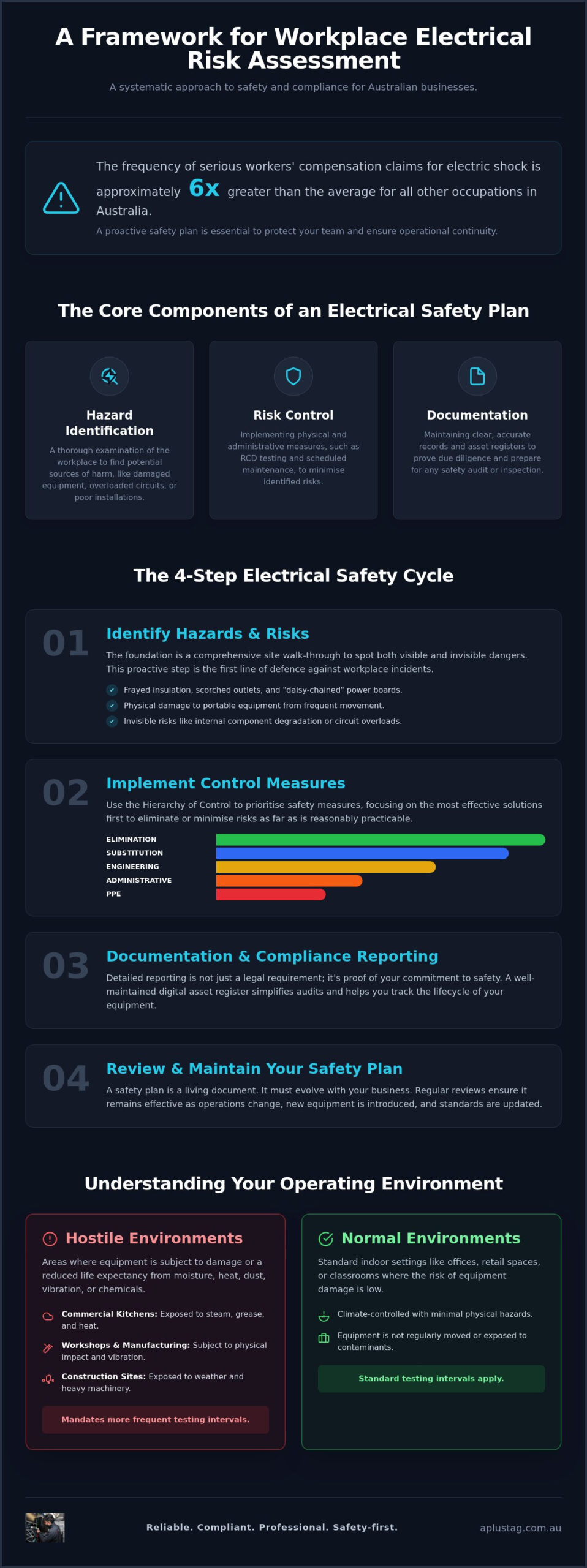
Did you know that the frequency of serious workers’ compensation claims for electric shock is approximately six times greater than the average for all other occupations in Australia? For facility and operations managers, this statistic represents more than just a number; it reflects the constant pressure of ensuring every staff member returns home safely. It’s understandable if you feel a sense of unease regarding varying testing intervals or the difficulty of tracking equipment across multiple sites.
We agree that managing a complex compliance schedule shouldn’t be a source of stress or operational downtime. This guide provides a clear, professional framework to help you develop a robust electrical risk assessment workplace plan that aligns with current Australian Standards. By following a systematic approach, you can move from a state of uncertainty to one of organised control.
You’ll learn how to identify hidden hazards, meet the specific requirements of AS/NZS 3760:2022 and AS/NZS 2293.3:2026, and implement a maintenance cycle that prioritises both safety and efficiency. We’ll outline how a dependable partnership simplifies your documentation, ensuring your asset registers remain accurate and your workplace stays fully compliant without disrupting your core business activities.
Key Takeaways
- Understand your legal obligations as a PCBU under Australian WHS laws and how a systematic approach to safety minimises operational risk.
- Learn the practical steps for conducting an electrical risk assessment workplace walk-through to identify damaged portable equipment and overloaded circuits.
- Discover how to prioritise safety measures using the Hierarchy of Control and implement recurring maintenance schedules that meet AS/NZS 3760 requirements.
- Recognise the importance of detailed compliance reporting and digital asset registers in demonstrating due diligence during professional audits.
- Establish a structured review process to ensure your workplace safety plan evolves alongside your business operations and equipment upgrades.
What is an Electrical Risk Assessment in the Workplace?
An electrical risk assessment workplace strategy is a deliberate and systematic process designed to identify, evaluate, and manage potential electrical hazards before they lead to an incident. It isn’t merely a compliance hurdle; it’s a fundamental management tool that ensures your business operates safely and without interruption. By evaluating the condition of equipment and the environment in which it’s used, you can implement controls that align with fundamental electrical safety principles.
Under Australian Work Health and Safety (WHS) laws, the legal duty falls on the Person Conducting a Business or Undertaking (PCBU). This responsibility requires you to eliminate risks to health and safety so far as is reasonably practicable. If elimination isn’t possible, you must minimise those risks. The primary objective of implementing a robust electrical risk assessment workplace plan is the prevention of electric shock, thermal burns, and electrical fires. Achieving this requires moving beyond reactive repairs toward a proactive maintenance cycle.
The Core Components of an Electrical Safety Plan
A professional safety plan relies on three distinct pillars. First, hazard identification involves a thorough examination of the workplace to find anything that could cause harm, such as damaged insulation, overloaded circuits, or poorly maintained switchboards. Second, risk control focuses on implementing physical and administrative measures. This includes essential services like RCD testing, which provides a critical fail-safe against current leakage. Finally, documentation serves as your proof of diligence. Maintaining a clear record of all testing and maintenance ensures you’re prepared for any safety audit or inspection.
Identifying Hostile Operating Environments
Not all work areas carry the same level of risk. Australian Standard AS/NZS 3760:2022 distinguishes between normal operating conditions and hostile operating environments. A hostile environment is one where electrical equipment is likely to be subject to damage or reduced life expectancy due to factors like moisture, heat, dust, vibration, or mechanical stress. Because the likelihood of equipment failure is significantly higher in these settings, the standard mandates more frequent testing intervals.
Common examples of these challenging settings include:
- Commercial kitchens where steam, grease, and heat are prevalent.
- Workshops and manufacturing floors where physical impact and vibration occur daily.
- Construction and demolition sites exposed to weather and heavy machinery.
- Laboratory settings involving corrosive chemicals or frequent cleaning.
Differentiating between these environments ensures your safety plan is both effective and efficient, focusing your specialised resources where they’re needed most to maintain long-term safety.
Step 1: Identifying Electrical Hazards and Risks
The foundation of any robust electrical risk assessment workplace strategy is a comprehensive site walk-through. This initial phase focuses on spotting immediate, visible dangers that could compromise staff safety or lead to equipment failure. Walking the floor allows you to identify obvious issues like frayed insulation on power leads, scorched outlets, or the dangerous practice of “daisy-chaining” multiple power boards together. While Australian standards are our primary focus, international frameworks such as OSHA electrical standards also highlight the importance of systematic hazard recognition as the first line of defence against workplace accidents.
During this process, pay particular attention to portable equipment. Because these items are frequently moved, plugged, and unplugged, they’re the most likely to sustain physical damage over time. However, a professional assessment must look beyond what’s easily reachable. Fixed installations and switchboards form the backbone of your facility’s power distribution and require equal scrutiny. While a visual check is a great start, identifying “invisible” risks, such as internal component degradation or circuit overloads, requires specialised testing services. If you’re unsure how to categorise the equipment on your site, you can arrange a professional site review to ensure nothing is overlooked.
Common Workplace Electrical Hazards
Identifying hazards isn’t just about finding broken things; it’s about recognising risky environments and behaviours. Some of the most frequent issues discovered during an electrical risk assessment workplace inspection include:
- Damaged Insulation: Cracks or abrasions on extension leads and power tool cords that expose live wires.
- Unauthorised Repairs: Electrical equipment that has been modified or repaired using electrical tape or non-standard components instead of being professionally serviced.
- Environmental Risks: Using standard electrical equipment in wet areas, such as near sinks or in outdoor zones, without the protection of a weather-rated enclosure or a dedicated RCD.
- Overloaded Circuits: High-draw appliances, like heaters or kettles, plugged into power boards that aren’t designed to handle the combined load.
Advanced Detection: Thermal Imaging for Switchboards
Standard visual inspections cannot detect the heat build-up that occurs within a switchboard when a connection begins to fail. Thermal imaging allows our technicians to see these hot spots before they escalate into a fire or a major power outage. It’s a completely non-disruptive process, meaning we can assess the health of your infrastructure while your site remains fully operational. This technology is particularly valuable in high-load environments where equipment runs continuously.
Thermal imaging acts as a proactive diagnostic tool for electrical infrastructure, identifying heat signatures that precede component failure. By integrating this into your safety plan, you move from reactive repairs to a systematic management approach that protects both your people and your property.
Step 2: Implementing Effective Control Measures
Once you’ve identified hazards through your electrical risk assessment workplace walk-through, the next phase is implementing robust controls. We prioritise these actions using the Hierarchy of Control. Ideally, you’d eliminate a hazard entirely by removing a faulty appliance from service. If elimination isn’t possible, you move to engineering controls, such as safety switches, or administrative controls, like scheduled maintenance. This structured approach ensures that the most effective safety measures are always the first choice for your organisation.
Establishing a recurring test and tag service schedule is a fundamental administrative control for managing portable equipment. This process involves a meticulous visual inspection to find physical damage, followed by electrical testing to verify insulation and earthing integrity. Testing intervals aren’t one-size-fits-all; they vary based on the equipment type and the specific environment where it’s used. A Plus Compliance Services acts as a dependable partner by managing these complex schedules for you, ensuring your site remains compliant without you having to track every individual item manually.
The Role of Test and Tag (AS/NZS 3760:2022)
Adherence to AS/NZS 3760:2022 is the established method for demonstrating due diligence in the maintenance of electrical equipment. The testing process identifies faults that aren’t visible to the naked eye, such as internal wire degradation or earth leakage. By implementing a systematic testing cycle, you create a predictable safety routine that minimises the risk of accidents. We focus on providing this service with minimal disruption, allowing your staff to continue their work while we ensure their tools are safe to use.
RCD Testing and Safety Switches
Residual Current Devices (RCDs) are the most critical life-saving devices in any modern workplace. They’re designed to disconnect power instantly if a fault is detected, preventing fatal shocks. While many managers rely on the “push-button” test, this only checks the mechanical trip. A professional trip-time test measures exactly how long the device takes to cut the power, ensuring it meets the required safety thresholds. This specialised testing is essential for both fixed RCDs in your switchboard and any portable units used in high-risk areas.
Finally, your safety plan must include emergency and exit lighting. Under AS/NZS 2293.3:2026, these systems require regular discharge testing to ensure they’ll function during a power failure. A well-maintained exit light system provides the clarity and order needed for a safe evacuation. By combining these technical services into a managed electrical risk assessment workplace schedule, you create a comprehensive safety net for your entire facility.
Step 3: Documentation and Compliance Reporting
In the professional management of site safety, a simple rule applies: if it isn’t documented, it isn’t compliant. A thorough electrical risk assessment workplace record serves as your primary defence during a safety audit or in the unfortunate event of an incident. While paper logbooks were once the industry standard, modern facilities are transitioning to a digital asset register. This shift provides greater transparency, allowing managers to track the history of every appliance across multiple sites with a few clicks.
A comprehensive compliance report must provide more than just a list of “Pass” or “Fail” results. It should include the specific date of the test, the unique ID of the equipment, the test results, and the name of the specialised technician who performed the work. This level of detail is vital for any electrical risk assessment workplace strategy, as it demonstrates a methodical approach to safety and ensures your records meet the requirements of Australian Standards like AS/NZS 3760.
Building an Audit-Ready Asset Register
An effective asset register is organised by location, equipment type, and a unique identification number. This structure makes it easy for an auditor to verify that every item on-site has been accounted for and tested within the correct interval. Beyond simple compliance, a well-maintained register simplifies your future planning. By seeing exactly when specific batches of equipment are due for re-testing, you can schedule service visits to ensure minimal disruption to your daily operations.
Managing Failed Items and Repairs
The discovery of a faulty item is a success for your safety plan, but the process doesn’t end there. You must establish a clear “Tag Out” procedure to ensure that any item failing the safety test is immediately removed from service. This prevents accidental use before the hazard is controlled. Every failed item should be recorded in a dedicated log, detailing the nature of the fault and the subsequent action taken.
Failed equipment must either be repaired by a licensed electrician or permanently disposed of to prevent it from reappearing in the workplace. Maintaining these disposal or repair records is essential to close the compliance loop. It proves to regulators that you haven’t just identified risks, but have actively managed them to completion. This systematic approach ensures your workplace remains a safe environment for everyone.
Step 4: Reviewing and Maintaining Your Safety Plan
A successful workplace safety strategy is never truly finished. It should be treated as a living document that adapts to the changing needs of your organisation. As you introduce new machinery, rearrange office layouts, or onboard new staff, the underlying electrical risk assessment workplace profile shifts. Conducting regular reviews of your plan ensures that your control measures remain effective and that no new hazards have been introduced unnoticed.
Relying on manual tracking for testing dates is a significant risk for busy facility managers. Automated due-date reminders are essential for maintaining a continuous chain of compliance. This proactive approach prevents the common pitfall of allowing equipment to fall out of its testing cycle, which could lead to safety gaps or legal liability during an audit. Moving from a reactive state to a scheduled maintenance cycle is the most efficient way to manage long-term safety.
Scheduled Maintenance and Reminders
Establishing a recurring service schedule significantly reduces the administrative burden on your management team. Instead of reacting to expired tags, a “safety-first” culture is fostered through predictable, pre-planned visits. By choosing a dependable partner like A Plus Compliance Services, you gain the peace of mind that comes with professional reminders. This ensures your site remains safe and compliant without requiring constant internal oversight or complex spreadsheet management.
Standardising Safety Across Multiple Sites
Managing electrical safety for a single site is challenging; doing so across several locations requires a higher level of systematic management. Coordinated reporting provides a high-level view of your entire organisation’s safety status, allowing you to identify trends or recurring issues at specific branches. A multi-site compliance partner can standardise the quality of your electrical risk assessment workplace documentation across your whole network, ensuring every location meets the same high standard.
Punctuality and responsiveness are key traits of a professional service provider. We understand that your operations must continue, so we focus on delivering thorough testing with minimal operational downtime. This methodical approach leads your business from a state of potential uncertainty toward a state of organised control, ensuring every location meets the current Australian Standards for safety and documentation. By maintaining this cycle of review and maintenance, you protect your staff and your business reputation for the long term.
Securing Your Workplace for the Long Term
Developing a workplace electrical safety plan is a strategic investment in your team’s safety and your business’s operational continuity. By moving from a reactive mindset to a structured, proactive cycle, you ensure that every hazard is identified and controlled before it can cause harm. We’ve explored how a systematic electrical risk assessment workplace strategy, supported by accurate documentation and regular maintenance, keeps you compliant with Australian Standards like AS/NZS 3760 and AS/NZS 2293.
A Plus Compliance Services acts as your dependable partner, providing specialised support through detailed asset registers and automated due-date reminders. This methodical approach minimises site disruption while guaranteeing that your safety obligations are met with professional precision. Whether you manage a single facility or several sites, maintaining order and transparency in your safety reporting is the most effective way to protect your staff and your reputation.
Taking control of your compliance requirements doesn’t have to be a source of stress. With the right framework and a reliable partner, you can feel confident that your workplace remains a safe, organised, and professional environment.
Frequently Asked Questions
What is an electrical risk in the workplace?
An electrical risk in the workplace is the potential for death, shock, or injury resulting from contact with electricity. These hazards often arise from damaged insulation, faulty wiring, or equipment that hasn’t been properly maintained. Identifying these dangers is the first step in an electrical risk assessment workplace strategy. By evaluating your environment, you can implement controls that prevent thermal burns or electrical fires before they occur, ensuring a safe work environment for all staff.
How often should a workplace electrical safety plan be reviewed?
You should treat your safety plan as a living document that requires regular review. While many organisations set an annual review date, you must also update the plan whenever significant changes occur. This includes introducing new equipment, changing site layouts, or onboarding new staff. Regular reviews ensure your risk controls remain effective and that your documentation stays accurate, reflecting the current state of your operations and any updated Australian Standards.
Who is considered a “competent person” for electrical testing in Australia?
Under AS/NZS 3760, a competent person is someone who has acquired through training, qualification, or experience the knowledge and skills to perform the required tasks safely. This individual must be able to use the necessary testing equipment correctly and interpret the results accurately. For many businesses, engaging a specialised compliance partner ensures that testing is conducted by professionals who maintain up-to-date knowledge of the relevant Australian Standards and safety protocols.
Do I need to test and tag brand-new electrical equipment?
Brand-new equipment doesn’t require a full electrical test before its first use, but it must still be managed within your safety plan. The PCBU is responsible for ensuring the item is safe and fit for purpose. You should conduct a visual inspection and apply a “New to Service” tag that indicates when the first scheduled test is due. This ensures the item is captured in your asset register and won’t be missed in future cycles.
What is the difference between a visual inspection and a full electrical test?
A visual inspection involves checking for obvious external damage, such as:
- Frayed or damaged cord insulation.
- Cracked plugs or scorched casings.
- Loose connections or missing covers.
While this identifies many hazards, a full electrical test uses specialised equipment to detect “invisible” faults like earth leakage. Both steps are essential components of an electrical risk assessment workplace routine to ensure complete safety.
What are my responsibilities if an electrical item fails a safety test?
If an item fails a safety test, your immediate responsibility is to remove it from service to prevent accidental use. You should follow a clear process:
- Apply a “Danger” or “Out of Service” tag to the item.
- Record the failure in your digital asset register.
- Arrange for repair by a licensed electrician or permanent disposal.
This systematic approach ensures the compliance loop is closed and the risk is effectively managed.
Is RCD testing mandatory for all Australian businesses?
Yes, regular RCD testing is mandatory for Australian businesses to ensure these life-saving devices function correctly during a fault. Safety switches must be tested at intervals defined by the nature of the workplace and the equipment used. While a simple push-button test checks the mechanical trip, professional trip-time testing is required to verify the device disconnects power within the safe limits specified in AS/NZS 3760. This is a critical component of workplace safety.
How long do I need to keep my electrical testing records?
You should keep your electrical testing records at least until the equipment is next tested. However, many industry professionals recommend maintaining a longer history within a digital asset register to demonstrate a consistent pattern of due diligence. Specific record-keeping requirements can vary based on your industry and state regulations, so it’s best to maintain detailed, easily accessible reports as part of your long-term compliance strategy and audit preparation.
