Body Protected Electrical Area: A Guide to AS/NZS 3003 Compliance
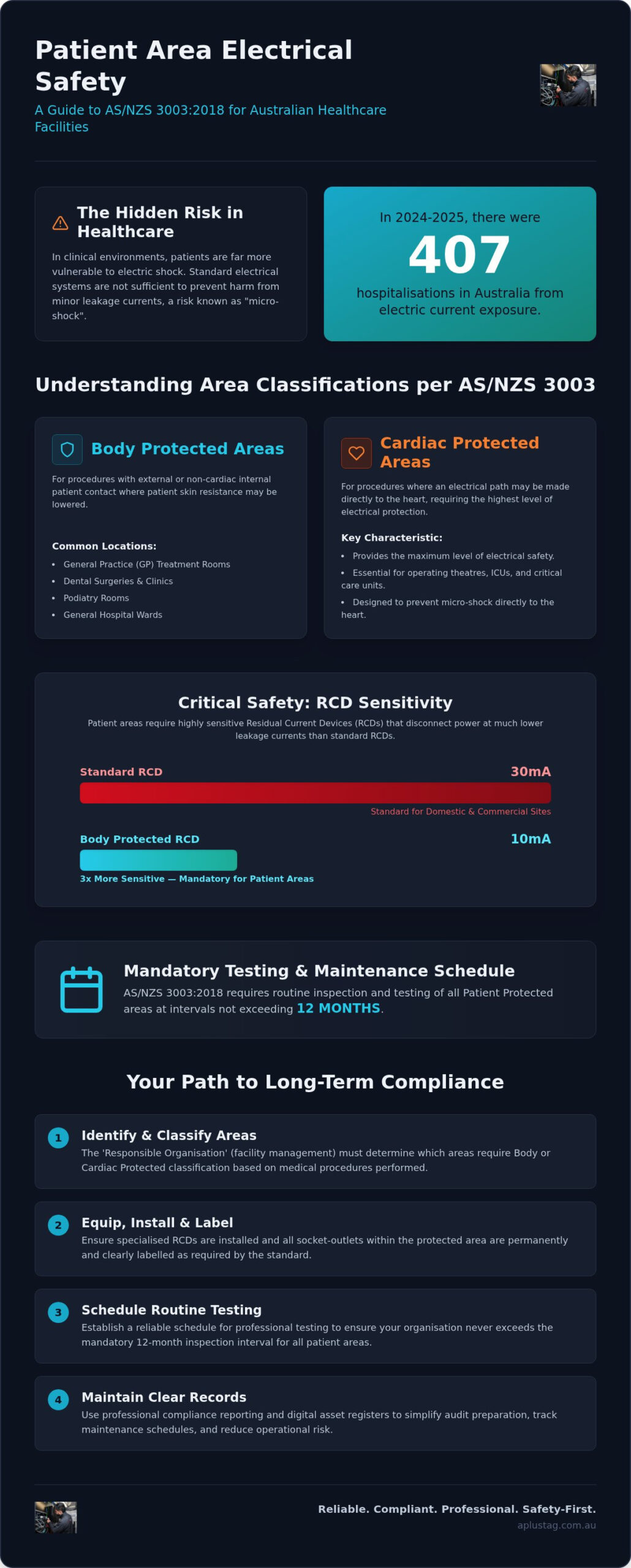
If a patient’s natural skin resistance is bypassed during a medical procedure, could your facility’s electrical system prevent a minor leakage current from becoming a serious safety event? It’s a sobering question for any healthcare manager, especially since 407 Australians were hospitalised specifically from exposure to electric current in the 2024-2025 period. Prioritising regular patient area electrical safety testing isn’t just about meeting a regulatory hurdle; it’s about ensuring that your clinical environment remains a place of healing rather than a source of hidden risk.
We understand that the technical details of AS/NZS 3003:2018 can feel overwhelming when you’re already managing a busy facility. You want to feel confident that your site is compliant without getting lost in complex electrical jargon. This guide will help you understand the essential safety requirements and mandatory testing cycles for body protected electrical areas. We’ll clarify the different area classifications, establish a manageable schedule for your recurring 12-month inspections, and explain how to maintain the reliable documentation needed for your next audit. By the end, you’ll have a clear path toward long-term compliance and a safer environment for everyone in your care.
Key Takeaways
- Understand the specific safety requirements for Body Protected Electrical Areas to protect patients during non-invasive medical procedures.
- Learn the critical differences between Body Protected and Cardiac Protected classifications to ensure your facility meets the correct Australian Standards.
- Clarify the role of the ‘Responsible Organisation’ in identifying area classifications so your technical team can perform accurate assessments.
- Establish a reliable schedule for patient area electrical safety testing, ensuring you never exceed the mandatory 12-month routine inspection interval.
- Discover how professional compliance reporting and digital asset registers simplify your audit preparation and reduce operational risk.
What is a Body Protected Electrical Area?
In a standard office or home, we rely on the natural resistance of our skin and basic circuit breakers to keep us safe. Clinical environments are different. In these spaces, patients often undergo procedures where medical equipment is in direct contact with their bodies, making them far more vulnerable to electric shock. A Body Protected Electrical Area is a designated zone within a healthcare facility designed to mitigate these risks through enhanced electrical safety measures. You’ll find these classifications in dental surgeries, GP treatment rooms, podiatry clinics, and various hospital departments. A body protected area is a location where patient safety depends on specific electrical protection.
The Role of AS/NZS 3003 in Australian Healthcare
AS/NZS 3003:2018 is the mandatory Australian Standard that governs electrical installations in patient areas. It works alongside the general wiring rules but adds a layer of protection specifically for medical settings. This standard has evolved to keep pace with the increasing complexity of medical devices and the biomedical engineering principles that define modern care. By maintaining these standards, facility managers ensure their organisation remains compliant with health regulations and protected against the legal risks associated with electrical failures. Failing to meet these requirements doesn’t just jeopardise patient health; it also leaves the facility open to significant professional indemnity issues and WorkSafe investigations. Routine patient area electrical safety testing is the primary way to verify that these specialised systems continue to function as intended over the long term.
Why Standard Power Outlets Are Not Sufficient
While a standard domestic power outlet is fine for a toaster, it doesn’t provide the precision required for a clinical procedure. In a medical context, the concept of “micro-shock” is a genuine concern. This occurs when a small amount of electrical leakage, which would be undetectable to a healthy person, passes through a patient whose natural defences are compromised by a procedure or illness. Standard RCDs don’t always trip at the low levels or high speeds required to prevent this. Patient area electrical safety testing ensures that the specialised RCDs and earthing systems in your facility are sensitive enough to cut power before harm occurs. This infrastructure works in tandem with the equipment itself, a topic we cover in detail in our biomedical devices guide. Relying on standard commercial electrical setups in a clinical environment is a risk that healthcare providers simply can’t afford to take.
Body Protected vs. Cardiac Protected: Understanding the Classifications
The classification of a clinical space is never a random choice; it’s a decision based on the specific medical procedures performed there. While both Body Protected and Cardiac Protected areas require rigorous patient area electrical safety testing, the technical infrastructure behind them differs significantly. Understanding these distinctions is vital for facility managers who must maintain compliance with the AS/NZS 3003:2018 standard. While Body Protected areas focus on external or non-cardiac internal contact, Cardiac Protected areas provide the highest level of protection for procedures involving direct electrical paths to the heart. Both classifications require specialised Residual Current Devices (RCDs) and regular verification to ensure they remain fit for purpose.
Characteristics of Body Protected Areas
Body Protected Electrical Areas are the most common classification in Australian healthcare, found in general practices, dental clinics, and treatment rooms. The primary safety mechanism in these zones is the 10mA RCD. These devices are designed to disconnect power much faster and at a lower current threshold than the standard 30mA RCDs found in domestic or commercial buildings. This high sensitivity is necessary because a patient’s electrical resistance may be lowered by fluids, medication, or minor skin abrasions during a procedure. Additionally, the standard requires every socket-outlet in the area to be permanently labelled. This labelling serves as a visual confirmation for clinical staff that the outlet is part of a protected circuit. During routine patient area electrical safety testing, qualified assessors check these RCDs and verify that the earthing system remains robust enough to handle potential faults without creating a hazard.
When is Cardiac Protection Required?
Cardiac Protected Electrical Areas are necessary whenever a procedure involves an electrical connection directly to a patient’s heart. This includes locations like cardiac catheter laboratories, intensive care units, and operating theatres. Because the heart is exceptionally sensitive to even tiny amounts of electrical current, these areas require more than just sensitive RCDs. They often utilise Equipotential Earthing, a system that connects all conductive surfaces to a common earthing point to eliminate any potential voltage differences. This prevents current from flowing through a patient if they touch two different objects simultaneously. If you’re managing a multi-use facility and are uncertain about the specific requirements for your clinical rooms, you can contact our team for professional guidance. For a deeper dive into the clinical justifications for these classifications, AS/NZS 2500 provides detailed recommendations for various medical procedures.
Who is Responsible for Electrical Area Classification?
Classification isn’t just a technical detail. It’s a critical management decision. Under the Australian Standards, the “Responsible Organisation” must determine how a space is used. This typically refers to the hospital board, clinic owner, or facility manager. While an electrician or technical tester implements the safety measures, they do so based on the classification provided by the management. This distinction is vital because the technical expert doesn’t always know which clinical procedures occur behind closed doors. If a room is used for procedures that require body protection but is only wired for general use, the liability rests with the organisation. Clear communication between clinical staff and technical teams ensures that the AS/NZS 3003:2018 requirements are met accurately every time.
The Duty of the Responsible Organisation
The legal obligation to maintain a safe environment is absolute. Every room within a healthcare facility should have its classification documented and clearly displayed. This documentation is the first thing a workplace safety auditor will look for. Incorrectly classifying an area or failing to update classifications after a room’s purpose changes can lead to failed audits. More importantly, it compromises patient safety. Proactive facility managers include these classifications in their site asset registers. This makes patient area electrical safety testing a seamless part of their annual maintenance cycle rather than a last-minute scramble. Accurate record-keeping ensures that if a safety incident ever occurs, you have the proof of diligence required for a legal defence.
Organising Professional Compliance Assessments
Engaging with experts during the design or refit phase of a clinic is the best way to avoid costly compliance gaps. A proactive approach to site-based management reduces the risk of operational downtime. By integrating professional test and tag services into your broader compliance strategy, you ensure that every piece of medical equipment and every power point meets the required standard. A Plus Compliance Services acts as a long-term partner for multi-site healthcare organisations. We provide the systematic management and clear reporting needed to stay organised. We help you move from a state of uncertainty to one of total control. This ensures that your patient area electrical safety testing is always up to date and fully documented for peace of mind.
Mandatory Testing Intervals and Maintenance Requirements
Compliance in healthcare isn’t a “set and forget” task. According to the AS/NZS 3003:2018 standard, all patient areas classified as Body Protected or Cardiac Protected must undergo routine inspection and testing at intervals not exceeding 12 months. This strict timeframe ensures that the sensitive protective devices required in clinical settings remain reliable over years of heavy use. While general office equipment might follow a different schedule based on risk, patient area electrical safety testing is a non-negotiable annual requirement for clinical environments. Maintaining an accurate electrical asset register for all outlets and RCDs is essential for tracking these cycles and proving diligence during an external audit.
The 12-Month Testing Cycle
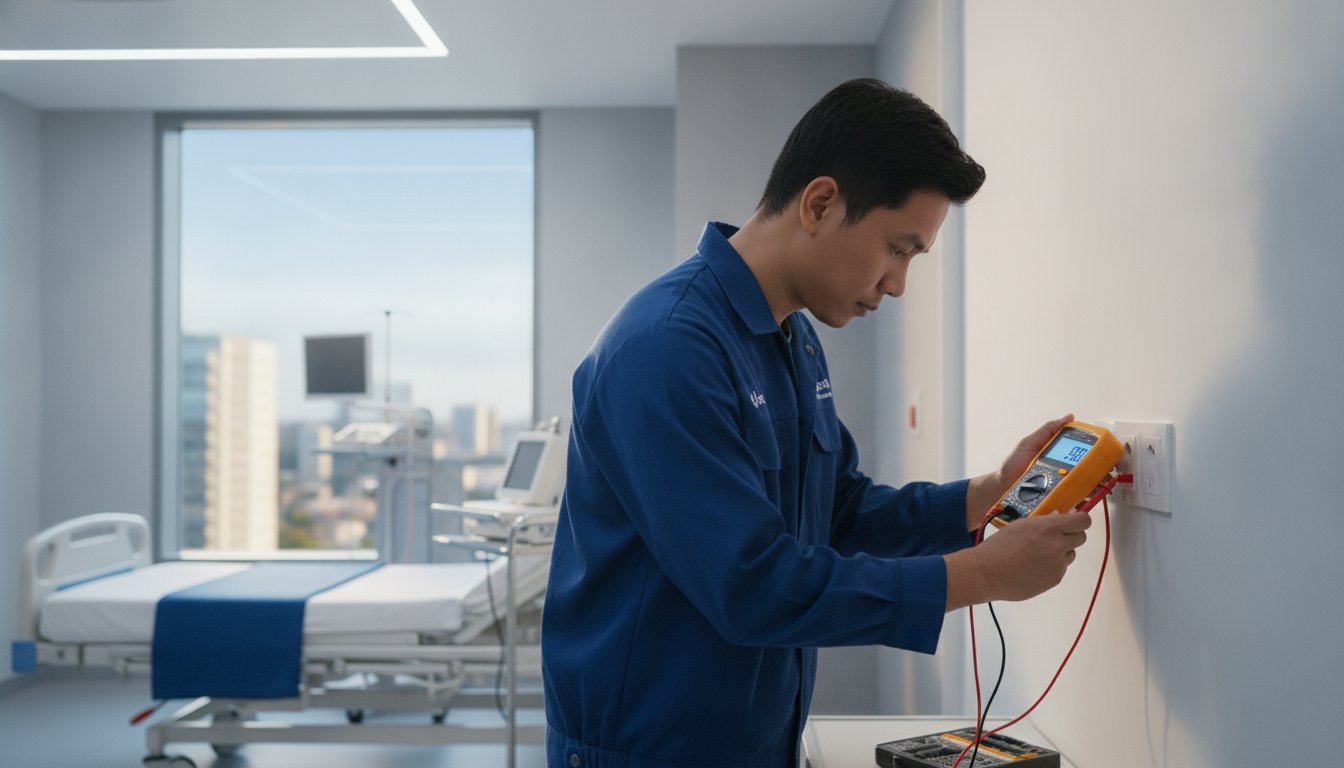
The physical testing process is methodical and thorough. It begins with a visual inspection where our assessors check for physical damage, cracked faceplates, or signs of overheating on all power outlets and permanent medical equipment. We then perform earth bond testing to verify that the earthing system provides a low-resistance path for fault currents; this is vital for preventing electric shock in vulnerable patients. Finally, we conduct RCD functional testing. This is perhaps the most critical stage. We measure the exact trip times of your specialised 10mA RCDs to ensure they disconnect power within the milliseconds required by the Australian Standard. These tests go beyond what a standard electrician might perform during a general maintenance visit, requiring specialised equipment and knowledge of the 3003 standard.
What Happens if an Area Fails Testing?
If an outlet or RCD fails to meet the required safety threshold, it must be identified and recorded immediately. Our assessors clearly tag the failed component to prevent its use until repairs are completed. Maintaining the safety status of a patient area is impossible if failed infrastructure remains in service. We provide detailed compliance reporting that highlights these issues, allowing you to arrange for swift rectification with your electrical contractor. To help you stay organised, our system provides automated due-date reminders. This proactive approach ensures that your next round of patient area electrical safety testing is scheduled well before your current certification expires, preventing any lapses in clinical compliance or safety.
Achieving Long-Term Compliance for Your Healthcare Facility
Maintaining a clinical environment requires more than just technical skill; it demands a systematic approach to risk management. We position ourselves as your long-term compliance partner, moving beyond the role of a standard contractor to become an essential ally in your facility’s safety. Our focus is on creating a safety-first culture that protects your patients and staff while respecting the operational needs of your practice. By integrating patient area electrical safety testing into your broader management strategy, you reduce the risk of unexpected failures and legal complications. We understand that clinical hours are precious, so we offer after-hours testing to ensure your practitioners can focus on patient care without unnecessary interruptions.
Comprehensive Reporting and Asset Registers
The true value of a professional assessment lies in the quality of the documentation left behind. After every testing session, we provide structured, digital reports that translate technical data into clear, actionable information. These reports include a full electrical asset register of every tested outlet and RCD, making audit preparation a stress-free experience for your administrative staff. Instead of searching through paper files, you can access a centralised digital system that provides a transparent history of your facility’s compliance status. This is particularly beneficial for multi-site healthcare organisations, as it allows facility managers to monitor safety standards across several locations from a single platform. Every entry in the register serves as a verified record of your commitment to the AS/NZS 3003 standard.
Professional Support for Patient Area Safety
A reliable compliance schedule is the foundation of a well-regulated healthcare facility. We take the guesswork out of maintenance by managing your recurring testing cycles and providing automated due-date reminders. This proactive approach ensures that your patient area electrical safety testing is never overlooked, keeping your facility organised and audit-ready year-round. Our commitment to clear communication and punctual service delivery means you’ll always know exactly when we’ll arrive and what to expect from the process. We value long-term relationships and consistent performance, acting as a steady, dependable presence that simplifies complex requirements for your organisation. If you’re ready to establish a more efficient and transparent safety protocol for your site, we invite you to take the next step.
Our team is here to help you navigate the nuances of clinical safety with confidence and ease. You can request a quote or book a site assessment to begin building a more resilient compliance framework for your facility today.
Strengthening Your Clinical Safety and Compliance
Maintaining a safe clinical environment is a continuous responsibility that extends beyond a single inspection. By correctly identifying your Body Protected areas and adhering to the mandatory 12-month cycle for patient area electrical safety testing, you protect your patients and your organisation from hidden electrical risks. We specialise in AS/NZS 3003 and AS/NZS 3551 compliance, ensuring your facility meets all regulatory requirements without the stress of complex paperwork.
Our service is designed to be a dependable partnership that prioritises clarity. We provide comprehensive asset registers with every job, offering a transparent digital record that simplifies your next audit. To minimise clinical downtime, we’ll offer flexible after-hours scheduling that keeps your practitioners focused on their work. It’s a methodical approach that transforms compliance from a burden into a reliable, automated routine for your healthcare facility.
We look forward to helping you maintain a safer, more organised workplace for your staff and patients.
Frequently Asked Questions
What is a body protected electrical area in an Australian medical clinic?
A Body Protected Electrical Area is a designated clinical space where medical equipment comes into contact with a patient’s body, requiring safety measures beyond standard wiring rules. These areas use specialised 10mA RCDs and robust earthing to protect patients during non-cardiac invasive procedures. Common examples include GP treatment rooms and dental surgeries. Ensuring these zones meet Australian Standards is the primary goal of patient area electrical safety testing, which verifies that protective systems function correctly under fault conditions.
How often do body protected areas need to be tested under AS/NZS 3003?
Routine inspection and testing of Body Protected and Cardiac Protected areas must be conducted at intervals not exceeding 12 months. This mandatory cycle is defined by the AS/NZS 3003:2018 standard to ensure that sensitive safety components, such as specialised RCDs, remain reliable over time. Adhering to this timeframe is essential for maintaining your facility’s compliance status. We provide automated due-date reminders to help you manage these recurring requirements without the risk of missing a critical deadline.
Is AS/NZS 3003 compliance mandatory for dental practices?
Yes, compliance with the AS/NZS 3003:2018 standard is mandatory for dental practices where medical electrical equipment is used on patients. Dental surgeries are almost always classified as Body Protected areas due to the nature of the procedures and the equipment involved. Failing to maintain these standards can lead to significant safety risks and legal liabilities. Regular patient area electrical safety testing ensures that your practice remains a safe environment for both your staff and your patients.
Can testing be completed outside of normal clinic operating hours to avoid disruption?
We offer flexible after-hours scheduling to ensure that your compliance requirements are met with minimal disruption to your clinical hours. We understand that clinical downtime can impact patient care and practice revenue; so our assessors can perform testing during evenings or weekends. This proactive approach allows you to maintain a high standard of safety without interrupting the daily operations of your medical centre, dental clinic, or specialist facility.
What is the difference between AS/NZS 3760 and AS/NZS 3003 testing?
While AS/NZS 3760 covers the general testing and tagging of plug-in electrical appliances, AS/NZS 3003 focuses on the fixed electrical installation within patient areas. This includes the testing of specialised RCDs, earth bonding, and the integrity of socket-outlets. Both standards are necessary for a comprehensive safety strategy. AS/NZS 3003 provides the specific layer of protection required for clinical environments where patients are more vulnerable to electric shock than they would be in a standard office.
Who is qualified to perform testing in a body protected electrical area?
Testing must be performed by a qualified professional who has a thorough understanding of the AS/NZS 3003 standard and the specialised equipment required for the task. This typically involves a licensed electrician or a specialised compliance technician with specific training in medical electrical installations. Using an expert ensures that your results are accurate and that your documentation is robust enough to withstand a professional audit. Our team specialises in these requirements to provide you with peace of mind.
What happens if our healthcare facility fails a compliance audit?
Failing a compliance audit can result in serious consequences, including formal improvement notices from regulatory bodies or potential legal action if a safety incident occurs. It also increases your organisation’s liability and could jeopardise your professional indemnity insurance coverage. Beyond the legal risks, non-compliance represents a direct threat to patient safety. Maintaining a structured testing schedule and keeping a digital asset register is the most effective way to prevent these issues and demonstrate your diligence.
Do I need to classify my own medical rooms or does the electrician decide?
The responsibility for classifying a medical room lies with the management of the healthcare facility, known as the Responsible Organisation. This decision is based on the specific medical procedures performed in each area. An electrician or compliance assessor provides the technical verification, but they must work from the classification you provide. Professional guidance can help you understand the criteria for each classification, ensuring that your clinical spaces are correctly identified and protected according to the relevant Australian Standards.
