Electrical Testing Services: Debunking Common Workplace Compliance Myths
Between 2014 and 2016, nearly 1,100 Australians were hospitalised due to electrical injuries, a figure that highlights why safety is about much more than just a sticker on a power cord. For many business owners, engaging electrical testing services feels like a recurring exercise in confusion, often driven by the fear of a surprise audit rather than a clear safety strategy. You’ve likely felt the frustration of deciphering complex AS/NZS standards or the anxiety that you’re being overcharged for tests your workplace doesn’t actually require. It’s common to feel that compliance is a moving target that’s difficult to hit without a specialised partner by your side.
The good news is that achieving genuine safety doesn’t have to be a source of stress or a drain on your budget. This article will help you discover the truth behind current safety standards, specifically the requirements found in AS/NZS 3760:2022, and how to move beyond basic tagging to create a robust risk-management framework. We’ll clarify the difference between mandatory and recommended testing, show you how to streamline your compliance schedule, and explain how professional documentation can significantly reduce your liability. By the end, you’ll have a clear, methodical path to a safer and more organised workplace.
Key Takeaways
- Understand why a physical tag is only one part of a professional safety regime and how to avoid the risks of a “tick and flick” approach.
- Identify the specialised electrical testing services required for high-risk areas, including RCD testing, thermal imaging, and biomedical equipment safety.
- Evaluate the true cost of DIY testing against the long-term security of professional documentation and reduced workplace liability.
- Optimise your compliance budget by learning how to set testing intervals based on the specific “harshness” of your workplace environment.
- Streamline your safety management with automated due-date reminders and comprehensive asset registers provided by a dependable partner.
The “Tick and Flick” Myth: Why Basic Tagging Isn’t Full Compliance
Many Australian businesses fall into the trap of believing that a colour-coded tag is a final guarantee of safety. This “tick and flick” approach treats compliance as a chore to be finished rather than a continuous safety regime. Professional electrical testing services provide a holistic framework that goes far beyond the surface. While Portable appliance testing (PAT) is a critical component, the tag itself is merely a visual indicator that an item was safe at a specific point in time. It doesn’t account for internal degradation or environmental stressors that occur between testing cycles.
The AS/NZS 3760:2022 standard serves as the baseline for workplace safety in Australia. However, viewing this standard as a ceiling rather than a floor is a mistake. True compliance involves understanding the specific risks of your industry and implementing a framework that protects your business from liability and your staff from harm. A visual inspection alone is insufficient; it cannot detect internal faults like insulation breakdown or faulty earthing. Comprehensive electrical testing services ensure these hidden dangers are identified before they cause harm.
The Danger of the “One-Off” Contractor Mentality
Relying on a different contractor for every visit often leads to fragmented records and missed deadlines. When safety is treated as a one-off transaction, it’s easy for equipment to fall through the cracks. A dependable partner manages the entire lifecycle of your electrical assets, ensuring that testing schedules are proactive rather than reactive. This methodical approach maintains a safer workplace by identifying potential hazards before they escalate into accidents. It creates a rhythm of safety that transactional services simply can’t match.
Documentation: The Real Proof of Safety
There’s a common myth that the tag on the cord is your primary legal record. In reality, if an incident occurs, a regulator will look for your comprehensive documentation, not a piece of plastic. You need a transparent trail of evidence to demonstrate due diligence and satisfy audit requirements. An asset register is a comprehensive digital log of every electrical item and its testing history. Without this detailed reporting, your business remains vulnerable to liability claims. You can find more information about these reporting requirements in the overview of our services.
Beyond the Power Cord: Specialised Electrical Testing You Might Be Missing
A common misconception in Australian workplaces is that electrical safety begins and ends with the power cords on your desks. While testing portable appliances is vital, a truly comprehensive safety strategy addresses the risks hidden within your infrastructure. Professional electrical testing services encompass a variety of specialised assessments designed to mitigate specific dangers, from catastrophic switchboard fires to lethal electric shocks. While global frameworks like OSHA’s electrical safety standards provide a broad perspective on hazard prevention, Australian businesses must adhere to local AS/NZS regulations to ensure total compliance and personnel protection.
RCD and Switchboard Safety
Functional testing for safety switches is a non-negotiable part of modern workplace safety. A simple push-button test by staff isn’t enough to satisfy the rigorous requirements of professional compliance. Expert injection testing measures the exact millisecond response, ensuring the device trips under fault conditions. This level of precision is fundamental to RCD testing and provides the data necessary for your legal asset register. If you are managing a site in Victoria, specialised RCD testing services can provide the precise verification needed to confirm your switches meet the required safety thresholds.
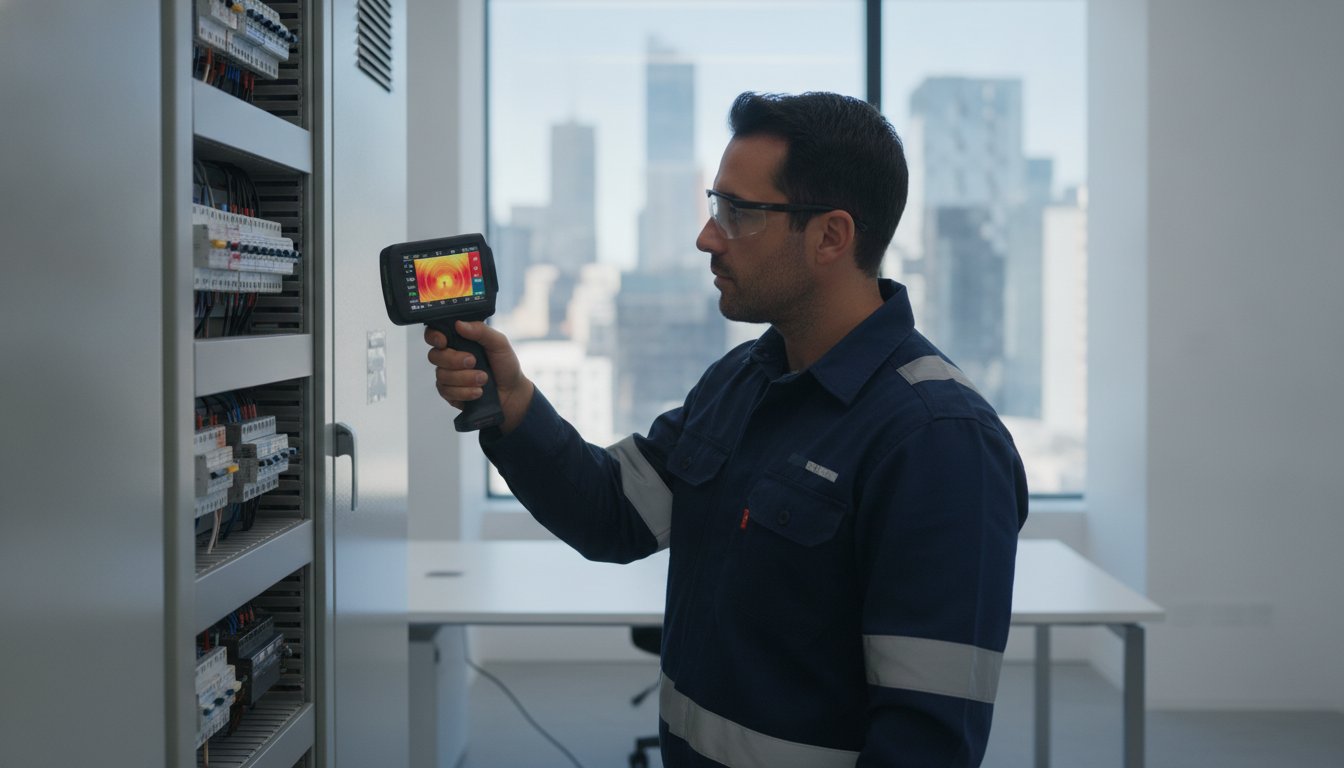
Thermal imaging is another essential but often overlooked tool. By using infrared technology, technicians can identify “hot spots” in switchboards caused by loose connections or overloaded circuits. These faults are invisible to the naked eye but are a leading cause of commercial fires. Catching these issues early prevents costly downtime and potentially life-threatening incidents. You can find more details on how these integrated solutions fit into your broader strategy in our summary of our services.
Biomedical and Patient Area Testing (AS/NZS 3551)
In healthcare environments, the stakes are significantly higher. It’s a dangerous myth that a medical monitor or a dental chair follows the same compliance rules as an office toaster. Under AS/NZS 3551, biomedical equipment requires rigorous verification to ensure it’s safe for patient contact. This includes specialised testing for body-protected and cardiac-protected areas where even a tiny leakage of current could be fatal. Healthcare providers must ensure their electrical testing services include technicians who understand these specific medical standards.
Managing these diverse requirements can be complex, but an experienced partner simplifies the process. If you’re unsure which specialised tests apply to your facility, you can speak with our compliance team to develop a tailored testing schedule.
DIY vs. Professional Compliance: The Cost of Getting It Wrong
Many Australian businesses attempt to save costs by assigning testing duties to a “handy” staff member. While this might seem efficient on paper, it often ignores the legal definition of a “Competent Person” as outlined in AS/NZS 3760:2022. This standard requires the individual to have the necessary skills, training, and experience to correctly perform the task and interpret the results. Professional electrical testing services bring this expertise to the table, ensuring that every assessment is legally defensible and technically accurate. Without this verified competence, your safety program may not hold up under the scrutiny of a workplace audit.
Beyond knowledge, professional testing requires specialised, calibrated equipment. A standard multimeter or a basic off-the-shelf tester isn’t enough for the insulation resistance or earth continuity tests required by the standard. High-quality PAT testers and thermal cameras are significant investments that most businesses can’t justify for internal use. Engaging electrical testing services provides access to these advanced tools without the capital expenditure, ensuring your workplace is monitored with precision instruments that are regularly verified for accuracy.
The Risk of Inaccurate Testing
Untrained individuals often miss subtle signs of wear during visual inspections, such as hairline cracks in casings or discolouration indicative of overheating. These small oversights can lead to severe workplace electrical injuries if a fault occurs. Professional technicians use instruments that are regularly calibrated to ensure valid, repeatable results. Additionally, a professional partner understands how to maintain site safety without interrupting your operations, working methodically to minimise disruption to your team’s daily workflow.
Insurance and Liability Implications
There’s a dangerous assumption that business insurance will cover any fire or accident regardless of maintenance history. In reality, insurers often require proof of regular, compliant maintenance before they’ll honour a claim. If an incident is traced back to an item that wasn’t properly tested, your liability could be substantial. Detailed compliance reports from professional technicians serve as critical evidence of your due diligence. Investing in professional test and tag services is a proactive risk management strategy that protects your people, your assets, and your bottom line. A complete workplace safety programme also extends beyond electrical equipment; ensuring your fire safety gear is current with a thorough fire extinguisher inspection checklist is equally important for satisfying insurers and demonstrating comprehensive due diligence.
Organising Your Compliance: Testing Intervals and Multi-Site Management
Efficiently managing a safety schedule requires more than just marking a calendar. One of the most persistent myths in the industry is that every electrical appliance, regardless of its location, must be tested every six or twelve months. This rigid thinking often leads to unnecessary costs or, conversely, dangerous gaps in high-risk zones. Professional electrical testing services help you navigate these requirements by applying a risk-management approach that prioritises safety where it’s needed most. You’ll move from a state of guesswork to a structured schedule that reflects the actual conditions of your workplace.
The environment determines the frequency. A power tool on a construction site faces far more physical stress than a computer monitor in a corporate office. By categorising your workplace based on “harshness”, you can establish a schedule that meets Australian standards without over-servicing low-risk areas. This methodical approach ensures you’re allocating your safety budget effectively while maintaining total compliance across all assets.
Determining the Correct Testing Frequency
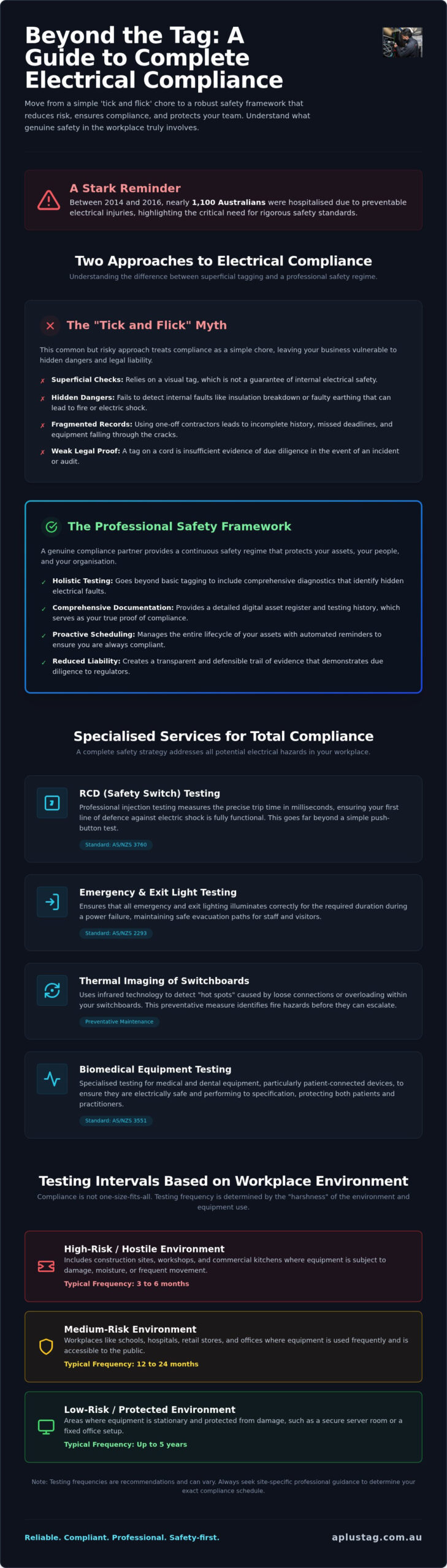
Australian standards provide clear guidance on intervals based on the equipment’s environment. For instance, construction and demolition sites require testing every three months due to the high risk of damage. Manufacturing and warehouse environments generally move to a twelve-month cycle. In contrast, equipment in non-hostile environments, like a standard office, may only require testing every five years. It’s also vital to remember that different systems have their own rules; for example, emergency lighting standards mandate specific six-monthly discharge testing to ensure battery reliability. Similarly, keeping your fire safety equipment current by following a structured fire extinguisher inspection checklist aligned with AS 1851-2012 ensures your entire safety framework remains audit-ready.
Streamlining Multi-Site Reporting
Managing compliance for a single office is straightforward, but coordinating safety across twenty regional branches is a significant logistical challenge. Facilities managers often struggle with fragmented data and expiring tags that go unnoticed until an audit. A unified digital asset register solves this by centralising every test result into one accessible platform. This transparency allows you to view the compliance status of every site in real-time, simplifying the audit process and reducing administrative burden. Our electrical testing services include automated due-date reminders, ensuring you’re never caught off guard by an expired tag.
A dependable partner acts as a proactive ally, providing clear communication throughout the project. This steady flow of information ensures that site managers are informed and prepared, while the head office maintains a bird’s-eye view of the entire organisation’s safety status. By moving toward a centralised reporting model, you eliminate the risk of missed deadlines and ensure a consistent standard of safety across every branch of your business.
Selecting a Dependable Partner for Electrical Testing Services
A common mistake in facilities management is assuming that all providers of electrical testing services offer the same level of protection. Choosing a partner based solely on the lowest price per tag often leads to hidden costs, such as incomplete asset registers or missed testing cycles. A professional compliance partner should act as a steady, dependable presence that simplifies your obligations rather than adding to your administrative workload. The right choice moves your business away from reactive maintenance toward a state of organised, long-term security.
When evaluating electrical testing services, look for a provider that demonstrates technical proficiency across multiple standards, including AS/NZS 3760 for general equipment and AS/NZS 3551 for medical environments. Reliability is measured by more than just showing up on time; it’s defined by the quality of the data they provide and their ability to integrate into your existing operations without cause for alarm. A “Safety-First” approach ensures that every technician is not just a contractor, but an essential ally in maintaining a well-regulated workplace.
What to Look for in a Service Proposal
A high-quality proposal should offer more than a simple headcount of appliances. It needs to outline a transparent reporting structure and provide features like automated due-date reminders and digital asset management. These tools are vital for reducing the “compliance burden” on managers, as they provide a clear audit trail without requiring constant manual oversight. You should also look for flexibility in scheduling, such as after-hours or phased testing, which allows for minimal disruption to your site’s daily operations. We encourage you to request a quote that focuses on a comprehensive, long-term strategy rather than a quick fix.
The A Plus Compliance Difference
At A Plus Compliance Services, our team prioritises a professional and educational approach. We believe that an informed client is a safer client, so we take the time to explain our findings and help you understand your specific risk profile. By positioning ourselves as a dependable partner, we ensure that your compliance schedule is always up to date and your documentation is ready for any audit. This methodical focus on detail is what sets us apart from transactional contractors who only look at the physical tag. You can arrange a site assessment today to discuss a recurring schedule tailored to your facility’s unique needs.
Ultimately, the goal of professional electrical testing is to create a predictable environment where safety is a constant, not a variable. By selecting a partner that values punctuality, responsiveness, and precise reporting, you can focus on your core business activities with the confidence that your workplace is fully compliant and your people are protected.
Securing Your Workplace with a Proactive Compliance Framework
Achieving genuine workplace safety requires moving beyond the “tick and flick” mentality toward a methodical risk-management strategy. By understanding that compliance is an ongoing cycle rather than a one-off task, you can better protect your staff and reduce your business’s liability. Whether you’re managing a single office or a complex multi-site operation, the key lies in adhering to specialised AS/NZS 3760, 3551, and 2293 standards. This structured approach replaces uncertainty with a reliable schedule that keeps your facility safe and compliant.
Engaging professional electrical testing services provides you with the detailed asset registers and compliance reporting necessary to satisfy any audit or insurance requirement. Our team focuses on delivering these results with minimal disruption to your site operations, ensuring your safety programme remains a stress-free part of your business management. You don’t have to navigate these complex requirements alone when you have a dependable partner to guide the way.
Frequently Asked Questions
What is electrical test and tag and is it mandatory for all businesses?
Electrical test and tag is a process of inspection and testing that helps businesses meet their mandatory duty of care under Australian WHS laws. While the specific standard AS/NZS 3760 is not a law itself, it is the primary framework used by regulators to determine if a business has met its legal safety obligations. Every employer must ensure their workplace is safe, and regular testing is a critical part of that responsibility.
How often does equipment need to be tested under Australian Standards?
Equipment testing intervals are determined by the specific environment and the “harshness” of the equipment’s use. For example, construction and demolition sites require testing every three months, while manufacturing environments typically follow a twelve-month cycle. In contrast, equipment in a non-hostile office environment may only require testing every five years. A professional assessment ensures your schedule aligns with the risk-management requirements of AS/NZS 3760.
Can electrical testing be completed outside of normal operating hours to avoid disruption?
Professional electrical testing services can certainly be completed outside of normal operating hours to eliminate workplace disruption. This flexible scheduling allows technicians to access power outlets and sensitive equipment without interrupting your team’s workflow. It is a practical solution for schools, medical clinics, and retail centres where daytime access is restricted. By working after-hours, we ensure a thorough inspection of every asset while your business remains productive.
What happens if an item fails an electrical safety test?
Any item that fails an electrical safety test must be withdrawn from service immediately to prevent accidental use. Our technicians will apply a “Failed” or “Danger” tag and clearly document the fault in your compliance report. You must then ensure the item is either repaired by a qualified professional or disposed of safely. This immediate action is essential for maintaining a safe environment and reducing your business liability.
Is thermal imaging necessary if I already perform regular test and tag?
Thermal imaging is a necessary addition to test and tag because it identifies different types of electrical risks. While test and tag focuses on portable appliances, thermal imaging uses infrared technology to inspect fixed infrastructure like switchboards and distribution boards. This identifies loose connections or overloaded circuits that are invisible to the naked eye. Combining both services provides a comprehensive safety regime that protects your facility from both shock and fire hazards.
Can you manage electrical compliance for multiple business locations?
We provide comprehensive management for businesses with multiple locations through a centralised digital asset register. This system allows you to track the compliance status of every branch from a single dashboard, ensuring a consistent safety standard across your entire organisation. Instead of managing fragmented paper records, you receive a unified reporting package that simplifies the audit process. This methodical approach is ideal for regional networks and national franchises.
Do I need biomedical testing for a standard GP clinic or aged care facility?
Yes, GP clinics and aged care facilities require specialised biomedical testing for equipment used in patient areas. Under AS/NZS 3551, any medical device that comes into contact with a patient must undergo rigorous verification to ensure it is safe for clinical use. Standard testing is insufficient for these devices, as they have different leakage current thresholds. Ensuring your facility meets these medical standards is vital for patient safety and professional accreditation.
Will I get reminders when my next electrical testing is due?
Our electrical testing services include automated due-date reminders so you never have to worry about expired tags. We maintain your asset register and track the specific testing intervals for every piece of equipment on your site. When a testing cycle is approaching its end, we contact you to organise a convenient time for the next inspection. This proactive approach ensures continuous compliance and removes the stress of manual record-keeping.
