
Fire Extinguisher Inspection Checklist: The 2026 Australian Compliance Guide
Did you know that while 95% of workplace fires are extinguishable if caught early, less than half of Australian employees feel confident using the equipment provided? Maintaining safety gear often feels like a constant cycle of paperwork and technical jargon. It’s easy to feel overwhelmed by the difference between your own monthly checks using a fire extinguisher inspection checklist and the rigorous professional servicing required by Australian Standards. You want to ensure your site is protected, but tracking maintenance dates across dozens of units can quickly become a logistical headache.
This guide simplifies your obligations by providing a professional breakdown of AS 1851-2012 requirements for 2026. We’ll walk through exactly what you need to look for during internal rotations, how to document your findings for audit readiness, and when it’s time to engage a specialist technician for scheduled maintenance. By the end of this article, you’ll have the tools to transform a confusing compliance task into a predictable, manageable safety routine that keeps your workplace ready for any emergency.
Key Takeaways
- Understand the mandatory requirements of AS 1851-2012 to ensure your organisation meets the latest Australian safety standards for fire protection equipment.
- Learn how to conduct effective monthly internal reviews using a practical fire extinguisher inspection checklist to ensure all units are visible, accessible, and ready for use.
- Recognise the specific maintenance intervals, including 6-monthly professional servicing, required to maintain compliance and equipment reliability.
- Identify critical red flags and physical defects that indicate a fire extinguisher has failed inspection and requires immediate specialised attention.
- Discover how asset registers and scheduled maintenance programs can streamline your safety documentation and simplify the audit process for multi-site operations.
Understanding Fire Extinguisher Inspection Requirements in Australia
A fire extinguisher acts as your workplace’s immediate response to a small blaze. It’s the first line of defence before emergency services arrive. While it might look like a simple red cylinder, it’s actually a precision-engineered safety device. Australian business owners have a clear legal obligation under Work Health and Safety (WHS) and Occupational Health and Safety (OHS) laws to ensure this equipment is functional. This isn’t just a recommendation. It’s a regulated requirement to maintain a safe environment for every person on your site.
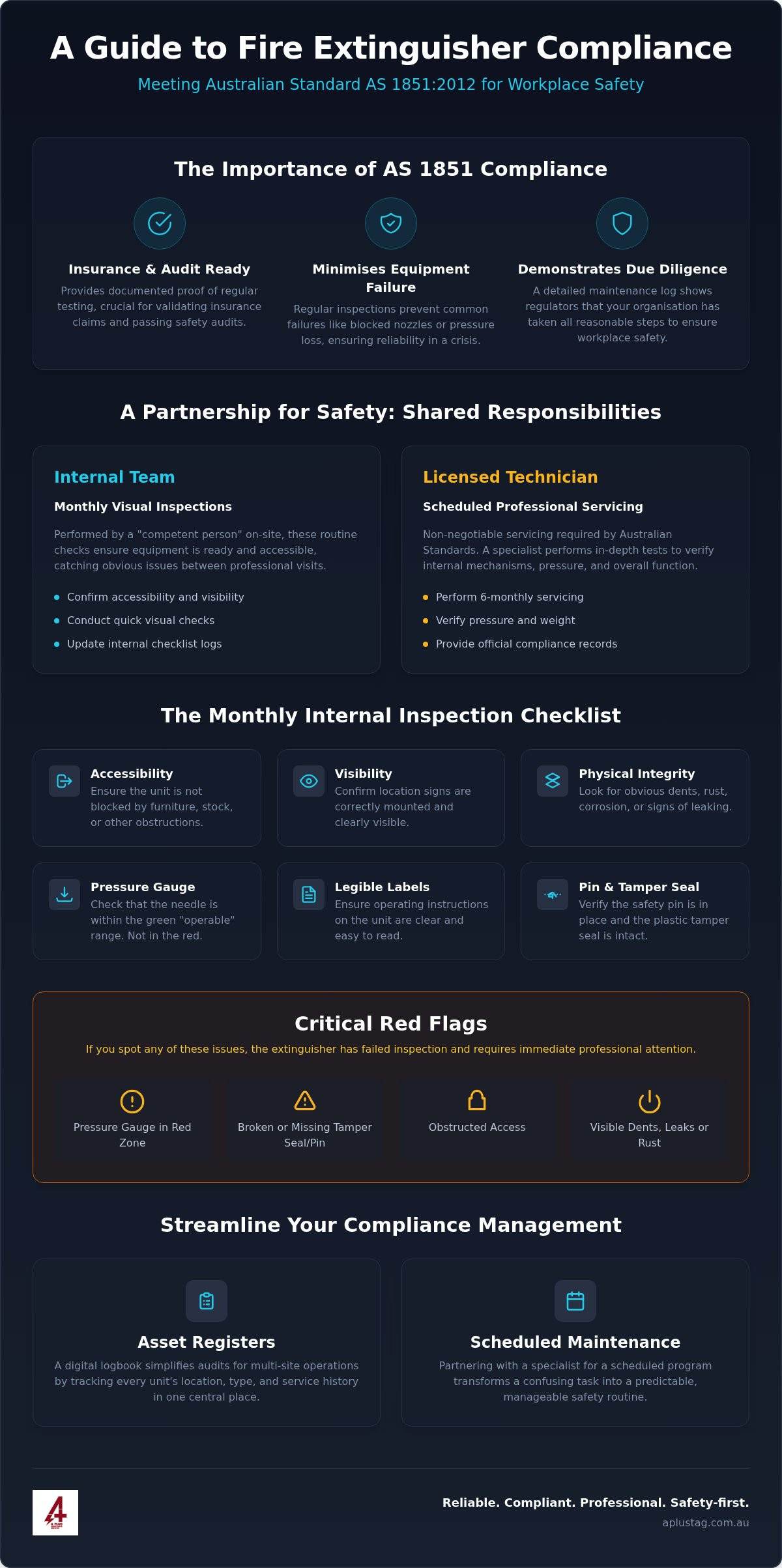
To meet these duties, businesses must adhere to AS 1851:2012. This is the current Australian Standard for the routine service of fire protection systems and equipment. It provides a systematic approach to maintenance, moving beyond casual visual checks. While your internal staff can perform basic observations using a fire extinguisher inspection checklist, these don’t replace the regulated maintenance records required for legal compliance. Informal checks help catch obvious issues, but the standard mandates a structured schedule of professional testing and documentation.
The Importance of AS 1851 Compliance
Adhering to AS 1851:2012 is the primary benchmark used by insurance providers and safety auditors during site inspections. If a fire occurs and your equipment fails, insurers often look for documented proof of regular testing to validate a claim. Regular inspections minimise the risk of equipment failure, such as blocked nozzles or lost pressure, during a crisis. Maintaining a detailed logbook or digital asset register demonstrates “due diligence” to regulators. It shows your organisation has taken every reasonable step to prevent harm and maintain essential safety measures.
Who is Responsible for Inspections?
Responsibility for safety is shared between your internal team and external experts. A “competent person” is defined as someone with the necessary training or experience to perform basic visual observations. Your staff can handle monthly reviews to ensure units aren’t obstructed, signs are visible, and the fire extinguisher inspection checklist is updated. However, professional servicing is non-negotiable.
Australian Standards require a licensed technician to perform deeper testing every six months. Arranging a professional fire equipment inspection ensures that internal mechanisms, weight, and pressure levels are verified by a specialist. This partnership between internal vigilance and professional expertise creates an impenetrable safety record. It ensures that when an emergency happens, your equipment works exactly as intended without delay or malfunction.
The Monthly Internal Fire Extinguisher Inspection Checklist
Maintaining your equipment between professional visits is vital for site safety. A 30-day routine ensures that your first line of defence is always ready for immediate use. Using a consistent fire extinguisher inspection checklist helps you spot minor issues before they become compliance failures during an audit. This internal process is simple but requires a methodical approach to be effective.
- Accessibility: Ensure no pallets, furniture, or stock items block access to the unit. Every second counts during a fire.
- Visibility: Confirm that location signs are mounted correctly and aren’t obscured by decorations or temporary displays.
- Physical Integrity: Look for dents, rust, or leaking powder that might suggest the cylinder is compromised.
- Labelling: Check that the operating instructions on the front of the unit are clear and legible for an untrained user.
The pressure gauge provides a quick health check for most portable units. The operable range for pressure gauges is defined as the green segment of the display. If the needle has drifted into the red “recharge” or “overcharged” zones, the unit requires professional attention immediately. A needle in the red means the extinguisher may not have the force required to discharge the contents effectively when you need it most.
Step-by-Step Visual Verification
Examine the safety pin and the plastic tamper seal. These components must be intact to prove the unit hasn’t been used or tampered with. Never pull the pin during a routine check, as this can break the seal and lead to a slow loss of pressure. Inspect the discharge hose and nozzle for cracks or blockages, such as dust buildup or small insect nests. Finally, lift the unit slightly to confirm it’s securely seated on its wall bracket or stand and hasn’t been knocked loose.
Recording Your Monthly Findings
Documentation is just as important as the physical check itself. Once you’ve verified the unit’s status, initial and date the yellow maintenance tag attached to the cylinder. This creates a visible history of your vigilance for any safety inspector who visits your site. Keeping a centralised logbook alongside your fire extinguisher inspection checklist simplifies safety audits and helps you track the lifecycle of your equipment across multiple rooms or floors. For help setting up a more robust scheduled maintenance program, reaching out for professional advice can save significant time and ensure you never miss a critical date.
AS 1851 Maintenance Intervals: When to Call the Professionals
Professional maintenance is the essential counterpart to your internal vigilance. While your staff ensure the equipment remains accessible using a monthly fire extinguisher inspection checklist, AS 1851-2012 requires a tiered approach to technical servicing. These intervals are designed to catch hidden mechanical failures that a visual check cannot detect, ensuring the unit operates correctly under pressure. Relying solely on internal observations can lead to non-compliance during a safety audit, as only a qualified technician can certify that the internal mechanisms are functional.
The standard defines three key levels of routine service: six-monthly, annual, and five-yearly. Each stage increases in complexity, moving from external observations to internal component testing. This systematic approach ensures that every unit on your site is ready for an emergency, regardless of its age or type. By following this schedule, you demonstrate a commitment to safety that satisfies both legal regulators and insurance requirements.
6-Monthly vs. Annual Professional Servicing
Every six months, a competent technician must perform a basic service to verify the unit’s pressure and physical condition. During this visit, they check the weight of the extinguisher to ensure no agent has leaked. They also inspect the hose for blockages and ensure the safety pin moves freely. The annual service is more comprehensive, involving a detailed inspection of the valve assembly and the discharge nozzle. Technicians also check for “compaction” in dry powder units by inverting the cylinder to ensure the powder remains free-flowing.
After each successful visit, the technician will update the yellow maintenance tag or metal stamped tag, providing clear evidence of compliance for safety audits. Many facility managers find it efficient to bundle these visits with other safety requirements. Because fire equipment and electrical safety often share similar testing frequencies, professional test and tag services frequently include fire equipment as part of a holistic safety package. This approach reduces site disruption and ensures all documentation is handled in a single, organised visit.
The 5-Year Overhaul and Recharge
The five-year overhaul is the most rigorous stage of the equipment’s lifecycle. At this milestone, extinguishers must undergo hydrostatic pressure testing to verify the cylinder’s structural integrity. This process involves emptying the unit and subjecting the shell to high pressure in a controlled environment. It is a critical safety measure to detect metal fatigue or internal corrosion that could cause the cylinder to rupture during use. Once the test is passed, the unit is recharged with fresh extinguishing agent and propellant gas.
For many standard units, such as 2.5kg dry powder extinguishers, the cost of this specialised testing and recharging can be comparable to the cost of a brand-new unit. In these cases, it is often more cost-effective to replace the extinguisher entirely. Replacing the unit ensures you have the latest safety technology and starts a fresh five-year compliance window, simplifying your long-term fire extinguisher inspection checklist management. Professional guidance can help you determine the best path for your specific inventory, balancing safety with operational budgets.
Identifying Red Flags: When an Extinguisher Fails Inspection
When you conduct your regular walkthrough with a fire extinguisher inspection checklist, you’ll eventually encounter a unit that doesn’t meet the required standard. Spotting these red flags is a critical skill for any facility manager. A failed inspection isn’t merely a compliance hurdle; it’s a warning that the equipment may not function during a crisis. Identifying these issues early allows you to take corrective action before an emergency occurs, ensuring your site remains protected and compliant.
Partially discharged units are one of the most dangerous findings. Even a brief, two-second “test” spray can compromise the valve’s seal, leading to a slow, silent leak of propellant gas. By the time the extinguisher is actually needed, it may be entirely empty. Similarly, physical corrosion on the cylinder body or handle is a major risk. Because these cylinders are under high pressure, rust can weaken the metal walls, creating a potential for the vessel to rupture or explode during handling. Any unit with a missing safety pin or a broken tamper seal must also be treated as a failure, as you can no longer guarantee its readiness.
Common Failure Points and Their Risks
Clogged nozzles are a frequent issue in Australian workplaces, where spiders and debris can build up in the discharge path over time. A blocked nozzle prevents the extinguishing agent from escaping, rendering the unit useless in a fire. Faded or damaged labels also pose a significant risk. If operating instructions are illegible, employees may panic or use the wrong technique in a high-stress situation. Finally, out-of-date tags represent a serious legal risk. Expired maintenance records suggest a breakdown in your organisation’s safety management system, which can lead to complications during insurance claims or safety audits.
The Failure Protocol: Immediate Action Steps
Once a unit fails your internal check, you must act immediately to maintain safety standards. Clearly tag the extinguisher as “Out of Service” and remove it from its bracket so it isn’t used by mistake during an emergency. You must arrange for a temporary replacement or a new unit to maintain the required fire safety coverage for that specific area. This proactive approach to managing equipment failures is a key part of maintaining overall site safety. For a more comprehensive look at your workplace safety obligations, you can also view our RCD testing guide to ensure your electrical systems are equally compliant.
Organising Your Compliance: Asset Registers and Scheduled Maintenance
Managing fire safety across a growing business requires more than just a clipboard and a fire extinguisher inspection checklist. While manual checks catch immediate hazards, an organised digital asset register provides the structural foundation for long-term compliance. This systematic approach transforms safety from a reactive task into a predictable, managed process. By centralising your data, you gain a clear overview of your site’s readiness and ensure that no unit is ever overlooked during a busy operational cycle. A Plus Compliance Services specialises in providing this level of structured oversight, acting as a dependable partner for your recurring safety programmes.
Professional reporting goes beyond simple pass or fail results. It provides facility managers with a comprehensive audit trail that is essential for modern business operations. When all your safety data is stored in a single, accessible register, you eliminate the risk of lost logbooks or missed maintenance windows. This transparency not only helps you stay organised but also builds a culture of safety where every piece of equipment is accounted for and verified by experts.
Building a Reliable Asset Register
A professional asset register acts as a living document for your workplace safety equipment. It should record specific data points for every unit, including its precise location, the type of extinguisher, the manufacture date, and the date of its last professional service. This level of detail is invaluable during a WorkSafe or insurance audit, as it provides instant proof of your commitment to AS 1851-2012. Having clear, reliable, and professional compliance support means you can produce these records at a moment’s notice, significantly reducing the stress and complexity of a safety inspection. It ensures your organisation remains audit-ready at all times without the need for last-minute paperwork scrambles.
Streamlining Multi-Site Compliance
Coordinating safety schedules across warehouses, offices, and retail sites is a complex logistical challenge for any operations manager. Scheduled maintenance programs eliminate the guesswork by ensuring all testing is conducted within the required windows across every location, regardless of the distance between them. This proactive management style minimises site disruption and ensures that your organisation maintains a consistent safety standard. By using automated due-date reminders, you stay ahead of your compliance obligations without having to manually track every yellow tag on every floor. This organised approach allows you to focus on your core business while knowing your fire safety obligations are fully met by a dedicated team of professionals.
Secure Your Workplace Safety Standards
Maintaining workplace safety doesn’t have to be a source of stress for your organisation. By combining your monthly internal vigilance with the technical expertise required by AS 1851-2012, you create a robust safety culture that protects your team and your assets. Utilising a structured fire extinguisher inspection checklist ensures your equipment is always accessible and visible, while professional servicing handles the complex mechanical verification that visual checks can’t cover.
Experienced Australian safety technicians provide the specialised AS 1851 compliant reporting and automated due-date reminders needed to keep your business audit-ready. This proactive approach minimises risk and ensures your essential safety measures are always functional and documented. Transitioning to a managed maintenance schedule allows you to focus on your core operations with the confidence that your compliance is in expert hands.
Taking control of your compliance requirements today provides lasting peace of mind for you and your staff. We’re here to act as your dependable partner in maintaining a safe, organised, and fully compliant workplace environment.
Frequently Asked Questions
How often do fire extinguishers need to be inspected in Australia?
Fire extinguishers require monthly internal visual checks and professional servicing every six months according to AS 1851:2012. These frequent intervals ensure the equipment remains unobstructed and functional. While your staff can manage the 30-day reviews, a specialised technician must complete the formal 6-monthly and annual inspections to maintain your site’s compliance and safety standards.
Can I perform the fire extinguisher inspections myself?
You can perform the monthly visual inspections yourself using a fire extinguisher inspection checklist, but formal servicing must be conducted by a competent professional. Your internal team is responsible for ensuring units are visible and accessible. However, the technical requirements of AS 1851:2012 mandate that a qualified technician performs the detailed 6-monthly, annual, and 5-yearly pressure tests to certify the equipment’s mechanical integrity.
What is the difference between a monthly check and a 6-monthly service?
A monthly check is a visual review of accessibility and condition, while a 6-monthly service is a technical inspection of the unit’s mechanical parts. During the monthly walkthrough, you ensure the unit is in its bracket and the gauge is in the green. The 6-monthly professional service involves weighing the cylinder and checking internal components to ensure the extinguishing agent will discharge correctly during an emergency.
How do I know if my fire extinguisher is still in date?
You can determine if your extinguisher is in date by examining the yellow maintenance tag or metal stamped tag attached to the cylinder. This tag displays the month and year of the last service. If the last recorded date was more than six months ago, the unit is out of compliance. Keeping a digital asset register alongside your fire extinguisher inspection checklist helps you track these dates across multiple units automatically.
What should I do if the pressure gauge is in the red zone?
If the pressure gauge needle is in the red zone, you must remove the extinguisher from service immediately and arrange for professional repair or replacement. A needle in the red indicates the unit is either under-pressurised or overcharged. Both conditions are dangerous, as the extinguisher may fail to discharge or could pose a safety risk during handling. Always replace the unit with a compliant spare to maintain site coverage.
Do fire blankets also need to be inspected regularly?
Fire blankets must be inspected every six months by a qualified technician to comply with Australian Standard AS 1851. These checks ensure the blanket is clean, correctly folded, and can be easily pulled from its container. During your internal monthly walkthroughs, you should also verify that the blanket is in its designated location and the instructions on the cover remain clearly legible for users.
What happens during a 5-yearly fire extinguisher test?
The 5-yearly test involves a comprehensive hydrostatic pressure test to verify the structural integrity of the cylinder. A technician empties the unit and subjects the shell to high pressure to check for metal fatigue or internal corrosion. This process ensures the cylinder won’t rupture under pressure. Depending on the unit type, it’s often more cost-effective to replace the extinguisher with a new one at this five-year milestone.
Is it a legal requirement to have a maintenance tag on the extinguisher?
Having a maintenance tag on your fire extinguisher is a legal requirement under Australian safety standards to demonstrate compliance. This tag serves as the official record of servicing and is the first thing a safety auditor or insurance representative will check. It must be initialled and dated by the technician after every 6-monthly and annual service to prove the equipment meets the necessary safety regulations.
