RCD Testing: The Complete Guide to Workplace Electrical Safety and Compliance
What if the safety switch designed to protect your team from a fatal electric shock hasn’t actually been triggered in five years? With eight electrical fatalities recorded in Australia during the 2022-2023 period, the stakes for rcd testing and workplace safety remain incredibly high. It’s common for facility managers to feel overwhelmed by the complex web of testing intervals and compliance dates required by Australian Standards. You likely understand that keeping people safe is the absolute priority, but the anxiety of a missed inspection or a potential penalty can be a constant weight on your shoulders.
This guide will clarify exactly what’s required to meet your obligations under AS/NZS 3760:2022 and maintain a robust safety record. We’ll explore specific testing requirements for different industries, explain how to manage schedules across multiple sites, and show you how to turn technical data into a reliable compliance system. By the end of this article, you’ll have a clear roadmap for creating a safer environment for your staff and visitors while ensuring your business remains fully organised and compliant.
Key Takeaways
- Understand the life-saving role of RCDs as safety switches and how they differ from standard circuit breakers in protecting your team from electrical faults.
- Learn the critical distinction between simple push-button user checks and the professional trip-time rcd testing required for full regulatory compliance.
- Identify the specific testing intervals mandated by AS/NZS 3760:2022 based on your unique workplace environment and equipment risk levels.
- Discover how professional asset registers and detailed reporting simplify audit readiness while providing a transparent record of your safety commitment.
- Establish a systematic maintenance schedule that ensures long-term electrical safety and minimises operational disruption across multiple sites.
RCD Testing: Why it’s Essential for Workplace Safety
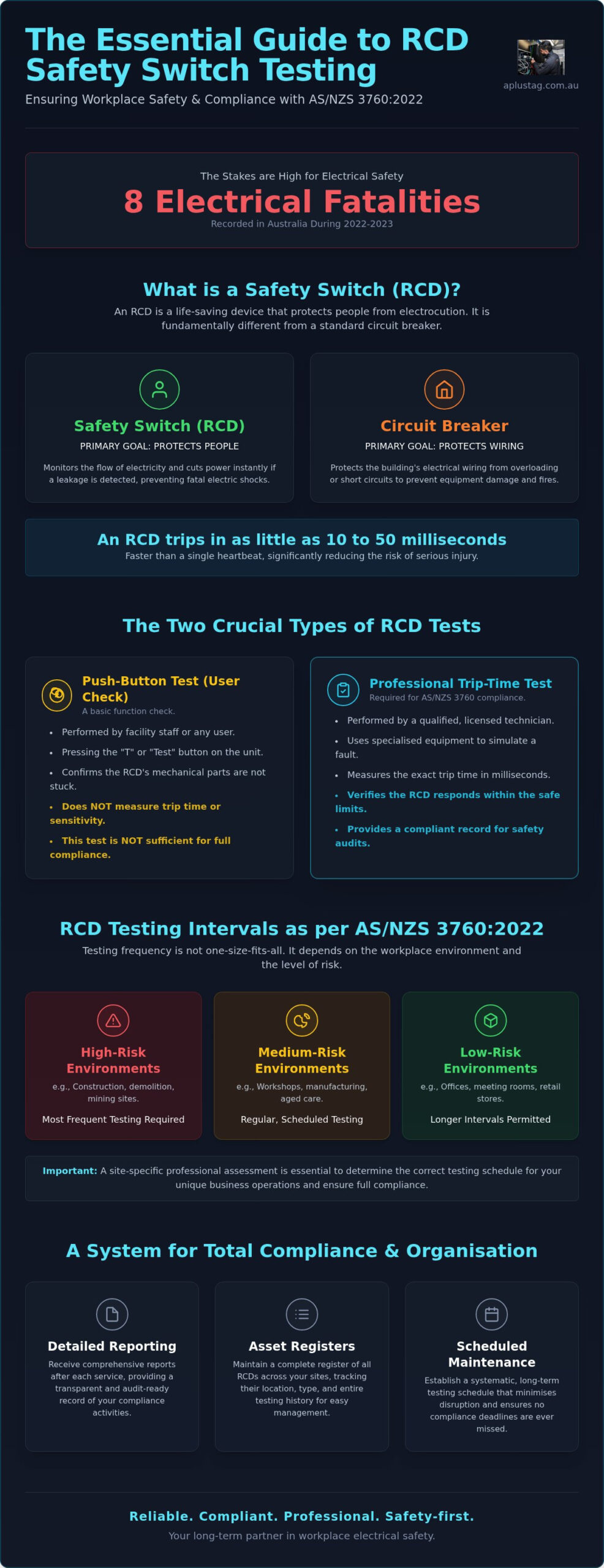
A Residual-current device, commonly known as a safety switch, is a life-saving component in any modern workplace electrical system. While many people confuse them with standard circuit breakers, their functions are distinct and vital. A circuit breaker is designed to protect your building’s wiring from overloading and catching fire. In contrast, an RCD is designed specifically to protect people. It prevents electrocution by constantly monitoring the flow of electricity through a circuit and cutting power instantly if a fault is detected. Professional rcd testing ensures these devices remain responsive and ready to act when needed.
To better understand this concept, watch this helpful video:
How Residual Current Devices Save Lives
The mechanism inside an RCD is incredibly precise. It monitors the balance of current between the active and neutral conductors. Under normal conditions, the current flowing into a circuit should equal the current flowing out. If an imbalance occurs, it usually means electricity is leaking to the ground, potentially through a person. The RCD detects this leakage and “trips,” disconnecting the power in as little as 10 to 50 milliseconds. This speed is critical because it’s often faster than a single heartbeat, significantly reducing the risk of cardiac arrest or serious injury from a shock. Without regular checks, a device might seize or fail, leaving your team unprotected from these invisible hazards.
The Legal Framework for RCD Testing in Australia
Under Australian Work Health and Safety (WHS) regulations, every business owner and facility manager has a “Duty of Care” to provide a safe working environment. This responsibility includes maintaining electrical installations and equipment in good working order to minimise risk. The primary standard governing this is AS/NZS 3760:2022, which outlines the specific requirements for in-service safety inspection and testing. These standards ensure that safety switches are not just present, but functional.
Compliance is about more than just avoiding penalties, which can be substantial under Commonwealth law. For example, as of July 2026, a single penalty unit is valued at $364, and corporations can face fines reaching into the tens of thousands for safety breaches. Beyond the financial impact, regular rcd testing is a fundamental part of an electrical safety programme that protects your most valuable asset: your staff. Because requirements vary based on the workplace and equipment type, we always recommend obtaining site-specific professional guidance to ensure your documentation remains audit-ready and your environment stays secure.
Understanding the Different Types of RCDs in Your Facility
Managing workplace safety requires a detailed understanding of the hardware protecting your staff. During a professional site assessment, identifying every device is critical because different units require distinct rcd testing protocols. Most modern Australian facilities utilise a combination of fixed and portable devices to achieve comprehensive protection. It’s also important to verify that your hardware meets current regulations; for instance, Type AC RCDs are no longer permitted for new installations in Australia because they may fail to detect certain electrical faults in modern electronics. If you’re navigating the confusion around what your workplace actually requires, our guide to electrical testing services and common compliance myths can help clarify which standards genuinely apply to your situation.
Fixed RCDs: Switchboard and Socket-Outlet Protection
Fixed devices are the backbone of a facility’s electrical safety. Switchboard-mounted RCDs, often integrated as Residual Current Breakers with Overcurrent protection (RCBOs), safeguard entire circuits from the point of origin. These permanent installations provide constant monitoring for the building’s wiring. In more specialised environments like medical laboratories or workshops, you might also find socket-outlet RCDs (SROs). These offer localised protection at the point of use, ensuring that a fault in one high-risk area doesn’t necessarily trip the power for the whole building. Because fixed RCDs are stationary, they are less prone to physical damage but still require periodic verification to ensure the internal mechanisms haven’t seized over time.
Portable and Non-Portable RCDs
Portable RCDs are essential for hostile environments, such as construction sites or workshops where extension leads and power tools are frequently moved. These devices are often plugged directly into a standard outlet or built into a portable power board. Because they are subject to vibration, moisture, and physical impact, they face a much higher risk of failure. Non-portable RCDs are built into specific industrial machinery or equipment. Both categories are subject to strict Electrical safety laws that mandate frequent inspections. For instance, portable devices used on construction sites typically require professional rcd testing every three months to account for the harsh conditions they endure.
Keeping track of these varying requirements across a large site can be challenging. A professional asset register helps by listing every device type and its corresponding due date, ensuring nothing is overlooked during a busy maintenance cycle. If you’re unsure which devices are currently installed at your facility, you might consider booking a site audit to establish a clear baseline for your safety programme.
Push-Button vs. Professional Trip-Time Testing: What is the Difference?
A frequent point of confusion for many facility managers is the difference between a simple user check and a comprehensive compliance inspection. While every safety switch features a “test” button, relying solely on this is a common safety gap. The button provides a basic mechanical verification, but it cannot confirm if the device will actually save a life during a real electrical fault. Professional rcd testing involves much more than just a physical trigger check; it requires precision measurements to ensure the device meets strict Australian safety standards.
The Limitations of the Push-Button Test
The “test” button on an RCD is designed for regular user-level checks. When you press it, the device simulates a small fault to verify that the internal mechanical trigger is still moving freely. It’s a useful way to ensure the switch hasn’t seized up due to dust or lack of use. However, this test is limited. It doesn’t measure the sensitivity of the device or the speed at which it disconnects the power. A safety switch might trip when the button is pressed but still take far too long to react during a genuine leakage event. AS/NZS 3760:2022 recommends these user-level checks every six months for most commercial environments, but they are never a substitute for a technician’s specialised assessment.
Operating Time Testing: The Professional Standard
To achieve full compliance and ensure maximum protection, technicians perform an “operating time test.” This process involves using a calibrated RCD tester to inject a precise amount of current leakage into the circuit. The tester then measures exactly how many milliseconds (ms) the device takes to disconnect. Under AS/NZS 3760:2022, devices must trip within specific threshold limits to pass. If a device takes too long to react, it may still “trip” during a button test, but it would fail a professional inspection because those extra milliseconds could be the difference between a minor shock and a fatal cardiac arrest.
By choosing specialised testing solutions, you receive a detailed breakdown of these trip times for every device on your site. This level of precision is the only way to verify that your safety switches are operating within the safe thresholds defined by law. It provides the documented evidence you need for your asset register and ensures that your rcd testing programme is based on hard data rather than guesswork. This methodical approach is what transforms a routine task into a reliable safety framework for your workplace.
AS/NZS 3760 Compliance: RCD Testing Intervals and Requirements
Compliance with AS/NZS 3760:2022 isn’t a one-size-fits-all approach. The standard recognises that an RCD in a clean, carpeted office faces far less stress than one on a dusty demolition site. Because of this, rcd testing intervals are determined by the environment’s risk level. Understanding these nuances is essential for facility managers who need to maintain safety without creating unnecessary operational downtime. For a broader look at how these rules fit into your overall safety strategy, refer to our Pillar Guide to Australian Workplace Compliance.
Testing Frequencies for Common Environments
The Australian Standard categorises workplaces based on their potential to damage electrical equipment. These categories dictate how often your safety switches must be professionally verified:
- Hostile Environments: Construction, demolition, and mining sites are high-risk. Equipment here is subject to moisture, dust, and physical impact. Consequently, portable RCDs usually require professional testing every 3 months.
- Manufacturing and Commercial Kitchens: These areas involve heat, steam, and frequent equipment use. Testing for fixed and portable units often occurs every 6 to 12 months.
- Non-Hostile Environments: In offices, retail stores, or schools, the risk of physical damage is lower. Intervals may extend to 2 years, though many businesses opt for annual checks to simplify their management cycles.
Factors That Influence Your Testing Schedule
Environmental conditions play a major role in device reliability. Moisture can cause internal corrosion; meanwhile, high heat or constant vibration from heavy machinery can desensitise the mechanical components of a safety switch. The frequency of equipment use also changes the risk profile. A portable RCD used daily on a production line requires more frequent oversight than a fixed unit protecting a server room.
Legal requirements for record-keeping are tied directly to these intervals. If an incident occurs, you must prove that testing was performed according to the specific schedule defined for your industry. This is why professional guidance is vital. A qualified technician can help you establish a site-specific schedule that balances safety with cost-effectiveness, ensuring you never miss a critical deadline. Many businesses also find it helpful to first address the common misconceptions surrounding electrical testing services before finalising their compliance approach. For businesses operating in Victoria, our detailed resource on RCD testing Melbourne workplace compliance outlines the specific obligations and penalty risks that apply to your region in 2026. Healthcare facilities should also be aware that RCD compliance intersects with the specialised requirements for biomedical devices safety testing and clinical compliance, which operates under a distinct set of standards beyond AS/NZS 3760.
Organising Your Workplace Compliance: Documentation and Asset Registers
Completing the physical rcd testing is only the first stage of a robust safety programme. For facility managers, the administrative burden of tracking every device across multiple sites often poses a greater challenge than the technical work itself. Professional documentation transforms a collection of individual test results into a functional management tool. A comprehensive compliance report should include several key components:
- A unique identification number for every RCD tested.
- The exact location of each device within the facility.
- The specific operating time measured in milliseconds.
- The date of the next scheduled inspection.
Without this clear paper trail, your business remains vulnerable during safety audits or insurance investigations, regardless of how recently your switches were checked. A professional report provides the transparency needed to demonstrate that your organisation takes its safety obligations seriously.
The Role of the Asset Register
An asset register serves as the definitive master list for your facility’s electrical safety. It documents every item with a unique ID, its precise location, and its complete history of passes or failures. This level of detail is invaluable when demonstrating compliance to WorkSafe inspectors or during annual insurance renewals. Beyond simple record-keeping, a digital register provides automated due-date reminders. This proactive approach ensures you never miss a recurring maintenance cycle, allowing you to maintain long-term order without the stress of manual tracking or spreadsheet errors. It’s an essential tool for maintaining audit readiness across national or Victorian sites. Establishing a systematic approach to compliance monitoring is what transforms this record-keeping from a reactive chore into a streamlined, professional routine. Facilities managing clinical equipment should note that the same principles of rigorous asset tracking apply to biomedical devices, where documentation requirements under AS/NZS 3551 are equally demanding.
What to Look for in a Compliance Partner
Selecting a partner for your compliance reporting and asset registers involves looking beyond the basic test. You need specialised technicians who understand the specific requirements of AS/NZS 3760:2022 and can provide transparent, audit-ready data. A high-quality partner prioritises a ‘minimal disruption’ service model, ensuring that safety checks don’t halt your daily operations in busy sectors like healthcare or education. They should act as a dependable ally, simplifying complex requirements rather than adding to your workload through messy or incomplete paperwork.
RCD testing is a comprehensive process of physical inspection, timing verification, and systematic record-keeping. By integrating these elements into a single, organised framework, you create a state of controlled safety. A Plus Compliance Services specialises in managing these administrative details, providing the clear reporting needed to stay organised and prepared for any scrutiny.
Securing Long-Term Electrical Safety for Your Workplace
Maintaining a compliant workplace is more than just a legal obligation; it’s a commitment to protecting your team’s well-being and your business’s continuity. Effective rcd testing combines technical precision with methodical documentation to ensure that your safety switches are always ready to act within milliseconds. Moving from reactive checks to a proactive maintenance schedule eliminates the confusion of varying intervals and the stress of potential audits.
A structured approach, supported by professional asset registers and scheduled maintenance reminders, ensures your organisation remains audit-ready. With nationwide compliance expertise, we help you manage these requirements with minimal disruption to your daily workflow. By partnering with experts who understand the nuances of AS/NZS 3760:2022, you can focus on your core operations with the confidence that your safety programme is managed with accuracy and care.
Taking these steps today creates a safer, more organised environment for your staff and visitors, providing you with lasting peace of mind.
Frequently Asked Questions
How often is RCD testing required in an Australian office?
In a standard Australian office environment, professional rcd testing is typically required every two years under AS/NZS 3760:2022. However, many Victorian businesses choose annual inspections to align with their broader electrical safety schedules. It’s also necessary to perform a simple push-button user test every six months. Because requirements vary based on your specific workplace and equipment type, we always recommend obtaining site-specific professional guidance to ensure full compliance.
Can I test my own RCDs using the test button?
You can and should use the test button for regular user-level checks. This simulates a fault to verify the mechanical trigger is functioning. However, this is not a substitute for professional trip-time testing. The button cannot measure the speed of the disconnection in milliseconds, which is the legal requirement for compliance. A technician using specialised equipment is necessary to verify the device meets the safety thresholds defined by Australian Standards.
What is the difference between an RCD and a safety switch?
There is no difference between an RCD and a safety switch; they are two names for the same life-saving device. “Residual Current Device” is the technical industry term, while “safety switch” is the common name used by most Australians. Both terms refer to a switch that monitors electrical flow and disconnects power instantly if an imbalance is detected. This prevents electric shock by cutting the circuit before serious injury occurs.
What happens if an RCD fails a professional trip-time test?
If a device fails a professional trip-time test, it must be immediately identified as faulty and removed from service. A technician will apply a “Failed” tag and record the result in your asset register. The faulty RCD must then be replaced by a licensed electrician to restore safety to that circuit. Continuing to use a circuit with a failed RCD significantly increases the risk of electrocution and non-compliance penalties.
Is RCD testing mandatory for all businesses in Victoria?
Yes, rcd testing is mandatory for Victorian businesses as part of their duty of care under the Occupational Health and Safety Act 2004. Employers must provide a safe working environment, which includes ensuring all electrical safety measures are functional. While specific testing intervals vary by industry, the requirement to maintain electrical equipment in a safe condition is a legal obligation for all workplaces, including healthcare, education, and hospitality sectors.
Do portable RCDs need to be tested more often than fixed ones?
Portable RCDs generally require more frequent testing than fixed units because they are more susceptible to physical damage. In hostile environments like construction or demolition sites, portable units must be professionally tested every three months. Fixed RCDs in the same environment are usually tested every 12 months. The increased frequency for portable devices accounts for the vibrations, moisture, and rough handling they endure during daily use on site.
What information should be included in an RCD compliance report?
A professional RCD compliance report must include a unique asset ID and the specific location of each device. It should clearly state the measured trip time in milliseconds, the date of the test, and whether the device passed or failed. Including the name of the technician and the date of the next scheduled inspection is also essential. This documentation forms your legal record and is vital for safety audits or insurance claims.
Can RCD testing be performed after hours to avoid disruption?
Yes, testing can be scheduled after hours or during quiet periods to minimise operational disruption. Since rcd testing requires a brief power interruption to the circuit, many facilities prefer to arrange service when staff aren’t using computers or sensitive equipment. We focus on a “minimal disruption” service model, working with site managers to coordinate a schedule that maintains safety without interrupting your essential business operations or patient care.
