Professional Test and Tag Services: The Complete Guide to Australian Workplace Compliance
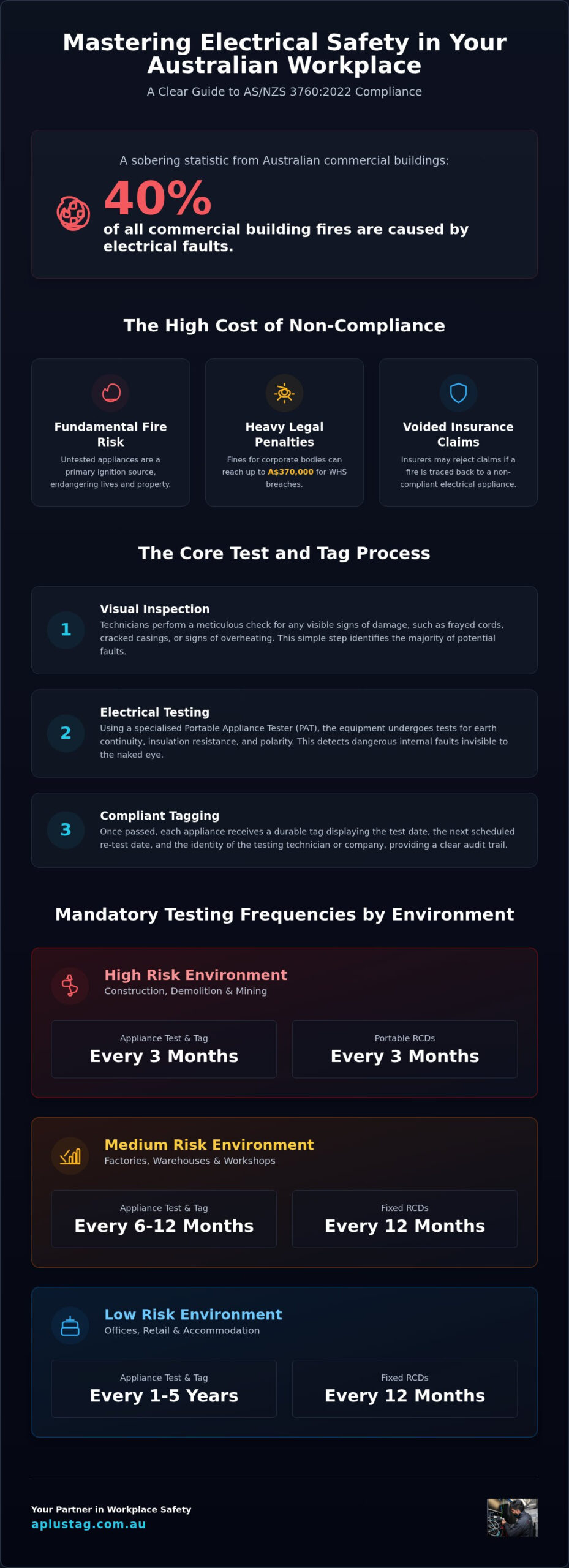
Electrical faults account for approximately 40% of all commercial building fires in Australia each year. This sobering statistic highlights why professional test and tag services are far more than a routine administrative task; they represent a fundamental layer of protection for your employees, your physical assets, and your legal standing.
Managing workplace safety often feels like chasing a moving target, especially when you are balancing different testing intervals for various industries and the fear of voiding insurance through simple oversight. It’s understandable to feel overwhelmed by the sheer volume of electrical assets that require documentation to remain compliant with AS/NZS 3760:2022 and fire safety standards.
This guide provides a clear, methodical pathway to mastering your safety obligations without the stress. You’ll learn how to establish a streamlined compliance process that ensures audit readiness through detailed asset registers, covering everything from RCD testing to fire equipment maintenance while maintaining total workplace productivity.
Key Takeaways
- Understand the mandatory requirements of AS/NZS 3760:2022 to ensure every portable electrical appliance in your workplace meets current Australian safety standards.
- Learn how professional test and tag services work alongside RCD and emergency lighting checks to provide a complete, streamlined compliance framework.
- Explore the benefits of proactive diagnostics, such as switchboard thermal imaging, in preventing equipment failure and reducing fire risks before they escalate.
- Master your documentation with digital asset registers that simplify the auditing process and provide transparent, real-time reporting for every electrical asset.
- Gain clarity on how to select a national compliance partner who prioritises methodical service delivery and punctuality to minimise workplace disruption.
Understanding Test and Tag Services and Australian Standards
Professional Portable Appliance Testing (Test and Tag) is a systematic process designed to ensure the ongoing safety of electrical equipment in Australian workplaces. This procedure involves two distinct phases: a meticulous visual inspection and a series of electrical tests using specialised equipment. In Australia, these protocols are governed by the AS/NZS 3760:2022 standard. This benchmark provides the necessary guidelines for in-service safety inspections, ensuring that portable appliances remain fit for use throughout their lifespan.
Compliance isn’t just a matter of sticking a tag on a lead. It’s a fundamental component of your “duty of care” under national Work Health and Safety (WHS) laws. If an electrical incident occurs, you’ll need to demonstrate that your business took every reasonable step to provide a safe environment. Engaging professional test and tag services provides the documented proof required to satisfy regulators and insurers. Without regular testing, you risk heavy fines, which can reach up to A$370,000 for corporate bodies in some jurisdictions, and the potential for insurance claims to be voided if a fire is traced back to an untested appliance.
Who Needs Professional Electrical Testing?
High-risk environments, such as construction and demolition sites, operate under the strictest rules. According to AS/NZS 3012, equipment in these areas requires testing every three months due to the harsh conditions and frequent wear. Factories, workshops, and warehouses typically require six-monthly or annual checks because the equipment is often prone to flexing or heavy industrial use. Even low-risk office environments aren’t exempt. While intervals might be longer, often extending to five years for stationary equipment, regular checks ensure that hidden faults don’t become life-threatening hazards.
The Core Testing Process
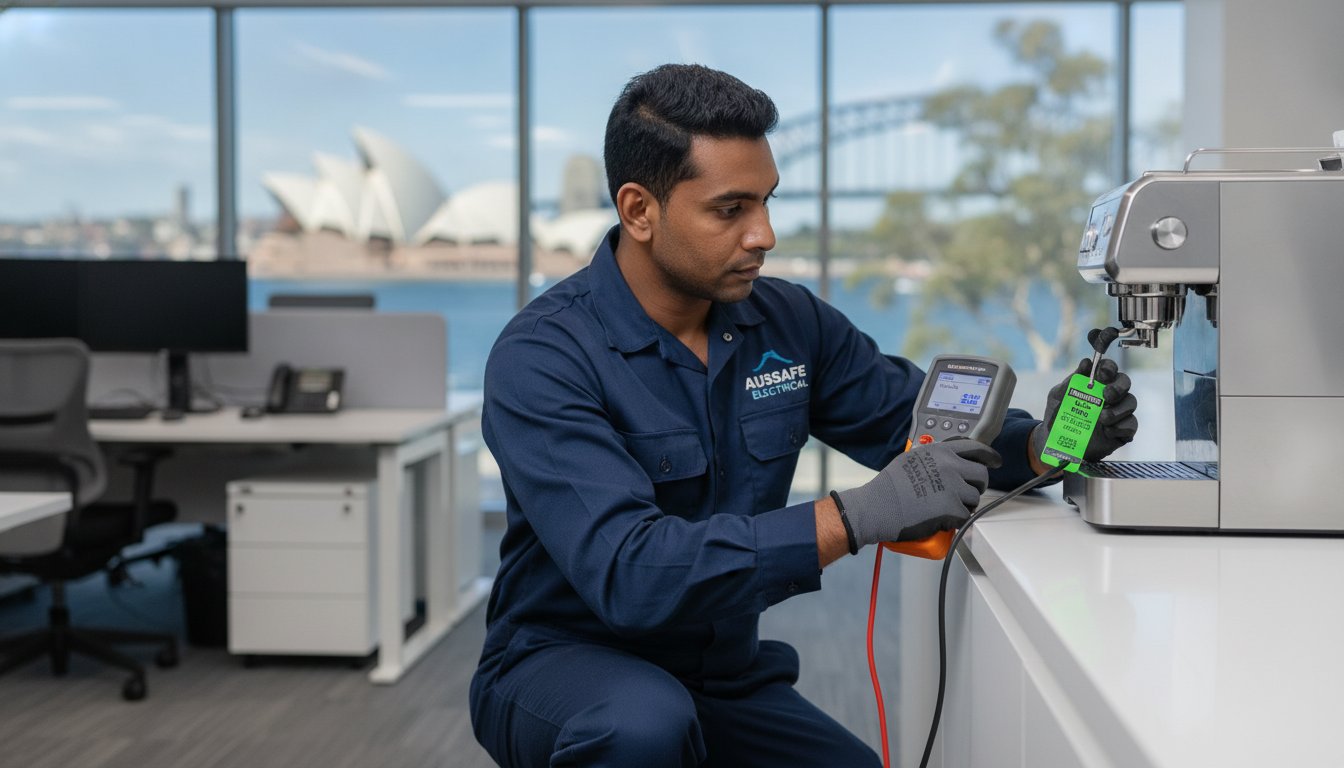
The process for professional test and tag services begins with a thorough visual inspection. Technicians look for frayed cords, cracked plugs, or signs of overheating on the casing. This step identifies the vast majority of faults before a meter is even attached. Next, the electrical testing phase uses a Portable Appliance Tester (PAT) to check earth continuity, insulation resistance, and polarity. These tests detect internal faults that are invisible to the naked eye. Finally, each passed item receives a durable tag. A compliant tag must clearly display the test date, the re-test date, and the identity of the person or company that performed the service.
Essential Workplace Compliance: RCD, Fire, and Emergency Lighting
Workplace safety extends far beyond the cords on a desk. While test and tag services address the integrity of portable appliances, a robust safety strategy must account for the fixed infrastructure designed to protect staff during an electrical fault or fire. Residual Current Devices (RCDs), emergency lighting, and fire suppression tools form a critical “safety net” for Australian businesses. Managing these requirements through a single, dependable partner ensures that no compliance gaps exist between service cycles, creating a more secure environment for everyone on-site.
Adopting an integrated approach to safety simplifies the complex OHS landscape. Instead of coordinating multiple contractors for different assets, businesses benefit from a methodical schedule that covers electrical and fire compliance simultaneously. This level of organisation minimises workplace disruption and provides a clear, unified view of your facility’s safety status. For many managers, moving toward integrated compliance solutions is the most efficient way to maintain order across hundreds of individual safety assets.
RCD Testing Intervals and Requirements
An RCD, or safety switch, is designed to disconnect power within milliseconds if a leakage to earth is detected. While many staff are familiar with the “push-button” test, which confirms the internal mechanism is functional, professional trip-time testing is essential for legal compliance. Using specialised meters, technicians measure exactly how fast the switch reacts. Under AS/NZS 3760:2022, these tests are non-negotiable. In high-risk environments like construction, portable RCDs require a trip-time test every three months, while standard commercial settings typically require testing every 12 months to satisfy duty of care obligations.
Emergency Lighting and Fire Protection
During a power failure or fire, emergency and exit lighting must remain illuminated for at least 90 minutes to allow for safe evacuation. AS/NZS 2293.2 mandates a full discharge test every six months to verify that batteries hold sufficient charge. Simultaneously, fire equipment maintenance must follow AS 1851-2012. This includes six-monthly visual inspections of extinguishers and fire blankets, along with annual operational flow tests for hose reels. Adherence to these standards, particularly AS 1851-2012, is a mandatory regulatory requirement for many commercial and residential building classes across Australia. Victorian businesses should also be aware that fire extinguisher testing requirements Victoria mandates include precise documentation standards and five-yearly pressure testing schedules that must be met to satisfy WorkSafe Victoria inspections and the Annual Essential Safety Measures Report. The consistent application of these benchmarks is crucial for maintaining safety and avoiding penalties. Regular documentation of these checks is the only way to ensure insurance validity and avoid significant penalties for non-compliance.
Advanced Diagnostics: Thermal Imaging and Biomedical Testing
While standard test and tag services address the safety of portable appliances, comprehensive risk management requires a deeper look into the fixed electrical infrastructure and specialised medical equipment. Advanced diagnostics represent a shift from reactive repair to proactive maintenance. By identifying hidden vulnerabilities before they manifest as equipment failure or fire, businesses can avoid the significant costs associated with unscheduled downtime and emergency electrical work. This methodical approach ensures that even the most complex environments, such as data centres or clinical facilities, remain operational and compliant.
Integrating advanced diagnostics into a regular safety cycle creates a robust protective layer for high-value assets. It allows facility managers to move beyond simple compliance and toward a model of long-term asset management. This transition is particularly vital for organisations where power continuity is critical for safety or service delivery. By combining routine inspections with technical diagnostics, a dependable partner helps you maintain total control over your workplace environment.
The Science of Switchboard Thermal Imaging
Thermal imaging uses infrared technology to detect heat signatures that are invisible to the human eye. In an electrical switchboard, “hot spots” often indicate loose connections, overloaded circuits, or unbalanced loads. If left unaddressed, these issues can lead to catastrophic component failure or electrical fires. A certified thermographer, operating under AS ISO 18436.7:2014, can conduct these scans without interrupting your power supply. For most commercial facilities, a 12-month inspection interval is recommended, while higher-risk sites like manufacturing plants or healthcare buildings often benefit from six-monthly scans to ensure maximum reliability.
Biomedical and Patient Area Compliance
Healthcare and clinical environments operate under a distinct set of safety requirements due to the vulnerability of patients and the sensitivity of medical devices. The management and testing of medical devices are guided by AS/NZS 3551, which ensures that equipment is safe for both staff and patient use. Beyond the devices themselves, the electrical environment must meet AS/NZS 3003 standards for patient areas. This includes the certification of body-protected and cardiac-protected electrical areas, where the risk of electric shock must be managed with extreme precision. Engaging technicians with specific expertise in these healthcare standards is essential for hospitals, dental clinics, and aged care facilities to maintain their accreditation and protect those in their care.
Data Management: Asset Registers and Compliance Reporting
Effective safety management relies on accurate data as much as it does on technical skill. While the physical tag provides an immediate visual check for staff, a digital asset register serves as the authoritative record for your entire facility. This documentation transforms a series of individual test and tag services into a cohesive compliance strategy. For facility managers, having a centralised database means that during a surprise audit or insurance review, the required proof of compliance is available in seconds, rather than buried in a paper trail.
A professional approach to data management moves beyond simple pass or fail results. It provides a transparent view of your equipment’s lifecycle, allowing you to track the movement and health of every electrical asset across multiple sites. By maintaining these records digitally, you can easily identify high-risk areas or equipment models that frequently fail testing, allowing for better-informed procurement decisions. You can access comprehensive compliance reporting that ensures your business remains audit-ready at all times.
Building Your Digital Asset Register
- Unique Identification: Every electrical appliance is assigned a unique ID, often through a durable QR code or barcode. This allows for instant tracking and eliminates confusion between similar assets.
- Detailed Recording: Technicians record the specific test results, the exact location of the item, and the date of the inspection. This creates a clear “chain of custody” for every piece of equipment.
- Historical Analysis: By maintaining a history for each asset, you can identify recurring faults. This data is invaluable for preventative maintenance and helps justify the replacement of aging or unreliable equipment.
Ancillary Safety: Microwaves and First Aid
Closing the safety loop requires looking at ancillary risks that often fall through the cracks. Microwave radiation testing is a vital component of kitchen safety; it ensures that seals haven’t degraded to the point where they leak harmful radiation levels. Similarly, workplace first aid kit servicing ensures that supplies are always stocked and, crucially, within their expiry dates. For those managing residential or commercial properties, regular smoke alarm testing is another essential layer of protection. These services, when integrated into your broader electrical safety schedule, ensure that every corner of your facility meets Australian standards without the need for multiple contractors.
The final piece of the data management puzzle is the use of automated reminders. By tracking the re-testing intervals for every asset, a dependable partner ensures you never miss a deadline. This proactive system removes the administrative burden from your team, allowing you to focus on core business activities while maintaining a state of continuous compliance.
Choosing a Professional Test and Tag Partner
Selecting a provider for your test and tag services is a decision that impacts your long-term legal security and operational continuity. A dependable partner acts as an essential ally, moving beyond the role of a distant contractor to become a proactive manager of your safety obligations. When evaluating potential providers, you must look for a combination of technical proficiency, comprehensive insurance, and high-grade testing equipment. A professional team should demonstrate an intimate understanding of current Australian standards while maintaining the punctuality and responsiveness required to keep your business running smoothly.
For multi-site organisations, national service coverage is a critical factor in maintaining a unified safety standard. Different states often have subtle variations in how WHS regulations are enforced, making it vital to work with a partner who can provide a consistent level of thoroughness across every location. This standardisation ensures that your compliance data is uniform, your asset registers are easily consolidated, and your safety culture remains robust regardless of where your staff are located. By choosing a partner with national reach, you simplify your administrative overhead and ensure that every branch meets the same high benchmark of safety.
The Value of Professionalism and Punctuality
In the compliance industry, “cheap” testing often proves to be an expensive mistake. Low-cost providers frequently rush through inspections, which leads to missed items, inaccurate data entry, and ultimately, failed audits. A professional approach prioritises accuracy and thoroughness, ensuring that every asset is accounted for and correctly tested. Furthermore, a methodical provider understands the importance of minimal disruption. They work with your team to schedule inspections during quiet periods or use a sequential flow that allows your daily operations to continue without significant downtime. Transparent pricing and detailed, upfront quotes are the hallmarks of a service built on trust and professional standards.
Next Steps for Your Compliance Journey
Mastering your safety obligations begins with a clear evaluation of your current testing status. Identify any gaps in your previous cycles, such as missed RCD tests or outdated fire extinguisher inspections. Consolidating these requirements with a single dependable partner is the most effective way to eliminate confusion and ensure that no asset falls through the cracks. This integrated model provides a stress-free experience, allowing you to focus on your core business while your safety infrastructure is managed with precision and care.
If you’re ready to transition from a state of uncertainty to one of organised control, the process is straightforward. You can organise a comprehensive safety audit with A Plus Compliance Services today to identify your specific needs and establish a recurring cycle of protection. Taking this step ensures that your workplace remains a safe, compliant, and productive environment for everyone.
Establishing a Proactive Safety Culture
Maintaining Australian workplace standards requires more than a reactive approach to electrical safety. By integrating professional test and tag services with advanced diagnostics like thermal imaging and fire equipment maintenance, you move from a state of uncertainty to one of organised control. This methodical strategy ensures that your business satisfies its duty of care under AS/NZS 3760 and specialised healthcare standards like AS/NZS 3003.
Utilising detailed digital asset registers provides the transparency needed for audit readiness, while a single-provider model for fire, electrical, and biomedical safety eliminates common compliance gaps. This level of thoroughness protects your staff, your property, and your insurance validity. You can secure your workplace with A Plus Compliance Services today to establish a dependable safety cycle that keeps your facility running smoothly.
With the right partner, managing complex OHS requirements becomes a streamlined, stress-free part of your business operations. You’ll feel prepared for any audit and confident that your workplace remains a safe environment for everyone.
Frequently Asked Questions
How often do I need to get my electrical equipment tested and tagged?
Testing intervals are determined by the specific environment and the type of equipment as outlined in AS/NZS 3760:2022. For example, construction and demolition sites require three-monthly testing, while factories and warehouses usually operate on a six-monthly cycle. Standard office environments typically require twelve-monthly checks for equipment prone to flexing, extending to five years for stationary items in low-risk areas like server rooms.
Is test and tag a legal requirement for all Australian businesses?
Electrical safety testing is a primary method for satisfying your “duty of care” under Australian Work Health and Safety (WHS) laws. While the specific term “test and tag” may not appear in every state’s legislation, the requirement to provide a safe system of work and maintain electrical equipment is mandatory. Failure to document these safety checks can lead to significant corporate penalties and the potential voiding of insurance policies.
What is the difference between AS/NZS 3760 and AS/NZS 3003?
AS/NZS 3760:2022 is the general standard for in-service safety inspection of electrical equipment, whereas AS/NZS 3003 is a specialised standard for patient areas. Hospitals, dental clinics, and aged care facilities must adhere to AS/NZS 3003 to ensure electrical installations in body-protected and cardiac-protected areas meet higher safety tiers. These environments require more rigorous testing to protect vulnerable patients from micro-shocks that standard equipment might not detect.
Does a new electrical appliance need to be tested before use?
New electrical appliances don’t require an electrical test before their first use, but they must be visually inspected and tagged as “New to Service”. This tag clearly indicates when the item entered the workplace and when its first formal test is due. Once the initial interval has passed, the item must then undergo the standard testing process to remain compliant with your established safety schedule.
What happens if an item fails the electrical safety test?
If an item fails an inspection, it must be immediately withdrawn from service and labelled with a “Danger: Do Not Use” tag. The faulty appliance should be quarantined or disposed of to prevent accidental use by staff. You’ll need to arrange for a licensed electrician to repair the fault or replace the unit entirely before it can be re-tested and returned to the workplace.
Can any electrician perform test and tag services?
Test and tag services can be performed by a “competent person” who has successfully completed a recognised training course. While a licensed electrician is always qualified to test, a trained technician with the correct equipment and knowledge of AS/NZS 3760:2022 is legally permitted to conduct inspections. However, only a licensed electrician is authorised to perform any actual repairs on faulty electrical equipment discovered during the audit.
How long does a typical test and tag session take for a medium-sized office?
A typical session for a medium-sized office with approximately 100 to 150 items usually takes between four to six hours. The duration depends heavily on the accessibility of power points and how easily the technician can reach cords and appliances. A methodical provider will work through each zone to ensure minimal disruption, allowing your team to continue their daily tasks while the safety audit is completed.
Why is switchboard thermal imaging recommended alongside standard testing?
Switchboard thermal imaging is recommended because it identifies hidden electrical faults that standard visual or electrical tests cannot detect. This infrared technology spots overloaded circuits and loose connections by identifying abnormal heat signatures within the board. Integrating these scans into your regular test and tag services provides a preventative layer of protection, significantly reducing the risk of catastrophic switchboard fires and unscheduled business outages.
