Test and Tag Requirements Victoria: A Guide to Workplace Compliance
A single missed inspection date can be the difference between a safe workplace and a costly regulatory intervention. It’s common to feel overwhelmed by the technicalities of test and tag requirements, especially when you’re responsible for managing hundreds of electrical assets across a busy site. The fear of non-compliance or potential liability is a significant weight for any business owner or manager, but maintaining safety shouldn’t have to be a source of constant stress.
This guide will help you master workplace electrical safety standards and ensure your workplace fully meets the AS/NZS 3760:2022 requirements. We’ll provide a clear breakdown of your legal obligations and offer a simplified system for managing re-testing cycles. By the end of this article, you’ll have a practical roadmap to maintain a compliant asset register, ensuring your team stays protected while your daily operations continue without unnecessary disruption.
- Understanding AS/NZS 3760:2022 and your legal duties.
- Practical strategies for managing test and tag schedules.
- Ensuring continuous compliance and worker safety.
Key Takeaways
- Understand how the Victorian OHS Act 2004 and the updated AS/NZS 3760:2022 standard establish the framework for your electrical safety obligations.
- Identify the difference between hostile and non-hostile environments to accurately schedule your equipment re-testing intervals.
- Clarify the test and tag requirements victoria mandates for a ‘competent person’ to ensure your inspections meet professional legal standards.
- Learn how a systematic asset register simplifies your compliance management and provides essential documentation for WorkSafe audits.
- Discover the benefits of a holistic safety approach, including thermal imaging and RCD testing, to proactively prevent electrical fires and equipment failure.
Understanding Victorian Electrical Safety Laws and AS/NZS 3760:2022
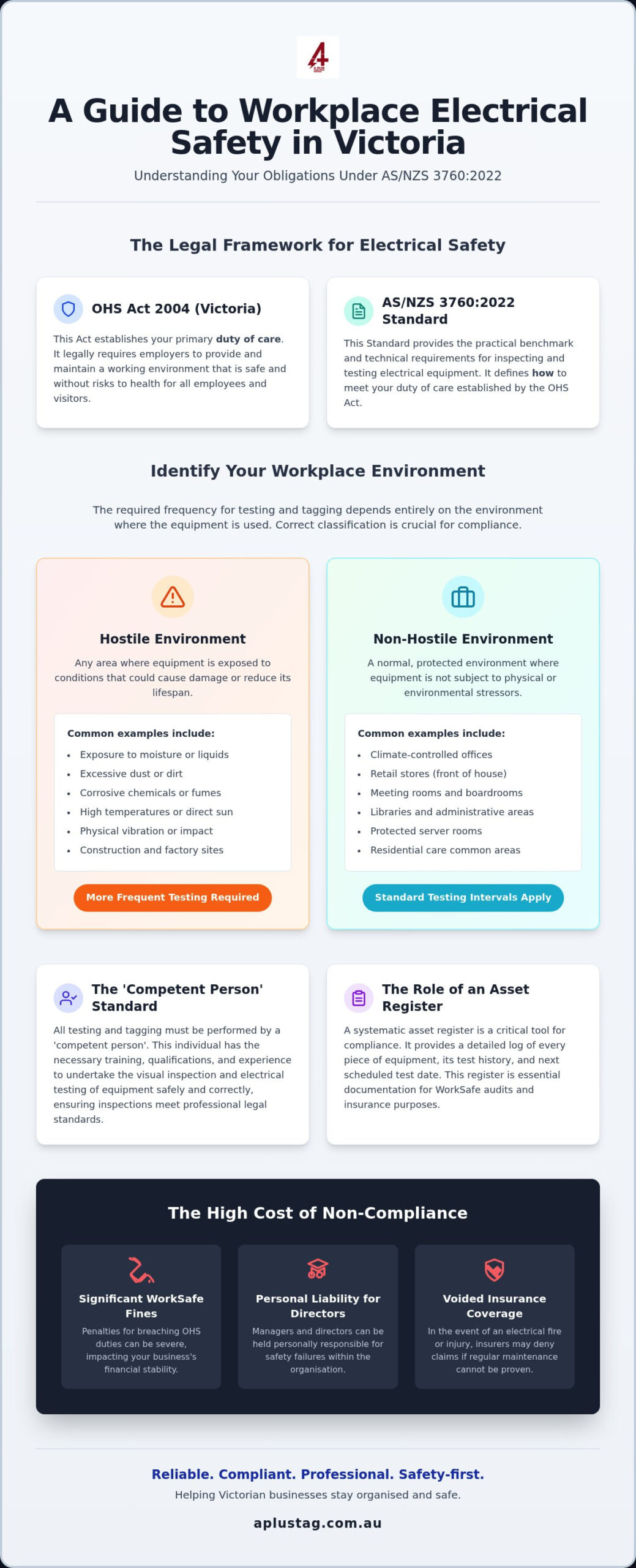
In Victoria, the responsibility for electrical safety rests squarely with the employer. The Occupational Health and Safety Act 2004 establishes a broad duty of care, requiring you to maintain a working environment that is safe and without risks to health. While the Act provides the legal mandate, the specific test and tag requirements victoria organisations must adhere to are found within Australian Standards. It’s essential to recognise that compliance isn’t just about a sticker; it’s a systematic risk-management process that ensures every electrical asset is fit for use.
Compliance hinges on the legal concept of being “reasonably practicable.” This requires you to assess the likelihood of a hazard and the degree of harm that could result, then balance this against the availability and suitability of ways to eliminate the risk. Because electrical faults are often invisible and potentially fatal, a regular testing and tagging schedule is regarded as a fundamental, cost-effective precaution. It demonstrates that you’ve taken active steps to mitigate known hazards before they lead to an incident.
Neglecting these cycles carries heavy consequences. Beyond the immediate danger to staff, non-compliance can lead to significant WorkSafe fines and personal liability for directors. Insurance companies frequently require proof of regular maintenance. Without a valid asset register, your business may find its coverage voided in the event of an electrical fire or injury, leaving you exposed to the full cost of damages and litigation.
Employer Duties Under the OHS Act
Victorian law dictates that you are responsible for any electrical equipment under your management and control. This duty extends to providing safe systems of work for every employee and visitor on your premises. By implementing Portable Appliance Testing (PAT), you establish a clear, documented record of safety diligence. This proactive approach transforms safety from a vague concept into a verifiable system that protects both your people and your legal standing during an audit.
The Role of AS/NZS 3760:2022
AS/NZS 3760:2022 is the primary benchmark for electrical compliance in Australia. This standard covers a wide range of equipment, from common office laptops and kitchen kettles to industrial flexible cords and portable RCDs. The 2022 update introduced more precise requirements for testing frequencies and clarified the role of the competent person, ensuring that safety protocols keep pace with modern electrical designs. Adhering to this standard ensures that every piece of equipment is systematically checked for insulation integrity, earthing continuity, and physical damage. Establishing a clear understanding of these laws is the first step toward a compliant workplace, allowing you to move from uncertainty to organized control.
Identifying Your Workplace Environment: Hostile vs. Non-Hostile
Determining how often you need to inspect your equipment depends entirely on the conditions where that equipment is used. The test and tag requirements victoria enforces are not a one-size-fits-all solution; they are designed to scale with the level of risk present in your specific workplace. A piece of machinery on a vibrating factory floor faces far greater wear than a desktop computer in a climate-controlled office, and your testing schedule must reflect that reality. Understanding these distinctions is the only way to ensure your safety system is both effective and legally sound.
A hostile environment is defined by conditions that are likely to result in damage to the equipment or a reduction in its expected life span. This includes exposure to moisture, heat, dust, corrosive chemicals, or physical vibration. Following the Safe Work Australia electrical safety guidelines, these high-risk areas require more frequent intervention. Regular inspections ensure that small faults, such as a frayed lead or a cracked casing, don’t escalate into life-threatening hazards or fire risks.
Conversely, a non-hostile environment is one where the equipment is not subject to these stressors. However, even in these settings, a “set and forget” mentality is a dangerous compliance risk. Dust buildup inside a stationary printer or a pinched cord behind a heavy desk can still lead to failure over time. Correctly identifying these zones is vital to meeting test and tag requirements victoria standards without over-servicing low-risk areas, allowing you to allocate your safety budget where it is needed most.
Examples of Hostile Environments in Victoria
Victoria’s diverse industries present several common hostile scenarios. Commercial kitchens are a prime example, where high moisture levels and intense heat can quickly degrade electrical insulation. Manufacturing floors also fall into this category, as power leads are often subject to frequent movement, abrasion, or being stepped on by heavy foot traffic. Outdoor workshops and construction sites are perhaps the most obvious, where equipment is constantly exposed to the elements and rough handling.
Non-Hostile and Low-Risk Settings
Standard office environments, retail spaces, and some professional consulting rooms are typically classified as non-hostile. In these settings, equipment like monitors and stationary printers remains in a fixed, protected position. Under the AS/NZS 3760:2022 standard, some of these assets may fall under the “5-year rule,” meaning they only require testing every 60 months. This interval only applies if the equipment is not moved and the environment is truly low-risk.
Misclassifying a hostile area as low-risk can lead to severe liability if an accident occurs. If you aren’t certain how to categorise your specific site, a professional assessment from A Plus Compliance Services can provide the clarity needed to keep your team safe and your business compliant.
Who Can Test and Tag? The ‘Competent Person’ Standard
A common misconception regarding test and tag requirements victoria is that any staff member with a basic understanding of electricity can perform the inspections. In reality, the AS/NZS 3760:2022 standard is very specific about the “Competent Person” requirement. This individual must possess the necessary practical and theoretical knowledge, usually acquired through a combination of training, skills, and experience. In Victoria, this is typically evidenced by a Statement of Attainment for the skill set UEESS00174, which covers the electrical safety testing of cord-connected equipment.
Choosing the right person for the task is a critical step in your risk management strategy. While some businesses consider training an internal staff member to save on costs, this often leads to hidden expenses. You must account for the time lost from their primary role, the ongoing cost of purchasing and calibrating specialized testing equipment, and the risk of a non-compliant audit if their documentation is incomplete. A professional technician doesn’t just apply a tag; they provide a methodical verification of your safety systems that an internal employee might lack the experience to deliver.
Accuracy depends heavily on the tools being used. Professional testing devices require regular calibration to ensure they are providing precise readings for earth continuity and insulation resistance. If your internal testing equipment is out of calibration, your entire safety record could be called into question during an investigation. Following the WorkSafe Victoria electrical safety guidelines, employers must ensure that the individual conducting these tests has the necessary training and tools to do so accurately. This third-party verification offers a much higher level of liability protection, as it provides an unbiased, expert account of your workplace safety status.
Skills and Knowledge Requirements
A competent person must be able to distinguish between Class I (earthed) and Class II (double insulated) equipment, as each requires a different testing protocol. They must also be proficient in visual inspections, which is where approximately 80% of electrical faults are identified. This involves checking for damage to the outer casing, frayed cords, and signs of overheating. Beyond the physical check, they must know how to interpret the numerical data from their testing unit to spot subtle failures that could lead to a future incident.
The Value of Professional Compliance Services
Outsourcing your safety checks to a dedicated partner eliminates the productivity losses associated with DIY testing. Professional services provide comprehensive compliance reporting and asset registers that are often far more detailed than what internal staff can produce. This systematic documentation acts as your primary defence in the event of a WorkSafe audit. Having a dependable ally manage the entire cycle ensures that no re-testing dates are missed, allowing you to focus on your core business while maintaining a state of organized control over your electrical assets.
Managing Compliance: Asset Registers and Re-testing Intervals
WorkSafe inspectors don’t just look for tags on power cords. They look for the system that produced them. A robust asset register is your primary defence during an audit, acting as the “source of truth” for your safety diligence. While physical tags provide a quick visual reference for staff, the register provides the deep documentation required to prove you are meeting test and tag requirements victoria standards. This document transforms a collection of individual checks into a managed safety programme, ensuring that no piece of equipment is overlooked as it moves through its lifecycle.
Managing the lifecycle of a tag requires a proactive approach. It begins with an initial inspection and the assignment of a unique identifier, followed by recording the specific electrical values of the device. As the “Next Test Due” date approaches, your system should trigger a re-test. This cycle continues until the asset is retired or fails a test, at which point it must be immediately removed from service and recorded as such in the register. This systematic management leads to a state of organised control, reducing the risk of accidental use of faulty equipment.
The Components of a Robust Asset Register
To be effective, your asset register must go beyond a simple checklist. Every entry should include a unique asset ID number, the location of the equipment, and the name of the competent person who performed the test. Crucially, it should record detailed test results, such as earth leakage and insulation resistance values, rather than just a “pass” or “fail.” Having clear re-test dates allows you to plan inspections well in advance, ensuring minimal workplace disruption. You can secure these detailed records through professional compliance reporting and asset registers that simplify your long-term documentation needs.
Standard Testing Intervals by Industry
The frequency of your testing is dictated by the environment risk level, as established in the AS/NZS 3760:2022 standard. Construction and demolition sites operate under the strictest test and tag requirements victoria prescribes, requiring a three-monthly cycle. For 2026, these sites follow specific colour codes: Red (December to February), Green (March to May), Blue (June to August), and Yellow (September to November). Factories and warehouses typically require testing every six to 12 months due to the higher likelihood of equipment wear and tear.
In contrast, corporate offices and retail settings often follow a 12-month interval for equipment in high-use areas, such as shared kitchen appliances or flexible desk leads. For truly low-risk, stationary equipment like desktop computers, the interval may extend to five years. However, this five-year rule only applies if the environment remains non-hostile and the equipment is not moved. Maintaining a clear schedule across these varied intervals is essential for staying compliant and keeping your insurance coverage valid.
Streamlining Your Safety Obligations with A Plus Compliance
Achieving full compliance doesn’t have to be a logistical burden for your business. While understanding the test and tag requirements victoria mandates is the first step, implementing a systematic maintenance programme is what ensures long-term safety. A Plus Compliance Services acts as a dependable partner, transforming complex regulatory obligations into a streamlined, predictable cycle. By centralising your safety checks, you move away from reactive fixes toward a state of organised control, allowing your team to work with confidence and security.
Our approach goes beyond simply attaching a tag to a cord. We provide a methodical verification of your entire electrical environment, ensuring that every safety layer is functional and documented. This proactive management style minimises workplace disruption, as we coordinate inspections to suit your operational needs. Whether you are managing a single retail site or a sprawling industrial facility, having a knowledgeable ally to oversee your re-testing dates ensures that no asset ever falls through the cracks, protecting you from both physical hazards and legal liability.
Comprehensive Safety Solutions
Electrical safety is a multi-faceted discipline that requires more than just appliance checks. Residual Current Device (RCD) testing is a vital companion to tagging, as these safety switches are your primary defence against electric shock. We integrate RCD trip-time testing into your regular schedule to ensure they react instantly during a fault. Our comprehensive service also includes:
- Emergency and Exit Light Testing: Ensuring clear passage during power failures or evacuations.
- Fire Extinguisher and Fire Blanket Testing: Verifying that your first-response equipment is ready for immediate use.
- Microwave Radiation Testing: Checking for harmful leakages in staff kitchen areas to protect employee health.
- Workplace First Aid Kit Servicing: Maintaining essential supplies to meet your OHS obligations.
Switchboard Thermal Imaging: The Proactive Edge
One of the most effective ways to prevent electrical fires is through switchboard thermal imaging. Thermal imaging identifies faults invisible to the naked eye by detecting heat signatures emitted by failing components. This technology allows our technicians to spot loose connections, overloaded circuits, or imbalanced loads before they escalate into a fire or a costly equipment failure. It is a non-invasive process that provides a high level of transparency regarding the health of your infrastructure.
The primary benefit of thermal imaging is that it requires zero power shutdowns. We can assess your switchboards while they are under normal load, meaning there is no impact on your business productivity. This proactive edge is essential for identifying hidden risks that standard test and tag requirements victoria checks might not uncover. By identifying “hot spots” early, you can schedule minor repairs during planned maintenance windows rather than dealing with an unexpected and expensive emergency breakdown. This methodical approach ensures your facility remains safe, compliant, and fully operational year-round.
Securing Your Workplace with Systematic Compliance
Maintaining safety in a Victorian workplace requires more than a casual glance at your power leads. By identifying your specific environmental risks and adhering to the AS/NZS 3760:2022 standards, you transform a legal obligation into a robust shield for your employees and your assets. A systematic approach to test and tag requirements victoria ensures that your business remains audit-ready while preventing the hidden risks of electrical failure. Accurate record-keeping and regular testing cycles are the foundations of a safe, well-regulated facility.
Our expert technicians serve businesses across Victoria, providing a level of detail that goes far beyond a simple sticker. We specialise in switchboard thermal imaging to detect faults invisible to the naked eye and provide comprehensive asset registers with every service to simplify your long-term documentation. Ensure your business is fully compliant with A Plus Compliance Services and experience the clarity that comes from a professional safety partnership. It’s time to move toward a state of organised control and let our methodical team manage the complexities of your compliance cycle for you.
Frequently Asked Questions
Is testing and tagging a legal requirement in Victoria?
Yes, testing and tagging is a primary method for fulfilling your legal duty of care under the Occupational Health and Safety Act 2004. While the Act doesn’t explicitly name “test and tag,” it mandates that employers provide a safe working environment. WorkSafe Victoria enforces compliance with the AS/NZS 3760:2022 standard as the benchmark for meeting these safety obligations.
How often do I need to test and tag my office equipment?
Standard office equipment typically requires testing every 12 months in areas where leads are subject to regular movement or flex. For stationary equipment in low-risk, non-hostile environments, the interval can be extended to five years. This extension only applies if a risk assessment confirms the environment won’t cause damage or excessive wear to the electrical assets.
What happens if a piece of equipment fails the test?
Any equipment that fails an inspection must be withdrawn from service immediately to eliminate the risk of electric shock or fire. The technician will apply a “Danger” or “Caution” tag to the item and record the failure in your asset register. You must then arrange for a qualified professional to repair the fault or dispose of the item safely.
Do new electrical items need to be tagged before use in Victoria?
New electrical items don’t strictly require a formal test before their first use if they are “new to service” from the manufacturer. However, test and tag requirements victoria dictate that you should visually inspect the item for damage and apply a “New to Service” tag. This tag establishes the date the item entered the workplace and sets the schedule for its first re-test.
Who is authorised to perform test and tag services in a workplace?
Testing must be conducted by a “Competent Person” who possesses the necessary training, skills, and experience. In Victoria, this is typically someone who has completed the UEESS00174 skill set and holds a Statement of Attainment. They must also use calibrated testing equipment to ensure that every result is accurate and meets the test and tag requirements victoria demands for legal compliance.
Do I need to keep a record of all my tested equipment?
Yes, maintaining a detailed asset register is essential for proving your compliance during a WorkSafe audit or insurance claim. This record should include the unique asset ID, the test date, the specific results of the inspection, and the name of the person who performed the test. Systematic documentation ensures you have a verifiable history of your workplace safety diligence.
What is the difference between Class I and Class II appliances?
Class I appliances rely on a protective earth connection for safety and are typically identified by a three-pin plug and metal casing. Class II appliances are double-insulated and don’t require an earth wire to protect the user from faults. Technicians use different testing protocols for each class to accurately measure insulation resistance and earth continuity according to the Australian Standard.
Does a home office need to meet Victorian test and tag requirements?
The Victorian OHS Act applies to any location where work is being performed, including home offices. If you’re an employer with staff working remotely, you’re responsible for ensuring the electrical equipment they use for work is safe. Implementing a regular testing schedule for home-based equipment is a practical way to manage this duty and protect your employees from electrical hazards.
