Biomedical Equipment Safety Testing: The 2026 Guide to Clinical Compliance in Victoria
Did you know that by 20 March 2026, the voluntary reporting period for medical device adverse events officially ends, making mandatory reporting the new standard for Victorian healthcare facilities? This regulatory shift highlights the critical role of regular biomedical equipment safety testing in maintaining a defensible safety record. Managing a busy clinical environment is already demanding, and we understand the pressure of ensuring that hundreds of specialised assets, from diagnostic tools to life-support gear, are verified and safe for every patient procedure.
You probably agree that the complexity of medical standards can feel overwhelming compared to general electrical tagging. This guide simplifies the path to clinical compliance, helping you master the requirements of AS/NZS 3551 and stay ahead of the 2026 regulatory changes. We’ll explore how to establish a clear asset register, navigate the implementation of the Unique Device Identification (UDI) system, and maintain safety with minimal disruption to your daily operations. By the end, you’ll have a practical framework to ensure your facility remains organised, compliant, and audit-ready at all times.
Key Takeaways
- Understand the critical differences between general electrical tagging and the specialised requirements of AS/NZS 3551 for medical electrical devices.
- Learn how detailed asset registers and professional reporting simplify the audit process for healthcare facility managers across Victoria.
- Discover how biomedical equipment safety testing utilising the Rigel 288+ analyser ensures precise Earth Bond and Insulation measurements for patient-critical gear.
- Identify the specific testing needs for diverse clinical environments, ranging from GP surgeries to specialised DEXA and KYM rooms.
- Gain confidence in your facility’s safety by moving from reactive maintenance to a proactive, long-term compliance partnership.
Understanding Biomedical Equipment Safety Testing in Australia
Biomedical equipment safety testing is a specialised verification process designed for medical electrical devices used in clinical settings. Unlike general workplace appliances, medical gear often comes into direct contact with patients, sometimes involving invasive procedures or life-support functions. The core objective of this testing is to ensure both patient and operator safety by verifying that every device performs within strict electrical and functional parameters.
At A Plus Compliance Services, we adopt a safety-first approach for Victorian medical centres. We understand that in a healthcare environment, “good enough” isn’t an option. Our process involves systematic inspection and testing to identify potential faults before they lead to equipment failure or clinical incidents. By maintaining a steady, dependable presence, we help facility managers simplify complex requirements and focus on patient care.
Why Standard Test and Tag Isn’t Enough for Medical Gear
Many facility managers ask why they can’t use standard commercial test and tag protocols. While AS/NZS 3760 is suitable for office kettles and printers, it doesn’t account for the unique risks associated with medical devices. For example, a standard PAT tester cannot measure the minute leakage currents that could be fatal to a patient in a vulnerable state. The increased risk profile of equipment in direct contact with patients demands a higher level of scrutiny.
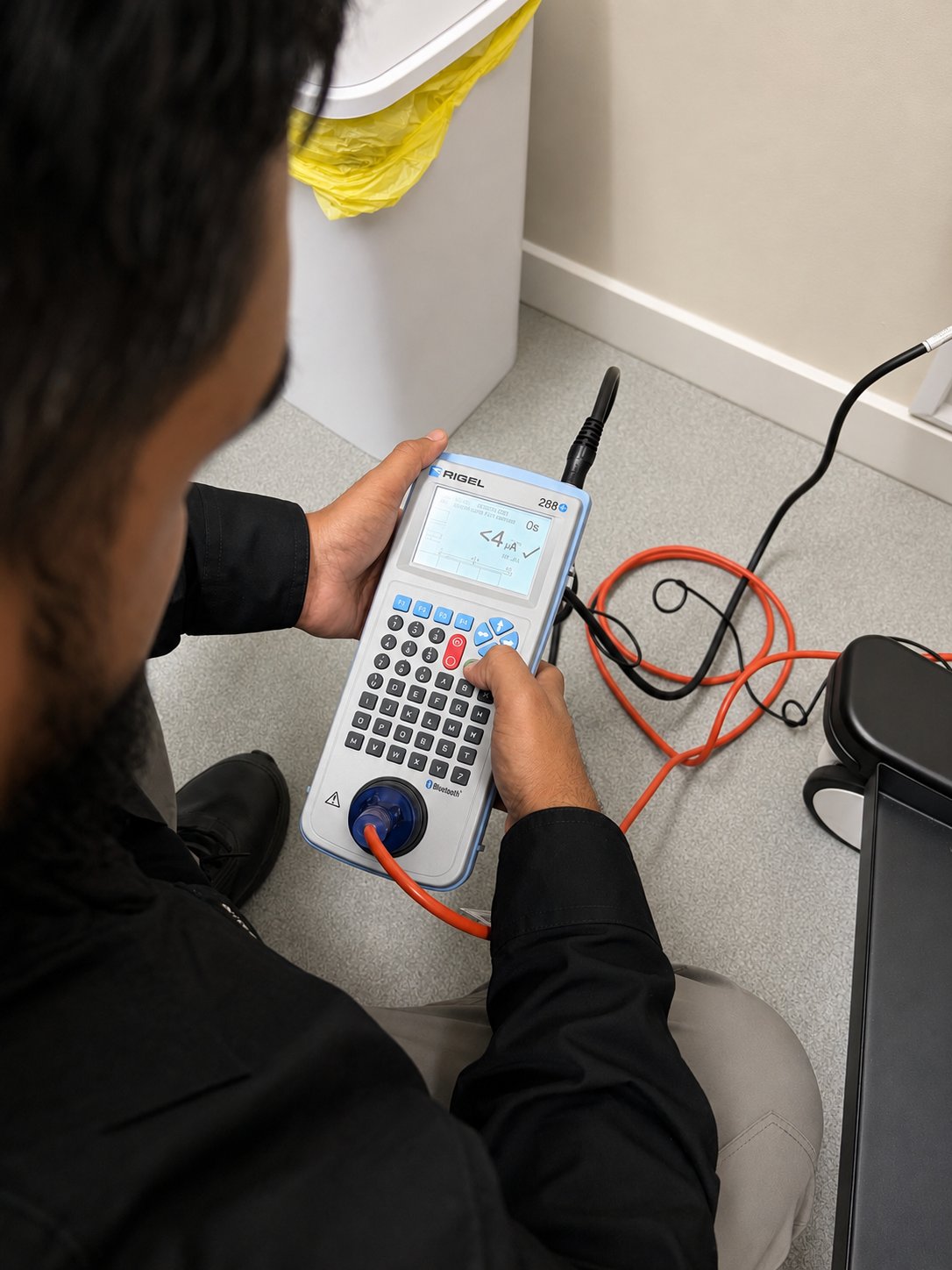
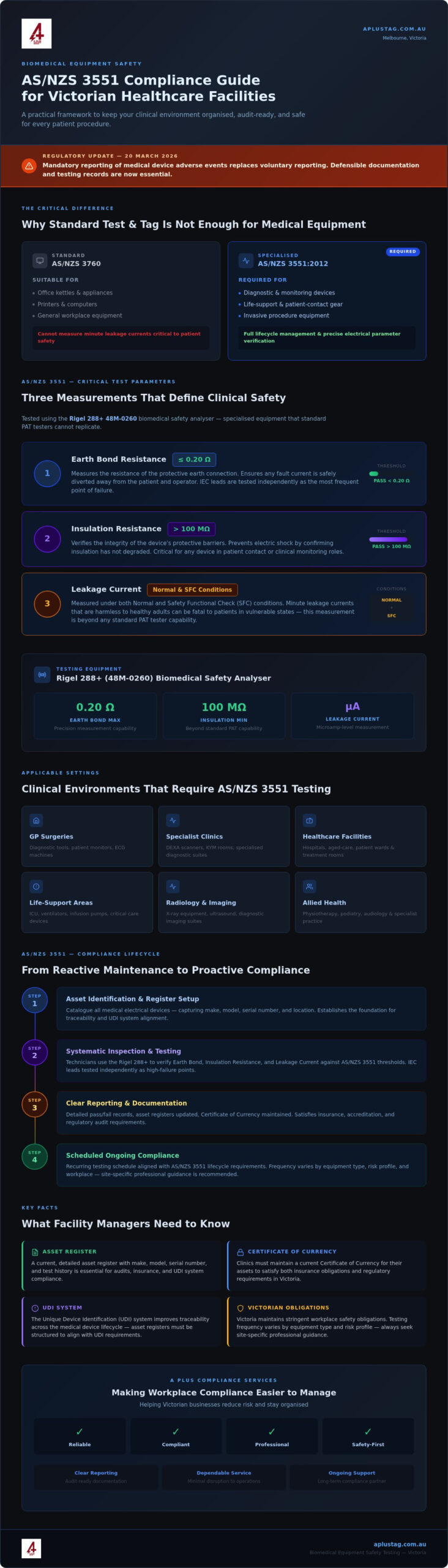
To meet these requirements, we use specialised analysers such as the Rigel 288+ 48M-0260. This equipment allows our technicians to verify that Earth Bond limits do not exceed 0.20 Ω and that Insulation resistance remains above 100 MΩ. These precise measurements are vital for patient safety but are beyond the capabilities of standard PAT testers. Additionally, clinics must maintain a current Certificate of Currency for their assets to satisfy insurance and regulatory requirements.
The Role of AS/NZS 3551 in 2026 Compliance
The primary standard governing this field is AS/NZS 3551:2012. It outlines the management and routine testing of medical devices throughout their entire lifecycle. Following Biomedical engineering principles, this standard treats compliance as a recurring cycle rather than a one-off event. It requires regular intervals of inspection to ensure ongoing reliability and accuracy of diagnostic gear.
In Victoria, workplace safety obligations are stringent. As we move into 2026, professional biomedical equipment safety testing ensures that your documentation and traceability meet the highest standards. Staying compliant requires a detailed understanding of how each device fits into the clinical workflow. Our specialised services help Victorian businesses reduce risk and stay organised by aligning their maintenance schedules with these rigorous standards.
The Technical Standard: AS/NZS 3551 Parameters and Procedures
Precision is the hallmark of effective biomedical equipment safety testing. To achieve a “Pass” result, every device must meet strict thresholds defined by the AS/NZS 3551 standard. Our technicians utilise the Rigel 288+ 48M-0260 biomedical safety analyser to capture these data points, ensuring each asset is verified against clinical safety benchmarks. This methodical approach provides facility managers with the documented evidence required for safety audits and accreditation.
Earth Bond testing measures the resistance of the protective earth connection, which must remain at or below 0.20 Ω to ensure a safe path for fault current. Beyond the main unit, we pay close attention to IEC leads, as these are often the most frequent point of failure in medical setups. These detachable power cables are subject to constant movement and physical strain, which can compromise internal wiring. Testing these leads independently is a vital step in preventing unexpected equipment downtime and ensuring the entire electrical chain remains secure.
Key Test Measurements Explained
Compliance is determined by three primary electrical measurements that safeguard both clinicians and patients. First, the Earth Bond limit of 0.20 Ω ensures that any fault current is safely diverted away from the user. Second, Insulation Resistance must exceed 100 MΩ to prevent electric shock by confirming the integrity of the device’s protective barriers. Finally, we measure Leakage Current under both Normal and Safety Functional Check (SFC) conditions. This dual-state verification aligns with pre-clinical testing and regulatory considerations, identifying potential risks that standard commercial testing might overlook.
Class I vs Class II Medical Equipment
Medical devices are categorised based on their construction and protection methods, requiring different testing methodologies. Class I equipment, such as DEXA body scanners, relies on a protective earth connection for safety. In contrast, Class II equipment, like Lenovo adaptors for medical PCs, uses double insulation and does not require an earth wire. Because Class II devices lack an earth path, our testing methodology shifts to focus primarily on insulation integrity and leakage current.
Understanding these distinctions is essential for maintaining an accurate asset register and ensuring every piece of gear receives the correct level of scrutiny. If you’re unsure which category your clinic’s assets fall into, you can speak with our team to arrange a site-specific assessment. Our specialised services are designed to make workplace compliance easier to manage while ensuring your facility stays organised and audit-ready.
Clinical Environments: From GP Surgeries to Patient Areas
Clinical environments in Victoria vary significantly, from local GP surgeries to large-scale aged-care facilities. Each setting demands a specific strategy for biomedical equipment safety testing to ensure patient safety and operational continuity. In specialised spaces like DEXA rooms, KYM rooms, and Astha rooms, the density of electronic diagnostic gear requires a methodical verification process. We manage a diverse range of assets, ensuring everything from OMRON blood pressure machines to Welch Allyn examination lights meets the rigorous standards of AS/NZS 3551. For a deeper look at specific equipment categories, refer to our comprehensive Biomedical Devices guide.
Managing hundreds of assets with different testing intervals can be a logistical challenge for facility managers. Whether you are operating a private clinic in Melbourne or a regional hospital, keeping equipment verified is a key part of your risk management strategy. We focus on being a steady, dependable presence that simplifies these requirements, allowing your clinical staff to focus on patient outcomes without the fear of equipment failure during a procedure.
AS/NZS 3003 and Patient Area Testing
While AS/NZS 3551 focuses on individual devices, AS/NZS 3003 governs the electrical installations in the rooms where these devices are used. These spaces are classified as Body Protected or Cardiac Protected areas based on the clinical procedures performed. Area certification is a necessary complement to equipment testing, as it ensures the entire electrical environment is safe for patient contact. This includes verifying treatment plinths, such as Healthtech or Omega E models, which must be correctly earthed to prevent micro-shocks. Maintaining this dual level of compliance provides the highest degree of safety for both patients and clinicians.
Sector-Specific Compliance: Dental, Vet, and Medical
Compliance requirements often differ across sectors. Dental practices, for instance, must account for the high-use cycle of autoclaves and specialised imaging gear. Veterinary surgeries face similar challenges, requiring precise calibration to ensure safety for animal patients. For larger healthcare groups across Victoria, we provide multi-site coordination to keep all facilities on a unified schedule. This proactive approach helps reduce risk and keeps your organisation audit-ready throughout the year.
Our goal is to provide a stress-free experience with minimal disruption to patient care. We act as a dependable partner, helping Victorian businesses stay organised through scheduled maintenance and clear reporting. Whether you manage a single surgery or a network of healthcare hubs, our specialised services ensure your facility remains compliant and safe. If you need to discuss a compliance schedule for your site, our team is available to provide professional guidance tailored to your specific workplace requirements.
Managing Your Medical Asset Register and Compliance Reporting
A comprehensive Asset Register is the foundation of any audit-ready healthcare facility. Rather than just a list of equipment, it serves as a live document that simplifies the audit process for facility managers. By centralising data, you can quickly demonstrate that every device has undergone biomedical equipment safety testing according to the required schedule. This level of transparency is essential for meeting Victorian workplace safety obligations and ensuring long-term order. Our goal is to help Victorian businesses reduce risk and stay organised by providing a clear, defensible history for every asset on site.
Tracking hundreds of items across multiple rooms or sites requires a systematic approach. Each device is assigned a unique Asset ID, allowing for precise tracking over several years. This documentation is vital for identifying recurring issues with specific equipment types or brands, helping you make informed decisions about future asset replacements. We focus on making workplace compliance easier to manage by delivering data in a format that is ready for immediate presentation to auditors or health department officials.
The Anatomy of a Biomedical Test Report
Clear reporting is a core brand message for us because data is only useful if it’s accessible and accurate. A professional report from A Plus Compliance Services includes the unique Asset ID, detailed device comments, and the specific measured values captured by the Rigel 288+ analyser. We record precise values like Live Voltage (235 V) and Neutral Voltage (0 V) to verify the power supply integrity during the procedure. If a device fails to meet the standard, any corrective actions are documented immediately to provide a complete safety trail. These results are certified by our Bio Med Engineer, Haris Haneefa, providing expert verification that your gear meets the AS/NZS 3551 standard.
Automated Due-Date Reminders and Recurring Support
Compliance is a recurring cycle, not a one-off event. For equipment tested during our 2026 schedule, the next review cycle is typically due by 7 May 2027, though exact requirements vary based on the workplace, equipment type, and risk assessment. We help Victorian businesses stay organised by managing these timelines through automated due-date reminders and proactive multi-site scheduling. This approach prevents compliance lapses and ensures your facility is always prepared for an unannounced inspection. Effective Compliance Monitoring allows you to focus on patient care while we handle the technical documentation and scheduling.
Securing a Reliable Biomedical Compliance Partner in Victoria
Choosing a partner for biomedical equipment safety testing is about more than just finding a technician; it’s about securing a long-term ally for your facility’s safety. A one-off contractor might tick a box, but a dependable partner ensures your compliance cycle is never interrupted. From the medical hubs in St Kilda to the expanding healthcare centres in Dandenong, Victorian facilities require a partner who understands the local landscape and the rigorous demands of AS/NZS 3551. We position ourselves as that essential ally, providing the steady presence needed to simplify complex requirements.
Our approach is grounded in being “Reliable. Compliant. Professional. Safety-first.” We focus on helping Victorian businesses reduce risk and stay organised through clear reporting and dependable service. By choosing a partner who values long-term relationships over quick transactions, you gain the confidence that your life-support and diagnostic gear is always verified and audit-ready.
Why Choose A Plus Compliance Services?
We prioritise safety and professionalism in every interaction. Our technicians understand that clinical environments operate on tight schedules where patient care is the absolute priority. We work around your site operations to ensure minimal clinical downtime, performing tests efficiently without compromising on the depth of the verification. This methodical approach creates a narrative of efficiency and predictability for your facility. Our expertise isn’t limited to medical gear; we provide a holistic compliance strategy that includes our Test and Tag Services, allowing you to manage all electrical safety requirements through a single, trusted provider.
Steps to Arrange Your Next Compliance Audit
Organising your next biomedical equipment safety testing audit is a straightforward, methodical process. From our Melbourne headquarters, we provide a Victorian-wide service that begins with a detailed discussion of your specific facility needs. Once we understand your asset count and environment type, we coordinate a booking that fits your clinical schedule. Following the testing, you receive a comprehensive report and a Certificate of Currency, which are essential for your accreditation and insurance records.
Clear reporting, dependable service and ongoing compliance support are the hallmarks of our partnership. If you manage multiple facilities or require a recurring program tailored to your site, we invite you to request a quote or arrange a site assessment with our team. We’re here to help you move from a state of potential uncertainty to a state of organised control, ensuring your facility remains safe for every patient procedure.
Future-Proofing Your Clinical Compliance in Victoria
Mastering the complexities of AS/NZS 3551 ensures your facility remains safe and audit-ready as regulatory requirements evolve into 2026. By implementing a systematic approach to biomedical equipment safety testing, you move from reactive maintenance to a state of organised control. We utilise the specialised Rigel 288+ biomedical safety analyser for all clinical tests, providing the precise Earth Bond and Insulation measurements needed for a defensible asset register. This transparency helps Victorian businesses reduce risk and stay organised while maintaining an absolute focus on patient outcomes.
Maintaining a safe clinical environment is a long-term commitment that requires technical precision and steady documentation. We’re here to act as your dependable partner, providing clear reporting, professional support, and a “Safety-first” approach every step of the way. Whether you manage a local GP surgery or a large aged-care network, we’ll help you stay compliant and professional. Let’s work together to ensure your gear is verified and your facility is prepared for any audit.
Staying ahead of compliance deadlines shouldn’t be a source of stress. With the right verification partner, you can ensure your equipment performs reliably and your facility meets every Victorian standard with confidence.
Frequently Asked Questions
How often does biomedical equipment need safety testing in Australia?
Testing intervals for biomedical equipment aren’t fixed for every device; they depend on the specific environment, equipment type, and your clinic’s risk-management procedures. While some assets require annual verification, others might need more frequent checks based on manufacturer requirements or clinical use. We recommend obtaining site-specific professional guidance to establish a compliant schedule. A Plus Compliance Services provides automated reminders to ensure your Victorian facility never misses a necessary review cycle.
What is the difference between AS/NZS 3551 and AS/NZS 3760?
AS/NZS 3551 is the specialised standard for the management and routine testing of medical electrical equipment in clinical settings. In contrast, AS/NZS 3760 covers general portable appliances like office kettles or printers. General testing isn’t an acceptable alternative for ensuring the clinical safety of medical devices. Medical gear requires specific parameters, such as leakage current and earth bond limits of ≤ 0.20 Ω, which are verified using specialised analysers like the Rigel 288+.
What happens if a piece of medical equipment fails its safety test?
If a device fails its verification, it’s clearly identified and recorded in your compliance report so it can be removed from service immediately. We provide detailed asset reporting that highlights why an item didn’t meet the required threshold. Once a failed item is repaired or replaced, it must be reassessed before being introduced back into the clinical environment. This process ensures that only verified, safe equipment is used during patient procedures in your facility.
Can biomedical testing be performed outside of normal clinic hours?
Yes, we can arrange for testing to be completed outside your normal operating hours to minimise disruption to patient care. We understand that busy Victorian clinics and hospitals need a dependable partner who works around their clinical schedule. Our technicians coordinate with facility managers to find the most suitable time for access, ensuring that biomedical equipment safety testing is performed thoroughly without impacting your daily operations or treatment rooms in Melbourne.
Is a biomedical safety certificate the same as an insurance Certificate of Currency?
No, a biomedical safety certificate is a document verifying that specific medical assets have passed electrical safety testing; it’s not an insurance Certificate of Currency. While it serves as essential evidence for safety audits and accreditation, it only applies to the biomedical equipment and associated leads recorded in the nominated report. You should maintain both your safety certificates and your insurance documentation to ensure full regulatory and operational compliance for your healthcare business in Victoria.
Does my clinic need ‘Patient Area’ testing as well as equipment testing?
Yes, patient area testing under AS/NZS 3003 is a necessary complement to individual equipment verification. This standard governs the electrical installations in treatment rooms, classifying them as Body Protected or Cardiac Protected areas. Ensuring the room itself is safe provides an extra layer of protection for patients undergoing procedures. A Plus Compliance Services can help you manage both equipment and area testing to ensure your entire clinical environment meets Victorian safety obligations and standards.
What specific medical devices are covered under AS/NZS 3551?
AS/NZS 3551 covers a wide range of medical electrical equipment, including Class I earthed devices and Class II double-insulated devices. Common examples include DEXA body scanners, OMRON blood pressure machines, Welch Allyn examination lights, and treatment plinths from brands like Healthtech or Omega E. The standard also applies to the IEC leads that power these assets. Every device that comes into contact with a patient or operator in a clinical setting should be included in your program.
Who is qualified to perform biomedical equipment safety testing in Victoria?
Biomedical equipment safety testing must be performed by a competent person with the specialised technical knowledge required to interpret AS/NZS 3551. At A Plus Compliance Services, our tests are conducted by experienced professionals, such as our Bio Med Engineer, Haris Haneefa. Using the Rigel 288+ analyser, our technicians provide the expert verification needed to ensure your diagnostic and life-support gear is safe, helping Victorian healthcare providers stay organised and reduce clinical risk effectively.
