Fire Equipment Inspection: Victorian Compliance Guide 2026
Your fire safety strategy is only as effective as your last fire equipment inspection. While it’s easy to view compliance as a bureaucratic hurdle, the reality is that properly maintained extinguishers, blankets, and exit lights are the primary line of defence for your Victorian workplace. You likely understand the pressure of keeping track of varying testing intervals and the fear of missing a critical date before an audit occurs.
To remain legally compliant in Victoria, businesses must adhere to the Building Regulations 2018 and maintenance standards like AS 1851:2012, which require regular 6-monthly and annual servicing. This guide explains these essential requirements for 2026 to ensure your site remains safe and audit-ready. We’ll explore specific maintenance cycles and the documentation needed for your Annual Essential Safety Measures Report (AESMR), helping you manage your safety obligations with confidence and minimal stress.
Key Takeaways
- Understand your legal obligations under Victorian legislation and the role of Essential Safety Measures in maintaining workplace safety.
- Learn why a professional fire equipment inspection is critical for verifying the functionality of portable suppression tools like extinguishers and blankets.
- Identify the standard maintenance intervals and how testing requirements vary based on your specific equipment and workplace risk assessment.
- Discover how clear reporting and digital asset registers help Victorian businesses stay organised and reduce the risk of non-compliance.
- Explore the benefits of a long-term compliance partnership to ensure your safety systems remain up to date with minimal disruption to your operations.
Fire Equipment Inspection Requirements for Victorian Workplaces
A professional fire equipment inspection is a systematic verification process designed to ensure your workplace’s portable suppression tools are fully functional. In Victoria, this goes beyond a simple visual check; it involves a methodical assessment of extinguishers and blankets to confirm they will perform as expected during an emergency. A Plus Compliance Services operates with a “Reliable. Compliant. Professional. Safety-first” mindset, positioning these inspections as a baseline for operational safety rather than a mere administrative hurdle. While avoiding fines is a practical benefit, the primary goal is ensuring your team is protected by equipment that works when it matters most.
The Legal Framework in Victoria
Employer responsibilities in Victoria are primarily governed by the Occupational Health and Safety Act 2004. This legislation mandates that those in control of a workplace must provide and maintain a safe environment, which includes the upkeep of Active fire protection systems. WorkSafe Victoria guidelines expect businesses to follow rigorous maintenance schedules to mitigate risks. Adhering to Australian Standards, such as AS 1851:2012, is the industry-recognised method for meeting these legal obligations. Beyond statutory compliance, maintaining up-to-date service records is often a prerequisite for insurance policies. Failure to demonstrate regular testing can lead to complicated liability issues or the denial of claims following an incident.
Duty of Care for Facility Managers
Facility managers, site supervisors, and business owners are typically classified as the “person in control” of a workplace. This designation carries a significant duty of care to identify potential fire hazards and ensure suppression equipment is accessible and operational. Implementing a regular fire equipment inspection schedule helps Victorian businesses reduce risk and stay organised. It represents a shift from reactive, high-stress repairs to a proactive maintenance model that provides long-term peace of mind.
By integrating these requirements into a broader suite of compliance services, managers can ensure that no testing deadline is missed. This organised approach involves detailed asset registers and clear reporting, making it easier to manage multi-site operations or complex industrial environments. When maintenance is scheduled predictably, it minimises disruption to daily business activities while ensuring the site remains audit-ready and, most importantly, safe for all occupants.
Essential Fire Suppression Maintenance: Extinguishers and Blankets
A Plus Compliance Services focuses on the systematic maintenance of portable suppression tools. A casual visual check by staff might identify a missing unit; however, it doesn’t replace a professional functional test. During a comprehensive fire equipment inspection, technicians verify the mechanical integrity of each device. This process includes checking pressure levels and ensuring the discharge mechanism hasn’t seized over time. Professional tagging provides a clear, visible record of the last test date, which is essential for remaining audit-ready. This methodical approach aligns with Fire Rescue Victoria’s safety guidelines for maintaining a secure commercial environment.
Portable Fire Extinguisher Testing
Each extinguisher type requires specialised technical knowledge during a fire equipment inspection. CO2, Dry Powder, and Wet Chemical units have different pressure requirements and weight tolerances. Technicians check the pressure gauge to ensure it sits within the operative zone and inspect the anti-tamper seal to confirm the unit hasn’t been partially discharged. Weight verification is particularly critical; a loss of weight often indicates a slow leak that could render the extinguisher useless during an emergency. We provide specialised testing for all common extinguisher types found in Victorian commercial sites.
Fire Blanket Inspection Protocols
Fire blankets are vital safety tools, particularly in hospitality and office kitchenettes. An inspection involves more than confirming the container is mounted on the wall. Technicians ensure the blanket is easy to withdraw and free from fraying, contamination, or grease build-up. In a commercial kitchen, a grease-soaked blanket can actually become a fire hazard. We also verify that the instruction label remains legible and that the blanket is installed in a location that doesn’t require the user to reach over a potential fire source to access it.
Clear reporting helps facility managers track equipment health across multiple locations. If you need to verify your current suppression equipment is operational, you can discuss a compliance schedule with our team. This proactive strategy is part of our commitment to helping Victorian businesses reduce risk and stay organised.
Understanding Inspection Intervals and Compliance Standards
Maintaining a safe workplace requires more than just installing equipment; it demands a disciplined schedule of verification. The frequency of a fire equipment inspection is primarily dictated by Australian Standard AS 1851:2012, yet these requirements often vary based on your specific workplace, equipment type, and risk assessment. For instance, a quiet office environment has a different risk profile compared to a high-traffic hospitality venue or a busy warehouse. Because of these variables, obtaining site-specific professional guidance is essential to ensure your schedule meets WorkSafe Victoria’s fire protection requirements. A Plus Compliance Services simplifies this by managing recurring programs, allowing facility managers to focus on their core operations.
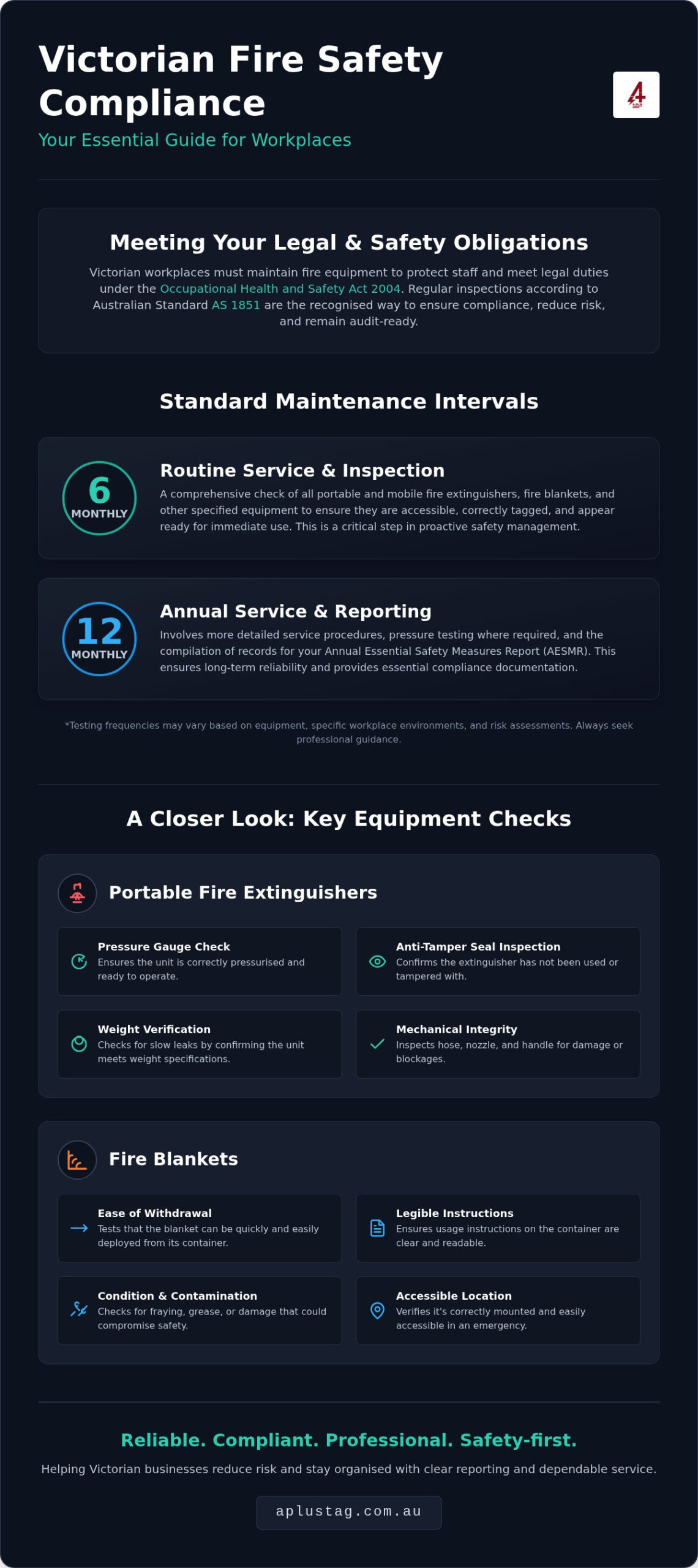
The 6-Month Routine Service
The 6-month routine service acts as a bi-annual health check for your suppression tools. During this visit, technicians perform a visual and functional verification to ensure every unit is in its designated location, remains unobstructed, and shows no signs of external damage. In high-risk environments such as commercial kitchens or industrial sites, equipment is more susceptible to accidental impact or grease accumulation, making these 6-monthly checks vital for safety. Once the inspection is finished, the technician updates the service tag on-site, providing immediate evidence of compliance for any visiting authorities or insurance auditors.
Annual and 5-Yearly Comprehensive Testing
While the 6-monthly check is a robust baseline, the annual inspection is more comprehensive. It involves a deeper assessment of the unit’s mechanical components, seals, and weight to ensure no internal degradation has occurred over the year. Beyond the yearly cycle, most fire extinguishers require a 5-yearly overhaul, which includes hydrostatic testing. This process involves pressure testing the cylinder to confirm it can still safely contain its contents under high pressure without failing.
Managing these multi-year cycles is where many Victorian businesses feel the most pressure. Missing a 5-yearly test can invalidate your compliance status and pose a serious safety risk. A Plus Compliance Services uses automated due-date reminders and detailed asset registers as part of our scheduled maintenance services. By tracking every piece of equipment individually, we ensure that your 12-monthly and 5-yearly obligations are met without you needing to monitor the calendar yourself. This proactive approach is central to making workplace compliance easier to manage.
Managing Compliance Records and Asset Registers
For many Victorian businesses, the physical fire equipment inspection is only half the battle. Making workplace compliance easier to manage truly begins with comprehensive documentation. Without a clear paper trail, even the most diligent maintenance schedule can fail to satisfy a council inspector or an insurance auditor. A digital asset register is particularly valuable for facility managers overseeing large or multi-site operations across Melbourne. It provides a centralised view of every extinguisher and blanket, ensuring no unit is overlooked during a scheduled cycle.
In Victoria, maintaining these records for at least seven years is a standard requirement for Essential Safety Measures (ESM) compliance and general risk management. This long-term data history does more than just tick a legal box; it allows managers to justify safety expenditure to stakeholders by providing concrete evidence of equipment lifecycles and recurring maintenance needs. Organised reporting transforms safety from a hidden cost into a transparent, manageable part of your operational budget.
The Components of a Professional Report
A professional report acts as the definitive record of your site’s safety status. It must include unique asset IDs, precise locations, test results, and the specific details of the attending technician. When an item fails an inspection, it is identified immediately and recorded for removal from service to prevent accidental use. This transparency ensures you always have a current snapshot of your risk profile. You can learn about our compliance reporting services to see how we structure these records for maximum clarity and ease of use.
Preparing for a Fire Safety Audit
Preparing for a fire safety audit should not be a high-stress event. Having an up-to-date asset register simplifies the process significantly, as all required documentation for your Annual Essential Safety Measures Report (AESMR) is already organised and accessible. Clear communication before, during, and after each job ensures that everyone on-site understands the status of their fire protection tools. Victorian businesses trust A Plus Compliance Services to act as a dependable partner that keeps them organised and audit-ready throughout the year. We focus on being proactive, identifying potential issues before they become compliance failures.
Partnering with A Plus Compliance Services in Melbourne
A Plus Compliance Services positions itself as a knowledgeable and supportive expert for Victorian businesses. We understand that managing safety requirements shouldn’t feel like a burden or a source of anxiety during an audit. Our “Reliable. Compliant. Professional. Safety-first” approach ensures that every fire equipment inspection is managed with methodical precision. By acting as an essential ally rather than a distant contractor, we provide clear reporting, dependable service and ongoing compliance support to help you meet your ESM obligations without the stress of missed deadlines or incomplete records.
Service Area and Local Expertise
Headquartered in Scoresby, our local team understands the specific geographic and regulatory needs of Melbourne businesses. We serve suburbs from the CBD to Dandenong and extend our reach across regional Victoria. Our experience is diverse, allowing us to support facility managers in schools, healthcare facilities, aged-care homes, warehouses, and hospitality venues. Each sector has unique risk profiles, and our technicians are trained to provide site-specific professional guidance tailored to your equipment and environment. You can explore our full range of electrical and fire safety services to see how we can consolidate your compliance needs into one organised schedule.
Minimal Disruption to Your Operations
Maintaining a safe environment shouldn’t come at the cost of your business productivity. We specialise in making workplace compliance easier to manage by offering flexible scheduling that respects your daily operations. This includes the ability to perform inspections outside normal operating hours to minimise disruption to your staff and clients. Our team is experienced and methodical; we arrive on time, conduct thorough testing, and provide the transparent documentation you need to stay organised. Helping Victorian businesses reduce risk and stay organised is at the heart of our service delivery, ensuring you move from a state of uncertainty toward organised control.
Our business model is built on routine and precision. We provide automated due-date reminders and detailed asset registers, so you don’t have to monitor the calendar yourself. This proactive management style reinforces our role as a dependable partner that values long-term relationships and consistent performance. Whether you’re managing a single office or a complex industrial site, we offer the steady presence required to maintain a safe and compliant workplace for the long term.
Request a quote or book a site assessment today
Secure Your Victorian Workplace Compliance
Maintaining a safe workplace in Victoria requires more than a one-off check; it demands a systematic approach to risk management. By adhering to the mandatory maintenance cycles for extinguishers and blankets, you ensure that your suppression tools are ready for an emergency and your site remains audit-ready. Clear reporting and digital asset registers are the foundations for making workplace compliance easier to manage, providing the transparency needed for stakeholders and insurance purposes. A professional fire equipment inspection is the most reliable way to verify your equipment’s functionality and protect your team.
A Plus Compliance Services acts as your dependable partner, offering professional, punctual, and safety-first service delivery. We focus on helping Victorian businesses reduce risk and stay organised through clear reporting and ongoing compliance support. Whether you operate a school, warehouse, or hospitality venue, our methodical process minimises disruption while keeping your safety systems up to date. We take pride in simplifying complex requirements so you can focus on your core operations.
Our team is ready to help you simplify your maintenance schedule and provide the peace of mind that comes with professional oversight. We look forward to supporting your long-term safety and compliance goals.
Frequently Asked Questions
How often does fire equipment need to be inspected in Victoria?
Intervals for a fire equipment inspection depend on your specific environment, equipment type, and site risk-management procedures. While Australian Standards generally mandate 6-monthly and annual checks, some high-risk Victorian workplaces may require more frequent verification. A Plus Compliance Services can organise a tailored schedule for your site to ensure you remain compliant with the Building Regulations 2018. Professional guidance is recommended to determine the exact requirements for your facility.
Is fire equipment testing mandatory for small businesses?
Yes, fire safety obligations apply to all Victorian workplaces, including small businesses. Under the Victorian OHS Act 2004, every employer has a duty of care to provide a safe working environment, which includes maintaining functional suppression tools. Whether you operate a small office in Caulfield or a boutique retail shop in St Kilda, regular testing ensures your equipment is operational and helps protect you from potential liability in the event of an emergency.
What happens if a fire extinguisher fails its inspection?
If an item fails, it is clearly identified and recorded in your compliance report. You must immediately remove the failed unit from service to prevent accidental use during an emergency. Once removed, you can arrange for a repair or replacement to restore your site’s safety levels. A Plus Compliance Services documents these failures in your digital asset register, helping you maintain an accurate and transparent history of your workplace safety equipment for future audits.
Do fire blankets have an expiry date?
Fire blankets don’t have a specific pre-printed expiry date, but they must be replaced if they fail a fire equipment inspection. Our technicians check for signs of damage, fraying, or contamination from oils and grease, which are common in hospitality venues. If the blanket is compromised or the instruction label is illegible, it no longer meets safety standards. Regular 6-monthly inspections ensure these vital tools are ready for immediate use in your kitchen or breakroom.
Can testing be completed outside of normal business hours?
Yes, scheduling can be arranged outside of normal business hours to suit your operational needs. We understand that facility managers in sectors like healthcare or hospitality need to minimise disruption to their daily activities. A Plus Compliance Services offers flexible timing for site visits across Melbourne, ensuring your equipment is tested and tagged without interrupting your staff or clients. This proactive approach helps your organisation stay organised while maintaining a high standard of safety.
What is the difference between a fire safety inspection and fire equipment testing?
A fire safety inspection is typically a visual check to ensure equipment is present, accessible, and unobstructed. Fire equipment testing is a more technical process involving functional verification to confirm the device will actually work. For example, testing an extinguisher might involve checking pressure levels, weight, and anti-tamper seals. Both processes are essential components of a robust safety strategy, ensuring your Victorian workplace is prepared for any fire-related incidents and remains legally compliant.
Who is qualified to perform fire equipment inspections in Melbourne?
Inspections should be performed by a competent person with the specialised knowledge required to interpret Australian Standards. A Plus Compliance Services provides expert technicians who serve Melbourne and surrounding suburbs, including Clayton, Mulgrave, and Bayswater. Our team understands the specific requirements for Victorian commercial sites, from schools to industrial warehouses. Partnering with a local provider ensures your safety records are accurate, up to date, and meet the expectations of Victorian regulatory bodies.
How much does fire equipment inspection cost for a standard office?
The cost of an inspection depends on several factors, including the number of assets on-site, the type of equipment, and the specific environment. Because every Victorian workplace has different risk profiles and equipment counts, we recommend requesting a site-specific quote. This ensures you receive a clear and accurate estimate tailored to your facility’s needs. You can contact A Plus Compliance Services on 1300 427 158 to discuss a recurring compliance schedule for your office.
