Emergency Lighting Test: The 2026 Guide to Australian Standards and Compliance
If a power failure occurs, your exit signs have exactly 90 minutes to prove they’re functional, or your evacuation strategy fails. It’s a high-stakes requirement that often feels like a logistical headache for Victorian facility managers. You likely feel the pressure of navigating the AS/NZS 2293 standards while worrying that a routine emergency lighting test might disrupt your team’s productivity or lead to a failed audit. We understand that maintaining safety shouldn’t have to mean managing chaos.
This guide clarifies exactly how to handle your 6-monthly discharge tests to ensure your workplace remains compliant and your people stay protected. You’ll learn about the latest 2026 updates to Australian Standards, including the June 2026 release of AS/NZS 2293.3. We also provide a clear roadmap for managing your documentation, from asset registers to digital logbooks, so you can feel prepared for any inspection. By the end, you’ll have a systematic approach to compliance that minimises disruption and keeps your business organised.
Key Takeaways
- Understand the mandatory 6-monthly 90-minute discharge test required to meet Victorian safety standards and AS/NZS 2293.
- Learn how to maintain accurate digital or physical logbooks that satisfy audit requirements and demonstrate ongoing compliance.
- Identify common reasons for fitting failures and the systematic steps required to rectify safety issues without disrupting your operations.
- Discover how a professionally managed emergency lighting test schedule helps Victorian businesses reduce risk and stay organised.
- See the benefits of bundling your lighting maintenance with other essential services to create a more efficient workplace safety program.
What is an Emergency Lighting Test and Why is it Essential?
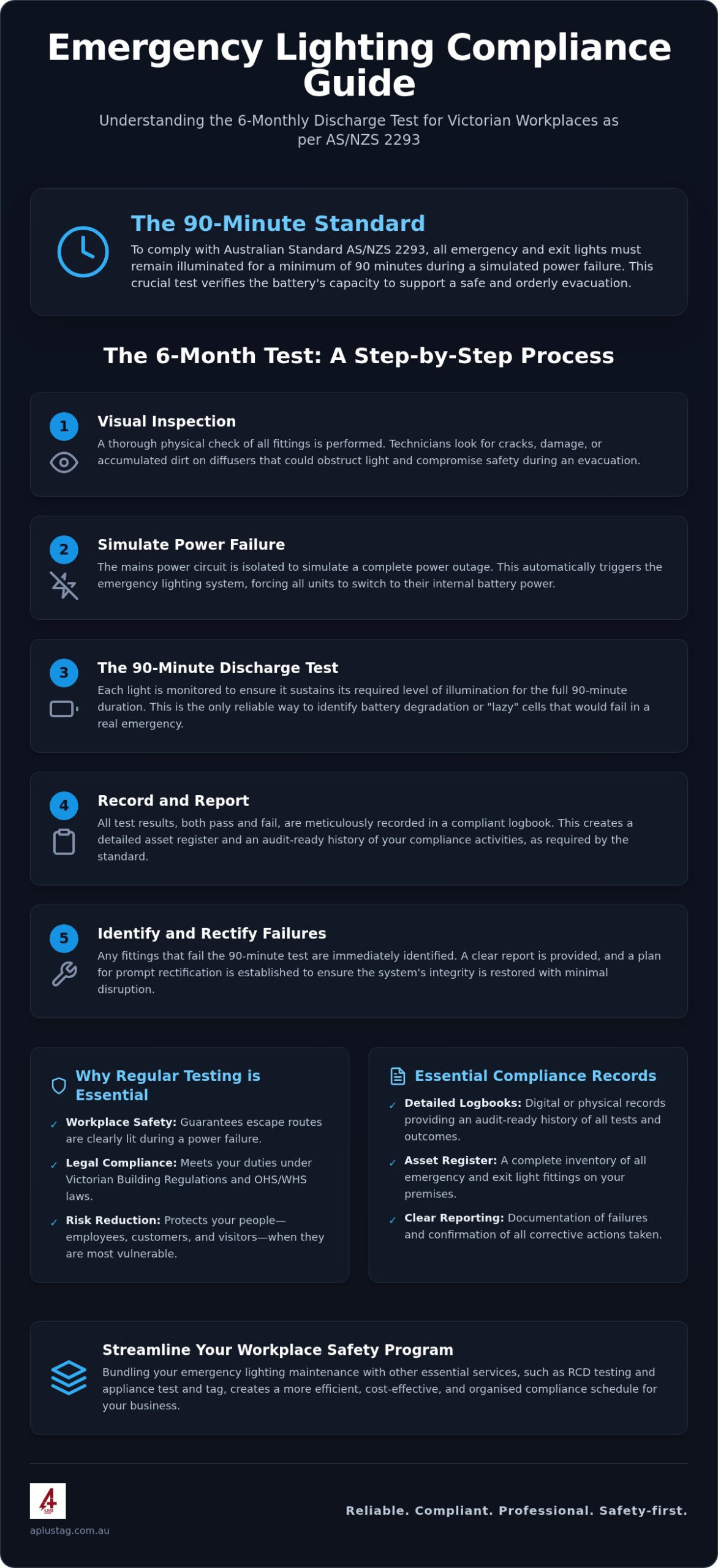
An Emergency light system is a vital safety feature that remains dormant until the moment a building loses power. An emergency lighting test is a systematic procedure where we simulate a mains power failure to ensure these units activate and remain illuminated for the duration required by law. It isn’t just about checking if the bulb turns on; it’s about verifying that the internal battery has the capacity to support occupants during an evacuation. In most commercial settings, this means the light must stay on for at least 90 minutes to allow for a safe and orderly exit.
Safety is our priority. This information must be read in conjunction with AS/NZS 3760:2010 as a whole, and particularly clause 2.1. This ensures a comprehensive approach to electrical safety and compliance within your facility.
Understanding Your Workplace Safety Obligations
As a business owner or facility manager in Victoria, you carry a legal responsibility to maintain a safe environment. Under the Victorian Building Regulations 2018 and standard OHS/WHS frameworks, failing to maintain fire protection systems can lead to significant liability. This is especially critical in high-traffic or high-risk environments like schools, aged-care facilities, and hospitals. Regular testing protects your employees, customers, and visitors by ensuring escape routes are clearly marked when they are needed most. We help Victorian businesses reduce risk and stay organised by ensuring these obligations are met through methodical scheduling and clear reporting.
The Role of AS/NZS 2293 in Victorian Workplaces
The AS/NZS 2293 series is the primary standard governing the design, installation, and maintenance of these systems. It specifies that a 6-monthly discharge test is mandatory to confirm the system’s integrity. Performing a regular emergency lighting test ensures that every fitting is accounted for and that failures are recorded in a permanent logbook. For a deeper look at these requirements, you can refer to our Emergency Lighting Standards Australia Pillar. Following these guidelines isn’t just a box-ticking exercise; it’s a core component of a professional safety-first strategy. It ensures that your documentation is audit-ready and that your facility remains fully compliant with Australian Standards.
Reliable. Compliant. Professional. Safety-first. A thorough compliance check typically covers:
- Visual inspection of all fittings for physical damage or degradation.
- Battery discharge testing to verify 90-minute operation.
- Detailed recording of results in a digital or physical asset register.
- Prompt identification of failed units for immediate rectification.
The 6-Month Discharge Test: A Deep Dive into the Process
The Australian Standard AS/NZS 2293 mandates that every commercial building in Victoria undergoes a full emergency lighting test every six months. This isn’t a simple visual check. It’s a rigorous performance evaluation designed to confirm that your safety systems will work when the mains power fails. We follow a methodical process to ensure every unit is functional, from the smallest exit sign in a stairwell to large floodlights in a warehouse.
Before we begin the electrical simulation, we perform a thorough visual inspection. Technicians check diffusers and light fittings for physical damage, cracks, or accumulated dirt. Dust and grime on a diffuser can significantly reduce the light’s effectiveness during an evacuation. Once the test is complete and power is restored, we verify that the charging indicators are active. This confirms the unit is successfully drawing power to replenish its battery for the next potential outage.
How the 90-Minute Battery Test Works
The core of the 6-monthly requirement is the 90-minute discharge. We simulate a total power loss to trigger the units into battery mode. Every light must sustain its illumination for the full 90-minute duration. This specific timeframe is the legal benchmark because it provides enough time for all occupants to exit the building safely and allows emergency services to conduct a search if necessary. Testing under load is essential. It’s the only reliable way to identify “lazy” battery cells that might show a full charge on a meter but fail within minutes of losing mains power.
Manual vs. Automatic Testing Systems
Buildings generally use either manual or automatic testing infrastructure. Manual systems require a technician to physically operate a test switch or isolate a circuit at the switchboard. These are common in smaller Victorian offices and retail spaces. Automatic or “smart” systems are networked and can conduct self-tests, reporting failures to a central controller. These are highly efficient for large-scale facilities like hospitals or schools.
A professional technician knows how to manage these tests to avoid total battery depletion, which can permanently damage older battery types. Our goal is to provide clear reporting and dependable service while protecting your equipment’s longevity. If you’re managing a complex site and need to establish a recurring compliance cycle, you can reach out to our team to arrange a site assessment. We focus on making workplace compliance easier to manage for every Victorian business owner.
Essential Compliance Documentation and Logbook Management
In the field of workplace safety, the rule is simple: if it isn’t documented, it hasn’t been done. Completing an emergency lighting test is only half the battle. To meet your legal obligations under AS/NZS 2293, you must maintain a permanent record of every inspection and discharge test. These records serve as your primary evidence during an audit and provide a historical health check of your safety systems. Without accurate documentation, you cannot prove that your facility meets Victorian safety standards.
A permanent on-site logbook is a mandatory requirement. While traditional physical books are still used, many Victorian organisations are moving toward digital formats for better accessibility and security. Every entry must clearly state the date of the test, the specific result for each fitting, and the details of the technician who performed the work. According to current Australian Standards, these records must be kept for a minimum of seven years. For businesses looking to streamline this process, our Compliance Monitoring Services offer a structured way to manage this data without the risk of losing paperwork.
Maintaining an Accurate Asset Register
An asset register is a comprehensive list of every emergency and exit light on your premises. We assign a unique ID tag to each fitting, which allows us to track its performance history over several cycles. This systematic approach makes it much easier to identify recurring faults or specific units that are nearing the end of their battery life. When a light fails, the asset register tells us exactly where it is and what specialised parts it needs. This level of detail simplifies the repair and replacement process and reduces downtime for your facility.
Meeting the Requirements of Victorian Safety Audits
Victorian businesses are subject to audits from various bodies, including Fire Rescue Victoria (FRV) and insurance providers. Having your logbooks and asset registers ready is the best way to demonstrate a proactive safety culture. An auditor wants to see a consistent pattern of testing rather than a last-minute scramble to catch up. A Plus Compliance Services focuses on providing clear, audit-ready reports that give you total transparency. Our goal is to help Victorian businesses reduce risk and stay organised by ensuring documentation is always accurate and up-to-date. Clear reporting and dependable service are the foundations of a professional, safety-first workplace.
Managing Failures: What Happens When a Light Doesn’t Pass?
A failed result during a routine emergency lighting test represents a critical safety gap that requires immediate rectification. In the context of Victorian OHS requirements, a non-compliant fitting is more than a minor administrative issue; it is a failure of a life-safety system. When a unit fails to meet the 90-minute discharge threshold, it must be clearly identified in your logbook and asset register to ensure it isn’t overlooked during subsequent maintenance cycles. This systematic tracking is essential for maintaining long-term order and safety.
Prompt action is essential for maintaining a safe environment. Australian Standards require that non-compliant fittings are either repaired or replaced to restore the system’s integrity. In some cases, this may involve removing a faulty fitting from service entirely until a specialised technician can resolve the fault. Clear reporting ensures that facility managers have the data needed to make informed decisions about these repairs without causing unnecessary disruption to daily operations. We focus on making workplace compliance easier to manage by providing transparent results after every inspection.
Common Reasons for Emergency Light Failure
Batteries are the most frequent point of failure in any emergency system. Most units utilise batteries with a functional lifespan of approximately three to five years. Over time, the chemical ability of the battery to hold a charge diminishes. Constant charging cycles combined with the ambient heat often found in ceiling cavities can accelerate this degradation. While older fluorescent fittings often suffered from tube burnout or ballast failure, modern LED units are more likely to experience issues with LED drivers or circuit faults. Identifying these specific technical issues is a key part of a professional emergency lighting test.
Post-Test Corrective Actions and Re-testing
Once a failure is identified, the next step involves arranging for a replacement battery or a new fitting. It’s a methodical process that prioritises your building’s safety. After the repair is completed, a re-test is mandatory to confirm that the new components perform as expected under load. Swapping a battery isn’t enough. You must verify that the unit now meets the full 90-minute discharge requirement. A Plus Compliance Services helps identify these needs during your routine service, ensuring your site remains organised and compliant. We act as a dependable partner to lead you from uncertainty toward total control over your safety systems.
Organising Your Ongoing Emergency Lighting Maintenance
Managing safety requirements shouldn’t feel like a constant interruption to your core business. Establishing a recurring compliance schedule is the most effective way to ensure you never miss a mandatory 6-monthly deadline. By automating this cycle, you shift from a reactive mindset to one of organised control. This proactive approach reduces the risk of audit failures and ensures your safety systems are always functional when needed. Helping Victorian businesses reduce risk and stay organised is at the heart of our service delivery.
Many Victorian facility managers find efficiency by bundling their emergency lighting test with other essential safety tasks. Integrating this requirement with Electrical Test and Tag or RCD testing creates a streamlined safety program. This combined approach means fewer site visits, reduced administrative overhead, and a more holistic view of your building’s electrical health. For more information on how we can support your site, you can view our services.
Scheduling Routine Testing Around Business Operations
Maintaining workplace safety shouldn’t come at the cost of productivity. For high-traffic sites like healthcare facilities, schools, or 24/7 warehouses, we offer the flexibility of after-hours or weekend testing. This allows the 90-minute discharge test to proceed without affecting your staff, students, or visitors. Our professional team can also test specific sections of a building in stages. This ensures that while one area is being evaluated, the rest of the facility remains fully operational. Punctuality and clear communication are the hallmarks of our service, ensuring you know exactly when we’ll arrive and when the job will be completed.
Partnering with A Plus Compliance Services in Melbourne
We position ourselves as an essential ally for Victorian businesses, providing specialised support from St Kilda and the CBD through to Dandenong and Pakenham. As a dependable partner, we understand the local regulatory landscape and the specific needs of diverse industries across the state. Our methodical approach ensures that every site receives clear reporting, dependable service, and ongoing compliance support. By choosing a professional team that values long-term relationships, you can focus on your business while we handle the technical details. We are committed to making workplace compliance easier to manage for every client. If you’re ready to discuss a compliance schedule or need an immediate assessment, contact our team on 1300 427 158 or 1300 CAN TEST.
Securing Your Facility with Systematic Compliance
Maintaining a safe workplace in Victoria requires more than just installing the right equipment. It’s about establishing a consistent cycle of maintenance that ensures your life-safety systems perform when they’re needed most. By prioritising your 6-monthly emergency lighting test, you don’t just meet the legal requirements of AS/NZS 2293; you protect your people and your business from unnecessary risk.
Accurate documentation through asset registers and digital logbooks remains the foundation of any successful audit. When failures occur, addressing them methodically ensures your safety net remains intact. A Plus Compliance Services acts as your dependable partner. We provide clear reporting and dependable service across Melbourne and are specialists in AS/NZS 2293 compliance.
Reliable. Compliant. Professional. Safety-first. We’re here to help you stay organised and prepared for any inspection. Take the next step toward a safer, more compliant workplace today.
Frequently Asked Questions
Is emergency light testing a legal requirement for Victorian businesses?
Yes, it’s a mandatory legal requirement for Victorian businesses to maintain fire protection systems, including emergency lighting. Under the Victorian Building Regulations 2018 and the National Construction Code, building owners must ensure these systems are functional to protect occupants. Failure to comply can lead to significant OHS liability and safety risks. This information must be read in conjunction with AS/NZS 3760:2010 as a whole, and particularly clause 2.1.
How often should emergency and exit lights be tested?
A mandatory 90-minute battery discharge test must be conducted on all emergency and exit lights every six months. While some environments or risk assessments may require more frequent inspections, the 6-monthly cycle is the standard benchmark for commercial buildings under AS/NZS 2293. We recommend obtaining site-specific professional guidance to determine if your workplace requires a specialised schedule based on your specific equipment type or risk profile.
What exactly happens during a 90-minute discharge test?
During an emergency lighting test, a technician simulates a total power failure by isolating the mains supply. This triggers the units to switch to battery mode. Each fitting must remain illuminated for the full 90-minute duration required by Australian Standards. We also perform a visual inspection of diffusers and fittings for damage. Once the test concludes, we restore power and verify that each unit’s charging indicator is active.
Do I need a physical logbook for my emergency lighting records?
You must maintain a permanent on-site record of all testing, which can be either a physical logbook or a digital asset register. These records must include the date of the test, specific results for every fitting, and the technician’s details. Australian Standards require you to keep these records for a minimum of seven years. Having clear, audit-ready reports helps Victorian businesses reduce risk and stay organised during fire brigade or insurance inspections.
Can I test my own emergency lights or do I need a professional?
While anyone can visually check if a light is on, a professional technician is required to perform the specialised 90-minute discharge test and provide the necessary compliance documentation. Testing involves electrical isolation and technical verification that meets AS/NZS 2293 standards. Partnering with a professional ensures your logbooks are accurate and that failures are correctly identified. We provide safety-first service delivery across Melbourne, from St Kilda to Pakenham, to simplify your compliance obligations.
What is the difference between a 6-month and a 12-month test?
Both intervals involve a 90-minute discharge test to verify battery capacity. The 6-monthly test is the standard recurring requirement for all commercial fittings. An annual or 12-month inspection often involves a more comprehensive review of the entire system’s integrity, including deeper cleaning of diffusers and checking for circuit faults. Regularly scheduled maintenance ensures that your safety systems are proactive rather than reactive, keeping your facility compliant and safe all year round.
Can testing be completed outside of normal operating hours?
Yes, we can arrange for an emergency lighting test to be completed after-hours or on weekends to minimise disruption to your daily operations. This is particularly beneficial for high-traffic environments like hospitals, schools, or retail centres where isolating power during the day is impractical. Our team prioritises punctuality and clear communication to ensure the process is stress-free. We work around your site access and operational needs to maintain your safety schedule.
What happens if an emergency light fails its battery test?
If a fitting fails to stay illuminated for the full 90 minutes, it’s recorded as a fail in your asset register. You must then arrange for a repair or replacement, such as a new battery or a modern LED unit. Once the fault is rectified, a re-test is mandatory to confirm the unit now meets compliance standards. We help identify these needs promptly, providing clear reporting and dependable service to ensure your safety gap is closed.
