
Test and Tag Cost: 2026 Guide for Australian Businesses
The lowest quote for electrical safety on your desk is often the one that costs your business the most during a WorkSafe audit. It is a frustrating reality for many Australian business owners who find that a low initial test and tag cost quickly escalates once hidden call-out fees and separate charges for RCD testing or microwave leakage are added to the final invoice. You deserve a transparent partnership where safety is not a line-item surprise but a predictable, well-managed process.
We understand that managing multiple contractors for fire, electrical, and first aid compliance is a logistical headache you would rather avoid. It is common to worry that cut-price testing might skip the rigorous requirements of the latest AS/NZS 3760:2022 standards. This guide provides a clear framework for understanding current pricing structures, helping you evaluate service providers with confidence. We will explore the factors that influence professional rates, how to reduce your total compliance spend through site efficiency, and the essential reporting needed to keep your workplace organised and audit-ready.
Key Takeaways
- Evaluate the differences between per-item and hourly pricing models to determine which structure offers the most predictable value for your inventory size.
- Understand how the technical requirements of the AS/NZS 3760:2022 standard influence your total test and tag cost to ensure your documentation remains audit-ready.
- Identify site-specific variables like equipment accessibility and RCD testing needs that can impact the transparency and accuracy of your compliance quote.
- Recognise the long-term financial risks of sub-standard testing, including potential insurance complications and significant regulatory penalties.
- Streamline your safety management and reduce travel expenses by integrating electrical, fire, and first aid servicing into a single, efficient compliance day.
What Determines the Cost of Test and Tag Services in 2026?
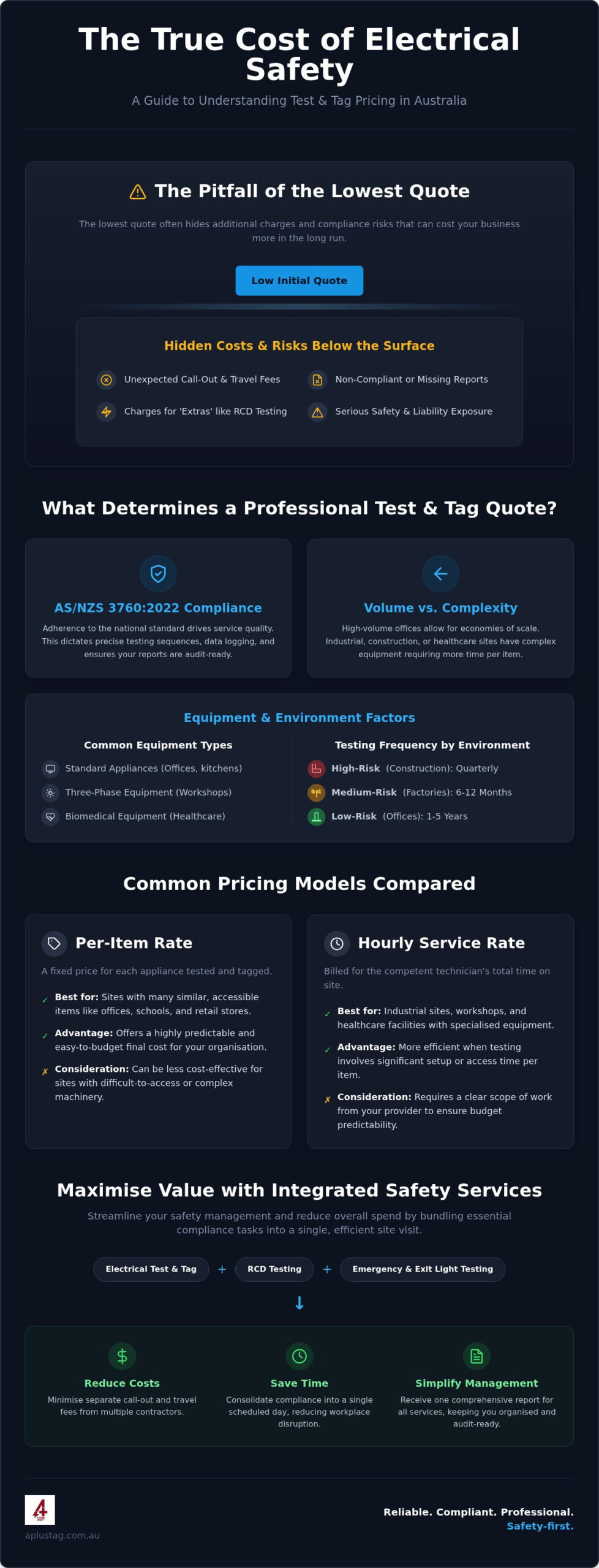
Determining a fair test and tag cost involves looking beyond the surface of a simple sticker application. While some providers might offer a low entry rate, the actual value of the service is tied directly to the depth of the inspection and the technical requirements of Australian safety standards. A compliant service includes a multi-stage process that ensures every piece of equipment is safe for use in its specific environment. It is a systematic approach to risk management that protects your staff and your business assets.
Many people assume the process is merely a visual check. However, Portable appliance testing (PAT) requires a series of electrical tests, including earth continuity, insulation resistance, and polarity checks. Skipping these steps might lower the immediate price, but it leaves your business exposed to significant liability if an incident occurs. The cost of a professional service reflects the time taken to perform these electrical measurements accurately and record the results in a detailed asset register.
The Role of AS/NZS 3760 in Pricing
Adherence to the AS/NZS 3760:2022 standard is the primary driver of service quality. This standard dictates the exact testing sequences required for different classes of equipment. A professional provider invests in calibrated testing instruments and ongoing training to ensure their staff remain “competent persons” under Australian law. When you review a quote, you are paying for this technical proficiency and the reassurance that your documentation will withstand a regulatory audit. Cheap, rapid-fire testing often fails to meet these rigorous data-logging requirements, which can lead to expensive complications during a WorkSafe inspection.
Volume vs. Complexity
The scale of your facility plays a major role in shaping your total test and tag cost. High-volume environments, such as large corporate offices, allow technicians to work through many items in a single location, creating significant economies of scale. Conversely, industrial sites or healthcare facilities present higher complexity that requires more time per item. Consider these variables that influence the workload:
- Standard Appliances: Computers, monitors, and kitchen appliances in low-risk office settings.
- Three-Phase Equipment: Heavy machinery that requires specialised adaptors and longer testing durations.
- Biomedical Equipment: Sensitive medical devices that must meet stricter Patient Area Testing standards.
- High-Risk Environments: Construction sites or workshops where equipment is subject to “flexing” or harsh conditions, necessitating more frequent cycles.
Your industry risk level determines how often your equipment must be tested. A construction site requires quarterly testing, whereas a standard office environment may only need testing every five years for certain items. This frequency directly impacts your long-term compliance budget. By understanding these variables, you can move away from chasing the lowest per-unit price and toward a strategy that prioritises reliability and systematic risk management.
Common Pricing Models: Per-Item vs. Hourly Service Rates
Choosing the right billing structure is essential for maintaining a predictable budget and ensuring your workplace remains compliant. Most Australian service providers operate on either a per-item or an hourly basis. Each model has specific advantages depending on your workplace layout, the variety of equipment you manage, and the total volume of appliances. Understanding these differences helps you avoid unexpected expenses and ensures the technician has sufficient time to perform a thorough inspection.
Australian businesses have a clear duty under work health and safety (WHS) regulations to manage electrical risks through systematic risk assessments. These assessments help determine the testing scope, which then dictates which pricing model is most cost-effective for your specific needs. While an office might benefit from a simple count, a complex industrial site often requires a more flexible approach to account for the labour involved in accessing difficult equipment. If you want a deeper understanding of your obligations, our tag and test complete guide to Australian workplace safety covers testing intervals, WHS laws, and compliance processes in detail.
Standard service fees generally cover more than just the physical tag. A professional quote usually incorporates the technician’s travel, the use of calibrated testing machinery, and the generation of a comprehensive compliance report. This documentation is your primary defence during an audit, so it is vital that the pricing model you choose supports detailed record-keeping rather than just speed. If you are looking for a transparent breakdown of how these models apply to your facility, requesting a structured quote is a practical first step toward organised compliance.
When to Choose Per-Item Billing
Per-item billing is the most common model for businesses with a stable and predictable inventory. It is ideal for corporate offices, retail spaces, and schools where appliances are easily accessible and the total count is known. This model ensures complete transparency, as your total test and tag cost is calculated by multiplying the number of units by a fixed rate. As your business grows, many providers offer volume-based discounts. This means the unit price often decreases as the number of appliances at a single site increases, rewarding businesses that consolidate their testing schedules.
Understanding Minimum Service Charges
Small sites or businesses with very few appliances will typically encounter a minimum service charge. This base fee, often referred to as a call-out fee, ensures the technician can cover the operational costs of visiting your site, regardless of the item count. To maximise the value of this initial charge, we recommend organising your equipment in advance. Ensuring all power boards, leads, and kitchen appliances are easily reachable allows the technician to complete the work efficiently. You might also consider checking if other safety items, such as fire blankets or first aid kits, can be serviced during the same visit to make the most of the minimum fee.
Technical Variables That Influence Your Compliance Quote
Beyond the simple volume of appliances, the technical environment of your workplace significantly shapes the final quote. A transparent provider considers the labour time required to navigate your site effectively. If equipment is located in difficult-to-reach areas, such as behind heavy warehouse racking or in high-ceiling environments, the technician requires more time to maintain safety standards. This extra labour is a necessary component of the test and tag cost to ensure no item is overlooked during the inspection cycle.
The inclusion of Residual Current Device (RCD) testing is another critical variable. While standard appliance testing is the foundation of electrical safety, RCDs (safety switches) require specific trip-time tests to ensure they disconnect power fast enough to prevent injury. Many businesses also require after-hours or weekend service to maintain zero downtime. Scheduling compliance work during quiet periods avoids disrupting your daily operations, though it typically involves a different rate structure to account for the unsociable hours required of the technical team.
Specialised Testing Requirements
Specialised machinery often requires more than a standard 10-amp plug test. Three-phase equipment, common in manufacturing and commercial kitchens, necessitates specific adapters and a higher level of technical expertise. We also suggest incorporating preventative measures like switchboard thermal imaging. This non-invasive check detects heat anomalies before they lead to fire or equipment failure, acting as a cost-saving preventative service. Adding microwave radiation checks and emergency lighting tests creates a comprehensive safety net, ensuring every compliance layer is managed by a single, dependable partner.
Documentation and Audit Readiness
The value of professional reporting cannot be overstated. A handwritten logbook is no longer sufficient for modern regulatory requirements. A digital asset register provides a detailed, searchable history of every test performed, including failed items and repair notes. This systematic documentation simplifies your insurance renewals and provides ironclad proof of diligence during a WorkSafe inspection. While high-quality reporting requires sophisticated software and administrative time, it transforms a simple safety check into a robust risk management tool that keeps your business organised and prepared.
Evaluating the Risks and Long-Term Costs of Low-Budget Testing
Opting for the lowest quote often creates a false sense of security that can vanish during a WorkSafe audit. While the initial test and tag cost might seem like a bargain, budget providers frequently cut corners to maintain their margins. This often manifests as “sticker-only” servicing, where tags are applied without the necessary electrical resistance or polarity tests. If a provider cannot produce calibration certificates for their equipment or fails to provide a detailed digital report, your business remains legally exposed. It’s a dangerous gamble that trades long-term safety for a minor upfront saving.
Budget-focused technicians often rush through a site without unplugging equipment or skipping the essential visual inspection of leads and plugs. This speed is a major red flag. A thorough service requires enough time to inspect, test, and document each asset correctly according to the AS/NZS 3760:2022 standards we’ve discussed. When testing is performed haphazardly, the resulting documentation is often riddled with errors, leading to double-handling and wasted management time when you eventually have to rectify the records for insurance or compliance purposes.
Identifying “Sticker-Only” Services
Identifying a sub-standard service before it’s too late is vital for your risk management strategy. You should watch for red flags in unusually low quotes, such as the absence of a clear breakdown of what the service includes. A professional provider will always be transparent about their testing process and the equipment they use. Always ask to see a technician’s equipment calibration records. If their testing instruments haven’t been professionally verified within the last 12 months, the results they produce might not stand up in a legal environment or a WorkSafe investigation.
The Financial Impact of Electrical Failure
The real cost of non-compliance isn’t the service fee; it’s the potential for catastrophic failure and business downtime. An electrical fire caused by a faulty, untagged appliance can lead to immediate site closures and significant revenue loss. Insurance companies are increasingly diligent about verifying safety records before processing claims related to electrical fires. Without a professional asset register, you risk a total denial of coverage, leaving your business to foot the bill for repairs and legal liabilities. Investing in preventative measures is a strategic choice that protects your bottom line and your reputation. To ensure your workplace meets every legal requirement without the stress of hidden risks, schedule a professional compliance audit today.
Maximising Value Through Integrated Safety and Compliance Bundles
Managing workplace safety often feels like a fragmented balancing act between different contractors. You might have one technician for fire extinguishers, another for first aid kits, and a third for your electrical requirements. This disjointed approach often inflates your total test and tag cost by multiplying travel fees and doubling the administrative hours spent on scheduling and invoice processing. Consolidating these essential services into a single, integrated safety bundle is the most effective way to reduce overheads while maintaining a high standard of protection.
We recommend the efficiency of a “compliance day” for your facility. This methodical approach allows a single technical partner to manage everything from RCD testing to fire blanket inspections in one systematic sweep. It transforms a logistical headache into a predictable, recurring cycle. Instead of paying multiple call-out fees throughout the year, you benefit from a streamlined site visit that covers all your regulatory obligations at once. This isn’t just about saving money; it’s about creating a state of organised control where every safety asset is accounted for in one unified digital register.
The Benefits of a Single Service Provider
The hidden cost of managing multiple safety contractors is often found in the gaps between their schedules. When responsibilities are split, it’s easy for a 6-month re-test date to slip through the cracks, leaving your business non-compliant. A single-provider model ensures that your entire safety programme is managed through a centralised schedule. This consistency extends to your reporting, as you receive a standardised asset register that covers fire, electrical, and first aid categories. It simplifies your internal audits and provides a clear, professional paper trail for your insurance provider or WorkSafe representatives.
Customising Your Safety Programme
A Plus Compliance Services prioritises a proactive strategy over a reactive one. We understand that a warehouse has different risk profiles than a medical clinic or a corporate office. By tailoring our quotes to your specific site requirements, we ensure you aren’t paying for unnecessary testing cycles while still meeting every technical obligation of the AS/NZS 3760:2022 standard. Our national service coverage ensures that businesses with multiple locations receive the same high level of documentation and punctuality across every site. Moving toward a long-term partnership allows us to identify preventative opportunities, such as switchboard thermal imaging, which can detect faults before they lead to expensive downtime. To simplify your safety management and receive a transparent breakdown of our integrated services, Request a comprehensive compliance quote from A Plus Compliance Services.
Securing Your Workplace with Transparent Compliance
Transitioning from a reactive safety approach to a proactive, systematic programme is the most effective way to manage your long-term compliance obligations. We’ve explored how the true test and tag cost is determined by technical precision, the depth of reporting, and strict adherence to the latest Australian Standards rather than just the number of stickers applied. By choosing a partner that prioritises detailed asset registers and specialised preventative services like switchboard thermal imaging, you protect your business from the hidden expenses of equipment failure and the severe penalties of regulatory non-compliance.
A Plus Compliance Services has been trusted by businesses across Australia for over a decade to deliver reliability and technical proficiency. Our specialised switchboard thermal imaging experts and field technicians provide comprehensive asset registers with every service, ensuring your documentation is always audit-ready. Get an accurate, transparent quote for your workplace compliance today and experience the peace of mind that comes with a methodical safety partner. We look forward to helping you create a safer, more organised workplace for your entire team.
Frequently Asked Questions
How much does test and tag cost per item in Australia?
Industry rates for standard portable appliance testing generally range from A$2.50 to A$6.00 per item across Australia. These rates often decrease as the volume of equipment increases, with high-volume sites like large warehouses or corporate offices typically receiving lower unit pricing through economies of scale. Factors such as the location of your site and the accessibility of your equipment will also influence the final per-item rate.
Is there a minimum charge for a technician to visit my site?
Most professional providers implement a minimum call-out fee to cover the operational expenses of a technician visiting your facility. This base charge usually ranges from A$100 to A$250 plus GST and often covers the first block of items, such as the first 10 to 20 appliances. This makes the minimum fee the most significant factor in the total test and tag cost for small businesses or retail outlets with limited equipment.
Does the price of testing change based on the industry I am in?
Your industry risk level directly influences the total investment because it dictates the required testing frequency under Australian standards. High-risk environments like construction sites or manufacturing plants require more frequent cycles and often involve complex three-phase machinery. This increased complexity and frequency lead to different annual budget requirements compared to low-risk environments like standard corporate offices.
Are there additional costs for RCD or emergency light testing?
RCD (safety switch) and emergency light testing are specialised services that carry different rates than standard portable appliances. Because RCDs require specific trip-time measurements and emergency lights involve timed discharge tests, these items are typically quoted as separate line items. This reflects the additional technical labour and specialised testing equipment required to meet the AS/NZS 3760:2022 standards.
Can I reduce my total compliance cost by bundling electrical and fire testing?
Bundling electrical, fire, and first aid servicing into a single site visit is one of the most effective ways to reduce your total compliance spend. This integrated approach eliminates multiple call-out fees and reduces the administrative time spent managing various contractors. It allows your business to achieve full regulatory compliance through one efficient, coordinated visit, lowering the overall cost per service.
What is included in a standard test and tag quote from A Plus Compliance Services?
A professional quote from A Plus Compliance Services incorporates the physical inspection and electrical testing of each asset, the application of durable tags, and the generation of a digital asset register. We prioritise transparency, so our quotes also include the comprehensive compliance reporting necessary to satisfy strict Australian regulatory audits and insurance requirements without hidden administrative expenses.
How often do I need to pay for re-testing to remain compliant?
Retesting intervals are determined by the AS/NZS 3760:2022 standard and vary based on your equipment type and environment. For example, equipment used on construction sites requires quarterly testing, while standard office appliances often move to a 12-month or 5-year cycle. These recurring cycles ensure your workplace remains safe and your documentation stays up to date for any potential WorkSafe inspections.
Do after-hours services cost more for electrical safety testing?
Scheduling safety testing outside of standard business hours typically incurs a higher rate to account for the technician’s unsociable hours. While the immediate test and tag cost may be higher for night or weekend work, many businesses find this model more cost-effective. It ensures zero downtime for your staff and prevents any disruption to daily operations or customer service during peak times.
