Professional Test and Tag Services Melbourne: The 2026 Workplace Compliance Guide
True workplace safety in Victoria isn’t just about the coloured tag attached to a power lead; it’s about the robust system of documentation and testing that sits behind it. For facility managers and business owners, finding reliable test and tag services Melbourne wide means more than just ticking a box. It’s about ensuring your organisation meets the rigorous benchmarks of the updated AS/NZS 3760:2022 standard while maintaining daily operational efficiency.
We understand that deciphering technical jargon and tracking recurring due dates across multiple Victorian sites can feel like a constant administrative burden. You need a clear path to compliance that doesn’t disrupt your staff or leave you guessing about your audit readiness. This guide explains how to manage your workplace safety obligations through professional electrical testing, transparent reporting, and structured maintenance schedules. We’ll explore the latest regulatory requirements, the value of precise asset registers, and how a proactive partnership helps your business reduce risk and stay organised.
Key Takeaways
- Learn how to align your safety protocols with AS/NZS 3760:2010 to ensure your Victorian workplace meets essential health and safety requirements.
- Discover why professional test and tag services Melbourne provide a systematic approach to safety that minimises staff disruption while ensuring thorough documentation.
- Find out how digital asset registers and detailed compliance reports replace confusing paper systems with clear, audit-ready data for your organisation.
- Explore the benefits of integrating RCD and emergency light testing into a single maintenance schedule to help your business stay organised and proactive.
- Understand the specific testing intervals required for different equipment types to maintain continuous compliance and reduce long-term operational risk.
What are Professional Test and Tag Services in Melbourne?
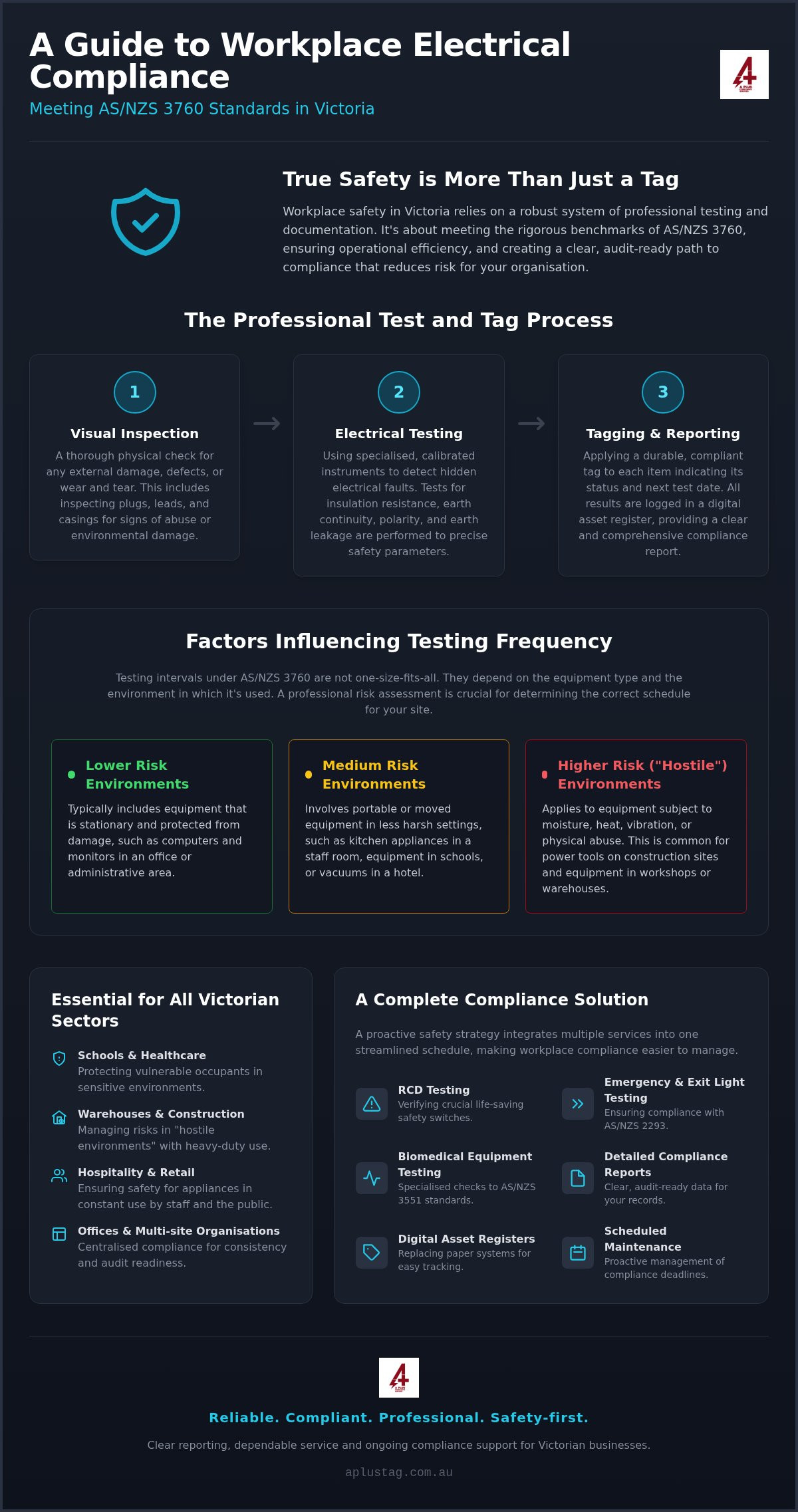
Professional test and tag services Melbourne provide a structured method for verifying the safety of portable electrical equipment. This systematic process involves two distinct phases: a thorough visual inspection and a series of electrical tests using specialised instruments. While known globally as Portable appliance testing, in Victoria, this procedure is the primary way businesses demonstrate their duty of care under the Occupational Health and Safety Act 2004. A plus compliance services delivers these essential safety checks across all major Melbourne hubs, from the high-rises of the CBD to the industrial precincts of Dandenong and beyond.
Relying on in-house staff or basic checks often fails to meet the rigorous requirements of Victorian safety standards. Professional verification ensures that every item, from a simple office kettle to complex biomedical equipment, is measured against precise safety parameters. By partnering with a dedicated provider, facility managers can focus on their core operations while ensuring their electrical assets remain compliant and safe for staff use.
To better understand this concept, watch this helpful video:
The Purpose of Electrical Equipment Verification
The primary goal of regular testing is to identify potential faults before they lead to workplace incidents. Many electrical hazards aren’t visible to the naked eye. Internal wiring damage or insulation breakdown can only be detected through calibrated testing instruments. Establishing a clear audit trail is equally vital. Accurate record-keeping provides a robust defence for insurance purposes and regulatory audits, helping Victorian businesses reduce risk and stay organised.
A plus compliance services adheres strictly to the AS/NZS 3760:2010 standard throughout the testing process. It is a mandatory requirement that this information be read in conjunction with AS/NZS 3760:2010 as a whole, and particularly clause 2.1. This standard provides the technical framework for ensuring all “in-service” equipment is fit for purpose. You can view our full range of specialised compliance services to see how we manage these requirements for different equipment types.
Who Needs Compliance Testing in Victoria?
Electrical safety is a universal requirement across all Victorian sectors. Schools and healthcare facilities face unique challenges due to the sensitive nature of their environments and the vulnerability of their occupants. For these organisations, professional test and tag services Melbourne are essential for maintaining a high standard of care. Similarly, warehouses and construction sites operate in “hostile environments” where equipment is subject to frequent movement and potential abuse.
Hospitality venues and high-traffic retail spaces also require diligent testing due to the constant use of appliances by both staff and the public. Multi-site organisations across Melbourne benefit from a centralised compliance approach, ensuring consistency in reporting and maintenance cycles across every location. This methodical strategy ensures that every site remains audit-ready and safe for daily operations.
Understanding AS/NZS 3760:2010 and Testing Intervals
Compliance with electrical safety isn’t a matter of guesswork. A plus compliance services operates with strict adherence to AS/NZS 3760:2010, ensuring that every piece of equipment is assessed against a recognised benchmark. It’s essential to understand that this information must be read in conjunction with AS/NZS 3760:2010 as a whole, and particularly clause 2.1. While technical, these guidelines provide the necessary framework for protecting your staff and property. As noted by WorkSafe Victoria, employers have a legal duty to maintain a safe working environment, making professional test and tag services Melbourne a core component of Victorian risk management.
The frequency of testing depends heavily on the environment where the equipment is used. Equipment in a workshop faces different risks than a computer in a quiet office, which is why the standard defines specific categories for testing schedules.
Standard Testing Intervals by Environment
- Factories and workshops (Category a): These areas are often considered hostile because equipment is subject to moisture, dust, or physical damage. General inspection and testing should occur every 6 months.
- Hostile environments (Category b): This refers to other environments where equipment might be subject to flexing or mechanical damage. Here, a 12-month interval is standard for both portable and fixed equipment.
- Non-hostile office environments (Category c): While the risk of damage is lower, most equipment still requires 12-month intervals to ensure ongoing safety and compliance.
Specialised Intervals for High-Risk Areas
Construction sites and hire equipment represent the highest risk environments in the state. Due to the extreme conditions and frequent handling, these require frequent 3-month testing cycles to maintain safety standards. Residential-type areas (Category d), such as hotels or boarding houses, follow their own specific rules: 3 months for portable items and 6 months for fixed equipment. Commercial cleaning equipment used in categories (b) and (c) environments also requires testing every 12 months to account for constant movement and wear.
Don’t forget that any equipment re-introduced to service after a repair must be tested according to AS/NZS 5762. This ensures the repair hasn’t compromised the electrical integrity of the device. If you’re unsure which category your workplace falls into, it’s best to discuss a compliance schedule with a professional who understands the nuances of the Victorian landscape.
Beyond the Tag: Specialised Compliance Services
Effective workplace safety requires more than a single-service mindset. While electrical appliance testing is a cornerstone of risk management, a multi-service approach ensures that all safety-critical systems are functional and compliant. By integrating electrical testing with fire safety and emergency systems, Victorian businesses can streamline their maintenance schedules and reduce administrative overhead. A plus compliance services utilises industry-leading diagnostic tools to provide this comprehensive level of support, moving beyond basic checks to offer a holistic safety solution. As highlighted by Safe Work Australia, managing electrical hazards is a fundamental duty for any person conducting a business or undertaking. To simplify this process, you can explore our full range of compliance services designed for diverse Melbourne workplaces.
Biomedical Equipment Testing (AS/NZS 3551)
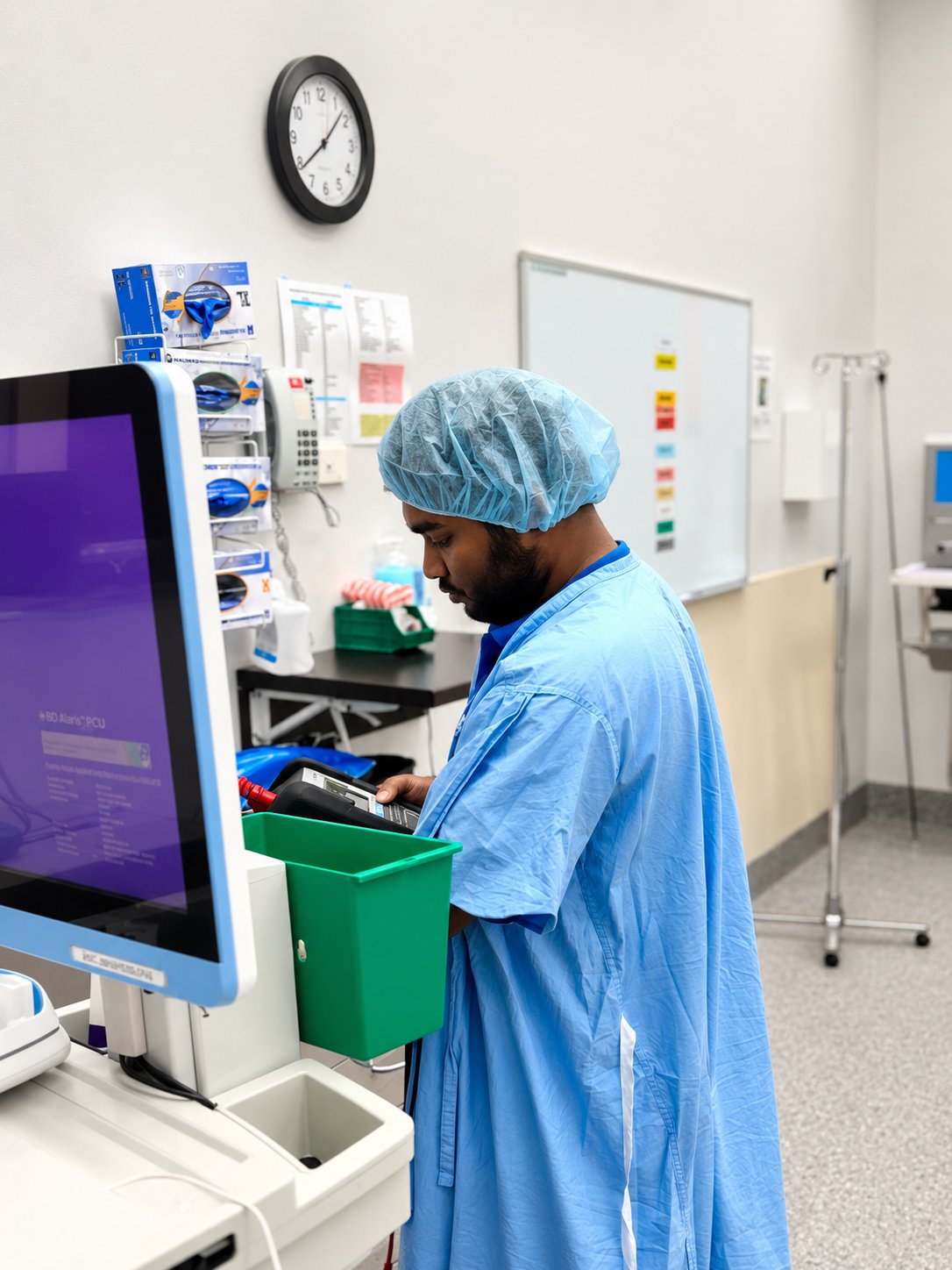
Healthcare and laboratory environments in Melbourne demand a higher level of technical precision. Unlike standard office equipment, medical devices must be tested according to AS/NZS 3551 to ensure patient and operator safety. A plus compliance services specialises in this field, using the Rigel 288+ 48M-0260 biomedical safety analyser. This advanced tool allows for precise measurement of leakage currents and earth bond resistance, ensuring that clinics, aged-care facilities, and hospitals remain safe environments for care. Professional verification in these sectors isn’t just about compliance; it’s about the safety-first protection of vulnerable individuals. Our specialised test and tag services Melbourne team understands the nuances of patient area testing and the critical nature of equipment uptime.
RCD, Emergency Lighting, and Fire Equipment
A comprehensive safety program must also account for the systems designed to protect staff during an emergency. Residual Current Device (RCD) testing is critical for verifying that safety switches trip within the required milliseconds to prevent fatal electric shocks. Without regular testing, these mechanical devices can seize or fail, leaving your workplace unprotected. These checks are essential for maintaining the “Safety-first” approach required by modern Victorian organisations.
Similarly, emergency and exit lighting systems require routine 6-month discharge tests in accordance with AS/NZS 2293. These tests confirm that battery-backed lights will remain illuminated for the required duration during a power failure, providing a safe path for evacuation. Integrating these checks with fire extinguisher and fire blanket testing for commercial kitchens and offices creates a reliable, professional environment. This organised approach helps Victorian businesses reduce risk and stay prepared for any situation, ensuring that all compliance obligations are met through a single, dependable partner.
The Compliance Reporting and Asset Register Process
Effective safety management relies on transparency and accuracy. Many Victorian organisations are moving away from cumbersome paper-based systems toward structured digital asset registers that provide a real-time overview of their electrical safety status. When you engage professional test and tag services Melbourne, the primary output is a document that serves as a definitive safety record for your organisation. This documentation ensures your safety protocols remain read in conjunction with AS/NZS 3760:2010 as a whole, and particularly clause 2.1. By maintaining digital records, you eliminate the risk of lost paperwork and ensure your business is always prepared for a regulatory inspection.
Building a Reliable Asset Register
A robust asset register tracks every portable appliance across your various Melbourne locations, from the front office to the warehouse floor. It’s not enough to simply list a pass or fail result. A comprehensive report includes a unique Asset ID, the specific location of the item, and the actual measured values for earth bond and insulation resistance. These measurements are vital because they allow facility managers to monitor the health of equipment over time. Organising this data digitally allows for easy retrieval during facility management reviews, making workplace compliance easier to manage for multi-site operations.
Managing Failed Items and Repairs
Identifying a hazard is the first step, but managing that hazard correctly is what prevents workplace accidents. Failed items must be clearly labelled with a failed tag and immediately removed from service to prevent accidental use by staff. This systematic approach is a core part of being a dependable partner in safety. If an item is sent for repair, it cannot simply be returned to the workstation once fixed. You must refer to AS/NZS 5762 after any electrical repair to verify the device’s safety before it’s re-introduced to service. A plus compliance services helps Victorian businesses reduce risk by maintaining an accurate record of these corrective actions, ensuring your asset register is always up to date.
Using these detailed reports simplifies your next safety audit. Instead of searching through folders for physical tags, you can present a structured digital report that demonstrates a proactive and safety-first approach. This level of organisation reflects a well-regulated business that values long-term safety and consistent performance. Clear reporting and ongoing compliance support turn a complex requirement into a manageable, routine part of your business operations.
Choosing a Dependable Partner for Melbourne Compliance
Selecting a partner for your test and tag services Melbourne shouldn’t be a decision based solely on the lowest quote. While large franchise models often focus on volume, a local, service-focused approach prioritises the specific safety needs of your Victorian workplace. A dependable partner acts as an extension of your facility management team, offering punctuality and a safety-first mindset that minimises disruption to your daily operations. This relationship is built on trust and the shared goal of maintaining a well-regulated environment.
One of the most significant challenges for Melbourne business owners is keeping track of recurring due dates across multiple sites. A professional provider removes this burden by implementing a structured maintenance program. By receiving automated reminders and organised schedules, you can ensure that no piece of equipment falls out of compliance. This proactive management helps Victorian businesses reduce risk and stay organised, allowing you to focus on your core objectives while we manage the technical details of electrical safety.
The A Plus Compliance Services Advantage
Clear communication is the foundation of our service delivery. We provide detailed briefings before, during, and after each site visit, ensuring you’re fully informed of any identified risks or necessary corrective actions. Our team develops practical solutions that work around your operational needs, whether you’re managing a busy healthcare clinic or a large-scale warehouse. Reliable. Compliant. Professional. Safety-first. This isn’t just a motto; it’s the standard we bring to every Victorian organisation we serve.
Next Steps: Arranging Your Site Assessment
Taking control of your workplace safety begins with a comprehensive site assessment. Whether you require testing for a single office or a complex multi-site organisation, we can provide a tailored quote that reflects your specific risk profile. It’s important to remember that testing requirements vary based on your workplace type, the equipment used, and site-specific risk assessments. We recommend obtaining professional guidance to determine the exact intervals suited to your environment.
To discuss a recurring compliance schedule or to learn more about our specialised safety testing, contact our team on 1300 427 158. We are here to help you navigate your Victorian safety obligations with clarity and confidence. Every piece of information provided should be read in conjunction with AS/NZS 3760:2010 as a whole, and particularly clause 2.1, to ensure full regulatory alignment.
Maintaining Long-Term Electrical Safety and Compliance
Effective workplace safety isn’t a one-off event; it’s a continuous cycle of verification and improvement. By implementing a structured programme that includes clear reporting and automated due-date reminders, your organisation can transition from reactive repairs to proactive maintenance. A plus compliance services provides the technical expertise required for diverse environments, including specialised biomedical testing to AS/NZS 3551 for healthcare facilities. This systematic approach ensures your business remains audit-ready while minimising operational downtime.
As you manage your safety obligations, remember that all technical information must be read in conjunction with AS/NZS 3760:2010 as a whole, and particularly clause 2.1. Partnering with a dedicated provider for your test and tag services Melbourne allows you to reduce risk and stay organised with confidence. We are here to simplify the complexities of compliance and provide the dependable support your Victorian business needs to thrive.
We look forward to helping you create a safer, more compliant workplace for your staff and visitors.
Frequently Asked Questions
What is electrical test and tag?
Electrical test and tag is the systematic process of visual inspection and electrical safety testing for portable electrical equipment, accompanied by precise record-keeping. This procedure ensures that devices are safe for continued use in the workplace. It’s essential that all testing information is read in conjunction with AS/NZS 3760:2010 as a whole, and particularly clause 2.1. By identifying faults early, we help Victorian businesses maintain a safe environment while fulfilling their legal duty of care.
How often does equipment need to be tested in a Melbourne office?
Testing intervals for a Melbourne office depend on the specific environment, equipment type, and your organisation’s risk-management procedures. For standard non-hostile office environments (Category c), most portable and fixed equipment requires testing every 12 months. However, high-traffic areas or shared equipment might require more frequent checks. A plus compliance services can help you organise a site-specific schedule that ensures continuous compliance while reducing operational risk for your Victorian workplace through professional verification.
Can testing be completed outside normal operating hours to avoid disruption?
Yes, testing can be arranged outside normal operating hours to minimise disruption to your staff and daily operations. We understand that facility managers need to maintain productivity while meeting safety obligations. Scheduling is flexible and can be coordinated around your site access requirements and specific operational needs. This service-focused approach allows your business to stay organised and compliant without the stress of daytime interruptions in busy Melbourne workplaces, ensuring a professional and efficient experience.
What happens when an electrical item fails the safety test?
When an item fails a safety test, it’s immediately and clearly identified with a failed tag. We record the failure in your asset register so you have an accurate compliance history of every device. The faulty equipment must be removed from service straight away to prevent accidental use. You can then arrange for repair or replacement. If you choose to repair the item, you must refer to AS/NZS 5762 before re-introducing it to service.
Does A Plus Compliance Services manage multiple locations across Victoria?
Yes, A plus compliance services specialises in managing coordinated testing programmes for multi-site organisations across Melbourne and wider Victoria. We can synchronise testing dates, reporting, and asset registers across all your locations, providing a centralised view of your compliance status. This methodical approach is ideal for schools, healthcare providers, and retail groups that need consistent safety standards and professional documentation across different Victorian site-based operations. It ensures that every location meets the same high safety-first benchmarks.
Do you provide reminders for future testing dates?
Yes, we provide automated due-date reminders and scheduled maintenance as part of our long-term compliance support. Keeping track of recurring cycles is one of the biggest challenges for business owners, so we manage this process for you. These reminders ensure that your test and tag services Melbourne remain up to date, helping you stay organised and reducing the risk of missed deadlines. This proactive system makes workplace compliance easier to manage and ensures you’re always audit-ready.
Is biomedical equipment testing different from standard electrical tagging?
Yes, biomedical equipment testing is a specialised process that follows the AS/NZS 3551 standard rather than standard appliance tagging rules. It requires specific diagnostic tools, such as the Rigel 288+ 48M-0260 biomedical safety analyser, to measure leakage currents and functional performance. This testing is critical for medical and laboratory equipment in hospitals and clinics to ensure patient safety. It’s a more technical verification process designed for high-risk medical environments where standard electrical checks are simply not sufficient.
What standards apply to emergency and exit light testing in Australia?
Emergency and exit lighting systems are tested in accordance with the AS/NZS 2293 standard. This requires routine 6-month discharge tests to verify that the battery-backed lights remain operational for the required duration during a power failure. Regular inspection of these systems is vital for safe evacuations. By integrating these checks with your standard electrical safety programme, A plus compliance services helps you maintain a fully compliant and safety-first Victorian workplace, ensuring all emergency systems are ready when needed.
