Portable Fire Equipment Testing: Victoria Workplace Guide
Portable fire equipment testing Victoria workplaces need to plan includes testing fire extinguishers and fire blankets. A clear equipment list and site scope help managers organise the work and keep service records connected to the right locations.
A Plus Compliance Services provides fire extinguisher and fire blanket testing for workplaces in Melbourne and throughout Victoria. Compliance reporting and asset registers help businesses keep service information organised as part of their wider workplace planning.
This guide explains what the service covers, how to prepare for a visit and how to organise testing across one or more sites. It also outlines practical details to gather about equipment, access and records before arranging the work.
Key Takeaways
- Portable fire equipment testing in Victoria covers fire extinguishers and fire blankets. List each category and its location when setting the scope.
- Share access arrangements and operating constraints before the visit so the service can be planned around site activity.
- A single-site visit and a coordinated multi-site programme have different planning and record-keeping needs.
- Compliance reporting and asset registers help organise service records and follow-up.
- For multiple locations, coordinated scheduling can keep site arrangements and compliance information together.
What portable fire equipment testing in Victoria covers
Portable fire equipment testing in Victoria workplaces covers fire extinguishers and fire blankets. These are distinct categories of portable equipment, so identify each one when preparing the scope. Record the relevant buildings or work areas as well, particularly if equipment is spread across a large site or several locations.
A defined scope helps facility and site managers organise access and keep a clear record of the service. It also makes it easier to distinguish portable fire equipment testing from other activities in a broader compliance schedule.
Which portable fire equipment is in scope?
The service includes fire extinguisher testing and fire blanket testing. List these categories separately in your site inventory so the planning process accounts for both. For general background on fire extinguisher types and operation, see the overview on Wikipedia.
As a practical starting point, note where extinguishers and fire blankets are located, which buildings or work areas should be included, and any access arrangements that affect those areas. This gives the service visit a clear scope. A Plus Compliance Services provides fire extinguisher and fire blanket testing, helping workplaces organise the work alongside their other compliance activities.
How does this differ from other workplace safety testing?
Portable fire equipment testing is separate from emergency and exit light testing, which is a distinct service associated with AS/NZS 2293. The equipment and service scope differ, so completing one activity does not mean the other has been covered. If your workplace needs both, list and track them as separate items in your maintenance arrangements.
Electrical Test and Tag is also a separate service. It covers electrical equipment, not fire extinguishers or fire blankets. Keeping these activities distinct in workplace records makes it easier to see what each service covers and organise any follow-up. A Plus Compliance Services provides fire equipment testing alongside other workplace safety testing services.
Portable fire equipment testing does not include every fire-safety or building system. Keep the scope focused on the fire extinguishers and fire blankets being tested, and record any other compliance activities separately. For sites with several equipment categories or locations, describe each clearly when arranging the work. This helps establish which items and areas are included and how the service records should be organised.
Why Victorian workplaces organise portable fire equipment testing
Planned testing makes fire equipment part of a workplace’s routine safety management. It gives managers a way to organise access, record service activity and track follow-up. Treating testing as a planned task also makes it easier to coordinate with other site work rather than arranging each visit without reference to the wider schedule.
The right plan depends on the workplace and its equipment. A school, warehouse and hospitality venue have different layouts, operating patterns and access needs, so one schedule should not be assumed to suit every site. Organise testing around the requirements that apply to the workplace and keep the reasoning and service records together.
What workplace factors shape a testing plan?
Before arranging a visit, consider the site conditions that affect access and day-to-day operations:
- Site layout: Identify the buildings, floors and work areas where fire extinguishers and fire blankets are located.
- Access: Note any entry arrangements, restricted areas or staff who need to coordinate access.
- Operating patterns: Flag busy periods or activities that could affect when areas are available.
- Site type: Explain how the workplace is used, whether it is a school, warehouse, office or hospitality venue, for example.
- Records: Gather the service information or asset details your team uses to track equipment and follow-up.
Sharing these details helps shape a practical plan for the site. It also helps managers keep the work aligned with daily operations and the applicable requirements, rather than applying a generic timetable across different workplaces.
Why do clear records matter to site managers?
Service records give managers a reference for the work completed and any follow-up identified. They can help teams share information when responsibilities change, review activity across locations and keep relevant details together. An asset register can organise equipment information in one place.
Records are useful management tools, but they do not by themselves establish compliance or guarantee that a workplace is safe. Managers still need to understand the requirements that apply to their site and act on relevant follow-up. A Plus Compliance Services provides compliance reporting and asset registers to support ongoing organisation, including for businesses coordinating activity across multiple sites.
To make planning more efficient, bring together an equipment list, the locations to include, access constraints and the records your team needs. This gives the service discussion a useful starting point and helps keep the visit aligned with workplace operations. If you’re organising fire equipment testing for a Victorian workplace, you can discuss your site requirements and service planning.
Comparing a one-off visit with a coordinated Victorian testing programme
The right arrangement depends on how your organisation operates, where equipment is located and how service records are managed. A single-site visit focuses on one workplace. A coordinated programme can organise work across multiple sites, with arrangements and records considered for each location. Neither approach should be treated as a complete plan for every ongoing requirement. Portable fire equipment testing in Victoria should be planned around the individual workplace and applicable guidance.
Use the comparison below to identify practical differences in coordination, access and documentation. It can help you prepare for a service discussion and choose an approach that fits your organisation.
| Planning factor | Single-site request | Recurring multi-site programme |
|---|---|---|
| Coordination | Focus on one location and its included equipment. | Coordinate arrangements across sites and relevant contacts. |
| Reporting | Keep a clear record of service activity at that workplace. | Organise reporting so activity can be reviewed across locations. |
| Access | Plan entry to the areas included in the visit. | Arrange access for each location, taking site conditions into account. |
| Due-date tracking | Track the site’s upcoming requirements separately. | Use a coordinated view to help manage dates across locations. |
When may a single-site visit suit a workplace?
A single-site request may suit a business organising testing for one workplace, such as an office or hospitality venue. Before the visit, identify the fire extinguishers and fire blankets to include, note their locations and plan how access will work around normal site activity. Afterwards, keep the service record with the workplace’s other relevant documentation so managers can refer to what was completed and track any follow-up.
A single visit is one service event, not necessarily a plan for future requirements. Decide who will keep upcoming work visible and maintain the relevant site information.
When is multi-site coordination useful?
When an organisation manages several workplaces, coordinating locations, access arrangements and reporting can make planning more consistent. A Plus Compliance Services provides multi-site compliance coordination alongside fire extinguisher and fire blanket testing. Each site can be considered according to its own scope and operating arrangements, rather than assuming all locations are identical.
Requirements can vary with the workplace and equipment. Keep site records separate and use site-specific professional guidance when planning testing, rather than carrying dates or assumptions from one location to another.
If you’re comparing a one-off request with coordinated planning, bring together the locations, access arrangements and reporting needs for your workplace. A Plus Compliance Services can help organise the service scope and plan testing for one or multiple sites. You can discuss the approach for your workplace.
Preparing for Portable Fire Equipment Testing at Your Site
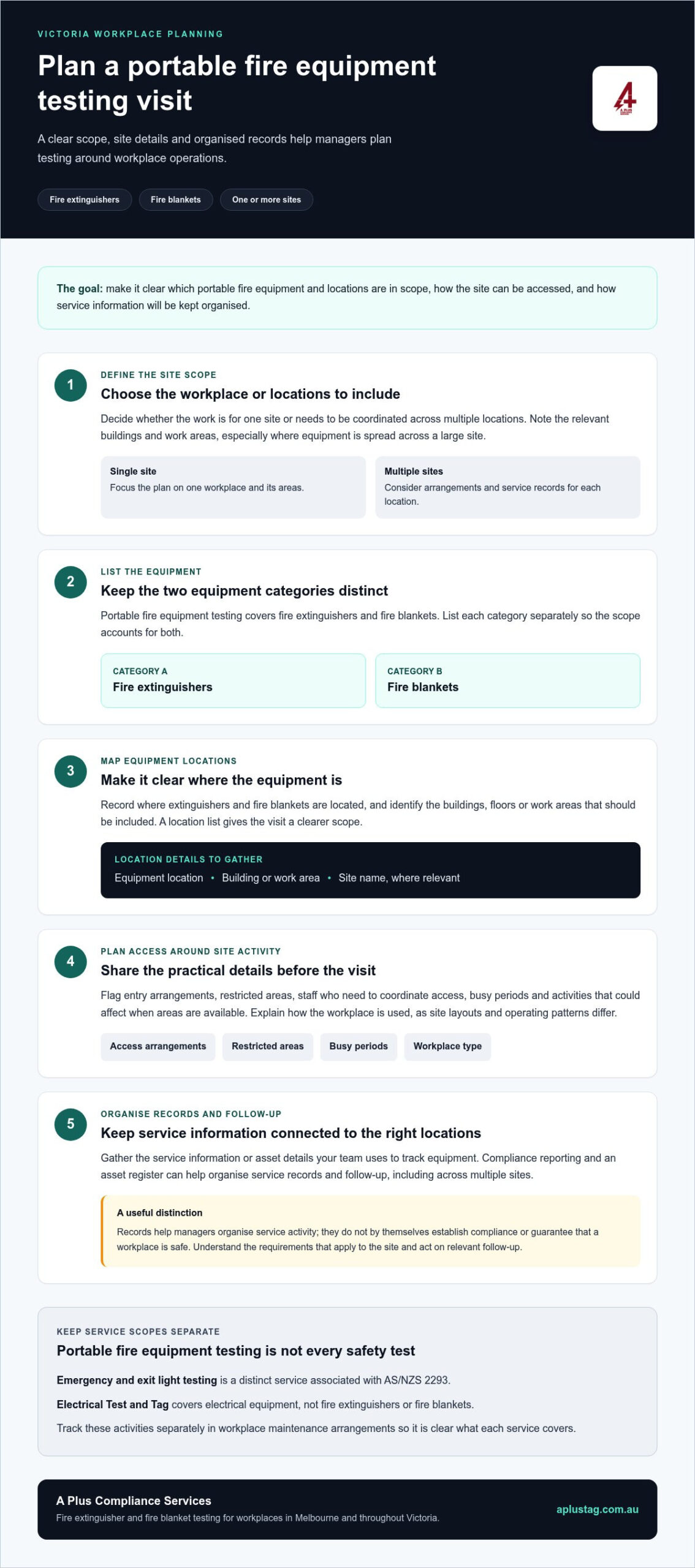
Preparation helps make a service visit easier to coordinate. For portable fire equipment testing in Victoria, start by defining the scope, locating the equipment, planning access and gathering relevant records. Share operational constraints early so arrangements can take the site’s day-to-day activity into account.
Use this sequence to get organised:
- Define the scope: Identify the fire extinguisher and fire blanket testing to be included.
- Map the locations: Note the buildings, floors or work areas where the equipment is situated.
- Plan access: Decide how the relevant areas can be accessed and who will coordinate entry.
- Gather records: Collect existing service information or asset details, if available, and note how your team manages follow-up.
This is a practical preparation list, not a mandatory document set. It helps clarify the site and the arrangements to be made before the visit.
What information should a site manager organise?
Bring together the details that clarify the scope and working conditions. A concise location list is useful when equipment is spread across buildings or work areas. Note access restrictions, busy periods, site contacts and activities that could affect when areas are available. Existing records can provide helpful context, even if they are not in a particular format.
- Site or building locations to include
- Equipment categories and their general locations
- Access arrangements and relevant site contacts
- Operating constraints or periods when access may be difficult
- Existing service records or asset information, if available
Separate details by site if your workplace has multiple locations. This makes it easier to discuss the scope, access and record-keeping for each one without mixing information together.
How can a visit minimise disruption?
Talk through site operations when planning the visit. Explain when particular areas are occupied, whether staff need to coordinate access, and which activities should be planned around. A suitable time can then be arranged with the site’s access and operational needs in mind. Planning depends on the workplace, so avoid assuming that all locations can follow the same arrangements or that disruption can be eliminated entirely.
For workplaces managing several compliance activities, coordinated support can bring service planning and records into a more organised process. A Plus Compliance Services provides fire extinguisher and fire blanket testing, as well as compliance reporting, asset registers and multi-site coordination. These services help businesses keep site arrangements and follow-up organised.
Arrange portable fire equipment testing with A Plus Compliance Services
A Plus Compliance Services provides fire extinguisher and fire blanket testing for commercial and regulated workplaces in Melbourne and throughout Victoria. To plan the work, share the equipment categories and locations to include, along with any access or operating considerations. This gives the service discussion a practical basis and helps shape arrangements around your workplace.
You can begin with the information you have. An equipment list or existing records can help clarify the scope, and the initial planning discussion can identify any other useful details. Requirements vary by workplace and equipment, so use site-specific professional guidance when establishing an appropriate testing schedule.
What can businesses discuss before arranging service?
Outline the site scope and how the workplace operates. Let the team know whether the request covers one location or several, which areas need access and what operating constraints could affect arrangements. If equipment information is incomplete, share what you have and note the gaps to work through during planning.
- Locations and buildings to include
- Whether fire extinguishers, fire blankets or both are in scope
- Access arrangements and relevant site contacts
- Operational needs that may influence timing
- Existing records or asset information that could support reporting
For one workplace, the discussion can focus on that location and its requirements. For organisations managing several locations, A Plus Compliance Services can coordinate multi-site compliance activity while accounting for each site’s arrangements.
How does ongoing compliance support fit in?
A planned service programme can help teams manage recurring work as part of broader workplace maintenance. Scheduled maintenance supports forward planning, while due-date reminders help keep upcoming requirements visible. The right approach depends on the organisation and site-specific guidance. Do not assume fire equipment testing follows the same intervals as other workplace testing.
Clear reporting and asset registers provide a structured reference for service information and follow-up. They help organisations keep records together, while managers remain responsible for understanding the requirements that apply to each site. For businesses coordinating several locations, combining service planning with reporting and asset registers can support a consistent view of activity.
For portable fire equipment testing Victoria workplaces can organise clearly, share the equipment, locations, access needs and records you want to manage. A Plus Compliance Services can discuss testing for one or multiple sites and help plan the service arrangements.
Make your next compliance step clear
Once the service scope is clear, assign someone in your organisation to keep site information together, coordinate access and pass relevant follow-up to the right people. A clear handover helps connect the work to broader workplace safety planning.
For portable fire equipment testing across Victoria, share your locations, operating needs and preferred approach to coordination. A Plus Compliance Services can discuss testing for your workplace and help organise ongoing planning. Clear information makes it easier for your team to manage decisions and follow-up.
When you’re ready, request a quote or discuss a compliance schedule with A Plus Compliance Services.
With the scope, access and records organised, your workplace can take the next step with a clearer plan.
Frequently Asked Questions
What is portable fire equipment testing?
Portable fire equipment testing covers testing of fire extinguishers and fire blankets included in the workplace service scope. Start by identifying which categories are on site and where they are located. Keep the service record linked to the relevant workplace so staff can distinguish fire equipment work from other maintenance and safety-testing activities.
Does portable fire equipment testing include fire blankets?
Yes. A Plus Compliance Services includes fire blanket testing in its portable fire equipment service. If blankets are located across different parts of a workplace, list those areas in the site information. Naming fire blankets explicitly helps define the scope and supports organised record-keeping.
How often should portable fire equipment be tested in Victoria?
There is not one testing interval that applies to every Victorian workplace. Requirements vary with the workplace, equipment type, risk assessment and applicable guidance. Do not rely on a schedule selected for a different setting. Obtain site-specific professional guidance to establish a suitable schedule and keep a record of the basis for it.
Can portable fire equipment testing be arranged outside normal operating hours?
Scheduling can be arranged around site access and operational needs. If access is easier before opening, after closing or during a quieter period, include that preference when planning the visit. Suitable timing depends on the workplace and its operating arrangements. Sharing constraints early helps coordinate access and minimise avoidable interference with staff, customers or normal site activity.
Can fire equipment testing be coordinated across multiple Victorian sites?
Yes. A Plus Compliance Services can coordinate fire equipment testing across multiple workplaces, with compliance reporting and asset registers helping organise activity. Arrangements can account for each site’s access needs rather than assuming every location is the same. Service coverage includes Melbourne and Victoria, including St Kilda, Caulfield, Oakleigh, Clayton, Springvale, Mulgrave, Dandenong, Berwick, Mount Waverley, Cranbourne, Bayswater, Notting Hill, Scoresby, Officer, Pakenham and Keysborough.
What should I have ready before arranging a fire equipment testing visit?
A list of workplace locations, equipment categories and access details is a useful starting point. Include a site contact and note operating constraints, such as areas occupied at particular times. Existing service records or asset information can provide helpful context. You can begin planning without preparing the information in a specific document format.
Is fire equipment testing the same as emergency lighting testing?
No. Fire equipment testing and emergency and exit light testing are separate workplace services. Emergency and exit light testing is associated with AS/NZS 2293, while fire equipment testing has a different scope. A visit or record for one does not cover the other. If your site needs both, list them as separate activities in maintenance planning so staff can track each service and organise relevant follow-up.
