Switchboard Thermal Imaging Benefits: Protecting Your Victorian Workplace from Invisible Risks
Did you know that electrical faults account for approximately 40% of all commercial building fires across Australia? As a facility manager or business owner, you’re likely already focused on keeping your site safe and compliant, but it’s the risks you can’t see that often cause the most significant disruption. Managing a Victorian workplace involves a constant balance between maintaining safety standards and avoiding costly downtime.
By exploring the primary switchboard thermal imaging benefits, you’ll discover how professional thermal scanning identifies hidden electrical faults before they escalate into fires, equipment failure, or complex insurance complications. It’s an essential tool for moving from reactive repairs to a more organised, preventative maintenance schedule.
This article explains how A Plus Compliance Services uses non-invasive technology to provide the clear reporting and peace of mind your organisation needs, all without interrupting your daily operations. We’ll outline how this proactive approach helps Victorian businesses reduce risk and stay organised while meeting modern insurance requirements.
Key Takeaways
- Identify hidden electrical hazards like loose connections and corroded terminals using non-invasive infrared technology before they escalate into fire risks.
- Maximise your switchboard thermal imaging benefits by scheduling scans during peak operational hours to detect faults under real-world load conditions.
- Protect your Victorian workplace from unexpected downtime and equipment failure through proactive maintenance that requires no power shutdown or operational disruption.
- Ensure your facility remains insurance-compliant with professional reports that document the safety and integrity of your electrical infrastructure.
- Learn how to integrate thermal scanning into a comprehensive safety plan alongside regular RCD testing and electrical Test and Tag services.
What is Switchboard Thermal Imaging and Why is it Essential?
Understanding What is Switchboard Thermal Imaging starts with recognising that electrical infrastructure produces heat as a natural byproduct of operation. However, excessive heat is almost always a precursor to failure. Switchboard thermal imaging is a specialised diagnostic technique that uses infrared cameras to capture and visualise these heat patterns. It allows our technicians to see exactly what’s happening behind the covers of your electrical panels without needing to touch a single wire.
This process addresses the “invisible threat” within your facility. Most electrical fires don’t start with a sudden explosion; they begin with a gradual buildup of heat caused by loose terminal connections, corroded components, or overloaded circuits. These issues generate high resistance, which creates thermal anomalies. Because these faults occur deep within the switchboard’s architecture, they remain invisible to the naked eye during a standard visual inspection. One of the primary switchboard thermal imaging benefits is the ability to detect these anomalies months before they result in a spark or a total system failure.
The Science of Infrared Thermography
Thermal cameras convert infrared radiation into a visible spectrum, creating a detailed heat map of your electrical system. When we scan a switchboard, we’re looking for “hot spots” that deviate from the expected temperature of surrounding components. This technology is far superior to traditional thermometer probes because it provides a comprehensive view of the entire board at once. It identifies precise points of resistance or friction that would be impossible to pinpoint through manual testing alone.
Non-Invasive Testing: Zero Downtime for Your Business
Perhaps the most practical of the switchboard thermal imaging benefits is that it requires absolutely no downtime. For a scan to be accurate, the switchboard must be under its normal operating load, ideally at least 40% of its capacity. This means we perform the inspection while your business is running at full tilt.
There’s no need to schedule power shutdowns or interrupt staff productivity. This makes it an ideal solution for high-uptime environments across Victoria, such as Melbourne healthcare facilities, aged-care centres, and 24/7 warehouses. A Plus Compliance Services integrates these scans into your broader safety strategy, ensuring your compliance requirements are met without any operational disruption.
Key Benefits of Regular Thermal Scanning for Switchboards
Regularly assessing your electrical infrastructure is about more than just checking a box. It’s about protecting your assets and your people. Electrical faults are a leading cause of workplace fires in Australia, accounting for approximately 40% of all commercial building fires. Research indicates that 6 out of 10 of these fires are related to issues within switchboards. By identifying overheating components early, you significantly reduce the risk of a catastrophic fire event. This proactive approach aligns with Victorian OHS obligations, which require businesses to identify and manage all electrical risks systematically. It ensures you are acting as a “safety-first” organisation that prioritises the well-being of every person on-site.
Beyond safety, one of the most practical switchboard thermal imaging benefits is the extension of your equipment’s lifespan. Excessive heat causes insulation to become brittle and components to degrade prematurely. By catching these thermal anomalies early, you can perform minor maintenance during scheduled windows rather than replacing entire sections of a switchboard after a burnout. This keeps your infrastructure in peak condition for longer and avoids the high cost of emergency hardware replacements.
Meeting Insurance Compliance Requirements
Many Australian insurers now mandate annual thermal imaging as a condition for commercial property cover. Without a professional report, a business may find their fire insurance claim voided if the cause is traced back to an unmaintained switchboard. A Plus Compliance Services provides insurance-compliant reporting that meets these strict requirements. These reports offer documented proof that you are managing your electrical risks responsibly. This documentation is often a mandatory prerequisite for securing property insurance in high-risk sectors like manufacturing or aged-care.
Preventing Unplanned Downtime and Revenue Loss
A sudden switchboard failure in an industrial hub like Dandenong or a retail centre in Clayton can halt operations instantly. The true cost of failure isn’t just the repair bill; it’s the lost revenue, idle staff, and potential damage to your reputation. Transitioning from reactive repairs to a planned maintenance model ensures operational continuity. It allows you to address minor issues before they become major crises. If you have concerns about your current electrical load or infrastructure age, you can discuss a compliance schedule with our team to keep your facility running smoothly.
Common Electrical Faults Identified by Thermal Imaging
Loose or corroded terminal connections are the primary cause of electrical fires in commercial properties. When a terminal is loose, electrical resistance increases, which generates concentrated heat at the point of contact. This heat is often invisible during a standard visual check but shows up clearly as a bright “hot spot” on an infrared camera. One of the most critical switchboard thermal imaging benefits is the ability to see these heat signatures long before the connection fails or ignites. This is particularly vital for high-risk environments like aged-care facilities or schools where fire safety is a top priority.
Corrosion is another frequent issue, especially in older Victorian buildings or facilities exposed to moisture. Over time, terminal surfaces oxidise, creating a layer of resistance that forces the system to work harder. Similarly, deteriorating insulation or damaged wiring within the cabinet can be detected through subtle temperature rises as the current struggles to flow efficiently. By identifying these issues through our compliance services, you can schedule targeted repairs during quiet periods rather than facing an emergency system failure during peak production.
Identifying Overloaded Circuits and Phase Imbalance
In many Victorian warehouses and manufacturing sites, three-phase systems are the standard for heavy machinery. If the electrical load is distributed unevenly across these phases, specific cables and components will run significantly hotter than others. This phase imbalance doesn’t just waste energy; it severely reduces the longevity of expensive equipment like electric motors and pumps. Using thermal data, we provide the insights needed to rebalance loads across the switchboard, improving both safety and energy efficiency across your entire site.
Detecting Failing Components Before They Trip
Circuit breakers, fuses, and contactors are designed to protect your system, but they aren’t immune to internal fatigue or mechanical wear. A failing component often shows a distinct thermal signature as its internal mechanisms degrade under load. One of the switchboard thermal imaging benefits is the ability to monitor the health of RCDs and switchgear while they are energised, ensuring they will actually function when a fault occurs. A professional thermographer identifies a failing busbar connection by detecting localised hot spots at bolted joints or along the conductor’s length, which signals high resistance or inadequate contact pressure. This early detection allows for a “safety-first” approach to maintenance, helping Victorian businesses reduce risk and stay organised.
The Professional Thermal Inspection Process
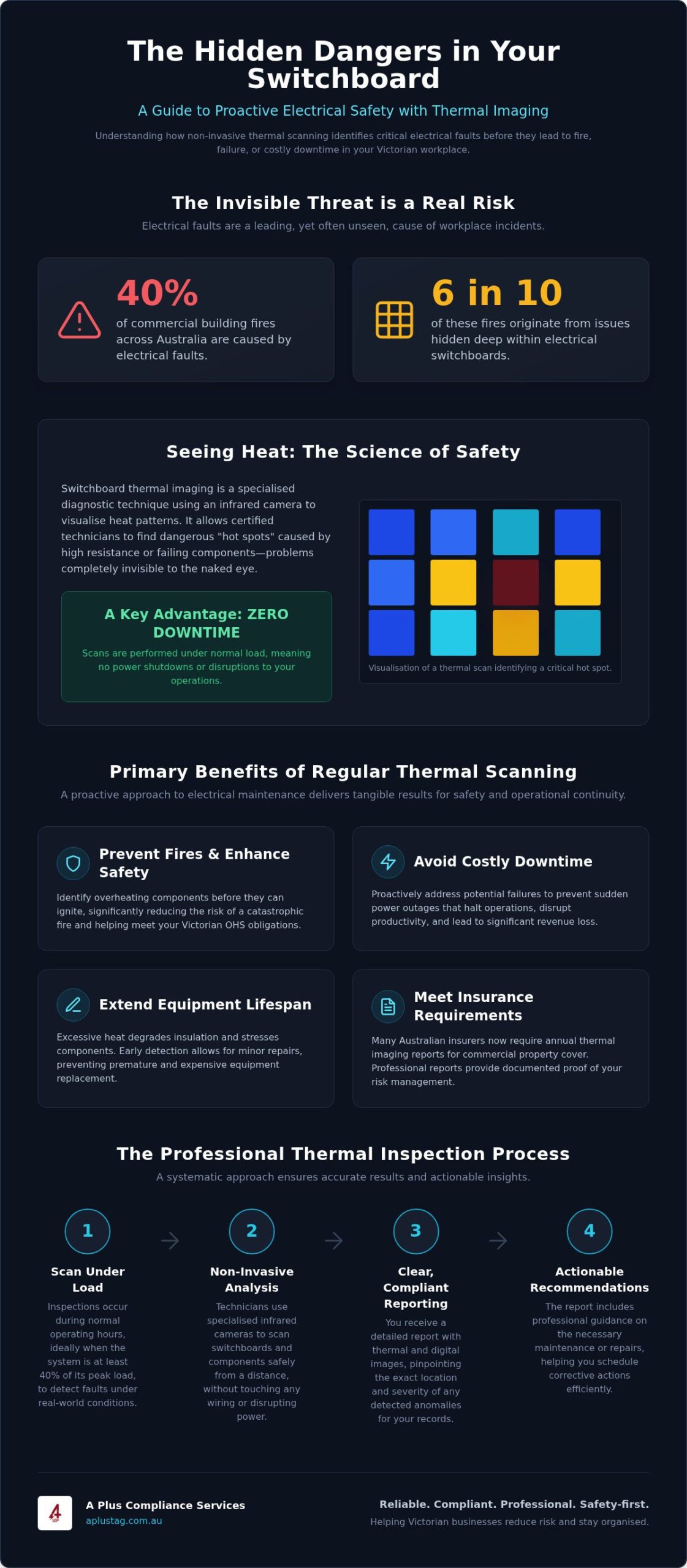
A professional inspection is a methodical, step-by-step evaluation of your electrical infrastructure. For our technicians to capture accurate data, the switchboard must be operating under a normal electrical load. Industry guidelines suggest a minimum of 40% load is necessary for thermal anomalies to become visible to the infrared sensors. This ensures that the results reflect your facility’s real-world conditions during peak operational hours. We move through each cabinet systematically, removing covers where safe and necessary to gain a clear line of sight to internal components like busbars, contactors, and terminal blocks.
Once the images are captured, the analysis phase begins. We don’t just look for “hot” components; we compare temperature rises against ambient room levels and, more importantly, against adjacent phases. A single phase running significantly hotter than the other two is a clear indicator of an unbalanced load or a loose connection. This comparative analysis is what allows us to deliver the full range of switchboard thermal imaging benefits, turning raw heat data into actionable maintenance insights.
The final stage is the creation of a comprehensive asset register. This document serves as a historical record of your equipment’s health. We include every board tested, even those with no faults, to provide a complete compliance trail. This organised approach helps Victorian businesses reduce risk and stay organised by providing a clear roadmap for future maintenance cycles.
What to Expect During Your Site Visit
Our technicians arrive punctually at your Melbourne or Berwick location, ready to integrate into your site’s specific workflow. Because the process is non-invasive, we work around your staff and operations with minimal disruption. We follow a strict safety-first approach, adhering to all site-specific OHS requirements and wearing appropriate personal protective equipment (PPE) while working near energised equipment. This professional conduct ensures a stress-free experience for facility managers who need to maintain safety without halting productivity.
Understanding Your Compliance Report
The value of our service lies in the clarity of our reporting. We categorise every identified fault into three distinct levels: Minor, Major, or Critical. This allows you to prioritise repairs based on the actual risk level. A “Critical” fault requires immediate attention to prevent fire, while a “Minor” anomaly might simply require monitoring during the next scheduled service. Each entry includes side-by-side thermal and digital photos. This visual evidence is invaluable for your electrician, as it shows them exactly which terminal or cable requires tightening or replacement, saving you time and money on diagnostic labour.
Integrating Thermal Imaging into Your Safety Strategy
Effective workplace safety is built on layers of protection. While some providers treat thermography as an isolated task, the greatest switchboard thermal imaging benefits are realised when the service is integrated into a holistic safety strategy. It doesn’t replace your standard Test & Tag services; rather, it provides a specialised layer of protection for your core infrastructure. While Test & Tag focuses on the safety of individual plug-in appliances, thermal imaging monitors the health of the switchboards that power your entire facility.
A Plus Compliance Services helps Victorian businesses reduce risk and stay organised by acting as a single, dependable partner for all safety requirements. We focus on providing clear reporting, dependable service and ongoing compliance support so you can focus on your core operations. The long-term switchboard thermal imaging benefits are most apparent when you have a history of reports to compare, allowing you to track the health of your electrical assets over several years and identify trends before they become failures.
Combining Thermal Scanning with RCD Testing
There is a powerful synergy between seeing heat anomalies and testing mechanical safety devices. Thermal imaging identifies the “invisible” heat caused by resistance, while RCD Testing ensures that your safety switches will actually trip in the event of a fault. Together, these services provide total protection for both your expensive equipment and your people. Using one professional provider for both means your safety documentation is unified, making workplace compliance easier to manage.
Scheduling and Maintenance Reminders
For multi-site organisations operating from Mulgrave to Pakenham, maintaining a consistent testing schedule is a significant challenge. Requirements for testing frequency vary based on your specific workplace, equipment type, and risk assessment. We recommend obtaining site-specific professional guidance to determine the ideal interval for your scans. We simplify this by setting up automated reminders and coordinating technicians across all your Victorian locations. This proactive approach ensures you never miss a compliance deadline or an insurance renewal requirement. You can contact A Plus Compliance Services to discuss a tailored compliance schedule that fits your operational needs.
Securing Your Infrastructure for the Long Term
Maintaining a safe and compliant workplace requires a methodical approach to electrical health. By identifying thermal anomalies before they lead to failure, you protect your facility from the leading cause of commercial fires and avoid the high costs of unplanned downtime. Professional scanning ensures your organisation remains insurance-compliant with clear, documented evidence of your preventative maintenance efforts.
The primary switchboard thermal imaging benefits include enhanced safety for your people and an extended lifespan for your electrical assets. A Plus Compliance Services is dedicated to helping Victorian businesses reduce risk and stay organised through our reliable, safety-first service delivery. Our team provides the clear reporting and dependable service across Melbourne that your facility needs to remain compliant and operational.
We look forward to becoming your long-term compliance partner and making your workplace safety easier to manage. Our experienced technicians are ready to help you maintain a professional and safety-first environment for your staff and visitors.
Frequently Asked Questions
Does switchboard thermal imaging require me to turn off the power?
No, your power stays on throughout the entire process. In fact, for a scan to be accurate, the electrical system must be operating under its normal load, typically at least 40%. This allows our technicians to identify heat patterns while the equipment is in use. This non-invasive approach is one of the key switchboard thermal imaging benefits, as it ensures zero downtime for your business operations.
How often should my business have a thermal scan performed?
The required frequency for thermal scanning varies based on your specific workplace, equipment type, and risk assessment. Most commercial insurers in Victoria recommend an annual inspection as a minimum standard for property protection. However, high-risk environments like healthcare facilities or large manufacturing plants may require more frequent testing. We recommend obtaining site-specific professional guidance from our team to establish an appropriate compliance schedule for your facility.
Will thermal imaging satisfy my insurance company’s requirements?
Yes, professional thermal imaging is increasingly a mandatory requirement for commercial property and fire insurance policies in Australia. Insurers often require a compliant report from a qualified technician to provide cover for electrical fire risks. A Plus Compliance Services provides the detailed, professional documentation that insurers demand. This proactive reporting helps you avoid insurance complications and ensures you meet your policy obligations without any stress or confusion.
What is the difference between thermal imaging and a standard electrical inspection?
A standard electrical inspection is primarily visual and manual, meaning it can only identify faults that are visible to the naked eye. Thermal imaging uses infrared technology to detect “invisible” heat build-up caused by loose connections or overloaded circuits while the board is energised. It provides a deeper level of diagnostic insight that traditional testing misses. This technology allows us to catch potential failures months before they cause a fire or equipment breakdown.
Can thermal imaging detect faults in older Victorian switchboards?
Yes, thermal imaging is exceptionally effective for older electrical infrastructure. Over time, terminal connections can loosen and components can degrade, which are common issues in older Melbourne buildings. Thermal scanning identifies these points of resistance and heat build-up before they lead to a total system failure. It’s an essential tool for managing the safety of aging switchboards while helping Victorian businesses reduce risk and stay organised through planned maintenance.
What happens if the technician finds a critical fault during the scan?
If a critical fault is identified, our technician will immediately notify your site manager or facility coordinator. The issue is clearly recorded and categorised in your compliance report with digital and thermal photos. This allows you to arrange for a licensed electrician to perform targeted repairs or replacements promptly. Our goal is to provide clear reporting and dependable service so you can maintain a safe environment and an accurate compliance record.
Is thermal imaging mandatory for Victorian workplaces under OHS law?
While thermal imaging is not explicitly named as a standalone requirement in OHS legislation, employers have a general duty of care to identify and manage all electrical risks. Thermal scanning is a recognised and highly effective method for meeting these obligations. Because it detects fire risks that other tests miss, it’s considered a best-practice safety measure. Many Victorian organisations use these scans to demonstrate they are taking every reasonable step to ensure workplace safety.
How long does a typical thermal scan take for a medium-sized office?
A typical thermal scan for a medium-sized office in Melbourne or Dandenong usually takes between one and two hours. The exact duration depends on the number of distribution boards and the accessibility of your electrical panels. Because the process is non-invasive and requires no power shutdown, our technicians can complete the work around your staff with minimal disruption. We pride ourselves on being punctual and professional, ensuring a smooth experience for your facility.
