
The Real Cost of Electrical Non-Compliance in Australia: 2026 Business Guide
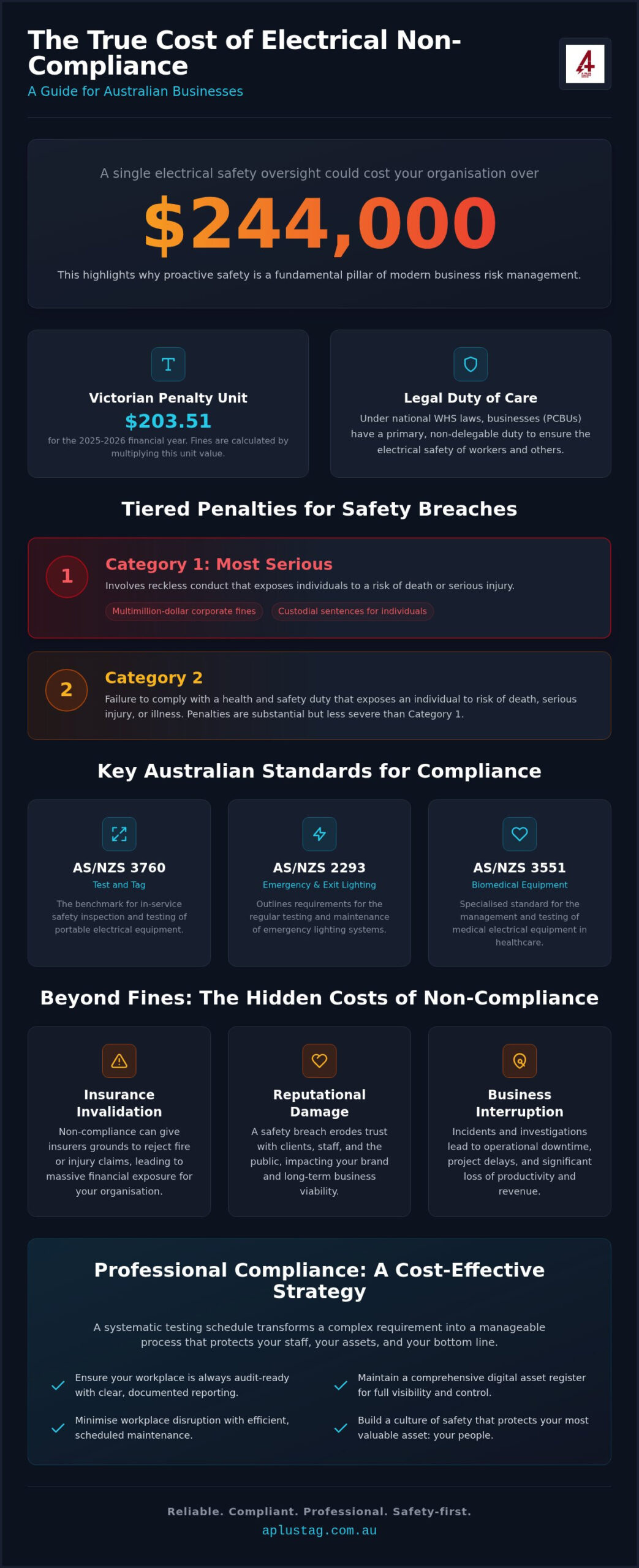
Would your organisation be prepared to manage a penalty exceeding $244,000 for a single electrical safety oversight? With the Victorian penalty unit value rising to $203.51 for the 2025-2026 financial year, the financial cost of electrical non-compliance in Australia has reached a level that no facility manager or business owner can afford to ignore. While it’s common to view routine testing as an administrative burden, the reality is that proactive safety is now a fundamental pillar of business continuity and risk management.
We recognise that balancing strict safety obligations against operational budgets can be challenging, especially when Australian Standards feel complex or contradictory. You likely want to ensure total compliance without causing unnecessary downtime during the workday. This guide provides the clarity you need to navigate these requirements, protecting your staff and your bottom line. We’ll examine the latest regulatory enforcement trends, the impact of documented compliance on insurance premiums, and how a systematic testing schedule can transform a complex requirement into a manageable, professional process that keeps your workplace running smoothly.
Key Takeaways
- Understand the tiered penalty system under national WHS laws and how directors can be held personally liable for electrical safety oversights.
- Discover why non-compliance often gives insurers grounds to reject fire or injury claims, which can lead to significant financial exposure for your organisation.
- Learn how to accurately evaluate the total cost of electrical non-compliance in Australia by looking beyond immediate fines to long-term business continuity.
- Identify the value of digital asset registers and clear reporting in ensuring your workplace remains audit-ready and compliant with current Australian Standards.
- Explore how a professional compliance partner minimises workplace disruption while maintaining essential safety systems, including RCDs and emergency lighting.
Understanding Electrical Non-Compliance in the Australian Workplace
Electrical non-compliance occurs when a business fails to meet the safety requirements established by Australian law and specific technical Standards. It isn’t merely a matter of missing paperwork; it represents a fundamental break in the safety systems designed to protect your staff and visitors. The cost of electrical non-compliance in Australia often begins with a single overlooked inspection and can escalate into severe legal and financial consequences. Maintaining alignment with Australian electrical codes is the only way to ensure your facility remains safe and operational.
To better understand how non-compliance affects your business, watch this helpful video:
Effective compliance is an ongoing cycle rather than a one-off event. A single certificate provides a snapshot in time, but equipment wears down and environments change. Regular testing ensures that safety measures, such as RCDs and emergency lighting, remain functional throughout their service life. This systematic approach transforms safety from a source of anxiety into a predictable, manageable part of your business operations.
The Legal Framework: WHS and Electrical Safety Acts
National model Work Health and Safety (WHS) laws provide a consistent framework for workplace safety across most of Australia. These laws place a clear “Duty of Care” on the Person Conducting a Business or Undertaking (PCBU). This responsibility cannot be delegated or ignored. A PCBU’s primary electrical safety obligation is to ensure, so far as is reasonably practicable, that workers and other persons are not put at risk from the electrical work or equipment within the workplace. Failure to uphold this duty can result in significant legal action, even if an accident hasn’t yet occurred.
Key Australian Standards for Commercial Compliance
Navigating the various Standards is simpler when you focus on the specific requirements of your industry. While AS/NZS 3000 sets the foundation for electrical installations, several other Standards govern ongoing safety. Accessing professional compliance services helps you identify which of the following apply to your site:
- AS/NZS 3760: This is the benchmark for the in-service safety inspection and testing of electrical equipment, commonly known as Test and Tag.
- AS/NZS 2293: This Standard outlines the requirements for the regular testing and maintenance of emergency and exit lighting systems.
- AS/NZS 3551: This specialised Standard governs the management and testing of medical electrical equipment in healthcare settings.
By following these established paths, you reduce the total cost of electrical non-compliance in Australia and build a workplace culture that prioritises the long-term well-being of everyone on-site.
The Immediate Financial Impact: Fines and Legal Penalties
When an incident occurs or a regulatory audit reveals a breach, the financial consequences are immediate and often severe. The cost of electrical non-compliance in Australia is structured to reflect the severity of the risk and the level of negligence involved. In Victoria, the value of a penalty unit for the 2025-2026 fiscal year is $203.51. Because fines are calculated by multiplying this unit value, even seemingly minor administrative oversights can quickly escalate into substantial financial liabilities for your organisation.
Tiered Penalties for Safety Breaches
Regulators use a tiered system to categorise offences based on the level of risk and conduct. Category 1 is the most serious, involving reckless conduct that exposes individuals to a risk of death or serious injury. These breaches can result in custodial sentences for individuals and multimillion-dollar fines for corporations. Understanding the tiered cost of electrical non-compliance in Australia helps managers prioritise high-risk areas before they become legal liabilities.
Category 2 offences occur when a business fails to comply with a health and safety duty, exposing an individual to a risk of death or serious injury. For a corporation that knowingly performs unsafe electrical work, the potential penalty can reach 1,200 penalty units, which is approximately $244,212. Category 3 covers general failures to comply with WHS duties without specific exposure to risk. Even without an injury, individuals can face potential penalties of up to $48,842 for certain offences under the Electricity Safety Act 1998.
The Cost of Legal Defence and Investigations
The headline fine is rarely the only expense. When WorkSafe or Energy Safe Victoria launches an investigation, the process can halt operations for days or weeks while inspectors examine equipment and records. This interruption leads to lost productivity that often exceeds the value of the fine itself. You’ll also need to engage specialist legal counsel to manage court proceedings, adding a significant layer of unbudgeted expense to your operations. In some instances, a regulator might accept an “Enforceable Undertaking” instead of prosecution. While this avoids a criminal conviction, it requires a legally binding commitment to fund safety projects or community training, which can be just as costly as a traditional fine.
Recent enforcement examples highlight these risks. In May 2026, a construction company was fined $90,000 after a worker suffered an electric shock. Only a few months later, in August 2026, an electrical firm was fined $40,000 simply for exposing an apprentice to a fall risk, even though no injury occurred. These cases demonstrate that regulators are increasingly proactive and maintain a low tolerance for safety gaps. To protect your organisation from these avoidable expenses, it’s a good idea to arrange a professional compliance assessment to identify potential gaps in your safety strategy.
The Hidden Costs: Insurance, Reputation, and Continuity
While government fines represent a visible financial hit, the hidden cost of electrical non-compliance in Australia often carries a much heavier long-term burden. Many organisations focus solely on avoiding prosecution, yet they overlook how a single safety breach can ripple through their insurance standing and brand reputation. These secondary effects don’t just cost money; they can threaten the very viability of a business. When safety is treated as a low priority, the resulting instability creates a cycle of reactive spending and operational uncertainty.
Reputational damage is particularly difficult to quantify but nearly impossible to reverse. In the age of instant digital reporting, a publicised safety incident or a WorkSafe conviction becomes a permanent part of your brand’s history. For businesses in sectors like aged care, education, or healthcare, this loss of trust can lead to a significant decline in client enrolments or contracts. Beyond external perceptions, a poor safety culture erodes staff morale. Employees who feel their physical safety isn’t a priority are less productive and more likely to seek opportunities elsewhere, leading to higher recruitment and retraining costs.
Insurance Implications of Neglecting AS/NZS 3760
Most Australian business insurance policies contain a “reasonable precautions” clause. This requires the policyholder to take all practical steps to prevent injury or damage. If a fire is traced back to a faulty appliance that hasn’t been tested according to AS/NZS 3760, your insurer may have grounds to reduce or entirely reject your claim. Without a professional asset register to prove your testing history, you’re left with no evidence to support your side of the dispute.
Ensuring your facility undergoes regular rcd testing can prevent catastrophic fire damage and provide the necessary documentation to resolve insurance disputes quickly. Beyond the risk of a rejected claim, a history of non-compliance or frequent minor incidents leads to higher premiums. Insurers view a lack of documentation as a sign of high risk, which directly influences the cost of your public liability and WorkCover policies. Maintaining a systematic safety record is a direct investment in lowering these recurring overheads.
Operational Downtime and Loss of Productivity
Business continuity relies on predictable equipment performance. Relying on emergency repairs is significantly more expensive than investing in scheduled maintenance, as reactive fixes often involve premium call-out fees and extended periods of downtime. If a regulator seizes equipment during an investigation or authorities cut power due to an unsafe installation, your entire operation could grind to a halt for weeks. The cost of electrical non-compliance in Australia includes these lost hours of productivity, which are rarely recoverable. A proactive strategy ensures that equipment issues are identified and resolved during quiet periods, minimising disruption to your daily service delivery.
Building a Cost-Effective Compliance Strategy
Moving from risk awareness to active management is the most effective way to lower the long-term cost of electrical non-compliance in Australia. A reactive approach, where testing only occurs after an internal reminder or a safety incident, often leads to missed deadlines and expensive, last-minute call-outs. Instead, building a structured strategy ensures safety remains a background process that supports your daily operations. By consolidating your requirements into a single service cycle, you minimise site visits and create a predictable budget for the year ahead.
Choosing a compliance partner who acts as a dependable ally rather than a distant contractor is vital. A professional partner doesn’t just apply tags; they provide the systematic management needed to keep a Victorian business organised. This includes coordinating different safety streams, such as Test and Tag, RCD testing, and fire safety inspections, into a streamlined schedule that respects your operational hours and reduces staff disruption.
Determining Your Testing Intervals
Testing frequencies aren’t one-size-fits-all. Requirements vary significantly based on the equipment type and the specific workplace environment. A construction site or a high-traffic workshop involves harsher conditions than a standard corporate office, necessitating more frequent inspections under AS/NZS 3760. A professional risk assessment helps determine the appropriate cycle for your site, ensuring you don’t over-test low-risk items while never neglecting high-usage machinery. Utilising compliance monitoring ensures you never miss a deadline, as automated systems track every asset and alert you well before a certificate expires.
The Value of Detailed Compliance Reporting
A simple tag on a power cord is only a small part of the process. The real protection for your organisation lies in the documentation that supports it. Professional compliance reporting provides a clear, digital audit trail that can be produced instantly during a WorkSafe investigation or an insurance query. A comprehensive report should include a detailed asset register, individual test results for every item, and a clear list of any failed equipment that requires immediate isolation or repair.
This digital register allows facility managers to track the lifecycle of their assets, identifying equipment that frequently fails or is nearing the end of its reliable service life. Clear documentation simplifies the process for site managers, removing the guesswork from safety audits and ensuring you remain in a state of constant readiness. This high level of organisation reinforces your role as a proactive PCBU and provides the transparency required by modern Australian Standards.
Why Professional Compliance Support is the Best Investment
Choosing between a basic “tagging” service and a professional compliance partner is the difference between meeting a minimum requirement and securing your business’s future. While a one-off contractor might provide the necessary tags, a dedicated partner implements a systematic safety programme that evolves with your organisation. This long-term approach is the most effective way to manage the cost of electrical non-compliance in Australia, as it replaces the stress of last-minute repairs with a predictable, documented cycle of safety.
A Plus Compliance Services: Clear, Reliable, and Professional
We prioritise a stress-free experience for our clients by focusing on punctuality and clear communication. Our service delivery is designed to minimise disruption to your daily operations, allowing your staff to remain productive while we ensure your equipment meets the relevant Australian Standards. Whether you manage a single site or a multi-site organisation, we provide a coordinated testing programme that ensures consistency and transparency across your entire asset register.
Our commitment to being a dependable partner includes providing automated due-date reminders for recurring maintenance. This proactive management removes the administrative burden from facility managers, ensuring that testing for RCDs, emergency lighting, and biomedical equipment never falls behind schedule. By handling these technical details with precision, we help business owners focus on their core work with the confidence that their legal obligations are fully met.
Securing Your Compliance Future
Moving from a reactive safety model to a proactive compliance schedule provides immediate benefits for your bottom line. A structured maintenance plan often leads to lower insurance premiums and extends the service life of your electrical assets. It also eliminates the unbudgeted expenses associated with emergency repairs and regulatory fines. Our methodical process leads you from a state of uncertainty toward a state of organised control, reflecting a business model built on precision and reliability.
For a more detailed look at how these processes work on-site, you can explore our Test and Tag Services guide. This resource provides a deeper dive into the specific requirements of AS/NZS 3760 and how we apply these Standards to protect your workplace. If you’re ready to transition toward a more secure safety strategy, requesting a comprehensive site assessment is the first step toward a more professional, safety-first environment. Our team is ready to discuss a tailored compliance schedule that meets the unique needs of your facility and equipment.
Securing Your Workplace with Systematic Compliance
Managing the long-term safety of your facility is a continuous responsibility that extends far beyond a single inspection. By establishing a recurring testing schedule, you protect your organisation from the immediate financial impact of regulatory penalties and the hidden risks of rejected insurance claims. Minimising the total cost of electrical non-compliance in Australia requires a shift from reactive repairs to a professional, documented strategy that ensures every asset remains safe and operational.
A Plus Compliance Services acts as your dependable ally, offering specialised expertise in RCD testing and biomedical equipment safety alongside comprehensive AS/NZS 3760 compliance reporting. Our methodical approach provides the clear audit trail you need for total peace of mind while reducing the administrative burden on your management team. We’re committed to building a reliable, long-term compliance partnership that keeps your workplace organised and safe.
Taking this proactive step today ensures your business remains resilient, compliant, and focused on its core goals for years to come.
Frequently Asked Questions
What are the maximum fines for electrical non-compliance in Australia?
Penalties for non-compliance are structured around a tiered system that reflects the severity of the risk. In Victoria, for the 2025-2026 financial year, the value of a penalty unit is $203.51. A corporation found guilty of a Category 2 offence can face up to 1,200 penalty units, totalling approximately $244,212. These figures represent the direct cost of electrical non-compliance in Australia, highlighting the importance of maintaining rigorous safety standards across your organisation.
Does my business insurance cover accidents if my equipment is not tested and tagged?
Standard Australian business insurance policies often include a “reasonable precautions” clause. This means that if an incident occurs involving equipment that hasn’t been tested and tagged according to AS/NZS 3760, your insurer might reject your claim. Without professional documentation, such as a clear asset register, you lack the evidence needed to prove you met your duty of care. Regular testing is therefore an essential part of protecting your financial interests.
How often does a commercial office need to perform RCD testing?
Testing frequencies for Residual Current Devices (RCDs) depend on the specific workplace environment and the type of equipment being protected. In a typical commercial office, push-button tests are often required every six months, with operating time tests conducted every two years. However, these requirements vary based on the workplace and equipment type. We always recommend obtaining site-specific professional guidance to ensure your compliance schedule aligns with current Australian Standards.
Can a business manager be held personally liable for an electrical accident?
Yes, business owners, directors, and managers can face personal liability under the Work Health and Safety (WHS) Act. As a “Person Conducting a Business or Undertaking” (PCBU), you have a non-delegable duty to ensure the safety of your workplace. Failure to manage electrical risks can lead to individual fines of up to $48,842 for certain offences. In extreme cases involving reckless conduct, individuals may even face custodial sentences under Category 1 provisions.
What is the difference between AS/NZS 3760 and AS/NZS 3000?
AS/NZS 3000, commonly referred to as the “Wiring Rules,” sets the standard for the design, construction, and verification of electrical installations. AS/NZS 3760 focuses specifically on the in-service safety inspection and testing of electrical equipment. Essentially, AS/NZS 3000 ensures that your building’s electrical framework is installed safely, while AS/NZS 3760 ensures that the appliances and devices you plug into that framework remain safe for continued use by your staff.
Will regular electrical testing disrupt my business operations?
Professional compliance testing is designed to be a systematic and methodical process that minimises impact on your business operations. Technicians typically test items individually, ensuring that power interruptions are brief and localised to specific workstations. By partnering with an experienced service provider that values punctuality and clear communication, you can ensure your workplace stays organised and safe without suffering significant downtime or loss of productivity during the testing cycle.
What happens if a piece of equipment fails a safety test?
When a piece of equipment fails a safety test, it must be immediately isolated and withdrawn from service to prevent accidental use. The technician will attach a highly visible “Caution: Do Not Use” tag and document the failure in your asset register. You must then decide whether to have the item repaired by a qualified professional or disposed of safely. This immediate action is a key part of managing the cost of electrical non-compliance in Australia.
Is an asset register legally required for electrical compliance?
While not always explicitly named as an “asset register” in basic regulations, Australian Standards like AS/NZS 3760 require detailed record-keeping of all safety inspections. A professional digital asset register is the most effective way to meet this obligation. It provides a clear, transparent audit trail that is essential for WorkSafe investigations, insurance claims, and internal safety audits, ensuring your organisation remains in a state of constant readiness and professional control.
