AS/NZS 3760 Compliance Requirements: The 2026 Workplace Safety Guide
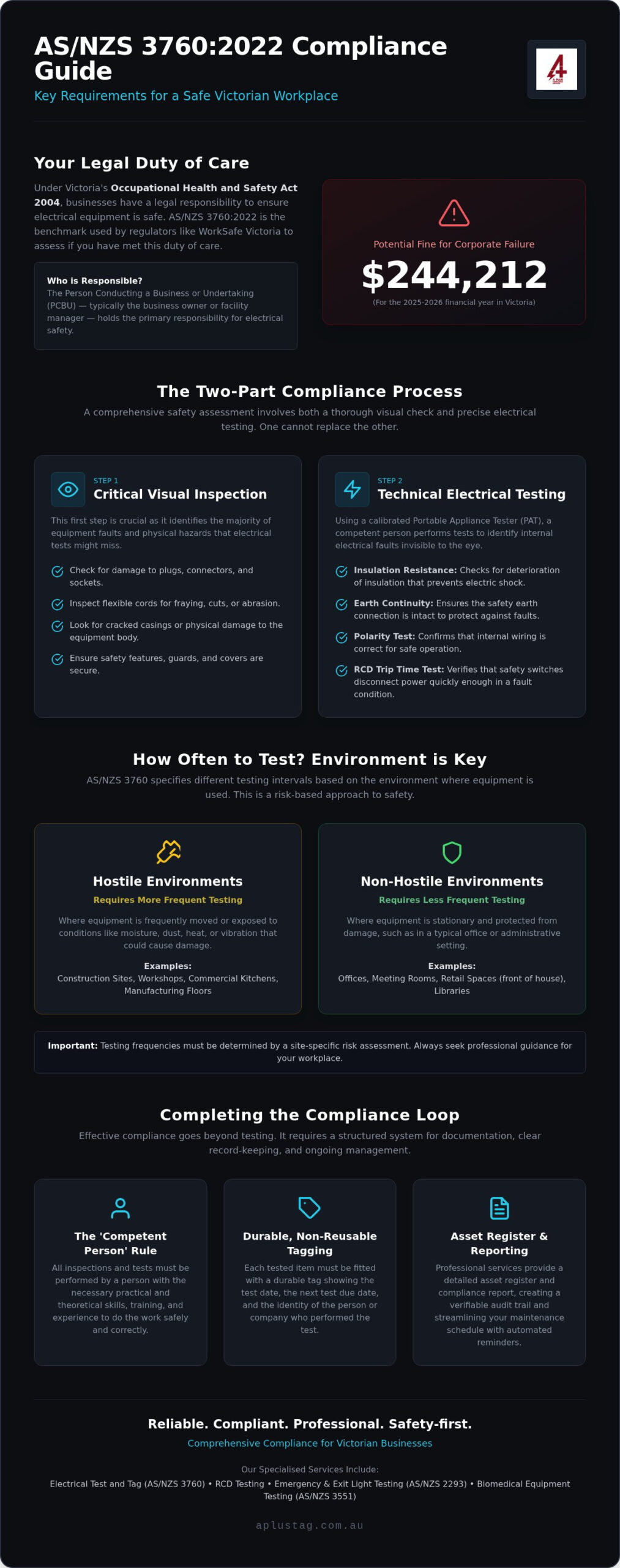
In Victoria, a corporate failure to maintain safe electrical equipment can result in fines reaching up to $244,212 for the 2025-2026 financial year. While these penalties are substantial, the real challenge for most operations managers isn’t a lack of commitment to safety; it’s the technical complexity of the regulations themselves. Managing AS/NZS 3760 compliance requirements often feels like a balancing act between interpreting jargon and keeping a busy workplace running smoothly. You’ve likely felt the uncertainty of an upcoming safety audit or wondered if your current testing frequencies truly align with the latest 2022 benchmarks.
We believe that workplace safety should be a source of confidence rather than a cause for stress. This guide simplifies your legal obligations and the technical specifics of electrical safety testing under the current Australian Standards. We’ll clarify exactly which items require testing, how often they need attention based on your specific environment, and how to minimise disruption through organised compliance records. By following this structured approach, you’ll ensure your workplace remains a safe environment for your employees while establishing a dependable system for long-term risk management.
Key Takeaways
- Understand how AS/NZS 3760:2022 serves as the primary benchmark for meeting your legal duty of care regarding electrical safety.
- Learn why a thorough visual inspection is just as critical as technical testing for identifying hazards and preventing workplace incidents.
- Identify the specific AS/NZS 3760 compliance requirements for your site by distinguishing between hostile and non-hostile equipment environments.
- Recognise the importance of the “competent person” rule and the role of durable, non-reusable tagging in maintaining accurate safety records.
- Discover how automated due-date reminders and professional asset registers can streamline your compliance schedule and minimise operational disruption.
Understanding AS/NZS 3760:2022 and Your Duty of Care
AS/NZS 3760:2022 is the current Australian Standard for in-service safety inspection and testing of electrical equipment. It provides a structured framework to ensure that appliances remain safe for use throughout their functional lifespan. The Standard specifically applies to portable electrical equipment connected to the electrical supply by a flexible cord or connecting device. By adhering to these AS/NZS 3760 compliance requirements, businesses can significantly reduce the risk of electric shock and workplace fires caused by faulty equipment.
Regular Portable appliance testing isn’t just about ticking a box; it’s a vital part of a proactive safety culture. Instead of waiting for a fault to cause an injury or a fire, a systematic testing regime identifies damaged insulation, internal faults, or earthing issues before they become life-threatening. Statistics from the Australian Institute of Health and Welfare show there were 14 deaths due to electric current in the 2023-24 period, highlighting that electrical hazards remain a serious workplace concern.
To better understand how these standards apply to your everyday operations, watch this helpful video:
The Legal Framework for Electrical Safety
The Standard supports national Work Health and Safety (WHS) legislation and, in Victoria, the Occupational Health and Safety Act 2004. While the Standard itself isn’t a law, regulators like WorkSafe Victoria use it as the benchmark to determine if an employer has met their legal obligations. The 2022 update encompasses any electrical equipment designed for connection to a low voltage supply by a flexible cord, including appliances, power tools, and extension leads. Transitioning from a reactive “fix it when it breaks” mindset to a proactive testing schedule ensures you’re always prepared for a safety audit.
Who is Responsible for Compliance?
Under Australian law, the Person Conducting a Business or Undertaking (PCBU) holds the primary duty of care. This means business owners and facility managers are responsible for ensuring all electrical equipment is safe and regularly maintained. You must take all “reasonably practicable” steps to eliminate or minimise risks. Meeting AS/NZS 3760 compliance requirements involves more than just hiring a contractor; it requires a structured compliance monitoring strategy to track testing intervals and keep accurate asset registers. Professional testing provides the documentation needed to prove you’ve met these responsibilities if an incident ever occurs.
Core Compliance Requirements: Visual Inspection and Electrical Testing
Adhering to AS/NZS 3760 compliance requirements involves a rigorous two-part assessment: a physical visual inspection followed by technical electrical testing. You cannot rely on one without the other. While a machine can measure electrical resistance, it cannot see a cracked casing or a frayed cord that might fail tomorrow. This dual approach ensures that equipment is both electrically sound and physically intact, providing a comprehensive safety net for your workforce.
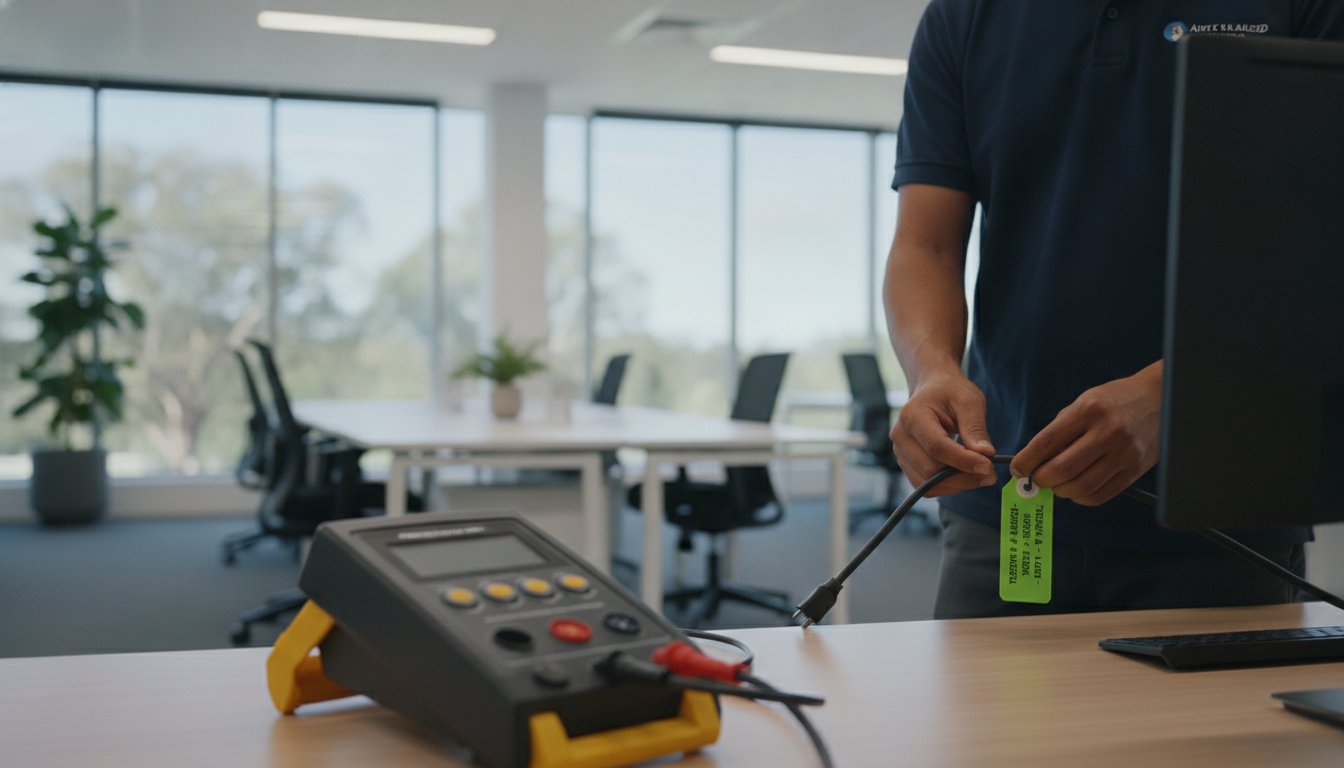
A calibrated Portable Appliance Tester (PAT) is the industry standard for these checks. These devices provide precise readings that manual testing simply cannot replicate. By using a PAT, technicians can store data for every item, which forms the basis of your compliance reporting and asset registers. If you’re unsure whether your current equipment meets these standards, you can speak with our team to arrange a site assessment.
The Visual Inspection Checklist
Professional technicians often identify the majority of equipment faults during the visual inspection phase. This stage is critical because it catches physical hazards that electrical tests might miss. Technicians follow a systematic checklist to ensure nothing is overlooked. Key focus areas include:
- Frayed, worn, or damaged cord insulation that exposes internal wiring.
- Plugs with bent pins, loose connections, or cracked covers.
- Evidence of overheating, such as discolouration or burn marks on the casing.
- Presence of legible safety labels and clear identification markings.
Technicians also check for “piggybacking,” where multiple power boards or adapters are plugged into one another. This is a common fire hazard in many offices. For a successful test, all equipment must be clean and easily accessible. Items hidden behind heavy furniture or covered in debris may be skipped, leaving a gap in your safety records.
Technical Testing Procedures
Once an item passes the visual check, it undergoes technical testing. These tests vary depending on the equipment’s construction. For Class I equipment, which includes earthed appliances like kettles or metal-cased tools, technicians perform an earth continuity test. This ensures the earth wire can safely carry current to the ground in a fault. For Class II items, which are double-insulated and lack an earth wire, the focus shifts to an insulation resistance test to ensure the protective casing is effective.
Polarity checks are mandatory for all extension leads, power boards, and detachable cords. This test confirms that the active and neutral wires are connected to the correct pins. Incorrect wiring can leave an appliance “live” even when it appears switched off, creating a severe shock risk. Every result is recorded, providing the transparency needed for your long-term safety management.
Determining Testing Intervals and Frequency for Your Workplace
Understanding how often to test your equipment is essential for maintaining a valid safety schedule. AS/NZS 3760 compliance requirements specify testing intervals based on the equipment’s environment rather than the item itself. A drill used on a construction site faces far more stress than a computer in a climate-controlled office. Consequently, the Standard mandates different frequencies to account for these varying levels of risk and potential for damage.
For the highest-risk environments, such as construction and demolition sites, testing must occur every 3 months. In these settings, equipment is frequently exposed to moisture, dust, and physical impact. Factories, warehouses, and commercial kitchens typically fall into a 12-month cycle. Conversely, low-risk environments where equipment is not subject to flex or harsh conditions, like a typical office space, often require testing only once every 5 years. It’s vital to remember that these are minimum recommendations; a site-specific risk assessment may reveal that more frequent testing is necessary for your particular operation.
Environmental Risk Assessment
A “hostile environment” is defined by factors that increase the likelihood of equipment damage or electrical failure. This includes exposure to heat, vibration, moisture, or corrosive chemicals. Regular usage also plays a role. A tool used daily will degrade faster than one used once a month. Conducting a thorough risk assessment helps you determine if your site requires more frequent testing than the minimum recommendations. For a deeper look at how these rules apply to different sectors, consult our Ultimate Guide to Test and Tag Services.
RCD Testing Requirements
Residual Current Devices (RCDs) are your primary defence against electric shock, but they must be functional to provide protection. Compliance involves two distinct types of checks. The first is a simple push-button test that users can perform to ensure the mechanism trips. However, the Standard also requires professional operating time tests. These measure exactly how long the device takes to cut power during a fault, ensuring it meets the required safety thresholds.
Professional RCD testing ensures these devices trip within the millisecond limits required by Australian Standards. Failing to maintain these devices can lead to catastrophic outcomes if a fault occurs. Because requirements vary based on the workplace and equipment type, we always recommend obtaining site-specific professional guidance to stay organised and safe. This methodical approach to testing ensures your safety systems are proactive rather than reactive.
Documentation, Tagging, and the Competent Person Rule
Meeting AS/NZS 3760 compliance requirements requires more than just the act of testing; it demands meticulous record-keeping and clear visual identification. Every item that passes must be fitted with a durable, non-reusable tag. These tags act as a quick-reference safety status for employees and contractors. At a minimum, each tag must display the test date, the scheduled re-test date, and the technician’s unique identification. This transparency ensures that any staff member can verify an appliance’s safety at a glance.
While the tag provides immediate information, the asset register is your primary defence during a safety audit or insurance claim. A professional register should include a unique ID for every appliance, its description, its location, the specific test results, and a chronological history of its compliance. This documentation provides the evidence required to prove you’ve fulfilled your duty of care. Without these records, a business remains vulnerable to legal scrutiny even if the physical testing was performed.
What Makes a Person Competent?
The Standard specifies that testing must be conducted by a “competent person.” This isn’t necessarily a licensed electrician, but someone who has acquired the necessary skills through training, qualification, or experience. They must understand how to operate the testing equipment and interpret the results correctly. Many Victorian businesses choose professional compliance services rather than training in-house staff. This approach ensures that technicians are fully updated on the latest 2022 Standard changes and possess the specialised tools required for accurate, high-volume reporting.
Managing Failed Equipment
When an item fails either a visual or technical test, the protocol must be immediate and decisive. The technician must apply a highly visible “Danger” or “Out of Service” tag and remove the item from the workspace. It’s the PCBU’s responsibility to ensure these items aren’t accidentally put back into use. Failed equipment must either be repaired by a qualified professional or disposed of safely to prevent future hazards. Every failure must be recorded in your compliance report. This creates a transparent paper trail that shows you’re actively managing risks rather than ignoring them.
Organising Your Compliance Schedule with A Plus Compliance Services
Managing AS/NZS 3760 compliance requirements across a complex organisation or multiple locations requires a systematic approach that goes beyond basic testing. A Plus Compliance Services acts as a dedicated partner, shifting your safety strategy from a reactive task to a streamlined, recurring cycle. We understand that for facility and operations managers, the primary difficulty lies in tracking due dates across thousands of individual assets. Our service model is designed to remove this burden through a proactive management system that prioritises reliability.
We provide automated due-date reminders to ensure that no testing cycle is missed, which is essential for maintaining continuous compliance. For businesses with multiple sites across Australia, we coordinate testing schedules to provide a unified reporting structure. This centralised management simplifies the audit process, as all records are kept in a consistent, easily accessible format. By consolidating your compliance needs, you gain a clear overview of your safety status across the entire business footprint, ensuring that every site meets the same high professional standards.
Comprehensive Safety Reporting
Following every site visit, we provide clear and professional reports that detail the status of every electrical asset. These digital asset registers allow facility managers to track equipment throughout its functional lifecycle, from initial commissioning to final disposal. This level of documentation is critical for demonstrating a proactive approach to safety during WorkSafe audits or when discussing insurance renewals. It replaces confusing manual logs with a transparent, digital trail that’s both accurate and easy to navigate at any time.
Our technicians operate with a methodical and professional approach, ensuring that safety checks are thorough while causing minimal disruption to your daily operations. We recognise that your business needs to remain productive. By scheduling work at appropriate times and maintaining a steady pace, we help you meet your legal obligations without compromising your output. This organised process leads your team from a state of potential uncertainty toward a state of total control over your workplace safety environment.
Beyond Electrical: A Holistic Compliance Approach
A truly safe workplace requires looking at the broader regulatory landscape. In addition to electrical testing, integrating emergency lighting standards into your maintenance schedule ensures that your site is prepared for any critical event. Managing multiple safety requirements through a single point of contact reduces administrative overhead and ensures that no specialised testing interval is overlooked. This holistic strategy provides a more robust safety net for your employees and visitors alike.
Choosing a long-term compliance partner means you aren’t just buying a tag; you’re investing in a reliable system of risk reduction. We focus on building dependable relationships based on punctuality and technical proficiency. We invite you to discuss your specific site requirements with our team to arrange a comprehensive assessment. This allows us to determine the most effective testing intervals for your environment and help you stay organised for the years ahead.
Securing Your Workplace with Consistent Compliance
Maintaining a safe workplace is a continuous cycle of assessment and documentation rather than a one-off task. By accurately identifying the hostile or non-hostile nature of your environment, you can establish testing frequencies that protect your staff and satisfy regulatory expectations. Effective risk management relies on the combination of thorough visual inspections, technical testing by a competent person, and the maintenance of detailed asset registers for your records.
Navigating AS/NZS 3760 compliance requirements doesn’t have to be a source of operational stress. Partnering with a professional service ensures you receive AS/NZS 3760:2022 compliant testing alongside automated due-date reminders for all recurring maintenance. This structured approach provides the transparency and order needed to pass safety audits with confidence while allowing you to focus on your core business operations.
Taking these proactive steps today creates a safer, more organised environment for everyone in your organisation. We look forward to helping you maintain a high standard of electrical safety and helping your business stay prepared for the future.
Frequently Asked Questions
What is the main purpose of AS/NZS 3760 compliance?
The primary objective is to ensure the safety of individuals using portable electrical equipment by identifying potential hazards before they cause injury. It provides a systematic framework for business owners to meet their legal duty of care. By following these guidelines, organisations can significantly reduce the risks of electric shock and workplace fires while maintaining a documented safety trail for audits and insurance purposes.
How often does electrical equipment need to be tested and tagged?
Testing intervals are determined by the risk level of the environment where the equipment is used. Construction sites require testing every 3 months, while factories and commercial kitchens typically follow a 12-month cycle. Low-risk office spaces often require testing only every 5 years. Because AS/NZS 3760 compliance requirements vary based on equipment type and site conditions, we always recommend obtaining site-specific professional guidance.
Who is considered a “competent person” for electrical testing?
A competent person is someone who has acquired the necessary practical and theoretical skills through training, qualification, or experience. They must be able to operate testing equipment correctly and interpret the results against the Standard’s safety thresholds. While this individual does not necessarily need to be a licensed electrician, they must stay updated on the latest 2022 Standard requirements to ensure all testing is accurate and valid.
What happens if a piece of equipment fails the safety test?
If an item fails either a visual or technical test, it must be immediately fitted with a “Danger” or “Out of Service” tag and removed from the workspace. The business owner is responsible for ensuring the faulty item is not used until it is professionally repaired or disposed of safely. Recording every failure in your compliance report is essential for maintaining a transparent and organised safety management system.
Is test and tag a legal requirement for all Australian businesses?
While the Standard itself is not a law, it is the benchmark used by state regulators to determine if a business has met its legal duty of care. In Victoria, failing to maintain safe electrical equipment can lead to severe penalties under the OHS Act 2004. Corporate fines for using unsafe equipment can reach up to $244,212 for the 2025-2026 financial year, making compliance a critical priority.
Do new electrical items need to be tested before their first use?
New equipment does not require an electrical test before its first use, but it must undergo a visual inspection for any transit damage. It should then be fitted with a “New to Service” tag that indicates when the item was introduced and when its first scheduled test is due. After this initial period, the equipment must be integrated into the regular testing and tagging cycle determined by its environment.
What records do I need to keep to prove compliance with AS/NZS 3760?
You must maintain a detailed asset register that includes a unique identification for every appliance, the test dates, specific results, and the technician’s ID. These records are vital for proving you have met your AS/NZS 3760 compliance requirements during a WorkSafe audit. Digital reporting and asset registers are preferred as they provide facility managers with organised, easily accessible data that can be kept for the required duration.
Can I perform my own test and tag if I have a PAT tester?
You can perform your own testing provided you meet the criteria for a “competent person” and use a correctly calibrated Portable Appliance Tester. However, you must also be capable of maintaining professional asset registers and stay informed about updates to the Australian Standards. Many Victorian businesses find that partnering with a specialised compliance service is more efficient and ensures that all safety records remain accurate and audit-ready.
