RCD Testing Melbourne: The Professional Guide to Workplace Compliance (2026)
Would your business be prepared for a snap audit if a corporate penalty of up to $244,212 was on the line? In 2026, Work Health and Safety (WHS) authorities have intensified their focus on electrical safety, making professional RCD testing a critical priority for every facility manager and business owner. We understand that keeping track of varying testing intervals while trying to minimise disruption to your team is a constant challenge. It’s common to feel frustrated by complex regulations or previous contractors who left you with incomplete documentation that fails to stand up under scrutiny.
A Plus Compliance Services’ comprehensive guide simplifies these requirements by providing a clear compliance schedule tailored to the specific needs of your workplace. You’ll learn how to maintain a detailed asset register that satisfies auditors and ensures your safety switches function exactly as intended. By following this systematic approach, you can secure total peace of mind, knowing your employees are protected from electric shock and your organisation is fully shielded from avoidable legal risks. We’ll examine the latest AS/NZS 3760:2022 standards and the exact steps required to maintain a safe, compliant environment.
Key Takeaways
- Learn how RCDs act as life-saving safety switches to prevent electrocution and electrical fires across your workplace.
- Understand how AS/NZS 3760 determines the required frequency of rcd testing melbourne based on your specific operating environment.
- Discover why technical trip time testing is essential for measuring response speeds, going far beyond a simple push-button functional check.
- Find out how to organise your site for a seamless compliance audit to minimise staff downtime and ensure every switchboard is accessible.
- Gain insights into using a digital asset register to simplify future risk management and provide clear evidence during WorkSafe inspections.
Understanding RCD Testing: Essential Protection for Melbourne Workplaces
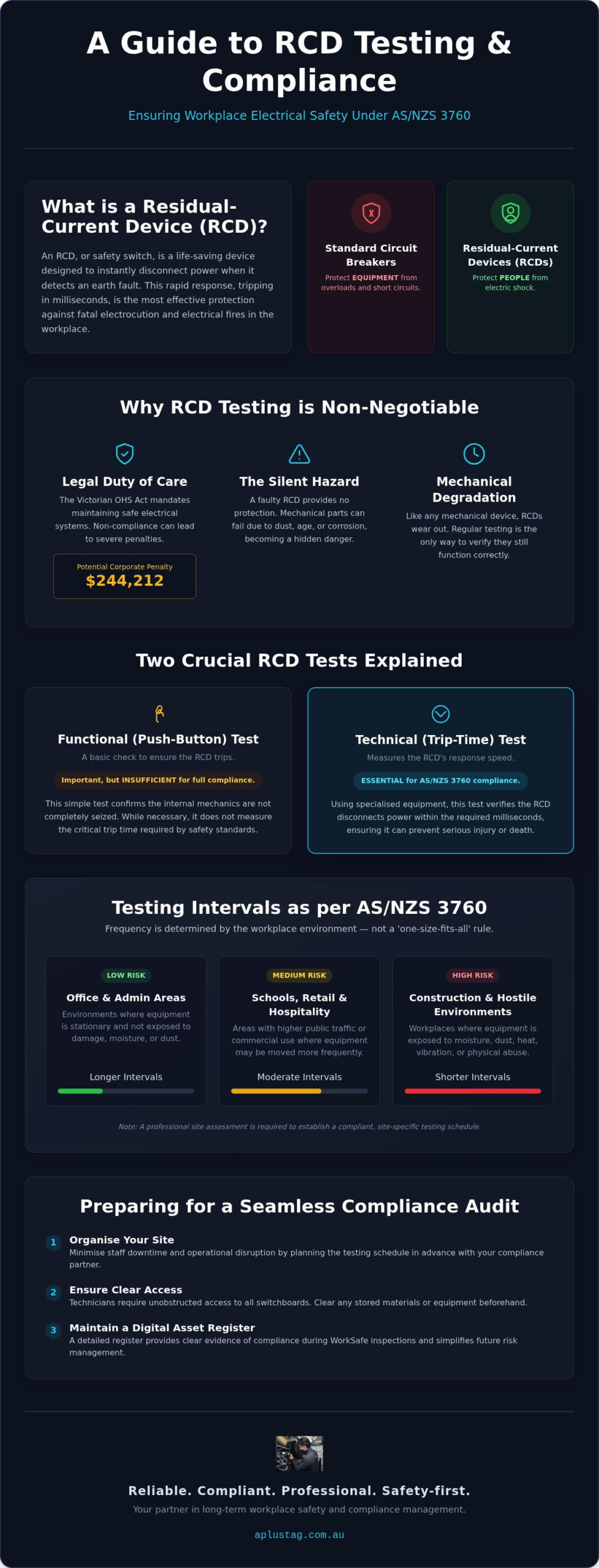
A Residual-current device (RCD) is a life-saving safety switch designed to immediately disconnect electricity when it detects a leakage to earth. While standard circuit breakers are engineered for overload protection to prevent wiring from overheating, RCDs are specifically designed for people protection. They monitor the flow of current and trip within milliseconds if an imbalance occurs, preventing fatal electrocution and electrical fires. This rapid response is what makes them the most effective line of defence against electrical accidents in a busy commercial environment.
For employers and facility managers, professional rcd testing melbourne isn’t just a best practice; it’s a fundamental legal requirement. Under the Victorian Occupational Health and Safety Act, business owners have a duty of care to ensure a safe working environment. This involves maintaining electrical installations and equipment to minimise any risk to staff or visitors. Regular testing ensures these devices remain responsive and fully compliant with the latest safety standards, shielding your organisation from both physical hazards and significant legal penalties.
To better understand the technical process of verifying these safety switches, watch this helpful video:
The Consequences of RCD Failure
RCDs are mechanical devices that can degrade over time due to environmental factors. Dust, corrosion, or simple age can lead to “sticky” internal components that prevent the switch from tripping when a fault occurs. A failed RCD is a silent hazard; it often looks perfectly functional on the switchboard but provides zero protection during a real-world incident. If a device fails to trip within the required milliseconds, the result can be a fatal electric shock or a devastating fire. Regular testing is the only way to verify mechanical reliability.
Fixed vs Portable RCDs: What Needs Testing?
Compliance protocols cover two distinct categories of devices that require attention. Fixed RCDs are installed directly into your switchboard to provide broad protection for entire circuits, including lights and power points. In contrast, portable RCDs are often found on construction sites or attached to extension leads used in hostile environments where equipment is moved frequently. Both types require specific testing protocols and intervals under Australian Standards to ensure they remain fit for purpose. Comprehensive rcd testing melbourne involves checking both categories to maintain a robust safety net across your entire site.
Compliance Standards and Testing Intervals under AS/NZS 3760
The primary standard governing electrical safety in Australian workplaces is AS/NZS 3760. This standard doesn’t just apply a “one size fits all” approach; instead, it dictates that testing frequency must be determined by the specific operating environment of the equipment. For business owners seeking rcd testing melbourne, understanding these nuances is essential to avoid non-compliance. While some environments are relatively stable, others expose electrical components to moisture, heat, or mechanical damage, which significantly accelerates wear and tear.
A professional assessment is the most reliable way to establish a site-specific compliance schedule. By adhering to WorkSafe Victoria electrical safety guidelines, you ensure that your documentation is robust enough to withstand a formal audit. Our team provides systematic rcd testing melbourne to help facility managers stay ahead of these recurring requirements. For specialised sectors, such as healthcare, additional standards like AS/NZS 3003 apply, requiring even stricter protocols for patient areas to guarantee absolute safety.
High-Risk Environments: Construction and Factories
Hostile environments, such as construction sites and manufacturing floors, are subject to the most rigorous testing requirements. These areas often involve dust, moisture, and vibration, which can compromise the mechanical integrity of safety switches. On construction and demolition sites, RCDs must undergo a push-button functional test every three months. In factory or production settings, this interval is typically every six months. Integrating these checks with broader test and tag services allows managers to maintain a comprehensive safety record while minimising operational downtime.
Low to Medium Risk: Offices and Retail
In cleaner, non-hostile environments like corporate offices or retail centres, the risk profile is lower, leading to longer testing intervals. Typical schedules might require testing every 12 months for environments with flexing cords, or up to five years for low-risk areas like dedicated server rooms. It’s important to distinguish between “fixed” RCDs in the switchboard and “portable” units used for specific tasks, as their testing cycles may differ. Even in a seemingly safe office, areas like staff kitchens or server rooms present hidden risks that demand regular attention. If you’re unsure which category your equipment falls into, you can discuss a compliance schedule with our team to ensure every asset is accounted for.
Functional vs Trip Time Testing: Ensuring Your Safety Switches Work
While many facility managers assume a quick press of the “test” button is sufficient, true compliance requires a dual-layered approach. Professional rcd testing melbourne involves both functional and technical assessments to ensure the device actually protects lives. Using specialised, calibrated equipment, a technician injects a simulated fault into the circuit to measure exactly how long the switch takes to disconnect the power. This precision is necessary because a mechanical click doesn’t always translate to an electrically safe response time. Many businesses also carry misconceptions about what these assessments involve, and it’s worth reviewing the common myths surrounding electrical testing services to ensure your compliance strategy is built on accurate information.
Professional results must be recorded in a formal asset register to provide legal proof of compliance. This documentation aligns with WorkSafe Victoria’s electrical safety guidelines and demonstrates that you’ve met your duty of care. For businesses looking to streamline this process, our rcd testing melbourne services include the creation of detailed digital registers for every asset on your site, ensuring you’re always prepared for an unexpected audit.
The Push-Button (Functional) Test
The push-button test is a user-led mechanical check that verifies the internal tripping mechanism is physically operational. By pressing the button, you’re confirming that the switch can move and break the circuit as intended. It’s a proactive step that staff should perform at regular intervals between professional visits to catch obvious mechanical failures. However, a successful button test doesn’t guarantee the RCD will trip fast enough to save a life. It merely proves the switch isn’t “stuck” due to dust or corrosion.
The Operating Time (Trip Time) Test
The operating time test is the technical core of workplace safety. It measures the trip time in milliseconds (ms) to ensure the device reacts before a lethal amount of energy reaches a person. Under AS/NZS 3760, a standard 30mA RCD must trip within 300ms at its rated current, and even faster, within 40ms, at five times the rated current. A “slow” RCD is just as dangerous as one that doesn’t trip at all. Even a fraction of a second of exposure to high-voltage current can lead to cardiac arrest or severe internal burns, making these millisecond measurements vital for employee protection.
How to Organise Your Workplace for a Seamless Compliance Audit
Organising your facility before a technician arrives is the most effective way to minimise operational downtime. Because professional rcd testing melbourne involves a deliberate interruption of the power supply to verify the trip mechanism, a lack of preparation can lead to unexpected disruptions for your team. By taking a proactive approach, you ensure the process is methodical and efficient, allowing your business to return to normal operations as quickly as possible. We recommend scheduling maintenance during low-activity periods, such as early mornings or scheduled shutdowns, to further reduce the impact on your daily workflow. This level of preparation transforms a potentially disruptive requirement into a smooth, manageable part of your safety routine. A similarly structured approach applies to other critical safety obligations, such as following a fire extinguisher inspection checklist to ensure all emergency equipment across your site is audit-ready and properly documented.
Step-by-Step Site Preparation
A well-prepared site allows our team to move through your facility with precision. Following these steps helps ensure that no circuit is overlooked and that your staff remain informed throughout the process:
- Locate all RCD-protected circuits and switchboards: Mapping these locations beforehand prevents the technician from spending valuable time searching your premises. It also ensures that every sub-board is accounted for in the final report.
- Identify sensitive electronic equipment: Devices like servers, laboratory equipment, or specialised production machinery may require a controlled shutdown. Notifying your IT department is essential to prevent data corruption during the brief power disconnection.
- Ensure clear access: Clear away furniture, stock, or storage items blocking switchboards or power points. Technicians need physical space to use their testing equipment safely and accurately.
- Communicate the testing window: Informing your team about the specific times when power will be interrupted helps them plan their tasks accordingly and reduces frustration.
Managing Failed Items
When a safety switch fails the trip time test, it no longer provides the protection required by Australian Standards. In these instances, our technicians follow a systematic “tag-out” procedure to ensure the faulty circuit is clearly identified and isolated from use. This immediate action is vital for maintaining workplace safety and preventing accidental exposure to electrical hazards. We prioritise transparency by documenting every failure in your digital asset register, providing you with a clear, audit-ready record of what needs repair or replacement. Our methodical approach to rcd testing melbourne ensures that failures are caught early and managed professionally, giving you a clear path back to full compliance without the stress of unorganised documentation.
Choosing a Reliable Partner for RCD Testing and Asset Management
Selecting a partner for your electrical safety needs is a decision that impacts your long-term liability and administrative workload. While “cheap” one-off checks might seem appealing initially, they often lack the technical depth and meticulous documentation required to satisfy a WorkSafe Victoria auditor. Professional rcd testing melbourne is about more than just a pass or fail sticker; it’s about building a systematic safety programme that protects your employees and your business reputation. By choosing a partner that prioritises systematic management, you move from a reactive state of hoping you’re compliant to a proactive state of knowing you’re protected. If you’ve ever wondered whether your current approach is based on fact or assumption, exploring the truth behind common electrical testing services myths can help you make more informed decisions about your safety programme.
A core benefit of a high-standard service is the implementation of a digital asset register. This living document tracks every safety switch on your premises, recording its location, unique identifier, and historical test results. For busy facility managers, this eliminates the stress of manual tracking. Automated due-date reminders ensure that your next cycle of rcd testing melbourne is scheduled well before your current certification expires. This proactive approach keeps your organisation organised and consistently compliant without the need for constant internal oversight. The same principle of systematic documentation applies across all workplace safety obligations, including maintaining a thorough fire extinguisher inspection checklist that satisfies AS 1851-2012 requirements and keeps your emergency equipment records current.
The Power of Professional Reporting
Every completed testing cycle should result in a detailed, professional report that serves as a vital paper trail. These records are essential for insurance renewals and demonstrating a clear duty of care during regulatory inspections. A Plus Compliance Services focuses on making compliance feel manageable by providing organised, easy-to-read documentation that clearly identifies any failed items and their subsequent resolutions. Instead of a pile of confusing paperwork, you receive a structured overview that simplifies your internal risk management processes and ensures you’re always audit-ready.
Tailored Compliance Schedules
No two workplaces are identical, and a rigid testing schedule rarely fits the operational realities of a multi-site organisation. We specialise in creating recurring programmes that align with your specific site requirements, whether you manage a high-stakes healthcare facility or a distributed retail network. Our team works around your operational needs to ensure minimal disruption while maintaining strict adherence to AS/NZS 3760. We invite you to contact us to discuss a bespoke schedule that secures your long-term compliance and peace of mind.
Securing Your Workplace Safety and Long-Term Compliance
Maintaining a safe workplace in 2026 requires more than just meeting a legal minimum. It involves a systematic approach to electrical safety that prioritises employee protection and organisational order. By understanding the technical requirements of rcd testing melbourne and adhering to the specific intervals set by AS/NZS 3760 and AS/NZS 3003, you ensure that your safety switches are always ready to respond in an emergency. This proactive strategy minimises operational risks while protecting your business from the penalties of non-compliance.
Our methodical process provides you with detailed Asset Registers and automated due-date reminders, effectively removing the administrative burden from your facility management team. This organised documentation serves as a robust paper trail, giving you total confidence during any WorkSafe Victoria audit. Choosing a specialised partner ensures that every technical detail, from trip times to mechanical reliability, is managed with precision and care.
We’re here to act as your dependable partner in safety. Let’s work together to create a secure environment where your team can thrive without the risk of electrical hazards.
Frequently Asked Questions
How often does RCD testing need to be carried out in a Melbourne office?
Testing intervals in a Melbourne office depend on the specific risk profile of the equipment and its environment. For items with flexing cords or those in higher-risk areas like staff kitchens, professional testing is required every 12 months. In low-risk environments such as dedicated server rooms, the interval may extend to five years. Always consult AS/NZS 3760:2022 to ensure your specific site meets the required safety standards.
What is the difference between a safety switch and an RCD?
There is no functional difference between a safety switch and a Residual Current Device (RCD). “Safety switch” is the common term used by most people, while “RCD” is the technical name used by electrical professionals and in Australian Standards. Both devices perform the same life-saving task of monitoring electrical current and tripping the power if a leakage to earth is detected, preventing fatal electrocution.
Can I perform RCD testing myself using the test button?
You can perform the functional push-button test yourself, but this does not satisfy your legal compliance requirements. While the button verifies the mechanical tripping action, it cannot measure the trip time in milliseconds. Comprehensive rcd testing melbourne requires a competent person using calibrated equipment to ensure the device disconnects fast enough to prevent injury, as mandated by the latest Australian Standards.
Will RCD testing cause power outages in my building?
Yes, RCD testing requires a brief power interruption to the specific circuit being tested. This disconnection is necessary to verify that the device successfully trips under fault conditions. We recommend notifying your IT department and staff in advance to manage shutdowns for sensitive equipment. Our team works methodically to ensure these outages are kept to the absolute minimum time required for accurate measurement.
What happens if an RCD fails the trip time test?
If an RCD fails the trip time test, it must be immediately tagged out of service to prevent accidental use. A device that trips too slowly or fails to trip at all cannot provide the necessary protection against electric shock. You’ll need to arrange for a licensed professional to repair or replace the unit promptly. We document all failures in your asset register to maintain a transparent compliance history.
Are RCD testing records legally required for Victorian businesses?
Yes, Victorian businesses are legally required to maintain detailed records of all electrical safety inspections and RCD tests. These documents serve as essential proof of compliance during a WorkSafe Victoria audit or following a workplace incident. Your records should include the date of testing, the specific result for each device, and the date the next test is due to demonstrate a continuous safety programme.
Does a new building still need professional RCD testing?
Yes, even new buildings and equipment require professional testing before their first use in certain environments. On construction sites, for example, AS/NZS 3760:2022 requires all equipment to be tested and tagged before it’s brought into service. Initial testing ensures that the installation was performed correctly and that no manufacturing defects exist in the safety switches before they’re relied upon to protect your staff.
What are the penalties for non-compliance with RCD testing standards?
Penalties for non-compliance with electrical safety standards in Victoria are significant. As of 2026, corporate penalties can reach up to $244,212 for failing to meet workplace safety obligations. Individuals can also face fines of approximately $48,842 for knowingly supplying or installing unsafe equipment. Beyond financial risks, failing to maintain rcd testing melbourne schedules leaves your organisation vulnerable to legal action and severe workplace safety incidents.
