The Essential Fire Blanket Checklist for Australian Workplace Compliance
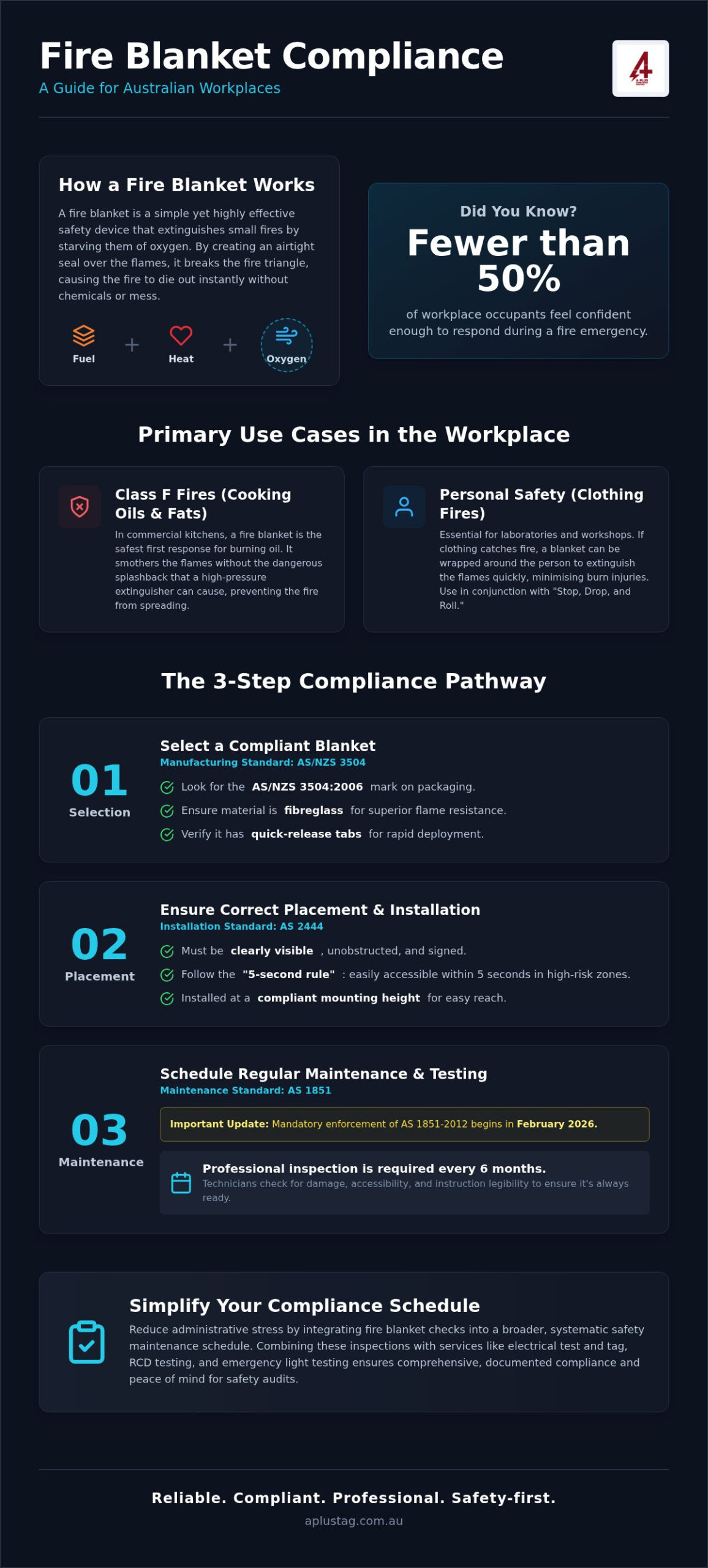
Did you know that while over 76% of structure fires in Australia are confined to their point of origin, fewer than half of workplace occupants feel confident enough to respond during an emergency? Most business owners understand that having a fire blanket on the wall is a basic requirement, yet the technicalities of compliance often feel like a moving target. It’s frustrating to face the uncertainty of a safety audit when you aren’t sure if your equipment meets the latest regulatory shifts, such as the mandatory enforcement of AS 1851-2012 starting in February 2026.
This guide clears the confusion by showing you exactly how to select, place, and maintain your fire blanket to meet Australian safety standards. You’ll gain a clear understanding of the differences between AS/NZS 3504 manufacturing requirements and AS 1851 maintenance routines. We’ll also provide a practical, actionable checklist to ensure your site remains fully compliant and your staff stay protected in high-risk areas like commercial kitchens. By following a systematic approach to fire safety, you can replace audit anxiety with the confidence that your workplace is prepared and professional.
Key Takeaways
- Identify the essential manufacturing requirements of AS/NZS 3504 to ensure you select the appropriate material for your specific workplace risks.
- Master the “5-second rule” for accessibility and the correct mounting heights to ensure your fire blanket is always ready for an emergency.
- Confirm your compliance with AS 1851-2012 by understanding the technical requirements of the mandatory 6-monthly professional inspection cycle.
- Learn how to reduce administrative stress by integrating fire safety checks into a broader, systematic electrical maintenance schedule.
- Implement a clear, actionable checklist that prepares your business for safety audits and provides documented peace of mind for your team.
What is a Fire Blanket and Why is it Critical for Safety?
Understanding What is a Fire Blanket is essential for any safety-conscious manager. At its core, this equipment is a highly flame-resistant sheet designed to extinguish small incipient fires through a process called “oxygen starvation.” By draping the sheet over a flame, you create an airtight seal that effectively cuts off the oxygen supply. Since fire requires heat, fuel, and oxygen to survive, removing the air causes the flames to die out almost instantly. It’s a simple yet highly effective tool that requires no mechanical parts or chemicals to function.
While extinguishers are vital for larger incidents, they aren’t always the best tool for every situation. This equipment serves as a critical secondary line of defence, especially in environments where liquid fuel or human safety is a primary factor. It provides a controlled, mess-free way to manage specific risks that might otherwise escalate if treated with high-pressure discharge. For many businesses, it’s the first point of contact for suppressing a fire before it spreads.
To better understand how this equipment operates in a real-world scenario, watch this helpful video from Fire and Rescue NSW:
The Role of Fire Blankets in Class F Fires
In commercial kitchens, Class F fires involving cooking oils and fats present a unique challenge. Using a standard fire extinguisher on a deep fryer can be dangerous, as the high-pressure stream can splash burning oil onto surrounding surfaces or the operator, spreading the fire rapidly. A fire blanket is a safer first choice because it gently smothers the surface of the oil without causing turbulence. Fibreglass is the industry standard for these blankets because of its exceptional ability to withstand the extreme temperatures generated by burning fats without melting.
Personal Protection and Clothing Fires
Beyond kitchen safety, these protective sheets are essential for personal safety in laboratories and workshops. If a staff member’s clothing catches fire, the material can be used to wrap them tightly, quickly extinguishing the flames and minimising burn injuries. This method should always be used in conjunction with the “Stop, Drop, and Roll” technique to ensure the best possible outcome. Keeping safety equipment within arm’s reach in high-risk zones is a fundamental part of a comprehensive workplace safety strategy. However, simply having the equipment is not enough; it must be professionally verified to ensure it remains fit for purpose when needed most.
Selecting the Correct Fire Blanket: Sizes and Standards
Selecting a compliant fire blanket involves more than just picking a red box off a shelf. You must ensure the product meets the manufacturing requirements set out in AS/NZS 3504. This standard ensures the material can withstand extreme temperatures and remains electrically non-conductive, which is vital if the material accidentally brushes against a live appliance during use. While wool blankets are often discussed for bushfire protection or emergency evacuations, they aren’t suitable for the high-intensity heat of a commercial kitchen. For most workplace environments, fibreglass is the mandatory standard due to its superior flame-retardant properties and durability under stress.
Decoding AS/NZS 3504 Compliance
Compliance starts with the physical properties of the material. A compliant fire blanket must be able to smother a fire without the fabric breaking down or allowing heat to pass through to the operator’s hands. When you’re assessing equipment, look for the AS/NZS 3504:2006 mark on the packaging or the blanket’s container. This certification guarantees the unit features quick-release tabs, allowing for rapid deployment in seconds. These tabs are designed to be pulled downwards, instantly releasing the folded material so it can be placed over the flames without delay. Following Australian Standard AS 2444 is the best way to ensure your selection and installation meet legal obligations.
Choosing the Right Size for Your Environment
Size selection depends entirely on the specific risks present in your facility. A standard 1.0m x 1.0m blanket is generally sufficient for small office kitchenettes where the primary risk is a small toaster or a single hotplate. However, industrial kitchens and high-risk workshops require much larger coverage. In these settings, you should opt for 1.2m x 1.8m or even 1.8m x 1.8m versions. A larger surface area is critical for dealing with burning liquids, as it ensures the entire container is covered and the oxygen is completely cut off. Smaller blankets simply cannot provide the necessary overlap to guarantee oxygen starvation on larger stovetops.
It’s also vital to remember that every fire blanket is a single-use safety device. Once the material has been exposed to flames or high heat, the fibres can degrade, compromising its structural integrity. Even if it looks undamaged, a used blanket must be replaced immediately to maintain your safety standards. If you’re unsure whether your current equipment is still compliant or correctly sized, you can speak with our team for a professional assessment. Ensuring your equipment is fit for purpose is a key step in a systematic safety audit that protects both your staff and your business assets.
Workplace Fire Blanket Compliance Checklist: A Practical Guide
Compliance involves more than just mounting a red box on the wall. It requires a systematic approach to placement and accessibility to ensure the equipment functions as intended during a crisis. A key metric used by safety professionals is the “5-second rule.” This principle dictates that any staff member should be able to reach and begin deploying the fire blanket within five seconds of identifying a fire. If a person has to hunt through a cluttered pantry or unlock a cupboard, the opportunity to contain a small fire may already be lost.
Strategic Placement and Accessibility
The location of your fire blanket is just as important as the material itself. You should never mount the blanket directly above a potential fire source, such as a stove or deep fryer. If flames erupt, reaching for a blanket positioned directly in the heat zone is dangerous and often impossible. Instead, mount the unit on the path of egress, which is the route a person would take to exit the room. This ensures they are moving away from the danger when they retrieve the safety equipment.
Accessibility also means considering the diverse needs of your workforce. The mounting height must be reachable by all staff members, typically between 1.5 and 2.0 metres from the floor. Avoid “hidden” installations. While it might be tempting to hide safety gear behind a cupboard door for aesthetic reasons, this is a direct violation of safety best practices. The unit must be visible, unobstructed, and ready for immediate use. Consider these placement essentials:
- Visibility: The unit must not be obscured by curtains, doors, or stacked stock.
- Distance: Ensure the blanket is within a reasonable distance of the risk area, typically between 2 and 10 metres.
- Clearance: There should be enough room to pull the release tabs downwards without hitting furniture or appliances.
Signage and Identification
Clear identification is a mandatory requirement under Australian safety standards. Every fire blanket must be accompanied by a standard red-and-white location sign mounted above the unit. This sign needs to be visible from a distance, even in a smoke-filled room or during a power failure. Additionally, the instruction label on the container itself must remain clean and legible. If the diagrams showing how to pull the tabs are faded or covered in kitchen grease, the equipment may fail a safety audit.
Professional oversight ensures these details aren’t overlooked. Our fire equipment services help manage these placement audits, ensuring every sign and mounting bracket meets the necessary criteria. Finally, don’t forget the human element. Regular staff training on how to pull the tabs and deploy the material correctly is the final piece of the compliance puzzle. A team that knows exactly how to react is your business’s most effective safety asset.
Maintenance and Testing: Meeting AS 1851 Requirements
AS 1851-2012 is the primary Australian Standard governing the routine servicing of fire protection systems and equipment. Compliance isn’t a “set and forget” task. It requires a disciplined schedule of professional inspections to ensure every safety device remains operational. For many businesses, failing to adhere to these intervals doesn’t just risk a fine; it jeopardises the safety of the entire facility. In New South Wales, mandatory compliance with this standard for fire blankets will be strictly enforced starting 13 February 2026, making professional oversight more critical than ever.
A qualified technician performs a thorough physical assessment during each visit. They look for subtle signs of degradation that an untrained eye might miss. Grease build-up is a frequent issue in commercial kitchens, as oily residues can eventually become a secondary fuel source or make the blanket difficult to handle. Technicians also test the integrity of the quick-release tabs and check for any tears or fraying in the material. If the fabric is compromised, it can’t effectively smother a fire. A structured approach to the maintenance of fire equipment ensures these assessments are conducted systematically and documented correctly for every asset on your site.
The 6-Monthly Professional Inspection
Routine servicing occurs at 6-monthly intervals to maintain peak readiness. During this check, the technician verifies the fire blanket is still in its correct location and remains completely unobstructed by stock or furniture. They also examine the outer container for cracks or hinge damage that could impede a rapid release during an emergency. Any fire blanket that has been used in a fire or contaminated by cooking oils must be replaced immediately, as the structural integrity of the fibreglass fibres is likely compromised.
Service Tags and Compliance Documentation
Documentation is the cornerstone of any successful safety audit. Once an inspection is complete, the technician marks the service tag attached to the unit to prove it has been verified. This physical record is backed by a digital asset register, which provides a comprehensive history of your safety equipment. Having an up-to-date register is essential for insurance purposes and WorkSafe audits, as it demonstrates a proactive approach to risk management. Often, Fire Extinguisher Testing Requirements Victoria will align with these blanket checks, allowing you to streamline your entire safety schedule in one visit. Understanding how often fire extinguishers need to be tested in Australia is equally important, as coordinating these mandatory inspection cycles with your blanket servicing helps ensure no compliance deadline is ever missed.
Streamlining Your Fire Safety and Compliance Schedule
Managing workplace safety involves balancing various regulatory demands, from electrical standards to fire protection. It’s easy to view a fire blanket as a simple piece of equipment that stays on the wall indefinitely, but true compliance requires viewing safety as a recurring cycle. By shifting away from reactive maintenance and toward a structured schedule, you ensure that every asset remains fit for purpose without the stress of last-minute preparations before a safety audit. This proactive mindset transforms safety from a chore into a reliable business process.
Multi-Service Efficiency
One of the most effective ways to manage these requirements is through service bundling. Instead of coordinating multiple contractors on different dates, you can combine your fire equipment checks with regular electrical test and tag, RCD testing, and emergency light assessments. This integrated approach offers several practical benefits for a busy workplace:
- Minimised Disruption: One technician visits your site to handle multiple compliance areas, significantly reducing the impact on your daily operations and staff productivity.
- Consistent Documentation: You receive a unified asset register and reporting package, making it easier to track the status of all safety equipment in one central location.
- Cost-Effective Management: Streamlining site visits reduces the administrative overhead associated with scheduling, site inductions, and processing multiple invoices.
Having a single, dependable partner for your safety needs ensures that nothing falls through the cracks. It creates a cohesive safety record that is easy to present during WorkSafe inspections or insurance reviews, providing clear evidence of your commitment to Australian Standards. For a comprehensive overview of how to structure these obligations, our fire equipment maintenance guide for Australian businesses provides a detailed roadmap for managing all your fire safety assets in a single, coordinated system.
The Professional Advantage
While it might be tempting to conduct internal “spot checks,” DIY inspections often fail to meet the rigorous documentation standards required by Australian law. A professional partner brings technical expertise and a systematic approach to every site assessment. They recognise the subtle differences in manufacturing standards and provide the specific verification needed to satisfy legal obligations. This level of thoroughness is what protects a business from the fear of failing a safety audit.
The most significant value of a professional partnership is the reduction of administrative burden. Automated reminders ensure you never miss a testing deadline, allowing you to focus on running your business while your safety obligations are managed in the background. Clear, reliable support turns a complex legal requirement into a manageable routine. Ultimately, safety isn’t a one-off purchase; it’s an ongoing commitment to the protection of your team and your property.
Taking these practical steps today provides long-term peace of mind for you and your staff. We’re here to act as your dependable partner in maintaining a secure and well-regulated workplace through every stage of the compliance cycle.
Frequently Asked Questions
Can you reuse a fire blanket after it has been used once?
No, fire blankets are strictly single-use safety devices. Once the material has been exposed to high heat or an open flame, the structural integrity of the fibreglass fibres is compromised. Even if the blanket appears undamaged, the material may have degraded, meaning it will not effectively smother a future fire. You must replace the unit immediately after any deployment to maintain your workplace safety standards and remain compliant with Australian regulations.
How often do fire blankets need to be tested in an Australian workplace?
Under AS 1851-2012, fire blankets in a commercial environment require professional testing every 6 months. These routine service intervals ensure the equipment remains unobstructed, the container is undamaged, and the release tabs are functional. Regular inspections prevent the accumulation of kitchen grease or dust, which could eventually impede the blanket’s performance during an emergency. Maintaining this 6-monthly cycle is a mandatory requirement for achieving workplace compliance across all Australian states and territories. You may also find it helpful to review how often fire extinguishers need to be tested in Australia to align all your fire safety equipment inspections into a single, manageable schedule.
Where is the best place to mount a fire blanket in a commercial kitchen?
Mounting the unit along the path of egress, approximately 2 to 10 metres from the cooking area, is the most effective strategy. You must avoid placing the container directly over a stovetop or fryer, as rising heat and flames would prevent safe access. Position the equipment at a reachable height, generally between 1.5 and 2.0 metres. This strategic placement allows staff to grab the material while moving toward a safe exit route during an emergency.
What is the difference between AS/NZS 3504 and AS 1851?
AS/NZS 3504:2006 focuses on the production phase, setting the benchmark for how a fire blanket is constructed and tested for heat resistance. AS 1851-2012 shifts the focus to the operational phase, outlining the mandatory routine for servicing the equipment once it is on your wall. While the manufacturing standard confirms the material is fit for purpose at the time of sale, the maintenance standard guarantees it remains functional through scheduled professional assessments and detailed record keeping.
Does a fire blanket expire or have a “use by” date?
Fire blankets do not have a specific “use by” date, but their lifespan is determined by their physical condition. Over time, exposure to moisture, grease, or harsh environmental factors can degrade the protective fibres. During your 6-monthly professional inspection, a technician will assess the material for signs of wear, fraying, or contamination. If the unit shows any signs of deterioration or if the container is damaged, the blanket must be replaced to ensure safety.
Can I use a fire blanket on an electrical fire?
Yes, provided the blanket complies with AS/NZS 3504, it is designed to be electrically non-conductive. This makes it safe to use on small fires involving electrical appliances, such as a toaster or computer. However, you should always attempt to turn off the electricity supply at the source if it is safe to do so. Smothering the fire with the blanket will cut off the oxygen supply while protecting the user from potential electrical shocks.
What signage is required for fire blankets in Australia?
Every fire blanket installation must include a standard red-and-white “Fire Blanket” location sign. This sign must be mounted at a height that ensures it is visible from a distance, even if the floor area is crowded or smoke-filled. The purpose of this signage is to allow any occupant to locate the equipment instantly during a crisis. Additionally, the instruction label on the blanket’s container must remain clean, legible, and unobstructed at all times.
Who is authorised to perform fire blanket testing?
Testing must be performed by a “competent person,” typically a qualified fire safety technician with the training and tools to meet AS 1851 standards. These professionals ensure that the inspection is documented correctly on a service tag and recorded in an asset register. Using an experienced technician from a reputable compliance service ensures that your business meets its legal obligations and that your safety documentation will stand up to scrutiny during a WorkSafe audit or insurance review.
