RCD Testing Services Victoria: The 2026 Workplace Safety Guide
Could your workplace safety switch fail in the millisecond you need it most? For many Victorian facility managers, Residual Current Devices (RCDs) are often “out of sight, out of mind”, yet these critical components require regular verification to ensure they trip instantly during an electrical fault. We understand that managing RCD testing services Victoria can feel like a moving target, especially when you’re balancing evolving safety standards against the daily demands of a busy workplace.
It’s a common concern that complex regulations might lead to accidental non-compliance or, more importantly, a safety risk to your team. You need a reliable way to maintain safety without disrupting your operations or drowning in technical jargon. This guide helps you discover how to ensure your Victorian workplace remains compliant and safe through professional RCD testing and systematic maintenance. We’ll clarify the testing intervals relevant to your specific environment, explain the documentation needed for accurate compliance reporting, and provide a practical framework for keeping your site organised and protected. Please note that this information should be read in conjunction with AS/NZS 3760:2010 as a whole, and particularly clause 2.1, to ensure full technical alignment.
Key Takeaways
- Understand your safety obligations and why all guidance must be read in conjunction with AS/NZS 3760:2010 to ensure your Victorian site remains fully compliant.
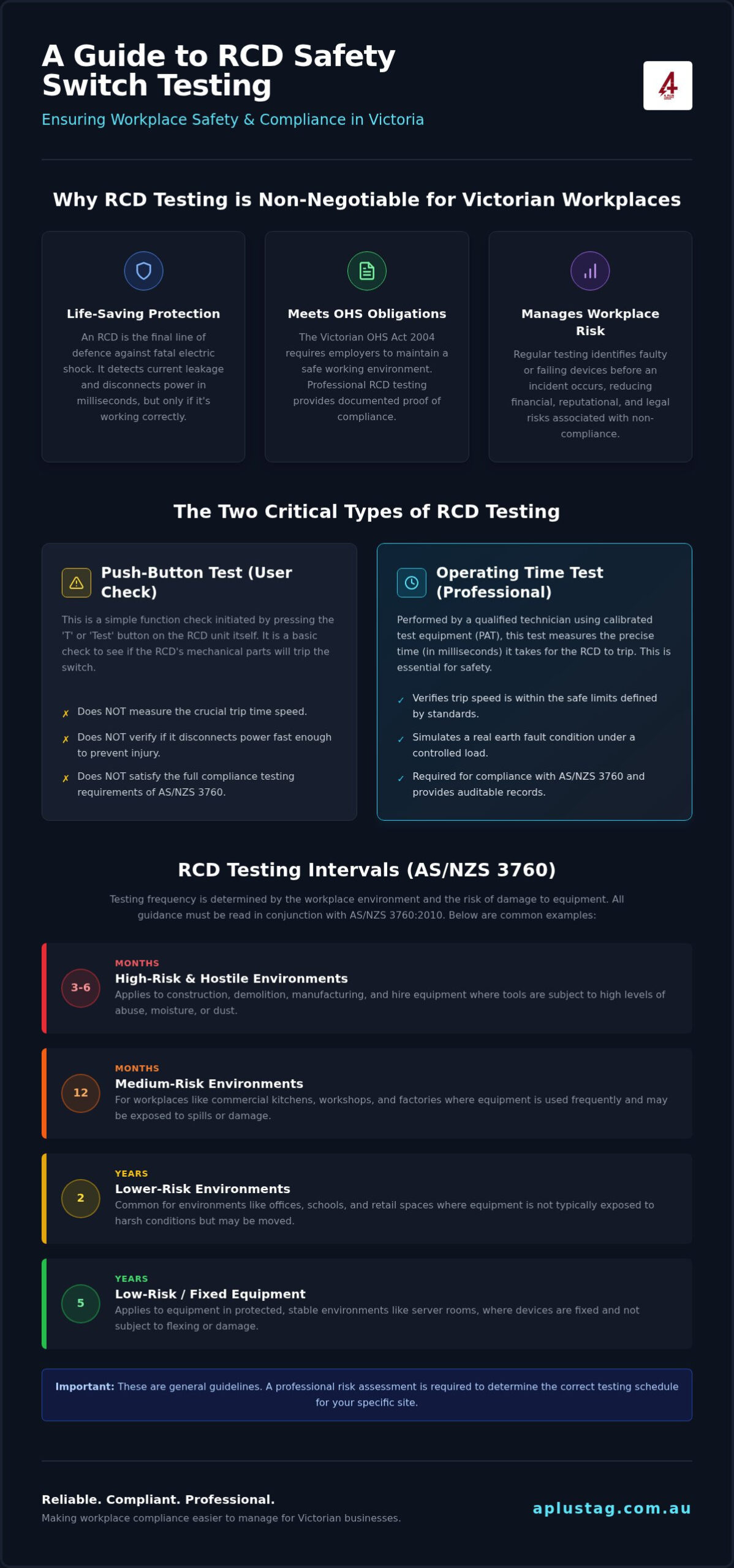
- Identify the correct testing intervals—ranging from 3 months to 5 years—based on your specific workplace environment and the risk level of your equipment.
- Learn the technical difference between routine push-button checks and professional ‘Operating Time’ tests that measure precise trip speeds to prevent electric shock.
- See how engaging expert RCD testing services Victoria provides you with clear compliance reporting and asset registers while minimising operational downtime.
- Discover how a proactive maintenance schedule helps Victorian businesses stay organised, reduce risk, and maintain a safety-first culture.
Why RCD Testing is Non-Negotiable for Victorian Workplaces
Every Victorian workplace, from a Melbourne office to a Dandenong warehouse, relies on electricity to function. However, electrical safety isn’t just about avoiding frayed cords or overloaded power boards. A Residual-current device (RCD), commonly known as a safety switch, serves as the final line of defence against electrocution. It monitors the flow of electricity and disconnects the power in milliseconds if it detects a leak to earth. Without professional verification, there’s no way to know if this silent guardian will actually trigger when needed.
In Victoria, the Occupational Health and Safety Act 2004 places a clear duty of care on employers and facility managers to maintain a safe working environment. This responsibility becomes even more critical in ‘hostile’ environments like commercial kitchens or construction sites where moisture, dust, and physical wear increase the likelihood of electrical faults. Proactive RCD testing services Victoria transform safety from a reactive approach into a structured, verifiable risk-management strategy.
To better understand how these tests are performed and documented, watch this helpful guide:
Protecting Your Team from Electrical Faults
Electrical faults don’t give warnings. An RCD is designed to detect current leakage, the type that occurs when a person touches a live wire, and shut down the circuit almost instantly. Our safety-first approach ensures that these devices are not just present, but fully functional. Regular testing is essential because mechanical components within an RCD can seize over time due to inactivity or environmental factors. By prioritising equipment verification, you’re directly supporting your broader workplace safety goals and protecting your most valuable asset: your people.
The Cost of Non-Compliance in Victoria
Ignoring your compliance obligations can lead to severe consequences. For the 2026-2027 financial year, a single penalty unit in Victoria is valued at $209.10, and fines for safety breaches are calculated based on these units. Beyond the financial impact, the risk of a workplace incident can damage your reputation and lead to legal complications under workplace manslaughter laws. Choosing A Plus Compliance Services means you receive clear, reliable, and professional compliance support. We provide the documentation you need to prove you’ve met your obligations, making workplace compliance easier to manage.
It’s vital to remember that all testing information must be read in conjunction with AS/NZS 3760:2010 as a whole, and particularly clause 2.1. If an RCD requires repair or service, you must also refer to AS/NZS 5762 to ensure it remains safe for continued use. For expert guidance on your specific site requirements, you can reach our team on 1300 427 158.
Understanding AS/NZS 3760:2010 and Compliance Intervals
Adhering to Australian Standards is the most effective way to ensure your workplace remains safe and legally compliant. It is vital to state that this information must be read in conjunction with AS/NZS 3760:2010 as a whole, and particularly clause 2.1. This standard provides the framework for professional RCD testing services Victoria, ensuring that safety switches are verified using calibrated equipment like a Portable Appliance Tester (PAT). These devices measure the precise operating time of an RCD, confirming it disconnects power before a fatal electric shock can occur.
The standards categorise workplaces into different environments, ranging from (a) to (f). These classifications help facility managers understand the level of risk associated with their specific site. For example, a construction zone is viewed differently to a climate-controlled office because the environmental “abuse” on electrical components is significantly higher. Following these WorkSafe Victoria guidelines ensures you’re applying the correct level of scrutiny to each area of your business.
Exact Testing Intervals for Victorian Businesses
Testing frequency isn’t a one-size-fits-all requirement. It’s essential to recognise that requirements vary based on the workplace, equipment type, risk assessment, or specific standards. We always recommend obtaining site-specific professional guidance to ensure your schedule is accurate. However, the following intervals are standard benchmarks for many Victorian sites:
- Factories and workshops: These require a 6 months interval for general inspection and testing of RCDs.
- Environments with flexing or abuse: In areas where equipment is frequently moved or subject to harsh conditions, a 12 months interval is often required.
- Residential-type areas: Sites like hotels or hostels generally require testing every 3 months for portable equipment and every 6 months for fixed RCDs.
- Hire equipment: Standard hire items typically follow a 6 months general cycle, though this reduces to 3 months for equipment used in construction or high-impact hire environments.
Other environments may extend to 2 years or 5 years intervals depending on the risk profile and equipment type. Maintaining a precise schedule helps Victorian businesses stay organised and reduces the risk of an expired compliance tag during an audit.
Post-Repair and Re-Introduction Requirements
Compliance doesn’t end with a scheduled test. If a piece of equipment or an RCD has undergone repair or service, you must refer to AS/NZS 5762 before it’s returned to active use. This standard covers the specific re-testing requirements for repaired electrical equipment to ensure the repair itself hasn’t introduced new safety risks. At A Plus Compliance Services, we help you manage these complex cycles by providing comprehensive compliance reporting and asset registers. To ensure your equipment meets these specific requirements, you can reach out for a compliance assessment to discuss a tailored schedule for your site.
The Two Types of RCD Testing: Push-Button vs. Operating Time
Effective electrical safety management requires more than just a visual inspection. To maintain a complete compliance profile, Victorian businesses must implement two distinct layers of verification. While one is a simple mechanical check conducted by staff, the other is a technical measurement performed by experts using specialised equipment. Comprehensive RCD testing services Victoria ensure that both methods are correctly applied, providing a robust safety net for your workplace. It’s essential to remember that this information must be read in conjunction with AS/NZS 3760:2010 as a whole, and particularly clause 2.1.
Following these standards ensures that your safety switches are not just present, but capable of performing their lifesaving function. By understanding the difference between user-led checks and professional verification, facility managers can better coordinate their safety schedules and ensure no gaps exist in their risk-management strategy.
User-Led Push-Button Testing
The push-button test is a fundamental mechanical check that can be performed by any staff member. By pressing the “Test” button on the RCD, you’re manually tripping the device to ensure the internal mechanism hasn’t seized due to dust or inactivity. In manufacturing and high-risk environments, WorkSafe Victoria’s electrical safety guidelines often require this check daily or before each use for portable RCDs. This proactive habit is a key part of a safety-first culture.
While this is a critical first step, it’s vital to realise it doesn’t replace the need for professional interval testing. It only confirms that the device can move; it doesn’t measure how fast it moves or if it will trip at the correct current level. We recommend recording these user-led tests in a dedicated workplace log to demonstrate proactive safety management between professional visits. This habit helps Victorian businesses stay organised and provides an extra layer of reassurance for the team.
Professional Operating Time Verification
To truly verify the integrity of a safety switch, a professional ‘Operating Time’ test is required. This technical procedure measures the exact speed, in milliseconds, at which the RCD disconnects the power during a simulated fault. If a device takes too long to trip, it may not prevent a serious injury. Qualified technicians use calibrated instruments, such as the Rigel 288+ biomedical safety analyser, to achieve these precise measurements in specialised environments like hospitals or dental clinics.
These advanced tools ensure that even the most sensitive equipment is tested accurately without risk of damage. At A Plus Compliance Services, we don’t just test; we integrate every result into detailed asset reports and compliance registers. This provides you with clear, dependable documentation that demonstrates your commitment to being reliable, compliant, and professional. By choosing a partner who uses such high-standard equipment, you’re ensuring your site remains compliant and your team stays protected. If you’re unsure when your next professional test is due, you can always reach out for a compliance assessment to discuss a tailored schedule for your site.
Minimising Disruption During Your Compliance Schedule
A major concern for many facility managers is that electrical safety checks will force a complete halt to business operations. We understand that your time is valuable. Our approach to RCD testing services Victoria is built on the principle of minimal intrusion. By coordinating with your site access requirements and operational needs, we ensure that safety remains a silent, supportive presence rather than a barrier to productivity. We act as a dependable partner, helping you maintain order without stalling your daily tasks.
This systematic management is essential for large-scale organisations with multiple locations. Whether you’re managing a school in St Kilda, a healthcare facility in Dandenong, or a warehouse in Pakenham, having a single, reliable partner makes workplace compliance easier to manage. All our guidance and procedures are designed to be read in conjunction with AS/NZS 3760:2010 as a whole, and particularly clause 2.1, ensuring technical accuracy remains at the forefront of our service delivery.
Flexible Scheduling for Busy Workplaces
We recognise that some environments, such as aged-care facilities or 24-hour manufacturing sites, cannot accommodate testing during peak daylight hours. To address this, our RCD testing services Victoria can be scheduled outside normal operating hours if required. This punctual and safety-first service delivery ensures that schools, hospitals, and large offices stay compliant without affecting their primary functions. Coordinated testing programs allow us to manage complex site access while maintaining a strict adherence to Australian Standards. Our team is experienced in working within the specific constraints of regulated environments, providing a stress-free experience for the client.
The Value of a Structured Asset Register
Once testing is complete, the focus shifts to documentation and transparency. A Plus Compliance Services provides a comprehensive asset register and digital reporting that makes safety audits and internal checks entirely stress-free. These records detail every device tested, its location, and its precise trip speed, creating a narrative of efficiency and predictability for your facility. This structured data is a vital component of long-term compliance monitoring. We also provide automated due-date reminders to ensure you never miss a testing interval, helping Victorian businesses stay organised and reduce risk.
Our goal is to provide clear reporting, dependable service, and ongoing compliance support. This proactive maintenance cycle ensures your site is always ready for an audit, allowing you to focus on your core business with confidence. By choosing a partner that prioritises systematic management, you’re investing in the long-term safety and stability of your workplace.
Professional RCD Testing with A Plus Compliance Services
Choosing a specialised partner for your electrical safety ensures that your business doesn’t just meet a checkbox requirement but builds a sustainable culture of safety. A Plus Compliance Services operates with a clear brand promise: Reliable. Compliant. Professional. Safety-first. We act as an essential ally for facility managers across Melbourne and regional Victoria, from the coastal precinct of St Kilda to the industrial hubs of Dandenong and Pakenham. Our team is frequently on-site in Berwick, Clayton, and Scoresby, helping Victorian businesses reduce risk and stay organised through systematic management and transparent communication.
As discussed throughout this guide, maintaining functional safety switches is a technical necessity that requires precision and routine. It’s critical that all information provided here is read in conjunction with AS/NZS 3760:2010 as a whole, and particularly clause 2.1. When you partner with us, you aren’t just hiring a contractor for a day; you’re securing a long-term compliance partner dedicated to clear reporting, dependable service and ongoing compliance support. We focus on being a steady, dependable presence that simplifies complex requirements for our clients.
Why Victorian Businesses Choose A Plus
Managers often face confusion over complex Australian Standards and the specific needs of different environments. Our practical, service-focused approach reduces this complexity by translating technical requirements into actionable maintenance schedules. We bring specialised expertise to every site, including the use of the Rigel 288+ biomedical safety analyser for healthcare environments requiring compliance with AS/NZS 3551. This level of technical proficiency ensures that whether you’re managing a local gym, a school, or a high-stakes medical facility, your RCD testing services Victoria are handled with the highest professional standards.
We prioritise making workplace compliance easier to manage. This involves more than just testing; it includes providing structured asset registers and automated reminders for your next 3 months, 6 months, 12 months, 2 years, or 5 years intervals. If any equipment undergoes repair, we guide you through the requirements of AS/NZS 5762 to ensure a safe return to service. This methodical thoroughness creates a narrative of efficiency and predictability for your organisation, allowing you to focus on your operations while we manage the technical details.
Arrange Your RCD Testing Assessment Today
Securing your workplace doesn’t have to be a disruptive or complicated process. We invite you to discuss a recurring compliance schedule tailored to your site’s specific risk assessment and equipment types. Our team is ready to help you transition from a state of potential uncertainty toward a state of organised control. By establishing a routine maintenance cycle, you protect your team and ensure your documentation is always audit-ready.
For immediate enquiries or to arrange a site visit, please contact our Melbourne office on 1300 427 158. Our experts are available to clarify your obligations and provide a transparent overview of your RCD testing services Victoria. We look forward to helping you maintain a safe and compliant workplace for the long term.
Request a quote for RCD testing services Victoria
Securing Your Workplace Safety for the Long Term
Maintaining a safe and compliant workplace requires a shift from reactive fixes to a structured maintenance cycle. By understanding the specific intervals required for your environment and implementing both user-led and professional testing, you significantly reduce the risk of electrical incidents. It’s essential that all procedures are read in conjunction with AS/NZS 3760:2010 as a whole, and particularly clause 2.1, to ensure full technical alignment.
Partnering with a specialist for your RCD testing services Victoria provides the transparency and order needed for stress-free audits. With detailed asset registers, automated due-date reminders, and specialised tools like the Rigel 288+ analyser, we help Victorian businesses stay organised. Our “Reliable. Compliant. Professional. Safety-first.” approach ensures your team is protected without stalling your daily operations.
Take the next step toward a more secure and well-regulated facility. We look forward to helping you navigate your safety obligations with confidence and clarity.
Frequently Asked Questions
What is RCD testing and why is it necessary for my Victoria business?
RCD testing involves verifying that your safety switches disconnect power in milliseconds during an electrical fault. It is necessary because mechanical components can seize over time, rendering the device useless when you need it most. In Victoria, employers have a duty of care under the OHS Act 2004 to provide a safe workplace. Regular RCD testing services Victoria ensure these life-saving devices function correctly, protecting your team from electrocution and helping your business meet its legal obligations.
How often does equipment need to be tested according to AS/NZS 3760:2010?
Intervals depend on your specific workplace environment and equipment type. Common intervals include 3 months, 6 months, and 12 months, while some low-risk areas may extend to 2 years or 5 years. This information must be read in conjunction with AS/NZS 3760:2010 as a whole, and particularly clause 2.1. We recommend obtaining site-specific professional guidance to determine the exact schedule for your Victorian facility, as requirements vary based on risk assessment and equipment usage.
Can RCD testing be completed outside of my normal business hours?
Yes, we can arrange for testing to be completed outside of your normal operating hours to ensure minimal disruption to your daily workflow. This is particularly beneficial for schools, hospitals, and 24-hour manufacturing sites in Melbourne. Our technicians are punctual and follow a safety-first service delivery model. By scheduling visits during low-occupancy times, we help you maintain compliance without halting productivity or affecting the essential services your organisation provides to the community.
What happens if an RCD fails the operating time test?
If an RCD fails to trip within the required milliseconds, it is clearly identified and recorded in your asset register. You must remove the faulty circuit or device from service immediately to prevent a safety hazard. Once the item is repaired or serviced, you must refer to AS/NZS 5762 for re-testing requirements before it is reintroduced to your workplace. We provide clear reporting to help you manage these failures and maintain a reliable, safety-first environment for your staff.
Do I need RCD testing if I already do regular test and tag?
Yes, RCD testing is a separate but complementary requirement to standard electrical test and tag. While test and tag focuses on the safety of portable appliances, RCD testing services Victoria specifically verify the performance of the safety switches that protect those circuits. Both are essential for a comprehensive compliance profile. Regular verification of your RCDs ensures that if an appliance develops a fault, the safety switch will actually trigger to prevent a serious electric shock.
What is the difference between a portable RCD and a fixed RCD test?
A portable RCD is a device you plug into a power point, while a fixed RCD is installed directly into your electrical switchboard. Portable RCDs in hostile environments often require daily push-button tests by the user, while fixed units typically follow longer professional intervals. Both require professional operating time testing to measure trip speed using calibrated equipment. This thoroughness ensures both your fixed infrastructure and portable safety devices remain compliant and ready to protect your staff at all times.
Will I receive a report or certificate after the RCD testing is finished?
Every site visit concludes with the provision of a structured asset register and compliance report. These documents detail each device tested, its location, and the precise test results. This clear reporting makes workplace compliance easier to manage and ensures you are prepared for safety audits. We also provide automated due-date reminders as part of our ongoing compliance support, helping Victorian businesses stay organised and reduce the risk of missing a mandatory testing interval.
Does A Plus Compliance Services manage RCD testing for multiple locations in Victoria?
We specialise in coordinated testing programs for organisations with multiple sites across Victoria. Whether you have offices in Melbourne, warehouses in Dandenong, or healthcare clinics in Pakenham, we can manage your entire compliance schedule from a central point. Our multi-site service includes consolidated asset registers and synchronised due-date tracking. This systematic management simplifies the oversight process for facility managers, ensuring consistent safety standards are maintained across every location in your Victorian network.
