Thermal Imaging Requirements for Commercial Insurance
Thermal imaging may be included in an insurer’s risk-management conditions, but it is not a blanket annual rule for every commercial site. Insurance requirements for thermal imaging vary by policy and site; some insurers request annual scans of electrical switchboards. The aim is to identify potential electrical faults that could contribute to fire or business interruption.
If your insurer has asked for a scan, it’s reasonable to want clear details about what needs inspecting and what the report must include. This guide explains why insurers request thermal imaging, how inspection frequency may be set, and what scope, methodology and standards can apply in Australia.
You’ll also learn what to look for in a useful report and how to plan an inspection around site operations, so you can understand the practical next steps for responding to the request.
Key Takeaways
- Insurers may request thermal imaging to identify electrical issues that could increase fire or operational risk.
- Some policies request annual switchboard scans, while high-risk environments may need inspections every six months.
- Inspection frequency depends on factors such as site risk, equipment and the insurer’s policy conditions.
- A useful scope and report should identify the equipment inspected, explain the method used and detail thermal exceptions.
- Plan the scan around normal operating conditions, with access and site safety arrangements considered in advance.
Why has my insurance requested Thermal Imaging?
Commercial insurers may request thermal imaging to assess electrical fire risks before a fault causes damage or interrupts operations. Insurance requirements for thermal imaging depend on the policy, and some insurers ask for switchboard scans as part of risk management. A scan records heat patterns while equipment is operating.
A thermal camera detects infrared radiation and converts it into temperature readings. This can help a thermographer identify abnormal heat before visible signs such as smoke, scorching or a burning smell appear. For example, a hot connection inside a switchboard may be detectable before external damage is visible.
To see how infrared inspection relates to electrical protection, watch this video:
Thermal scans can detect several electrical faults, including:
- Loose or improper terminations, which can create high-resistance connections and localised hot spots.
- Faulty components, overloaded circuits and unbalanced loads, where heat patterns can indicate abnormal operating conditions.
- Undersized connections or cables, which may become hotter under electrical load.
These findings can be particularly relevant in ageing electrical sub-boards. Wear, previous modifications or changing power demand can affect connections and components. A scan may highlight areas for closer investigation, but it cannot establish the cause on its own. A separate electrical assessment determines what action is needed.
Insurers may also specify who can conduct the scan. The research facts identify Level 1 thermography as the minimum qualification for an insurance-compliant scan. A thermographer’s specialised training supports consistent image capture and interpretation. The report should make clear what was inspected and record thermal exceptions for follow-up.
Thermal imaging and electrical work are different activities. AUSPTA says a qualified electrician is not required to perform a switchboard survey, while work on electrical plant is to be carried out by electricians. AUSPTA also notes that personnel removing or replacing electrical escutcheon panels generally need a valid electrical licence in most jurisdictions. This distinction matters if an inspection requires access beyond an external survey.
For a Melbourne site, confirm the insurer’s requested scope, thermographer qualification and access requirements before scheduling. AUSPTA advises thermographers to consider AS4836:2011 for safe work on or near low-voltage electrical installations and equipment, alongside site-specific safety planning. Clear requirements help align the inspection and report with the insurer’s request.
Recommended inspection frequency
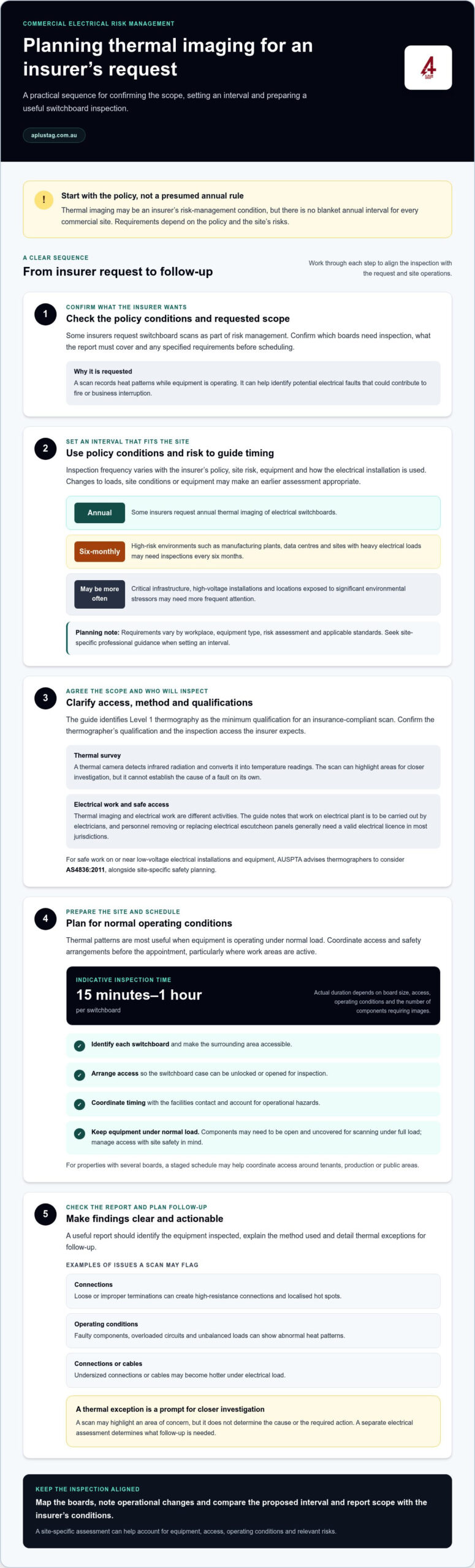
There is no single inspection interval for every commercial switchboard. Some insurers request annual thermal imaging, while high-risk environments such as manufacturing plants, data centres and sites with heavy electrical loads may need inspections every six months. Critical infrastructure, high-voltage installations and locations exposed to significant environmental stressors may need more frequent attention. The policy condition and site risks help determine a suitable schedule.
Inspection frequency also depends on how the electrical installation is used and how conditions change. For example, a warehouse adding machinery may place different demands on its switchboards than an office with stable equipment. Changes to loads, site conditions or equipment may make an earlier assessment appropriate. Requirements vary by workplace, equipment, risk assessment and applicable standards, so use site-specific professional guidance when setting intervals.
For planning purposes, allow 15 minutes to an hour per switchboard. The actual inspection duration depends on board size, access, operating conditions and the number of components requiring images. A commercial property with several boards may need a staged schedule, especially where access must be coordinated around tenants, production or public areas.
Preparation helps the inspection proceed safely and capture useful images. Before the appointment:
- Identify each switchboard and make the surrounding area accessible.
- Arrange for the switchboard case to be unlocked or open for inspection.
- Coordinate site access and operational timing with the relevant facilities contact.
- Keep equipment operating under normal load, so temperature patterns reflect typical use.
Switchboard components may need to be open and uncovered for scanning under full load. Manage access with site safety in mind. Before the inspection, confirm who will arrange access and how operational hazards will be controlled. Clear scheduling can help limit disruption in active workplaces, including healthcare facilities, schools and warehouses.
There is no single standard cost for an inspection. The scope depends on the number and type of switchboards, access arrangements, site location, operating conditions and reporting requirements. A large commercial property with multiple boards and complex access needs differs from a small premises with one accessible board. Compare the proposed scope and report deliverables, not price alone.
For a suitable schedule, map each board, note changes in operations and compare the proposed interval with the insurer’s policy conditions. A site-specific assessment can bring these details together, particularly where critical equipment or environmental exposure affects inspection planning.
Annual thermal imaging requested by insurers
An insurer may require annual thermal imaging of all electrical switchboards as a risk-management condition. This is not a universal interval for every Australian business. The schedule depends on the policy, the insurer’s requirements and the site’s risks. Some insurers require regular thermographic inspections to help manage fire risk and meet policy conditions.
Read the policy wording carefully. An annual condition may specify which boards to scan, what the report must contain and when evidence is due. For example, an insurer may expect records for every switchboard, not just selected boards. A clear asset list helps track what was inspected and identify omissions when the assessment is renewed.
Use a suitably qualified, certified thermographer who can meet the insurer’s stated criteria. The report should identify the inspection date, equipment assessed and any thermal exceptions. Images and temperature readings help document observed conditions, while clear board identification links each finding to the correct location. A camera resolution of at least 320 x 240 pixels is commonly used for Australian electrical inspections.
Annual scheduling also provides a consistent basis for comparison. Keep each report with the relevant switchboard records, then compare findings across inspection cycles. A changed temperature pattern may warrant investigation, while a recurring exception can show which equipment needs follow-up. The thermal report records observations; it does not replace electrical work needed to address a fault.
Plan the annual cycle around the policy due date and site operations. Facility managers can coordinate access to boards, notify affected teams and arrange inspections under normal operating conditions. For a business operating across several buildings, group boards by location and record completion for each site. This helps reduce the chance of missing a board in a recurring programme.
- Record the insurer’s due date and requested inspection scope.
- Maintain a list of switchboards and their site locations.
- File reports by inspection date and board identifier.
- Track thermal exceptions and document follow-up actions separately.
Australian Standards are not legally mandated in every case, but insurers, service contracts or construction contracts may require relevant standards to be followed. Use the policy wording as the key reference for an annual request, rather than assuming every business has the same obligation. Requirements vary between insurers, policies and sites, so confirm the applicable interval and report criteria with the insurer during planning.
A scheduled annual inspection can make insurance records easier to maintain and provide a more orderly view of electrical risk. For sites with heavy electrical loads, critical infrastructure or significant environmental exposure, an annual cycle may not be sufficient. Risk and operating conditions may call for more frequent inspections.
Scope of work, methodology and standards
A useful thermal imaging scope tells the thermographer what to inspect and how to document findings. For an insurance-related scan, list each on-site board’s location and description. This defines the inspection’s coverage and helps link thermal images to the correct equipment. If a site has several buildings, identify the boards at each location.
The scope should also state the method and relevant standards. AS ISO 18436.7:2014 is identified for switchboard thermal imaging, while ISO 18436.7 sets requirements for personnel qualification and assessment in infrared thermography. Australia and New Zealand have also developed an electrical code of practice for thermal imaging because no specific Australian standards address this area. Contractual requirements may also apply.
Operating conditions matter. Switchboards should remain energised during scanning, with equipment under full load and components open and uncovered. This allows the camera to capture temperature patterns while the business uses power as usual. Arrange access in advance, including an unlocked or open switchboard case, and plan site-specific safety controls.
Report boundaries should match the thermographer’s category. Under AS/ISO18436-7, a category 1 certified thermographer may record thermal images and report on those images, but doesn’t prepare reports on the state of the plant surveyed. The distinction affects what conclusions the report can support. Specify the required deliverable before work begins, especially if an insurer expects more than images and recorded exceptions.
A clear method records the conditions and observations behind each finding. The report should identify the equipment, note thermal exceptions and link each image to its board or component. This makes follow-up easier for those responsible for electrical assessment and maintenance. A scan identifies thermal patterns; it does not establish the cause of an electrical fault by itself.
- List the location and description of every board and item of equipment in scope.
- Set out the inspection method and relevant standards or contractual criteria.
- Record operating conditions and any access or safety arrangements.
- Define whether the deliverable is image-based reporting or a broader plant assessment.
Safety planning needs to reflect the site. AUSPTA advises thermographers to give due regard to AS4836:2011 for safe work on or near low-voltage electrical installations and equipment. It also recommends considering the JSA, or job safety analysis, when determining site-specific requirements. A client may set minimum arc-flash PPE requirements, and those arrangements should be reflected in the inspection plan.
Liability arrangements may matter when a thermographer provides professional advice. AUSPTA notes that professional indemnity insurance may be required for this work. Aligning the scope, method, qualifications and reporting expectations helps businesses prepare an inspection record that addresses their insurer’s requirements.
Thermal imaging and commercial insurance requirements
Commercial insurance conditions usually focus on the risk being assessed and the evidence the insurer expects. Thermal imaging of electrical switchboards examines heat patterns in operating electrical equipment, while building, industrial and roof inspections cover different assets and concerns. Ask the insurer to specify the property, equipment and reporting requirements covered by its request.
Yes, requirements can differ for building, electrical, industrial and roof thermal imaging. The inspection method and report should match the asset and purpose, such as identifying possible switchboard faults or locating moisture patterns in building materials. A policy requesting electrical switchboard images is not automatically satisfied by a roof scan.
For electrical work, infrared images can help reveal heat patterns associated with a possible fault or abnormal operating condition. Industrial inspections may include machinery as well as electrical equipment, while building and roof scans examine different surfaces and potential issues. Define the inspection boundaries before work begins, including which assets are in scope and which are not.
Insurers may set conditions for the thermographer’s qualifications, inspection frequency, method and report. Requirements vary by policy and client. For example, a policy may request annual thermal imaging of all electrical switchboards, while a site-specific risk profile may call for a different schedule. Read the exact wording and match the requested evidence to the named assets.
Reports have limits. A thermal image records observed temperatures under the conditions present during inspection; by itself, it does not establish the cause of a suspected failure. The report should identify each item inspected and detail thermal exceptions, helping the business decide which findings need further assessment. The insurer’s requested scope determines what evidence the inspection is intended to provide.
Policy exclusions affecting reports, defects or missed faults depend on the wording of the individual insurance contract. Review clauses about inspection scope, reporting, maintenance and disclosure, and note how the policy treats defects identified during an assessment. A thermal scan report is evidence of the inspection performed, not proof that every fault has been found or that all damage is covered.
To keep the process clear, compare the insurer’s request with the proposed inspection scope before work starts. Confirm the property or equipment category, required method, report format and any qualification criteria. Keep the policy request with the resulting report so facility managers can show what the thermographer was asked to do and what the assessment covered.
For commercial premises in Melbourne, start with the insurer’s wording, then align the inspection plan and report with the assets named. This helps avoid treating an electrical scan as a substitute for building or roof imaging, or assuming one report answers every insurance question.
A Plus Compliance Services: Test & Tag (Electrical Safety Testing)
A Plus Compliance Services provides thermal imaging testing to help businesses document electrical switchboard conditions and respond to insurer requests. Arrange an inspection when your policy calls for a scan or when you need to plan an inspection schedule for your site.
Before the visit, share the insurer’s requested scope and reporting conditions. Clear information about switchboard locations and access helps align the inspection with your operational needs. Keep the resulting report with your compliance records so findings and follow-up can be tracked over time.
For broader workplace electrical safety records, A Plus Compliance Services also provides Test & Tag, RCD testing and Emergency & Exit Light Testing. Contact A Plus Compliance Services to discuss thermal imaging testing for your site.
Turn the request into a managed process
Treat insurance requirements for thermal imaging as part of ongoing risk-management records, not as a task that ends when the report arrives. Assign responsibility for tracking insurer conditions, keeping inspection documents accessible and recording follow-up. This gives facility and operations teams a consistent reference when policies or site operations change.
Make the next step practical: compare the insurer’s request with current site records, note any gaps and plan how to address them. A clear process supports continuity when staff change and keeps insurance documentation connected to day-to-day workplace safety. Policy wording and site circumstances determine the details, so keep relevant records together for review.
With a clear recordkeeping process, your team can approach future reviews with greater confidence and organisation.
Frequently Asked Questions
Is thermal imaging a legal requirement in Victoria?
No. Thermal imaging is not a legal requirement in most industries in Victoria. A business may still face it as a condition of an insurance policy or commercial agreement. For a site operating across suburbs, keep separate records of each location’s policy conditions and inspection documents. This helps avoid applying one premises’ requirements to another with different circumstances.
Will I need insurances (public liability etc)?
If you’re arranging a scan for your premises, distinguish your organisation’s insurance from the cover held by the contractor doing the work. The report does not establish what insurance your business needs. Review your policy documents for relevant conditions, and keep the contractor’s insurance details with the inspection records if your procurement process requires them.
Will insurance companies need me to be qualified to do reports?
If you’re commissioning a report, the thermographer prepares it. Insurer acceptance depends on the reporting requirements in your policy. Before booking, ask the insurer what evidence the report must contain, such as asset identification and recorded findings. This helps you assess whether the delivered document addresses the request, rather than simply storing thermal images without context.
What insurance is legally required for thermal imaging businesses in Australia?
There is no single answer for every thermal imaging business and activity across Australia. Separate legal obligations from insurance conditions in client contracts or policies. A contractor should identify the work being undertaken, the state or territory involved, and whether the engagement includes advice or only image capture. These details help clarify which requirements apply to that business arrangement.
Do Australian thermal imaging contractors need public liability insurance, and what cover limits are typical?
Contract conditions determine the relevant cover limit, so no single figure applies to every Australian contractor. AUSPTA reports that client companies commonly specify public and product liability cover, with limits varying between contracts. Review the required cover types and limits before accepting an engagement. Keep the contract and insurance evidence together for procurement or site-access records.
Is professional indemnity insurance required for thermal imaging inspections in Australia?
According to AUSPTA, professional indemnity insurance may be required when the thermographer provides professional advice. For a business commissioning an inspection, this is a contractor-contract consideration, not a substitute for the site’s own insurance arrangements. The distinction matters if a report includes interpretation or recommendations. Read the engagement terms to understand the work and responsibilities involved.
Does thermal imaging equipment need separate insurance, and what does it cover?
Whether a thermal camera needs separate cover depends on the equipment owner’s policy arrangements. Check the policy schedule for the camera and accessories, then review applicable limits, exclusions and conditions of use. Consider how the equipment is stored and transported between sites. Keeping purchase records and equipment identifiers accessible can help describe the item accurately when reviewing cover.
How much does thermal imaging business insurance cost in Australia?
There is no single premium for every thermal imaging business. The amount depends on the cover selected and the business’s circumstances, so a general figure could mislead. To compare insurance options, describe the work accurately, including whether inspections involve site visits, image reporting or professional advice. Read exclusions and excess alongside the premium to assess the policy against the work undertaken.
