First Aid Resupply Guide for Victorian Workplaces
First aid resupply is a site-specific process, not a one-size-fits-all refill. An office, warehouse and construction site can have different risks, kit locations and patterns of use, so a routine that suits one workplace may not suit another. A clear review process helps you identify what needs attention and coordinate follow-up with less disruption to the working day.
There isn’t one schedule that fits every Victorian business. Resupply needs and review frequency depend on the workplace, its risk assessment and applicable requirements. The practical starting point is to identify each kit, assign responsibility for checking it and keep a record of actions.
This guide explains how to organise a repeatable review cycle, manage records and coordinate checks across one or more sites. It also covers how Workplace First Aid Kit Servicing can fit into workplace planning. A Plus Compliance Services provides this service for commercial and regulated workplaces in Melbourne and across Victoria.
Key Takeaways
- Plan first aid resupply around each workplace’s needs, rather than applying a universal refill schedule.
- Map kit locations and assign responsibility so checks and follow-up actions are easy to coordinate.
- Compare staff-managed checks, individual purchases and professional servicing against your site’s capacity and record-keeping needs.
- Account for the different work areas and operating arrangements at schools, healthcare settings, warehouses, hospitality venues and construction sites.
- A Plus Compliance Services provides Workplace First Aid Kit Servicing in Melbourne and across Victoria.
What first aid resupply means for a Victorian workplace
Workplace first aid resupply means reviewing the supplies in a workplace kit and arranging replenishment when the review identifies a need. It is part of keeping first aid arrangements organised, so staff can locate the relevant kit and know when supplies need attention.
Workplace first aid resupply is the site-specific process of checking first aid kit supplies and replenishing items where the workplace’s needs indicate. It does not automatically mean replacing every kit or ordering a complete refill. A review may find that a kit remains suitable, or that particular items need to be restocked or replaced.
Resupply, kit checks and replacement: what is the difference?
A check is a review of a kit and its contents to consider whether they remain suitable for the workplace. Replenishment is the follow-up action: arranging restocking or replacement for items identified during that review. Keeping these steps distinct makes it easier to see what has been checked and what still needs to happen.
There isn’t a universal list of contents or a single replacement trigger that applies to every workplace. Consider the site’s needs and the condition of its supplies instead of assuming every kit requires the same items or action. For general background on first aid kits and their contents, see First Aid Kit Contents and Standards. Workplace decisions should still reflect the relevant site requirements and risk assessment.
Why workplace requirements can differ
Work activities, site conditions and the workplace risk assessment all inform how first aid supplies are planned and reviewed. A shared office may have different considerations from a warehouse, where the work activities and physical environment differ. A healthcare setting needs planning that reflects the activities carried out there, while a construction site may need to account for changing work areas and conditions.
These examples are not a substitute for assessing an individual site. They show why a single schedule or kit arrangement should not be assumed to suit every location. Resupply needs and review frequency vary by workplace, risk assessment and applicable requirements. Obtain site-specific professional guidance when setting your approach.
For organisations with several work areas, consider each kit in its location and work context rather than treating all supplies as one central stock. This helps identify where follow-up is needed and coordinate it with site operations. A Plus Compliance Services provides Workplace First Aid Kit Servicing as part of its workplace compliance support.
How to organise a first aid resupply cycle
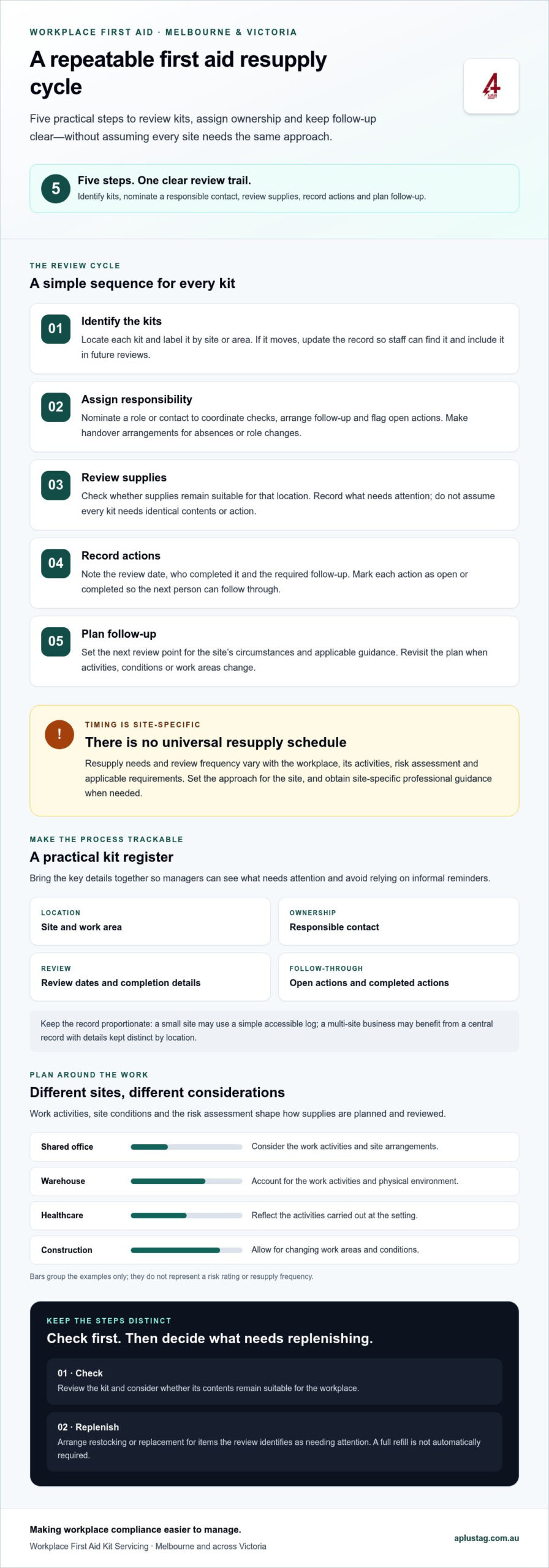
A workable cycle gives each kit a clear place in your site records, assigns someone to review it and tracks any actions identified. Keep the process simple enough to repeat, while allowing for differences between work areas and changes to site activities.
Set resupply timing according to the workplace, its activities, risk assessment and applicable requirements, not a universal calendar interval. Site-specific professional guidance can help managers shape an appropriate review plan.
- Identify the kits. Locate each kit and give it a clear site or area label. If a kit moves, update the record so staff can find it and managers can include it in future reviews.
- Assign responsibility. Nominate a role or contact to coordinate checks, arrange follow-up and flag outstanding actions. Set out how responsibility is handed over when that person is unavailable or changes roles.
- Review supplies. Check each kit in line with the workplace’s chosen approach. Consider whether its supplies remain suitable for that location, and record items that need attention without assuming every kit needs the same contents or action.
- Record actions. Note the review date, who completed it and what follow-up is required. Record whether each action is still open or has been completed.
- Plan follow-up. Set the next review point according to site circumstances and applicable guidance. Revisit the plan when work activities, site conditions or the arrangement of work areas change.
Set up site ownership and a kit register
A straightforward register can bring key details together: kit location, the responsible contact, review dates and any actions still open. This gives managers a practical view of which areas need attention, rather than relying on informal reminders. For multiple sites, keep each location’s details distinct in the central record, so a completed review at one workplace is not mistaken for a review elsewhere.
Review supplies and record the next action
During a review, describe what needs attention and the action required in clear language that another staff member can follow. Record when the action is completed, or note that it remains outstanding. This creates a useful handover trail and helps the next person follow through without repeating the review or guessing what was decided.
Keep records proportionate to the workplace. A small site may need a simple, accessible log, while a business with several locations may benefit from a central record that can be filtered by site or area. The aim is clear ownership and follow-through, not unnecessary administration.
For information about Workplace First Aid Kit Servicing, visit the A Plus Compliance Services contact page.
Self-managed restocking or professional first aid kit servicing?
There’s no single approach that suits every Victorian workplace. Staff-managed checks, purchasing individual refill items and professional servicing can each support first aid resupply, but they place different demands on staff coordination and record keeping. Compare them against your site’s complexity, available staff capacity and approach to follow-up.
| Approach | Coordination effort | Record organisation | Multiple locations |
|---|---|---|---|
| Staff-managed checks | Staff need an assigned role and time to complete reviews and follow up. | Records depend on the workplace’s chosen process and consistent updates. | Can work where local ownership is clear; managers need visibility across sites. |
| Individual refill purchasing | Someone must identify what needs attention, arrange purchases and track completion. | Purchase details and review records may need to be managed separately. | May require coordination between local contacts and whoever oversees purchasing. |
| Professional servicing | Managers coordinate with a service provider and plan around site operations. | Agree how outcomes and follow-up will be communicated and recorded. | Useful to consider when locations need coordinated planning. |
These approaches are not interchangeable in every situation, and none removes the need to plan for the specific workplace. Organised records can support broader oversight of workplace safety activities. Workplace compliance monitoring can also help managers consider how first aid arrangements sit alongside other compliance records.
When an internal process may suit a site
An internal process may suit a workplace where a responsible person has the capacity to coordinate reviews, keep records accessible and follow through on actions. Consider the number of work areas, how responsibilities are handed over and whether staff can maintain the process consistently. If those arrangements become difficult to oversee, review how the work is organised.
When coordinated servicing may be useful
Managers balancing several sites or competing operational demands may benefit from a coordinated servicing arrangement. A Plus Compliance Services provides Workplace First Aid Kit Servicing, which can form part of a broader workplace compliance programme. The approach should reflect each site and its operating needs.
An internal process may remain practical at one site while other locations need more coordination. Review the arrangement when responsibilities or operations change. Clear communication about what has been reviewed and what needs follow-up helps teams maintain oversight without assuming that every location requires the same process.
Details about Workplace First Aid Kit Servicing are available through A Plus Compliance Services.
Plan first aid resupply around Victorian sites and operations
Start with a clear picture of each site: which work areas are in use, where kits are located and who can provide access or coordinate a review. Mapping these details helps managers plan first aid resupply around how the workplace operates, rather than treating every kit or location as identical.
Before setting review arrangements, note:
- Each site and work area, including locations that operate separately from a main building.
- Where kits are kept and how staff can identify their location.
- The local contact who can coordinate access and share relevant site information.
- Operational considerations, such as busy periods, changing work areas or restricted access.
Use this information to arrange reviews at a suitable time and coordinate with the people responsible for each area. Planning access in advance can help limit interruptions, though the timing and arrangements will depend on the site.
Coordinate resupply across multiple locations
A central overview can help managers see the status of different locations, while each site keeps its own kit locations, contacts and review details. A local contact can report changes or follow-up needs promptly. Keep site records distinct, and avoid assuming every workplace should follow the same resupply timing: needs and review frequency vary with the workplace, risk assessment and applicable requirements.
Keep records useful for future planning
Record when a review took place, what needs were identified and what follow-up action remains. Update the record when an action is completed, and retain enough context for a colleague to understand the status without relying on an informal handover. Consistent records help managers coordinate resupply by showing what was reviewed, where attention is needed and what should happen next.
Records can also help managers notice when a site’s circumstances have changed. A school may need to account for how work areas are used during the school day; in healthcare, access and activity can vary between areas. A warehouse may have changing layouts or work zones, while hospitality operations can have distinct service and back-of-house areas. On construction sites, work areas and site arrangements may change as work progresses. These are prompts to consider local conditions, not fixed resupply rules.
For organisations managing several locations, agree how local contacts will share updates with the person overseeing the central record. This provides a clearer view of outstanding actions while preserving the details each site needs. Related workplace compliance services can also form part of a coordinated approach to site support.
Arrange workplace first aid kit servicing with A Plus Compliance Services
A Plus Compliance Services provides Workplace First Aid Kit Servicing for commercial and regulated workplaces. Based in Melbourne, the company serves workplaces across Victoria. Sharing a clear picture of your sites and current concerns helps make planning first aid resupply practical and relevant to your operations.
You don’t need to prepare a formal plan before getting in touch. A few details about your locations, work areas and current arrangements can help frame the discussion, particularly if your organisation has multiple sites.
What to prepare before discussing your site
Start with the basics. Note where your workplace is, which areas have kits and what questions or resupply concerns have come up. If you manage multiple locations, distinguish each site so the discussion reflects its own arrangements.
- Site locations and the work areas to be considered.
- Known kit locations and any current supply concerns.
- Operational constraints that could affect access or timing.
- Multi-site coordination needs or existing review arrangements.
These details provide useful context for planning. You can also describe how the site operates, including busy periods or areas where access needs coordination, so the discussion reflects your workplace’s practical requirements.
Build resupply into ongoing compliance planning
Consider how first aid kit servicing fits into your wider approach to workplace compliance. Clear communication supports a shared understanding of site needs and next steps, while organised records help managers maintain oversight. The appropriate arrangements depend on the workplace, its risk assessment and applicable requirements, so site-specific planning remains important.
Keep the scope clear. Workplace First Aid Kit Servicing is a distinct offering. A Plus Compliance Services also provides compliance reporting and asset registers as separate services. These can form part of wider compliance planning, but they are not the same as first aid kit servicing. Clear responsibilities and records across different activities help managers maintain oversight without confusing one service with another.
For facility, operations and site managers, a useful discussion can begin with the locations involved, current arrangements and practical constraints. You can then outline the support you’re seeking and how it may fit with ongoing workplace planning. A Plus Compliance Services provides compliance support for Victorian workplaces.
Make your next review a useful planning point
Use your next first aid resupply review to consider whether arrangements still fit the way each site works. A change in work areas, responsibilities or day-to-day operations can be a prompt to revisit who coordinates reviews and how follow-up is tracked. Keep the process practical and adjust it as workplace needs evolve.
If you’re considering external support, bring your current questions and site context to the discussion. This gives you a useful starting point for planning an approach that reflects your workplace, rather than applying a one-size-fits-all process.
A considered, repeatable approach can help your team keep workplace arrangements organised and easier to manage.
Frequently Asked Questions
Is there one first aid resupply schedule for every Victorian workplace?
No. First aid resupply timing should reflect each workplace, its risk assessment and applicable requirements. A change to work activities or site layout, for example, may be a reason to review arrangements rather than relying only on an old calendar entry. Site-specific professional guidance can help managers choose a suitable approach without assuming one interval applies everywhere.
Can a workplace manage first aid resupply in-house?
Yes. A workplace can manage its own process if it has clear ownership and the capacity to follow actions through. Consider what happens if the nominated contact is away: another staff member should be able to find the records and understand what remains to be done. Review the process as responsibilities, staffing or site operations change.
What should a manager do when a kit needs attention?
Record which kit needs attention, describe the issue clearly and pass it to the person responsible for follow-up. Arrange the appropriate next action and update the record when it is completed. If the action remains outstanding, make its status visible to the relevant manager or site contact so it is not mistaken for a resolved item during a later handover.
Can first aid resupply be coordinated across multiple workplace locations?
Yes. A central coordinator can oversee progress while local contacts provide updates for their own sites. Site identifiers help distinguish an outstanding action at one location from a completed review elsewhere. Keep local differences visible in the records, rather than assuming that shared oversight means every location has identical needs or timing.
Does first aid kit servicing replace first aid training?
No. Kit servicing concerns workplace first aid supplies; it does not provide training or assess whether a person’s training remains current. Managers should consider supply arrangements and staff training as separate parts of workplace first aid planning. For training requirements relevant to a particular workplace or role, refer to appropriate guidance and seek advice suited to the organisation’s circumstances.
What information is useful when arranging workplace first aid kit servicing?
Share your workplace locations, where kits are situated, the concerns you want addressed and any access or operational constraints. For workplaces in Melbourne and across Victoria, identify the relevant areas, such as St Kilda, Caulfield, Oakleigh, Clayton, Springvale, Mulgrave, Dandenong, Berwick, Mount Waverley, Cranbourne, Bayswater, Notting Hill, Scoresby, Officer, Pakenham and Keysborough. A Plus Compliance Services provides Workplace First Aid Kit Servicing across Melbourne and Victoria.
To arrange Workplace First Aid Kit Servicing for your Victorian workplace, request a quote from A Plus Compliance Services.
